Adobe Commerce vs. CWS Platform: Where Should Replenishment Policies Run in a B2B Procurement Marketplace?
An architecture comparison for deciding where pricing, approvals, net terms, inventory, catalog, and order policies should be enforced.

Editorial note: an architecture comparison between Adobe Commerce and the CWS Platform for a B2B procurement marketplace for supplies. Every statement about Adobe Commerce comes from its public documentation, with the source linked alongside it.
Adobe Commerce and the CWS Platform place emphasis on different areas when a marketplace supports recurring purchases under contract. The first architecture structures company accounts, buyers, shared catalogs, quotes, and purchase orders within the commerce environment, according to its B2B documentation. The second treats the channel as a layer for distributing and executing pricing, credit, inventory, approval, and order policies without turning the buyer into an ERP operator.
In this scenario, the storefront is not the center of the decision. The Commerce Director needs to make a known replenishment order flow across multiple suppliers, ship-to locations, and net-payment terms with minimal intervention. The CFO and CTO are part of the same conversation because every manual exception increases operating costs, creates room for commercial discrepancies, and makes it harder to explain why an order was accepted.
The architecture question, therefore, is not only where to publish the catalog. It is where each policy will be executed, which system will preserve the contractual source of truth, and how many human handoffs will be required before the order proceeds to fulfillment. The marketplace is the outcome of digitizing this operation, not a standalone objective.
The scenario: contract-based replenishment without renegotiating every order
Imagine a company that replenishes frequently used supplies across distributed facilities. The items have already been approved, the suppliers have already been selected, and a meaningful portion of the commercial terms already exists in contracts or ERP pricing tables. The buyer should not have to renegotiate every purchase. They should identify the need, build or repeat the cart, select the ship-to location, and submit the purchase under the current policy.
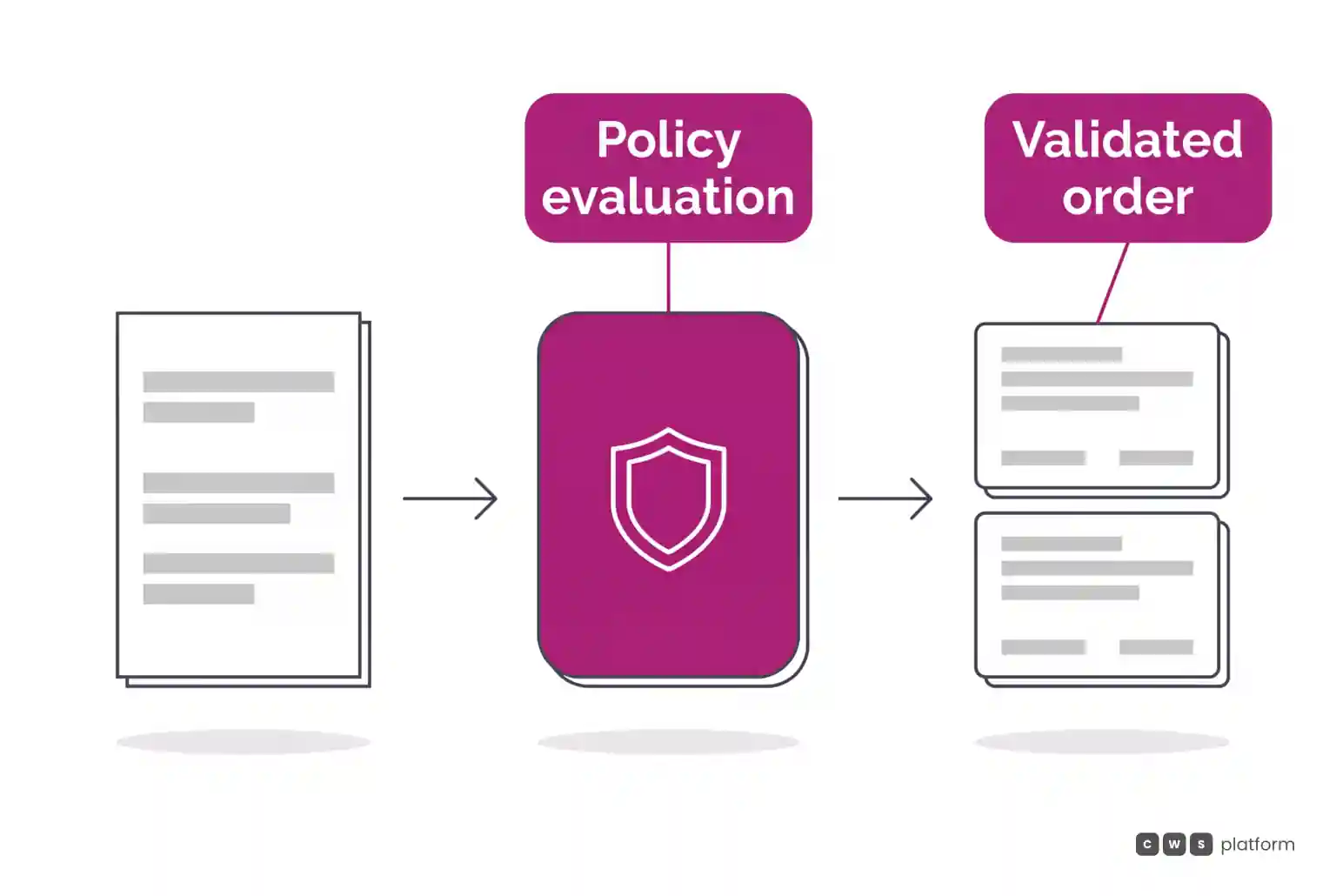
That apparent simplicity conceals a compound transaction. Pricing depends on the buyer’s identity, contract, volume, fulfillment source, and payment terms. Inventory must correspond to the warehouse capable of serving that address. Net terms require available credit. Approval requirements may change based on cost center, category, order value, and the requested exception.
When these decisions are scattered, the portal becomes just another screen. The buyer checks the channel, confirms pricing by email or chat, asks about availability by phone, and seeks approval outside the workflow. The digital order merely records the result of a process that remained manual. In that design, the transaction cost barely changes.
The operational goal should be different: distribute the execution of commercial rules without distributing ERP access. The channel retrieves or executes the policy, records exceptions, and delivers a coherent transaction to the system of record. That is how the marketplace emerges as the consequence of a digitized operation.
The six decisions this scenario requires
Before comparing modules, the Commerce Director can organize the choice around six design decisions. They also give the CFO a control framework and the CTO an integration map.
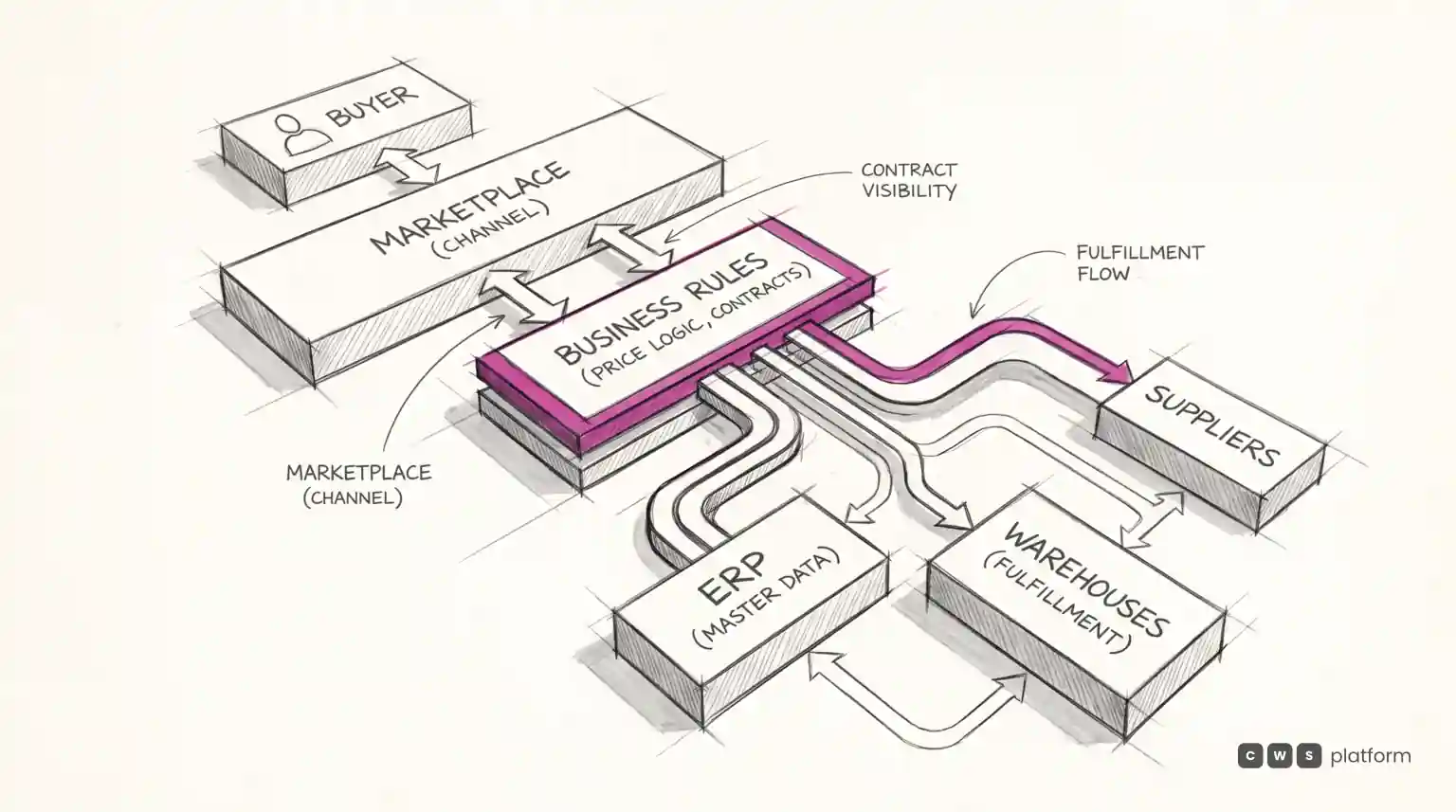
1. Where the negotiated price lives. The contract must remain recognizable when the buyer reaches the channel. If the ERP preserves the master condition, the platform must retrieve or receive that rule and apply it in the context of the cart. If the condition is also maintained in the channel, governance must prevent a local edit from contradicting the current agreement.
2. Who applies the approval rule. Approval must be executable, not merely described in a policy manual. Limits by buyer, cost center, category, and order value must result in approval, rejection, or routing within the workflow. When the rule depends on an approver’s memory, every replenishment order becomes a custom negotiation again.
3. What the checkout accepts as payment. Checkout must recognize the financial reality of the B2B relationship. Net terms and trade credit must be part of the transaction decision, together with the restrictions that apply to the purchase. A checkout that only collects a payment method leaves financial policy outside the process.
4. What the inventory source of truth is—and for which warehouse. The availability shown must point to the fulfillment source capable of keeping the promise. An aggregated balance can hide the fact that the selected facility does not have the item or that fulfillment depends on a different route. The decision must combine SKU, warehouse, address, quantity, and lead time before confirming the commitment.
5. Who creates and maintains the catalog. The catalog must reconcile supplier item numbers, applications, equivalents, and terminology. Clear responsibility must also exist for enriching, reviewing, and publishing that data. Without governance, buyers encounter long product lists but cannot reliably identify the contracted item.
6. Who edits the rule when it changes, and how quickly. Changes to limits, discounts, or approvals must happen through governed configuration. The change should record the reason, owner, and expected effect without requiring a new software release for every commercial adjustment. This shortens the time between a business decision and its execution in the channel.
What creates friction today, in the words of operators
Statements heard in the field show where the architecture stopped executing a decision and started transferring it to people.
“Every customer has their own price, and no one can put that on the site.” This reveals the decision about where the negotiated price will be calculated and how the channel will avoid contradicting the contract. It also shows that B2B pricing is not an isolated field but the result of commercial context.
“The customer puts everything in the cart and abandons checkout because there is no option for invoice billing with net terms.” This reveals the decision about which financial terms can complete the purchase. The problem does not begin in the checkout interface, but in the absence of credit and payment terms as executable parts of the policy.
“The portal shows inventory that is no longer available.” This reveals the decision about which warehouse supports the promise made to the buyer. When the channel relies on an aggregated or delayed view, it transfers the cost of correcting that commitment to customer service and logistics.
“I waste time looking for the right part; the fitment or application data is never complete.” This reveals the decision about who governs the catalog and how equivalents will be maintained across suppliers. If the buyer cannot identify the item, contract-based replenishment returns to the sales desk.
What Adobe Commerce handles well in this scenario
The B2B architecture starts with the company account. A company can include buyers, divisions, subdivisions, roles, and permissions, while the administrator controls access to orders, quotes, purchases, credit, and profile information. This is a strong fit when purchasing policy is expressed primarily through the account’s organizational structure, according to the B2B solution overview.
Customer-specific pricing can be organized through shared catalogs, with customized product prices for companies or customer groups. The same documentation states that administrators can also configure pricing tiers, payment methods, quote negotiation, and requisition lists. Recurring purchasing can therefore be supported by a commercial structure maintained within the commerce environment itself, as shown in the B2B extension documentation.
Quote negotiation begins in the cart for authorized buyers or in the administrative environment for sellers. The parties can change items and quantities, request or apply discounts, and exchange messages until they reach an agreement. This mechanism supports situations in which contract-based replenishment still allows an explicit negotiation step, according to the description of B2B features.
Purchase orders can be enabled for a company, causing the purchase to be created as a PO and submitted to approval rules related to the user’s role and the order. For the Commerce Director, this provides a native path for representing buyers and approvals in the channel. The exact mapping to cost centers, commercial exceptions, and policies maintained in the ERP must still be validated during the project, but the stated mechanism is covered in the company accounts documentation.
At the payment layer, the integrated service centralizes payment and order data from storefronts in the dashboard and separates testing and production environments. Available methods vary by region, requiring validation against the payment methods already used in the B2B operation. This design supports payment-processing administration within the ecosystem, according to the Payment Services guide.
The key consideration is distinguishing account structure from end-to-end commercial policy execution. Shared catalogs, quotes, POs, and approvals represent important parts of the process, but the project must still define where contract terms, warehouse availability, credit, taxes, and fulfillment capacity will be checked within the same transaction. This design requirement does not invalidate the mechanisms documented in the B2B solution; it simply defines what must be proven through integration.
How the CWS Platform is assembled: a transactional layer for executing existing policy
The architecture starts with Contextual Pricing (Pricing Engine), which applies pricing by customer, region, and volume. In a contract-based replenishment flow, its role is to turn identity, cart contents, and context into a commercial condition the channel can use. The ERP can continue to preserve contracts and master data, while the integration provides the engine with the required inputs and receives a coherent condition for the transaction.
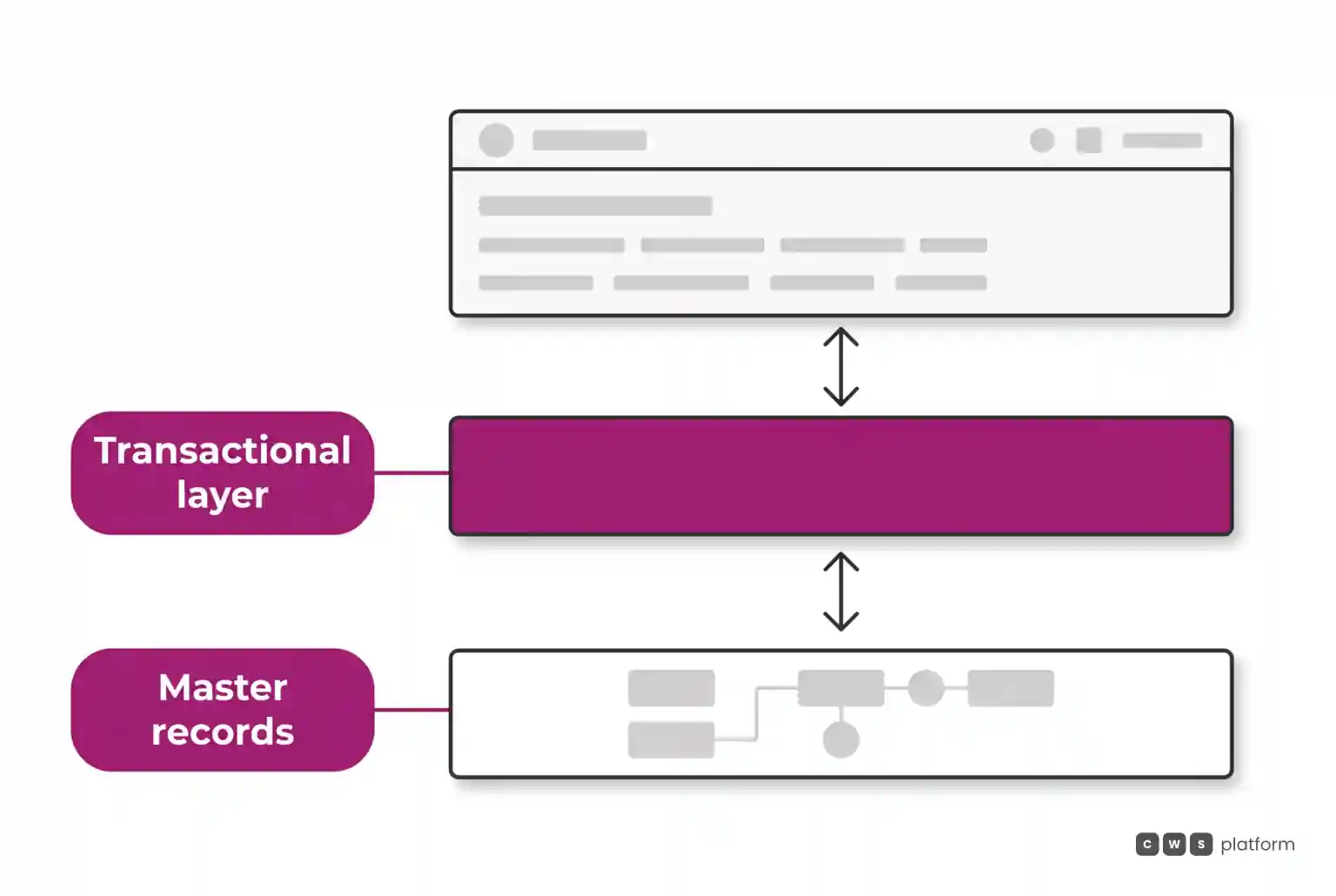
The rule that determines what can proceed resides in the Commerce Rules Engine (CDL Workspace). The engine executes deterministic policies for approval, credit, tax compliance, purchase-purpose restrictions, and permissions. Every change requires a reason and comment, allowing the CFO to distinguish an authorized update from an informal exception and giving the CTO a clearer boundary between configuration and code.
At checkout, Credit-First B2B Checkout (Checkout & Payments) treats trade credit as a native payment option for net terms. Before creating the commitment, the workflow validates inventory, price, credit, and taxes within the same transaction. When policy rejects a combination, the order is not created, preventing customer service and finance from receiving an unresolved exception disguised as a sale.
The physical promise comes from Distributed Inventory (Inventory Hub), which maintains availability by warehouse and SKU, along with physical inventory, logical inventory for controlled preorders, and lead time. For multiple ship-to locations, this makes it possible to evaluate the fulfillment source instead of showing only an aggregated balance. The goal is not to display more inventory, but to commit the facility that can fulfill the order.
After confirmation, the Order Management System (OMS / Seller Center) maintains status truth between the platform and the ERP. Order transitions carry operational requirements, such as compliance documentation before preparation and tracking before shipment. The order stops being a static record and begins to represent the verifiable progress of execution.
Product Catalog & MDM (Catalog Engine) governs products, SKUs, bundles, and global or local variants, with incremental imports. The catalog enrichment agent can help improve data and images, while human validation preserves accountability for application data and product equivalency. For a marketplace with multiple suppliers, this governance reduces the risk that different item numbers will fragment the same purchasing need.
When an exception requires interaction, the Assisted Selling Platform (Sales Hub) provides a shared cart for the buyer and seller, along with approval and negotiation support. The seller-support agent can organize context and suggestions, but the commercial decision remains subject to deterministic rules. Assistance is used to resolve the exception, not replace the policy governing recurring replenishment.
The CWS Platform has 11 modules, 6 AI Agents, and 1,029 configurable parameters. The count matters less than the connection among the layers: the catalog identifies the item, pricing interprets the contract, inventory locates the source, rules authorize the condition, checkout confirms credit and taxes, and order management tracks execution.
Market data helps size what is at stake. McKinsey estimates that a 1% price improvement, with no loss of volume, lifts operating profit by 8.7% (B2B pricing: Navigating the next phase of the AI revolution, 2025), which makes every condition applied outside the contract more expensive than it looks. In a different commercial process, McKinsey documented a heavy-equipment distributor that cut resolution time from 15 minutes to under 1 minute, a 90% reduction (Five ways B2B sales leaders can win with tech and AI, 2024). That is the effect this scenario is after: removing lookups and corrections from the path of a purchase that should already be repeatable.
The appropriate measure is the cost of each transaction completed within policy. An interface can appear efficient while still generating phone checks, price corrections, impossible inventory commitments, and approvals outside the workflow. The architecture creates value when it reduces these handoffs without removing governance from procurement, finance, and operations.
Where the architectures truly diverge
One architecture concentrates much of the B2B policy in the company account, its buyers, roles, shared catalogs, quotes, and purchase orders, as described in the B2B solution documentation. CWS distributes execution across specialized engines while keeping pricing, rules, credit, availability, and orders connected within the transaction.
The difference also appears in recurring purchasing. Requisition lists, customer-specific catalogs, and permissions provide structures for repeating purchases within the account, according to the introduction to B2B mechanisms. In CWS, repetition only reduces cost when the new cart is resubmitted to current contract, warehouse, credit, and tax conditions.
For payments, the documented architecture emphasizes an integrated service that centralizes information in the dashboard and operates with methods defined by region, according to the payments guide. CWS places the emphasis on trade credit and purchase authorization before order creation.
The choice, therefore, should not become a feature scorecard. The Commerce Director must identify the project’s center of gravity: corporate structure and commerce operations, or transactional execution of a policy distributed across contracts, warehouses, credit, and orders. The answer determines which integrations must be proven before signing a contract.
| Decision | Adobe Commerce, based on the documented mechanism | CWS Platform |
|---|---|---|
| Where buyer policy is expressed | Expresses policy through the company account, including divisions, buyers, roles, and permissions. | Executes policy through commercial rules tied to the transaction context. |
| Where contract pricing gains context | Organizes prices through shared catalogs associated with companies or groups. | Calculates the condition by customer, region, volume, and inputs received from systems of record. |
| When approval is triggered | Submits the purchase order to rules related to the user’s role and the order. | Checks the rule during negotiation and before creating the order. |
| Scope of the inventory source of truth | Depends on the integration design used to bring availability into the B2B workflow. | Maintains availability and lead time by SKU and warehouse to support the promise. |
| Where order management resides | Keeps the purchase in the commerce environment and can connect it to external management systems. | Governs states and operational requirements between the platform and the ERP. |
| When commercial policy changes | Updates company-account, catalog, and B2B workflow rule configurations. | Changes parameters with a reason, comment, and enforcement through the rules engine. |
The decisive test should use an actual replenishment order with a contract, buyer, cost center, ship-to address, supplier, warehouse, and net-payment terms. The demonstration must show not only an accepted cart, but also a rejected exception, a recorded rule change, and order continuity through operations.
When Adobe Commerce is the right choice for this scenario
In some situations, the center of the project is the native commerce mechanism rather than the construction of a specialized transactional layer. In those cases, the decision should explicitly recognize what is already structured and what will still depend on integration.
The buying company needs a detailed corporate structure in the channel. Choose this architecture when divisions, subdivisions, users, roles, and permissions are the primary model for controlling purchases. The solution documents these elements within the company account and allows them to be associated with orders, quotes, credit, and profile information, according to the B2B documentation.
The process requires native, role-based purchase orders. This approach makes sense when every purchase must originate as a PO and follow rules associated with the user’s role and the order. The mechanism is described in the B2B extension overview. In CWS, commercial approvals are governed by the rules engine.
Negotiated quotes within the commerce environment are central to the journey. The architecture is a fit when buyers and sellers need to change items, quantities, and discounts, exchange messages, and reach an agreement within the quote workflow. This mechanism is stated in the B2B negotiation documentation. The decision should simply separate that negotiation from the transactional validation that will still be required for pricing, credit, inventory, and taxes.
The project prioritizes integrated payment processing. Choose this design when the priority is to centralize payment and order data in the dashboard, work with separate testing and production environments, and configure methods available in the region. These mechanisms are described in the Payment Services guide.
Where to go next
If your question is still which architecture fits your operation—not which vendor to choose—the next step is the seven questions that distinguish B2B commerce architectures.
If the current obstacle is the operational pain behind this scenario, When the Catalog Turns Into Chaos and When Selling More Does Not Mean Earning More explore it in depth without discussing any vendor.
"responsive, technically engaged, and willing to work through complex commercial rules (negotiated pricing, credit, customer-specific conditions) rather than pushing generic answers"
Want to see this in your operation?
Real B2B operations already run on it.