B2B ecommerce platform: what it is, what it must do, and how to choose one
Selling to businesses online is not a retail store with a login. It means bringing per-account
pricing, net terms and the sales rep who negotiates into the digital channel. This guide explains
the category, compares the types of solution and shows how to choose.
A B2B ecommerce platform is the system a company uses to sell to other companies online: catalog, ordering, pricing, credit and ERP integration. Unlike B2C, price, terms and product mix change by customer and are negotiated. CWS Platform treats that negotiation as configurable rules rather than exceptions handled outside the system.
What is the difference between B2B and retail ecommerce?
The difference between B2B and retail ecommerce is that in B2B almost every condition of the sale
depends on who is buying. In retail, price is an attribute of the product, and the shopper either
accepts it or leaves. Between companies, price is the outcome of a contract, a region, a volume and a
tax rule, and it can still be negotiated. The table sums up what changes.
What changes between B2C and B2B ecommerce
What changes
Retail (B2C)
Business to business (B2B)
Price
One price per product, the same for everyone, with time-boxed promotions.
One price per customer, driven by contract, region, shipping warehouse, volume and tax rule.
Credit and terms
Card or wallet at the moment of purchase.
Invoiced on net terms (30, 60 or 90 days) inside a credit limit someone approved.
Minimums and composition
One unit, any combination.
Minimum order, case-pack multiples, size grids, kits and full cartons, varying by account.
Sales rep in the deal
None. The shopper decides alone.
A rep negotiates, quotes and manages the account, and the digital channel has to work with them, not around them.
ERP integration
Nice to have.
Mandatory: inventory, price, credit, invoicing and order status live in the ERP.
Technical catalog
Photo, description and reviews.
Technical attributes, fitment, cross-brand equivalents and thousands of items per product line.
Commercial rules
A few, identical for all.
Hundreds, with per-account exceptions, discount limits and recorded approvals.
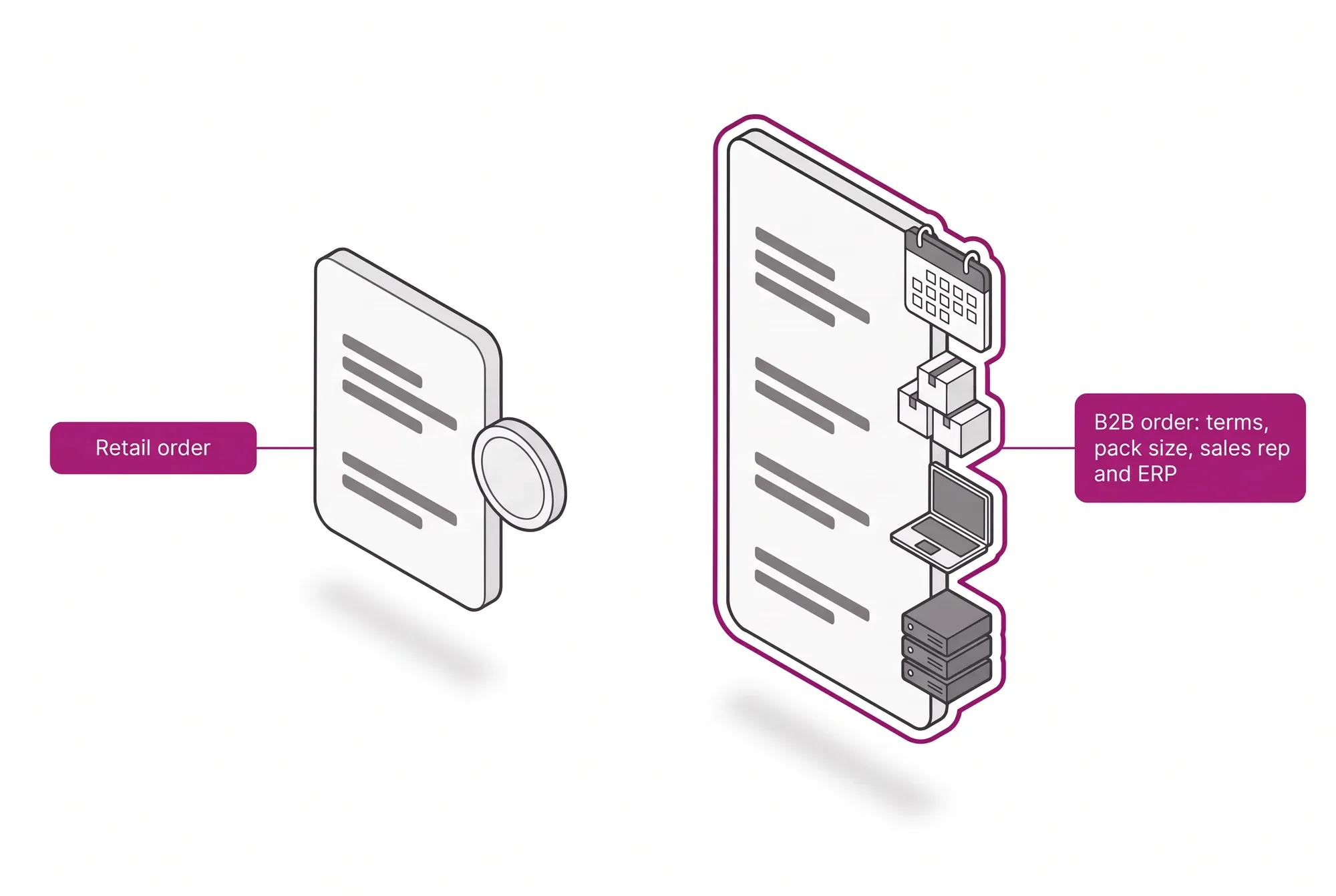
A B2B order carries more. In retail, an order is the item and the payment. In B2B it also brings the payment terms, the pack size, the account's sales rep and the ERP that records it all.
That is why an adapted retail store tends to stall on the first operation that genuinely negotiates:
the price the portal shows is not the price that closes, so the sale drifts back to the phone.
What must a B2B ecommerce platform do?
A B2B ecommerce platform must govern the five dimensions in which a business sale is negotiated:
price, delivery, payment, quantity and composition. On CWS Platform, all five are rules in the
Commerce Rules Engine (CDL Workspace), the engine that applies the company's commercial policy the
same way for the sales rep, the buyer and the AI agents. That is 11 modules and 6 AI Agents over
1,029 configurable parameters. Here is what each dimension requires and where it is handled.
01
Price: every buyer sees their own price, calculated on the spot
A B2B platform has to calculate price in the context of the transaction instead of looking it up in a static list. That context is the contract, the customer profile, the region, the shipping warehouse and the tax. A discount above the limit goes through approval and is recorded with its reason.
On CWS Platform: Contextual Pricing (Pricing Engine) prices by product, warehouse, profile and tax rule in milliseconds, with Approval Workflows, Discount Stacking Prevention and Reason Codes.
02
Delivery: lead time and freight depend on where the goods ship from
In B2B, freight is part of the deal. The platform needs to know which warehouse holds the item, what it costs to ship from there and whether the order can be split. Without that, the date promised on the portal is not the date delivered.
On CWS Platform: Shipping & Fulfillment (Logistics Engine) runs multi-DC freight priced by origin warehouse, split delivery, CIF and FOB, on top of the distributed stock of Distributed Inventory (Inventory Hub).
03
Payment: credit as a payment method, not an exception
Most business-to-business trade is invoiced on terms. A B2B platform has to close the order inside the buyer's credit limit, at checkout, instead of sending the buyer to accounts receivable by email.
On CWS Platform: Credit-First B2B Checkout (Checkout & Payments) treats credit as a native payment method (Net Terms), with multi-split and the 4-Point Checkout Validation before the order exists.
04
Quantity: volume changes the terms, and both sides need to see it
When the buyer raises the volume, price and terms move. If the rep and the buyer look at different screens, the negotiation goes back to the phone. The platform needs a cart both can edit together, with the rules recalculating on every line.
On CWS Platform: Assisted Selling Platform (Sales Hub) puts rep and buyer in the same cart in real time, with the Customer Intelligence Panel and the Sales Copilot agent.
05
Composition: kits, pairs and full cartons are negotiated too
What sells in B2B is not always a single unit. It is the pair, the kit, the set, the size grid. The platform has to know what makes up each offer and trace every component, or inventory and invoicing drift apart.
On CWS Platform: Product Catalog & MDM (Catalog Engine) models UNITARY, PAIR, KIT and SET with per-component traceability, plus technical attributes, fitment tables and cross-brand equivalents.
Around those five dimensions sit three requirements: ERP integration, which CWS Platform handles
through open APIs and webhooks without replacing the system of record;
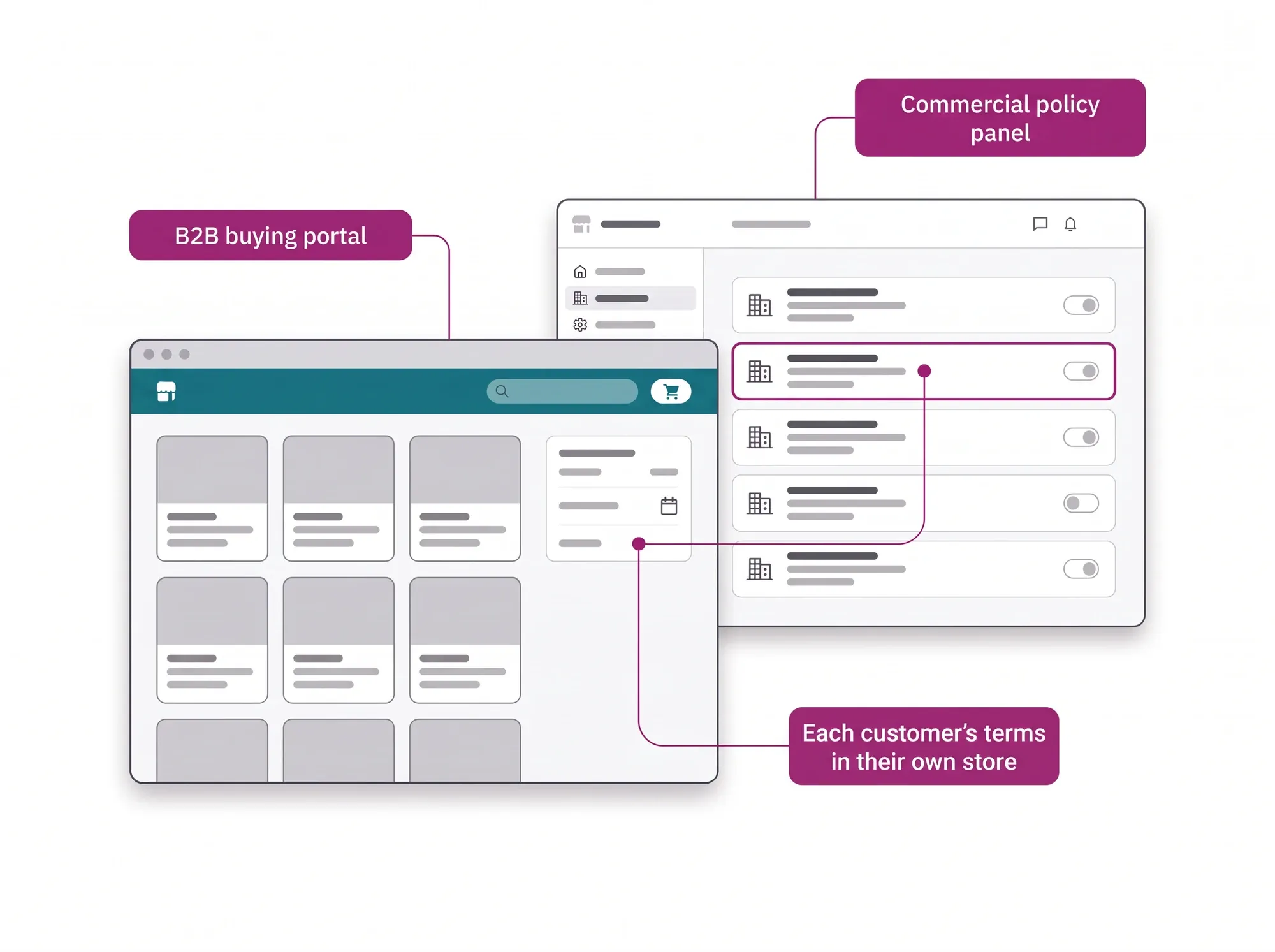
a portal for self-service and assisted selling, like the B2B portals;
and AI with boundaries, where the 6 AI Agents follow the same rules
as the rep and only suggest. More in the 5 dimensions of the negotiation.
How do you choose a B2B ecommerce platform?
Choose a B2B ecommerce platform by what it does with your exceptions, not by its storefront. Each
criterion below comes with the question to ask the vendor, and the right answer is a working screen,
not a slide.
1.Per-account pricing without a side spreadsheet
Ask the vendor: Show me the same item at three prices for three customers, with tax and freight calculated in the cart.
2.Credit inside checkout
Ask the vendor: Can a buyer place an order on terms, within their own credit limit, without leaving the portal?
3.Discounts with a limit and a recorded reason
Ask the vendor: Who approves a discount above the limit, and where is the reason for the concession stored?
4.Integration with the ERP you already run
Ask the vendor: Which ERPs do you integrate in production today, through which mechanism, and do I have to replace mine?
5.The sales rep inside the channel, not competing with it
Ask the vendor: Does the rep see the same price and stock as the customer? Are they still credited for digital orders from their accounts?
6.A real technical catalog
Ask the vendor: How does the platform handle fitment, cross-brand equivalents, kits and case-pack multiples?
7.Rules as configuration, not code
Ask the vendor: Does changing a discount policy or a payment term require a software release, or is it a parameter my team changes?
8.AI with clear boundaries
Ask the vendor: If an AI agent suggests terms outside the commercial policy, what stops that suggestion from becoming an order?
9.Proof in an operation like yours
Ask the vendor: Which customer with an operation like mine runs on the platform, and how much of that case is public?
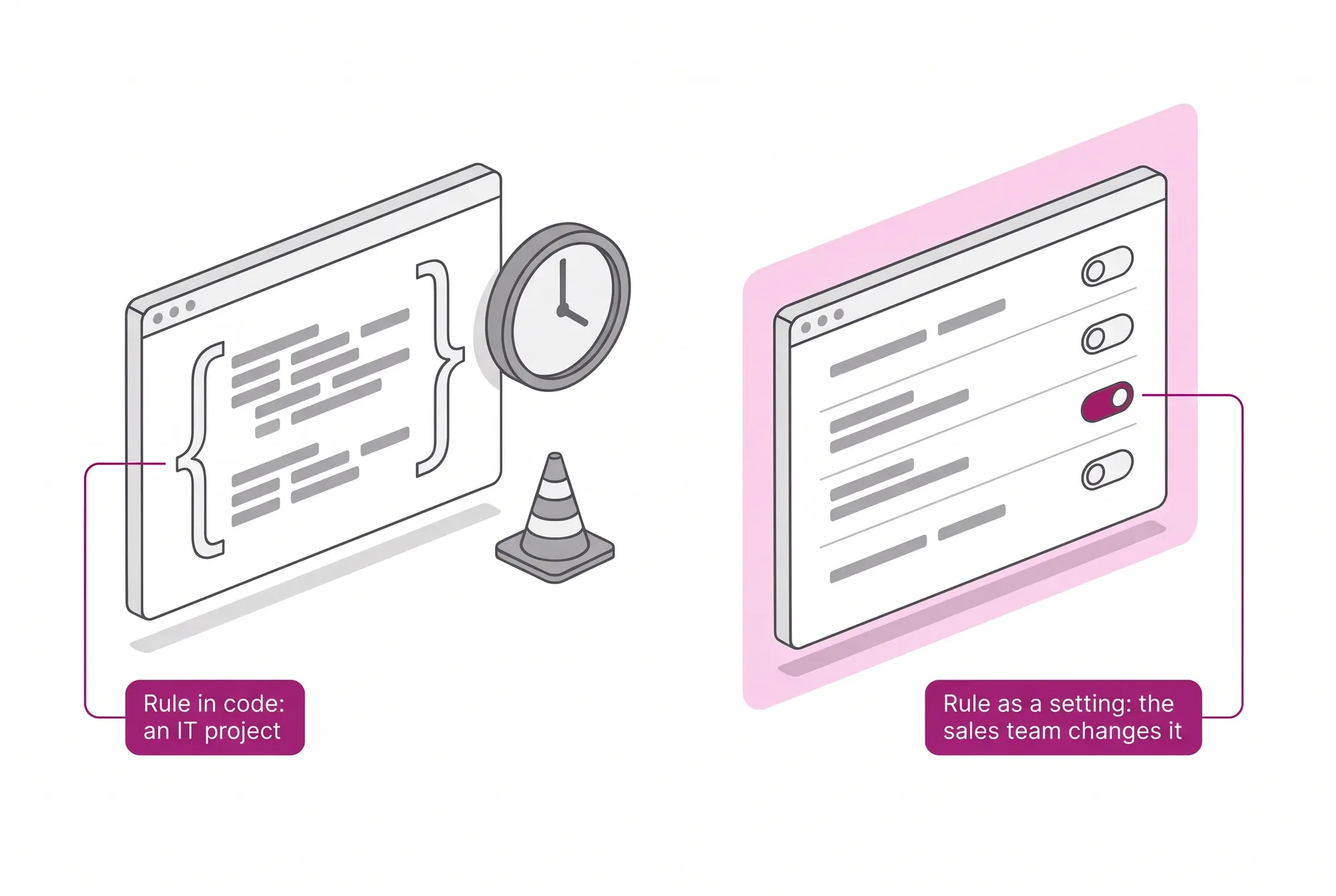
Rules as configuration. One question that separates platforms: does changing a discount policy need a new software release, or is it a setting your own team changes?
What types of B2B commerce platform are there?
There are four types of B2B commerce platform, and each was built for a different problem. The
comparison below is between categories, not vendors, and describes the typical behavior of each.
Every category has better and worse products inside it.
Comparison of the four categories of B2B ecommerce platform
Criterion
Adapted B2C platform
Simple-order B2B SaaS
Generic enterprise suite
Governed negotiation platform
Per-account pricing
Through an extension or separate price lists
Price list per customer, no contextual calculation
Possible, usually a customization project
Calculated by rule in the context of the transaction
Credit at checkout
Rare; payment methods are retail ones
Orders on terms, checked outside the system
Possible, via integration with finance
Native, with the limit validated before closing
Sales rep in the process
Outside the flow
Keys in orders on the customer's behalf
In another system, usually the CRM
In the same cart as the buyer
Changing a commercial rule
Code or a third-party app
Few rules available
An IT project
A parameter set by the commercial team
ERP integration
Generic connector
Order and stock sync
Deep, with a long project
Orchestrates on top of the ERP without replacing it
When it fits
Fixed prices and a simple checkout
Simple reorders, few accounts, few exceptions
Global group already standardized on one suite
Negotiated sales, with price, credit and mix varying by account
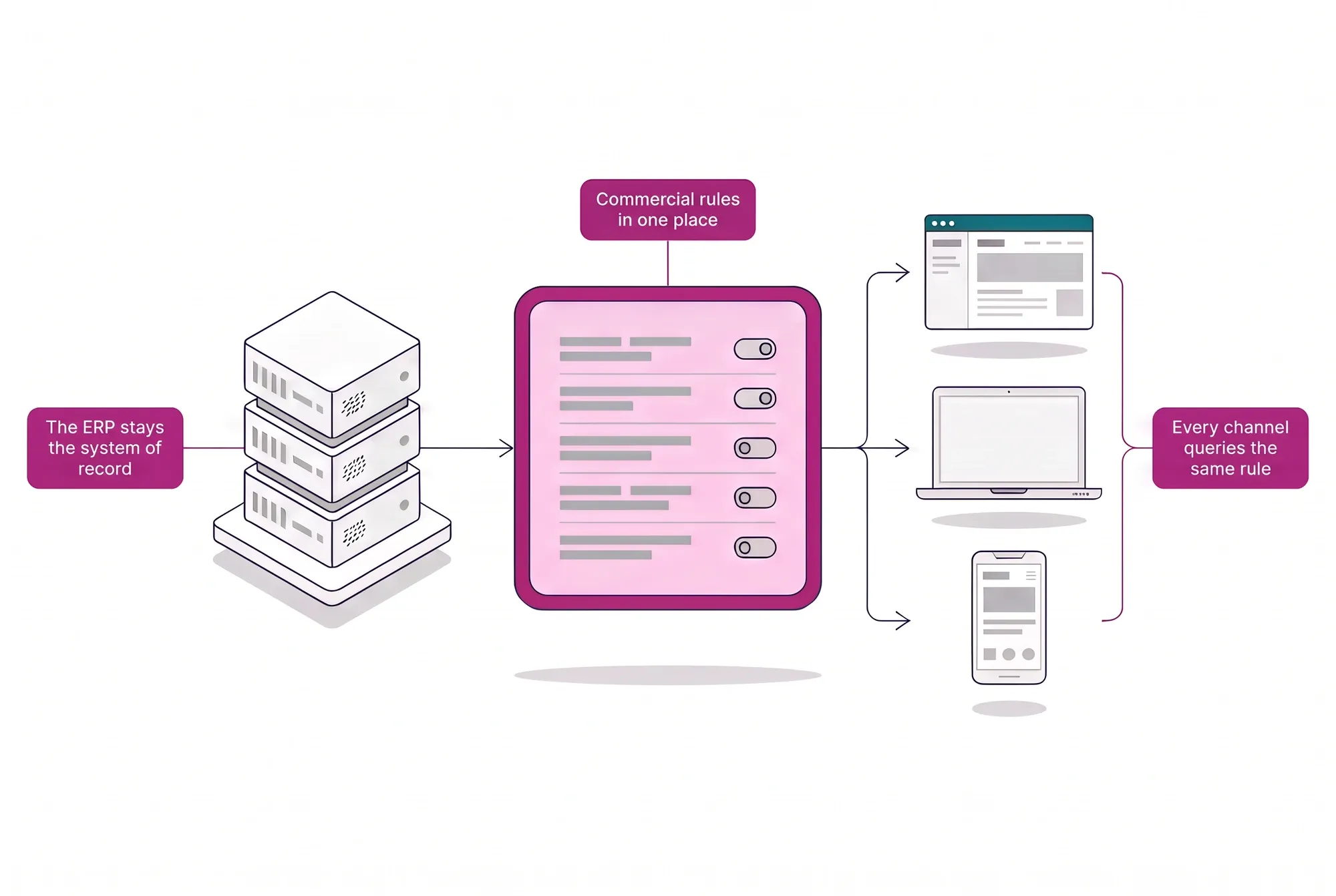
On top of the ERP, not instead of it. A governed negotiation platform orchestrates on top of the ERP you already run. What changes is where the rule lives: in one place, queried by every channel.
CWS Platform belongs to the fourth category. It was designed for complexity: where there is no
per-account pricing, no rep in the transaction and no discount limit, it is more than the operation
needs. Where those exist, it is the category that retires the side spreadsheet.
Who is a B2B ecommerce platform for?
A B2B ecommerce platform is for companies that sell to other companies on terms that vary by
customer. The most reliable signal is not the industry, it is the question: does your price list have
per-customer exceptions, and does someone have to approve a discount? Three profiles concentrate that
situation.
Manufacturers
Sell to distributors, dealers and networks, often through reps. They need channel pricing and a portal that organizes the network without cutting out the distributor.
Wide assortment, several branches, price by customer and region, net terms and long multi-line orders. This is where the cost of processing each order weighs most on margin.
Frequent reorders, minimum orders, size grids and full cartons. Buyers self-serve on routine orders and reps keep the negotiation.
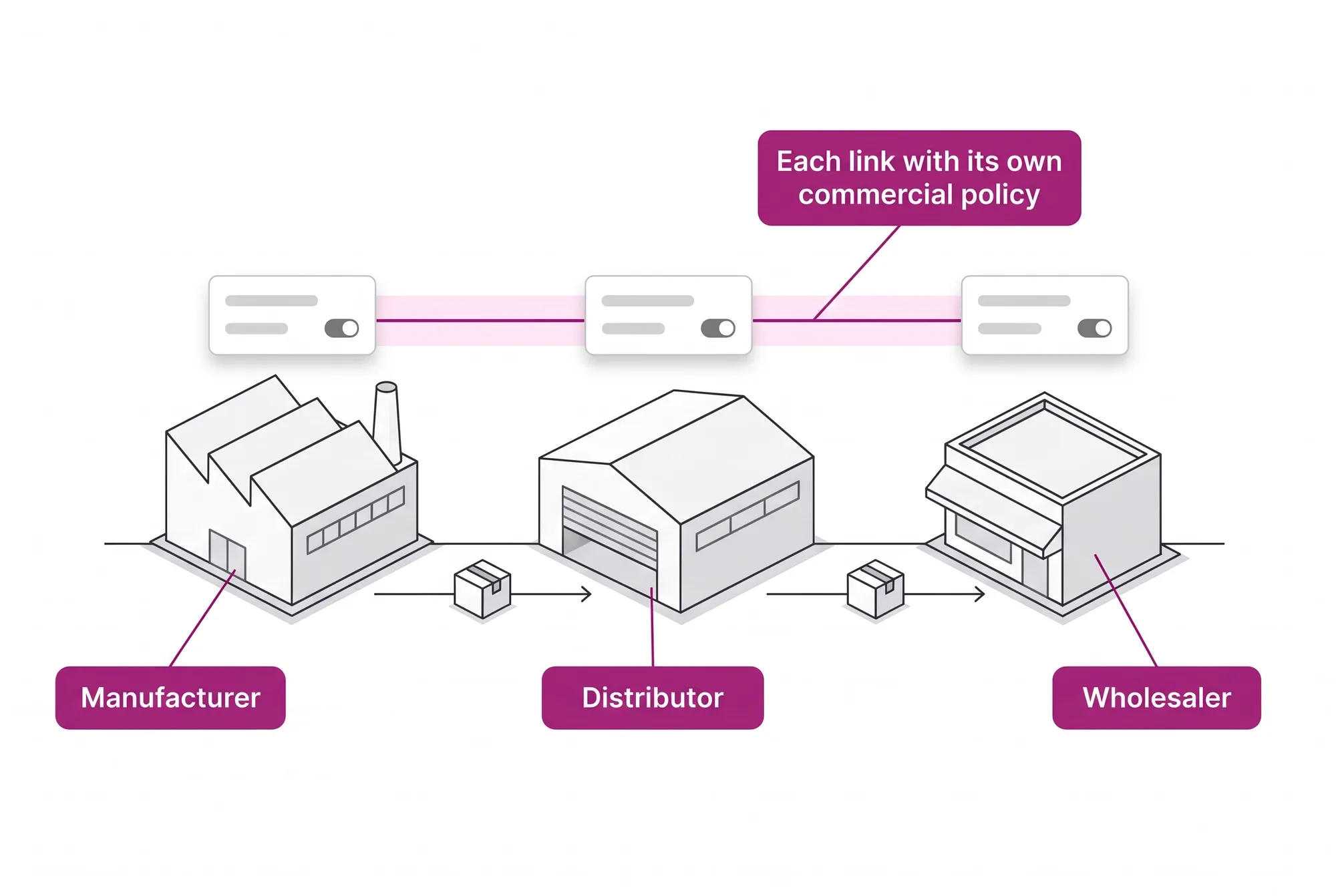
Three profiles, one logic. Manufacturers, distributors and wholesalers sell by account, with per-customer pricing and credit terms. Each sets its own policy on the same platform.
B2B ecommerce is the sale of goods between companies through a digital channel, usually connected to the seller's ERP. The buyer logs in, sees their contract price, orders against a credit limit and tracks delivery. What sets it apart from retail is that terms change by customer and are often negotiated.
How do you choose a B2B ecommerce platform?
Choose a B2B ecommerce platform by what it does with your exceptions, not by how the storefront looks. Ask the vendor to show one item at three prices for three customers, an order placed on credit inside checkout, a discount above the limit going through approval, and the integration with the ERP you already run. The checklist on this page lists more.
What's the difference between B2B and retail ecommerce?
The difference between B2B and retail ecommerce is that in B2B almost every condition of the sale depends on who is buying. Retail has one price per product and card payment at purchase. B2B has per-account pricing, net terms, minimum orders, sales reps in the deal and deep ERP integration.
What integrations must a B2B ecommerce platform have?
A B2B ecommerce platform must integrate with the ERP for inventory, price, credit, invoicing and order status, because that is where those records live. On CWS Platform this runs through open APIs and webhooks, without replacing the ERP, and publicly associated integrations include SAP, TOTVS, Senior and Sankhya. AI agents reach the same rules via MCP.
How do B2B ecommerce platforms handle dynamic pricing?
B2B ecommerce platforms handle dynamic pricing either with price lists per customer or by calculating the price as a rule at the moment of the transaction. The second approach is what CWS Platform's Contextual Pricing does: price by product, warehouse, customer profile and tax rule, with discounts above the limit routed to approval and recorded with a reason.
Manufacturers can't afford legacy B2B ecommerce platforms because every change to a commercial rule becomes an IT project. A new discount limit, a channel price or a payment term waits in a development queue while the market moves. On a platform where rules are configuration, the commercial team changes the parameter and it applies the same day, with the change recorded.
Is a wholesale ecommerce platform the same as a B2B ecommerce platform?
A wholesale ecommerce platform is a B2B ecommerce platform focused on distributors and wholesalers. It needs the same core: per-account pricing, credit terms, minimum orders and case packs, reorders, and a sales rep who can work inside the same cart as the buyer.
Want to test your exception, not the standard customer?
Bring a real order, with the price, credit and mix it carries today, and watch CWS Platform run it
as rules.