B2B ecommerce for distributors: every customer on its own price, credit and terms

For distributor sales managers
Every customer on its own price, written once as a rule.
Price list, customer type and seller role set the price; each customer’s credit and terms come from your ERP.
Illustrative scene with a real CWS Platform screen in a demo version. People, stores and on-screen data are fictitious.

For high-volume reorders
The 80-line order comes out built the way she asked.
Procurement Agent builds the cart from her request and history; anything over the credit limit waits for a person to approve.
Illustrative scene with a real CWS Platform screen in a demo version. People, stores and on-screen data are fictitious.

For counter teams
From a large mix, only the part that fits the customer’s vehicle.
The catalog filters by application, with real stock and the buying account’s price.
Illustrative scene with a real CWS Platform screen in a demo version. People, stores and on-screen data are fictitious.

For buyers near a branch
The local branch serves the order, and branches don’t compete for it.
The portal detects where the customer buys from and shows the stores serving that ZIP code, each with its lead time and delivery mode.
Illustrative scene with a real CWS Platform screen in a demo version. People, stores and on-screen data are fictitious.
Solution · Distributors
Wide assortment, several branches, price by customer and region, net terms and long multi-line orders. This is where the cost of processing each order weighs most on margin. CWS Platform moves the routine order to a portal the buyer actually uses and keeps the sales rep in the negotiation, over the ERP you already run.
In short
B2B ecommerce for distributors is the ordering channel where each customer buys on its own price, credit and terms, across a wide assortment and several branches. On CWS Platform, routine reorders move to the self-service portal, the sales rep keeps the negotiation inside the approval limits, and the assortment can grow with third-party stock in the same cart.
- Each buyer sees its own price and credit, and routine reorders leave the rep's desk. Source: B2B self-service portal.
- A distributor with millions of price rules gets every concession with an author and a justification. Source: business rules engine.
- Own stock and third-party stock sell in the same cart, so the assortment grows without tied-up capital. Source: governed B2B marketplace platform.
- At Imdepa, an auto parts distributor, the B2B portal activated 153 customers in 3 years. Source: Imdepa case.
Price by customer, credit terms and long reorders are among the criteria in the guide to choosing a B2B ecommerce platform. Price list management shows the first of them at work. Long reorders get their own page in the wholesale order form.
Inside the platform
See what happens on every screen
Four moments of a multi-store auto parts distributor, on the CWS Platform portal.

Right store
Every customer buys from the store that serves their region
The selector shows only the network stores that serve that customer, on desktop and on the phone. The order starts at the right branch, with its own stock and price.
Pain it removes: orders landing at the wrong branch and bouncing back to sales.
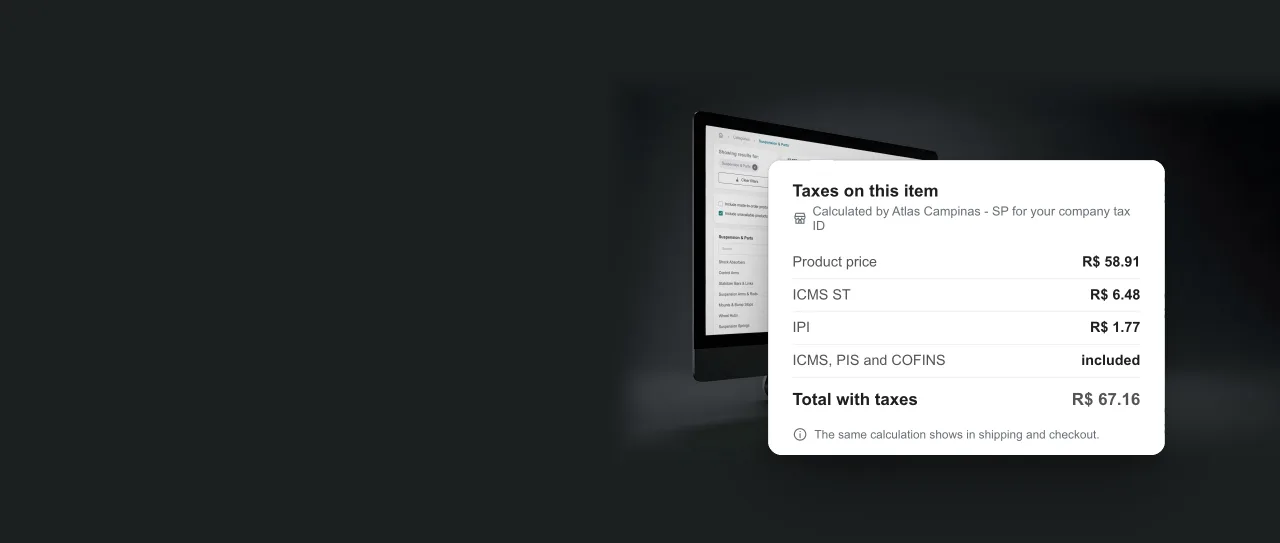
Taxes on screen
The customer's taxes show up before checkout
In the product list, the buyer opens the item detail and sees each tax and the total with taxes, calculated by the store that serves their company. The same calculation carries into shipping and checkout.
Pain it removes: orders redone because the final price changed on the invoice.

Chat agent
The customer asks in chat, the cart builds itself on the portal
The AI agent checks the fitment of each part number, splits items by seller and creates the cart. The customer opens the link and picks shipping and payment on the portal, within the terms they already have.
Pain it removes: orders retyped by hand from chat messages.

Shared cart
Sales rep and buyer in the same cart
The rep adjusts price and quantity within their approval limit, and the buyer sees every change flagged on the item. They close the order right there or send the cart back.
Pain it removes: negotiation scattered across email, spreadsheets and phone calls.
Core pain
Every order passes through a rep or a back office, and the per-order transaction cost eats the margin before the goods leave the warehouse. The buyer who already knows what it wants waits for someone to key it in.
The distributor portal in 1 minute
What changes for a distributor
Each customer's own price, credit and terms
The buyer logs in and the portal already loads its price list, credit and terms.
How does credit enter the order?
Credit is a native payment method (Net Terms 30/60/90), and stock, credit, tax and price are checked at the same time before the order moves forward.
The rep stays in the channel
Routine reorders go to self-service, and the rep keeps the complex negotiation, in the same cart as the buyer and inside the approval limit of the profile.
guided selling →Millions of price rules, every concession on record
A distributor with millions of price rules and approval limits by seniority, today with no record of who granted which discount, now has every concession with an author and a justification.
business rules engine →Freight by rule across distribution centers
A distributor with distribution centers in several states quotes freight by regional rule, weight and order value, not in a side spreadsheet.
Shipping & Fulfillment (Logistics Engine) →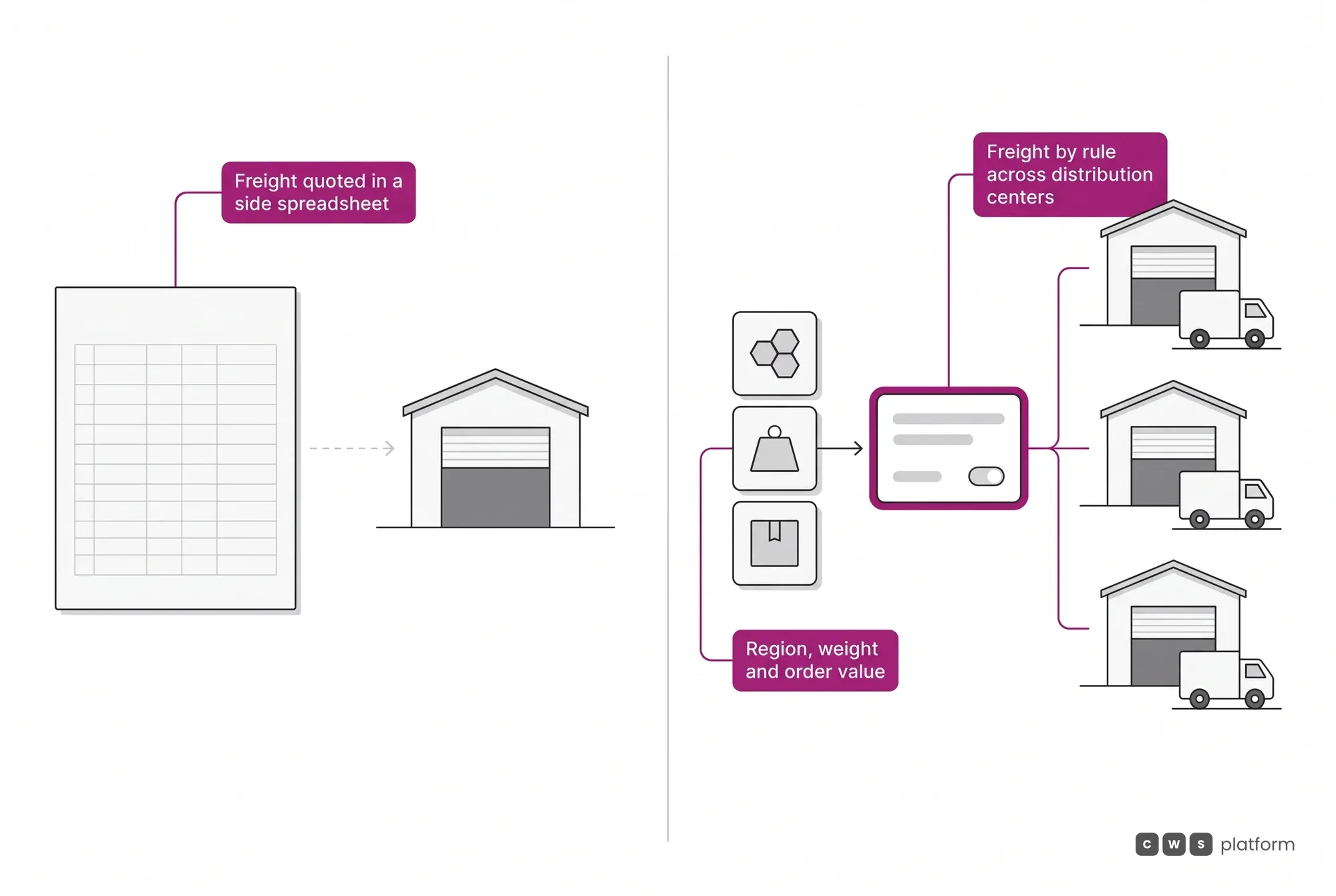
Two more changes: branches and long orders.
Branches that do not compete with each other
Region restriction and the priority order between combined stores keep the distributor's own branches from competing inside the portal.
governed B2B marketplace platform →Long orders, built for the buyer
A distributor's buyer who needs an eighty-line order with items from different suppliers gets the search, the comparison and the cart assembled by the Procurement Agent, under the same rules.
Procurement Agent →
Persona · Sales director, distributor
My customers order on their own, and my sales team is selling again.
On CWS Platform, each customer buys at their own price, credit and terms through the portal, and sales reps keep the negotiation, within their approval limits.

Persona · Reseller buyer
I order when I need to, at my price, without waiting for a call back.
The portal checks stock, credit, tax and price together before the order moves on, and routine reorders no longer depend on anyone on the other end.
Assisted selling
The rep joins the cart the customer is building.
In the Assisted Selling Platform (Sales Hub), the rep opens the customer's cart, sees the contract price list and the discount ceiling for their role, and negotiates right there; anything above the ceiling goes to the approver, on the same order.
See the Assisted Selling Platform →A buyer's order, in practice
In chat
The reorder list arrives in chat and goes back as a cart.
Customers send their monthly list the way they always have. The Sales Copilot sorts the items, checks stock at each branch and hands back a cart with that customer's terms. The rep opens the same cart in the portal to negotiate anything outside the rules.
In operation
Imdepa · auto parts distribution
153 customers activated
in 3 years on the B2B portal, with around 60,000 orders processed. A single cart holds an order of more than 250 SKUs, with taxes, freight and pre-approved credit calculated in seconds.
Read the Imdepa case →Tracbel · equipment distribution (Volvo CE dealer)
3,500 customers
on a distribution network with 40 units, integrated with SAP in both directions and in real time.
Read the Tracbel case →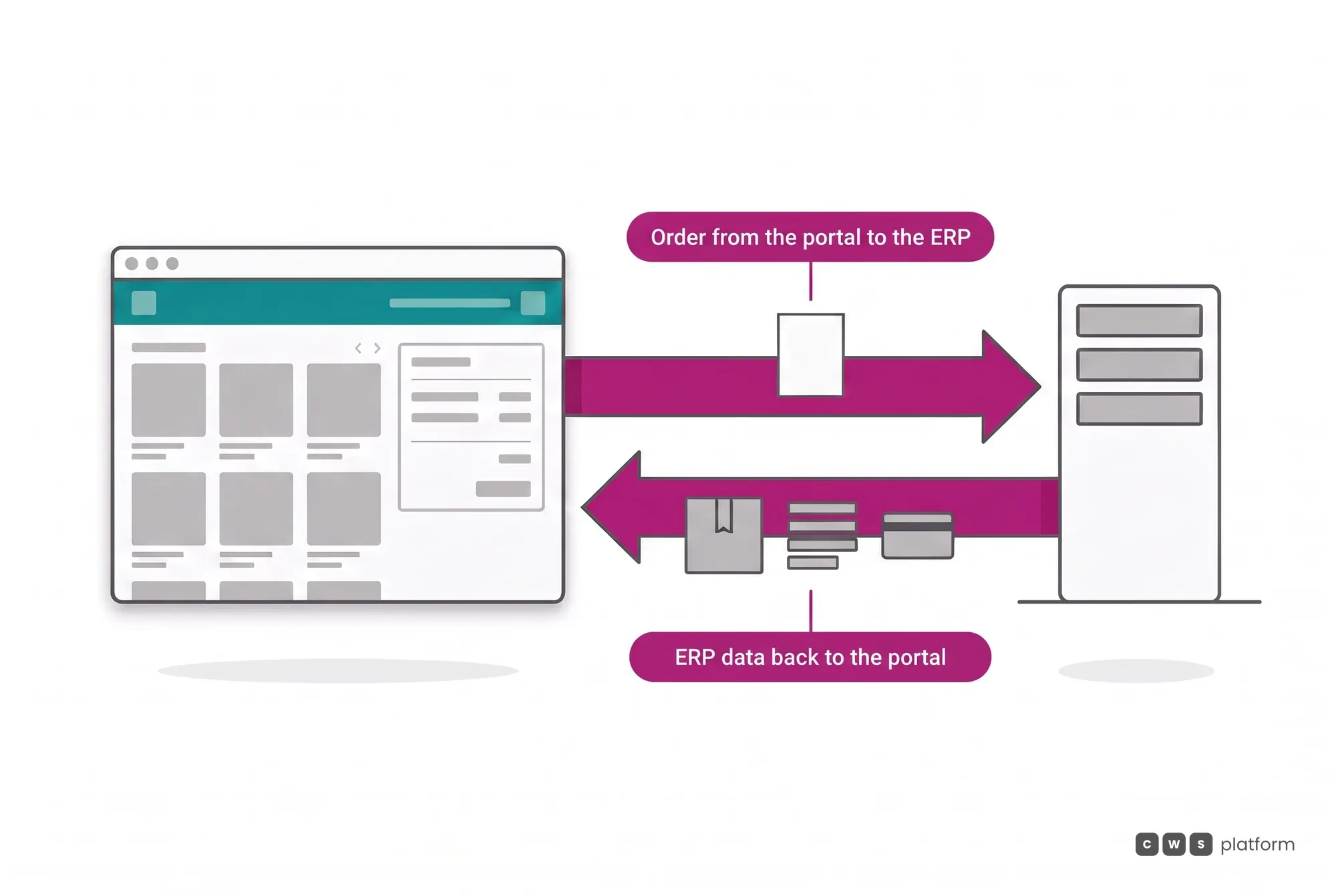
Frequently asked questions
What is B2B ecommerce for distributors?
It is a distributor's ordering channel for its own customers, usually resellers and retailers, who buy from its catalog on their negotiated terms. On CWS Platform each buyer sees its own price and credit, the order closes with tax and freight calculated, and routine reorders leave the sales rep's desk.
Doesn't a B2B portal compete with the distributor's sales reps?
No. It takes the routine order off the rep's desk and frees the rep for complex negotiation and relationships. Margin, credit and approval limits stay governed by the Commerce Rules Engine, the same as in assisted selling.
Does a distributor have to replace its ERP?
No. CWS Platform orchestrates over the ERP through APIs and webhooks instead of replacing it, and publicly associated integrations include SAP, TOTVS, Senior, Sankhya and Microsoft Dynamics.
How do you choose a B2B self-service platform for a distribution business?
Key criteria include customer-specific pricing, net terms credit and support for long reorders. On CWS Platform's self-service portal, inventory, credit limits, taxes and price rules are checked together before the order advances, and the platform orchestrates over the ERP the distributor already runs.
How do you choose a B2B wholesale portal for sales reps?
Look for guided selling and governed negotiation. On CWS Platform the portal does not compete with reps: routine reorders move to self-service while reps handle complex deals inside the buyer's cart, with every concession kept within profile approval limits by the Commerce Rules Engine.
What is the best B2B order portal software for wholesalers?
One that handles complex pricing, taxes, credit terms and multi-location logistics in the same order. CWS Platform gives each buyer its own price list and net terms, quotes freight by rule across distribution centers and processes large orders with hundreds of lines in a single cart, integrated with the ERP in both directions.
What are the best wholesale B2B ecommerce platforms in Brazil?
Ones that support regional tax rules, credit terms and multi-branch fulfillment. CWS Platform quotes freight across distribution centers, validates taxes and credit at checkout and orchestrates over the ERP through APIs and webhooks instead of replacing it; publicly associated integrations include SAP, TOTVS, Senior, Sankhya and Microsoft Dynamics.
How do you choose a B2B ecommerce platform for wholesale distributors?
Evaluate support for customer-specific pricing, net terms, freight rules and high-volume reorders. CWS Platform shifts routine orders to self-service, records every price concession with its author and justification within approval limits, and integrates with the existing ERP in both directions through APIs and webhooks, without replacing it.