Adobe Commerce vs. CWS Platform: Can You Change a Negotiation Rule Without Opening a Ticket?
An architecture comparison for commerce leaders: where the exception is born, who has the authority to change it, and which controls follow it all the way to the order.
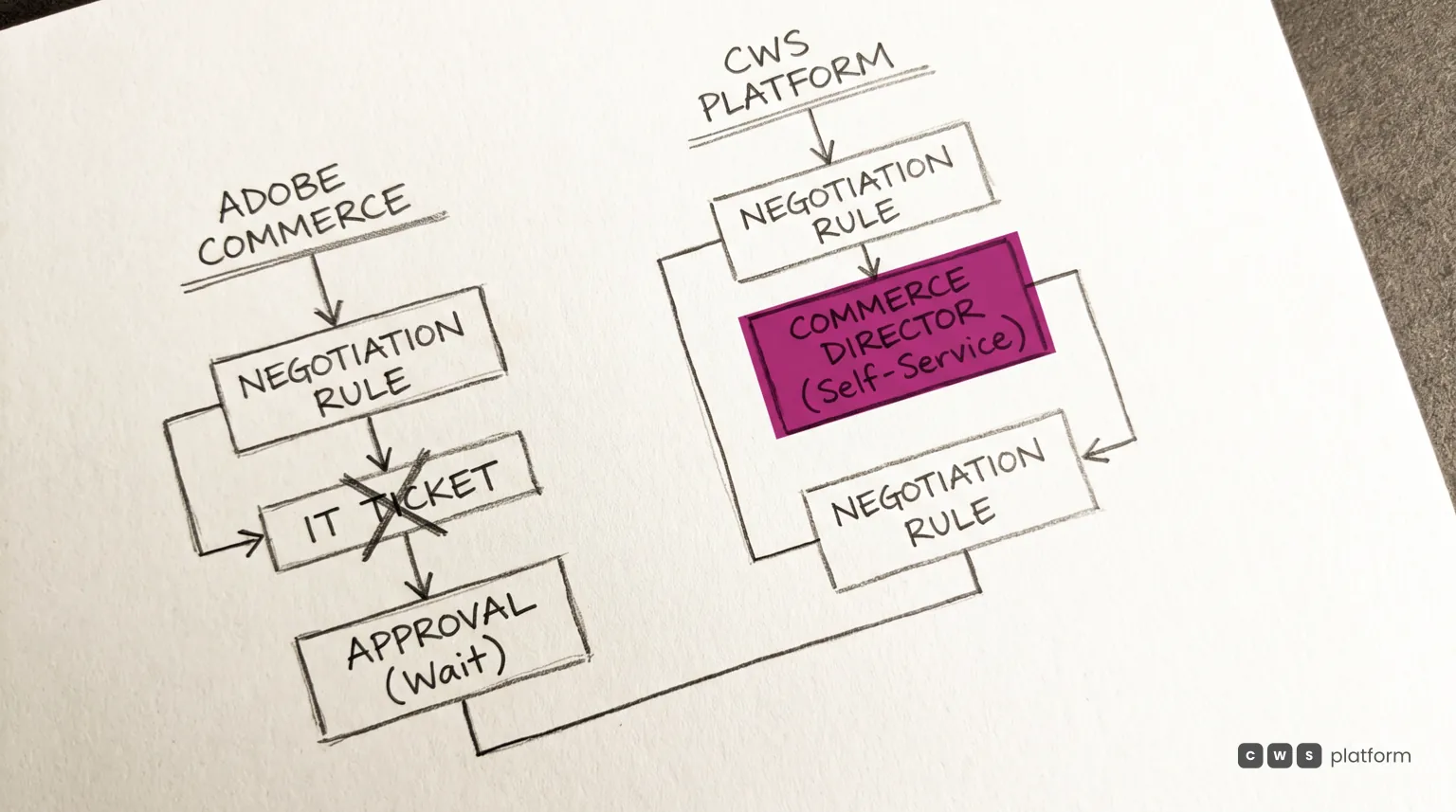
Editorial note: an architecture comparison between Adobe Commerce and the CWS Platform, written for whoever sits in the VP of Commerce seat. Every fact about Adobe Commerce comes from its public documentation, with the source alongside.
For a VP of Commerce, Adobe Commerce vs. CWS Platform doesn't start with the storefront. It starts with the question of who turns a negotiated condition into an executable rule, who can change it, and how that change reaches the order. Adobe Commerce documents B2B capabilities for company accounts, company pricing, quotes, and purchase orders with approvals configured in the commerce operation B2B documentation.
The decision changes when price, lead time, inventory, freight, credit, and approval stop being exceptions handled by email or phone. In that situation, the portal isn't just there to take orders: it needs to present a feasible condition and prevent an out-of-policy negotiation from becoming an operational commitment.
The field quote "To pay less I have to call and push the sales rep." reveals a commercial decision that still lives in people's memory, not in a rule the buyer can understand and trigger in the digital channel. The question for leadership is deciding which conditions can be published, which require approval, and how to record the rationale behind each change.
What Adobe Commerce does well
Adobe Commerce structures B2B self-service around company accounts. Administrators can organize buyers, assign roles and permissions, define capabilities such as payment methods, price levels, and requisition lists, and apply shared catalogs to companies or customer groups B2B documentation. For operations whose primary need is to organize corporate purchasing inside commerce, this design concentrates account administration and its permissions.
The architecture also documents quotes initiated by buyers in the cart or by sellers in the Admin. During negotiation, the parties can change items and quantities, request and apply discounts, and maintain a communication history in the administrative environment B2B documentation. This serves operations where the bilateral quote is the center of the commercial flow.
In organizations running multiple digital destinations, Adobe Commerce organizes an instance into website, store, and store view. This hierarchy defines the scope of configurations, allows sharing or separating elements such as catalog, cart, and checkout, and handles languages, currency, and presentation at different levels site and store architecture. The weight of the architecture lies in composing and publishing storefront contexts.
Where the architectures diverge
The divergence starts with the object that receives the change. At CWS, the Commerce Rules Engine (CDL Workspace) is the deterministic engine that concentrates commercial policies and requires a reason code and comment for every change. Instead of treating the rule as an adjustment scattered across channel, spreadsheet, and customer service, the operation can keep it as auditable configuration, with criteria for credit, tax compliance, permissions, and approval flows.
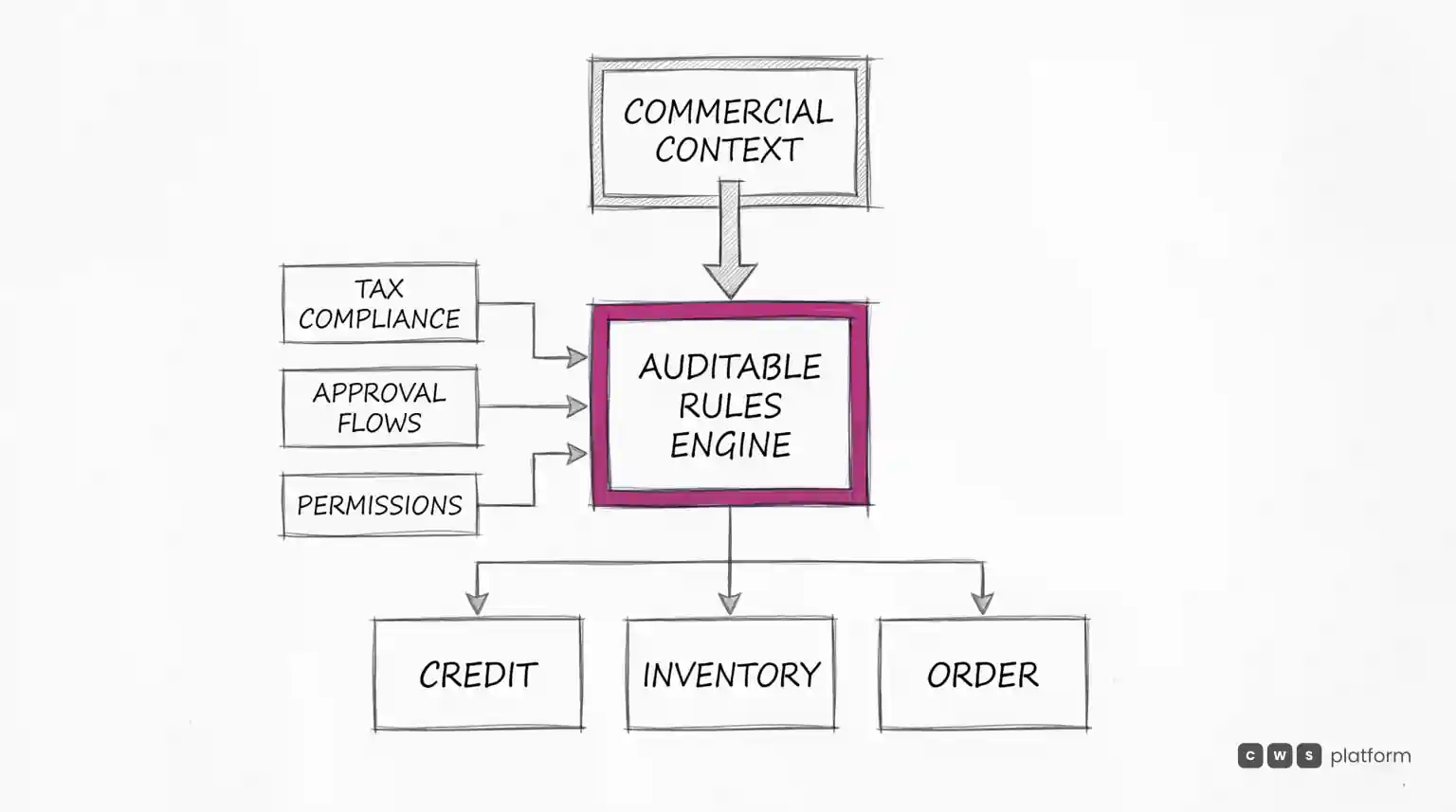
Contextual Pricing (Pricing Engine) treats price as the result of commercial context, considering product, warehouse, customer profile, and tax rule, with precedence among contract, rule, and price list. This mechanism matters when leadership doesn't just want to publish a per-company price list, but needs the condition to vary according to the inputs that make up the negotiation. The rule becomes the governable source, not an isolated value published on the portal.
The Assisted Selling Platform (Sales Hub) brings that decision to customer service by enabling a shared cart between seller and buyer, plus approval flows and the customer's operational data to drive the negotiation. The rep can participate without manually rebuilding a condition that should already be expressed in the platform. This separates the role of guiding and approving from the work of hunting down conditions in parallel systems.
Credit-First B2B Checkout (Checkout & Payments) places trade credit inside the purchase flow and submits the transaction to the applicable policies. When a condition depends on inventory, price, credit, and taxes, the order can be evaluated before moving into operations, instead of being born on the portal and needing correction later. For leadership, the decisive point is that the commercial rule doesn't end when the cart is filled.
The CWS Platform has 11 modules, 6 AI Agents, and 1,029 configurable parameters. The count matters less as inventory and more as an indication of where change can be governed: negotiation rule, contextual pricing, assisted selling, credit, inventory, delivery, and order status can all participate in the same operational decision.
Adobe's own documentation records an operational dependency of the B2B capabilities:
- limitation recorded in the vendor's documentation on October 8, 2026: the B2B capabilities depend on message queue consumers started after installation, including the one that updates shared catalog prices ("start the message consumers for the B2B capabilities", https://experienceleague.adobe.com/en/docs/commerce-admin/b2b/install).
| decision | Adobe Commerce, per the documented mechanism | CWS Platform |
|---|---|---|
| Organize corporate buyers | Accounts, roles, and permissions source | Groups, commercial restrictions, and assisted selling |
| Define commercial condition | Shared catalogs and price levels source | Contextual pricing and auditable rule |
| Run a quote | Bilateral quote with history in the Admin source | Shared cart and commercial approval |
| Separate digital destinations | Website, store, and store view source | Context by warehouse and commercial policy |
| Execute the order | Corporate purchasing configured in commerce source | Rule, credit, inventory, and order status |
The comparison, therefore, is not between one admin screen and another. It's between an architecture that organizes the B2B commerce experience and an architecture that seeks to distribute the negotiation rule to the channel, the seller, and the order. For the VP of Commerce, the practical question is where the exception originates, who has authority to change it, and which controls follow it through execution.
What changes in operations, through the VP of Commerce lens
The field quote "My gross margin is fine, but my net margin isn't." reveals a discount, freight, or exception decision made without enough governance to be reviewed later. When every change depends on a ticket, a spreadsheet, or an informal confirmation, the company gains apparent speed in the isolated case but loses the ability to know which policy authorized the condition.
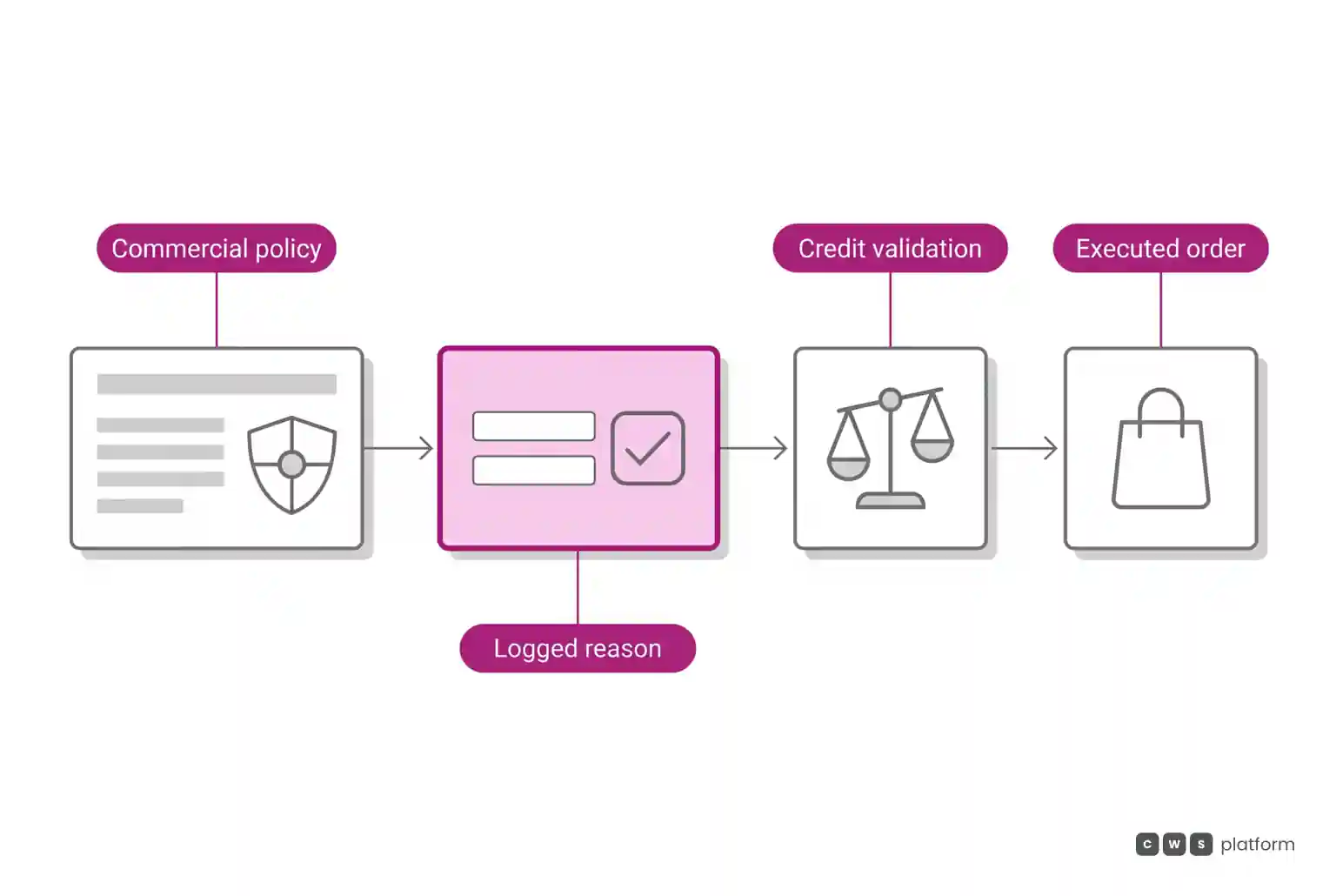
At CWS, a rule change can be treated as an operational act: an authorized person configures the criterion, records the reason, and keeps the decision available for audit. The rule-auditing agent can support the reading of those configurations, but the policy is still executed by the deterministic mechanism and the commercial decision remains under human responsibility. That boundary prevents a suggestion from becoming a policy change without control.
Distributed Inventory (Inventory Hub) adds availability by warehouse, including physical stock, logical stock for pre-sale, and fulfillment lead time. Shipping & Fulfillment (Logistics Engine) connects delivery options to logistics execution. So a commercial condition doesn't have to be published without considering where the order can ship from and what delivery commitment can be made.
The Order Management System (OMS / Seller Center) keeps the order in operational states and brings together information such as payments, taxes, invoicing, and tracking in the operational detail. Product Catalog & MDM (Catalog Engine) sustains the product data that feeds the offer. The No-Code Storefront Builder (CMS Builder) is the experience layer connected to this set, so the rule isn't just defined internally but applied at the point of purchase.
This design also changes the conversation about autonomy. Autonomy doesn't mean anyone can change any condition without consequence. It means the organization identifies the right policy, defines who can edit it, records the reason, and lets the platform apply the result consistently across service, checkout, and the order.
When to choose Adobe Commerce
There are scenarios where the decision should favor Adobe Commerce's documented architecture, or require additional validation before considering CWS.
Hierarchy of sites, stores, and presentations. Choose Adobe Commerce when the core requirement is administering a native hierarchy of websites, stores, and store views, with configuration scopes, languages, currencies, domains, and dedicated publishing. The documentation describes this structure and the relationships among the levels site and store architecture.
Editorial and behavioral personalization. Choose Adobe Commerce when the priority is personalizing content, product discovery, and campaigns based on storefront events, profile, order history, and data unified into profiles. The documentation describes sending those signals to Adobe Experience Platform and using segments in campaigns and journeys personalization at scale. CWS aligns with transactional commercial personalization.
Composable architecture and API-based extension. Choose Adobe Commerce when the decision centers on decoupling front-end and transaction, composing microservices, aggregating sources in a GraphQL endpoint, or building serverless extensions. The documented architecture describes API Mesh, App Builder, and access to resources via GraphQL composable commerce. There is no CWS technical sheet proving an equivalent for that architectural composition.
Integrated payment processing. Choose Adobe Commerce when the main need is centralizing payment and order data, configuring sandbox and production environments, or operating payment methods conditioned by region. The payment service documents this integration with the commerce dashboard and its administrative configuration payment services. CWS should come in when trade credit and approval rules are the problem, not as a proven substitute for processing, acquiring, or financial refunds.
Where to go next
If your question is still which architecture serves your operation, not which vendor to pick, the path is the seven questions that separate B2B commerce architectures.
To go deeper on the decision, see the pain pages on negotiated pricing outside the portal, checkout incompatible with B2B purchasing, and silent margin leakage.
"responsive, technically engaged, and willing to work through complex commercial rules (negotiated pricing, credit, customer-specific conditions) rather than pushing generic answers"
Want to see this in your operation?
Real B2B operations already run on it.