Adobe Commerce vs. CWS Platform: Who Does the CEO Depend On?
An architecture comparison focused on where dependency lives and who controls each commercial change.

Editorial note: an architectural comparison of Adobe Commerce and the CWS Platform, written for decision-makers accountable at the CEO level. Every fact about Adobe Commerce comes from its public documentation, with the source linked alongside it.
When comparing Adobe Commerce and the CWS Platform, a CEO should ask more than which technology meets today’s project requirements. The structural question is this: when pricing, credit, catalogs, inventory, or sales processes change, who will have the authority and the means to adapt the operation—the internal team, an implementation partner, an extension ecosystem, or the platform vendor itself?
Platform dependency never disappears. It simply moves. It can reside in custom code, infrastructure, integrations, specialized expertise, or business-rule configuration. The executive issue is determining which dependency matches the company’s operating capabilities—and which one turns every business change into a technical project.
The field objection, “My sales reps say the portal will kill their commissions,” reveals a decision that is not merely technical: whether the digital channel will operate as a separate online store or as part of the sales organization. When the architecture separates the portal, the sales rep, and the rules of negotiation, the company may depend on manual workarounds to reconcile those channels. When the architecture connects them, change can be managed within the sales workflow itself.
What Adobe Commerce does well
The documented offering provides distinct operating models. The SaaS offering is multi-tenant and receives automatic updates, while the PaaS offering uses dedicated single-tenant infrastructure. The core handles commerce transactions and can connect to other systems through APIs, events, webhooks, and extension tools. As a result, a significant part of the dependency decision lies in the operating model and integration architecture the company chooses. See the offering descriptions.
For companies that define autonomy as access to source code, the associated ecosystem provides an open-source path, Composer-managed packages, and contributions to the core. The API framework also exposes services through GraphQL, REST, and SOAP, with resource-level authorization and explicit declaration of published services. In this model, the freedom to modify and integrate comes with responsibility for maintaining code, dependencies, and extensions. Review the open-source model.
The multisite architecture organizes an instance into websites, stores, and store views. These levels determine what can be shared or separated, including catalogs, carts, checkout, presentation, language, and currency. For a company operating multiple brands or regional storefronts, this hierarchy provides a native storefront administration model, but it also means that structural changes depend on how those scopes were designed. Understand the website and store hierarchy.
For personalization, inputs can combine browsing events, checkout actions, order history, profile data, and back-office information. Data Connection sends this information to the Adobe Experience Platform Edge Network, while integrations with other products in the suite can support segments and journeys. The architectural emphasis is on capturing and unifying signals to tailor content, communications, discovery, and offers. See how data enters the personalization layer.
Where the architectures diverge
The divergence begins with the meaning of autonomy. In a code-extensible model, services are exposed through technical configuration, and changes may involve packages, APIs, and third-party components. This approach serves organizations that want to control the code and maintain a platform engineering function, but it also transfers responsibility for the evolution of customizations to those organizations. Read how services are exposed through APIs.
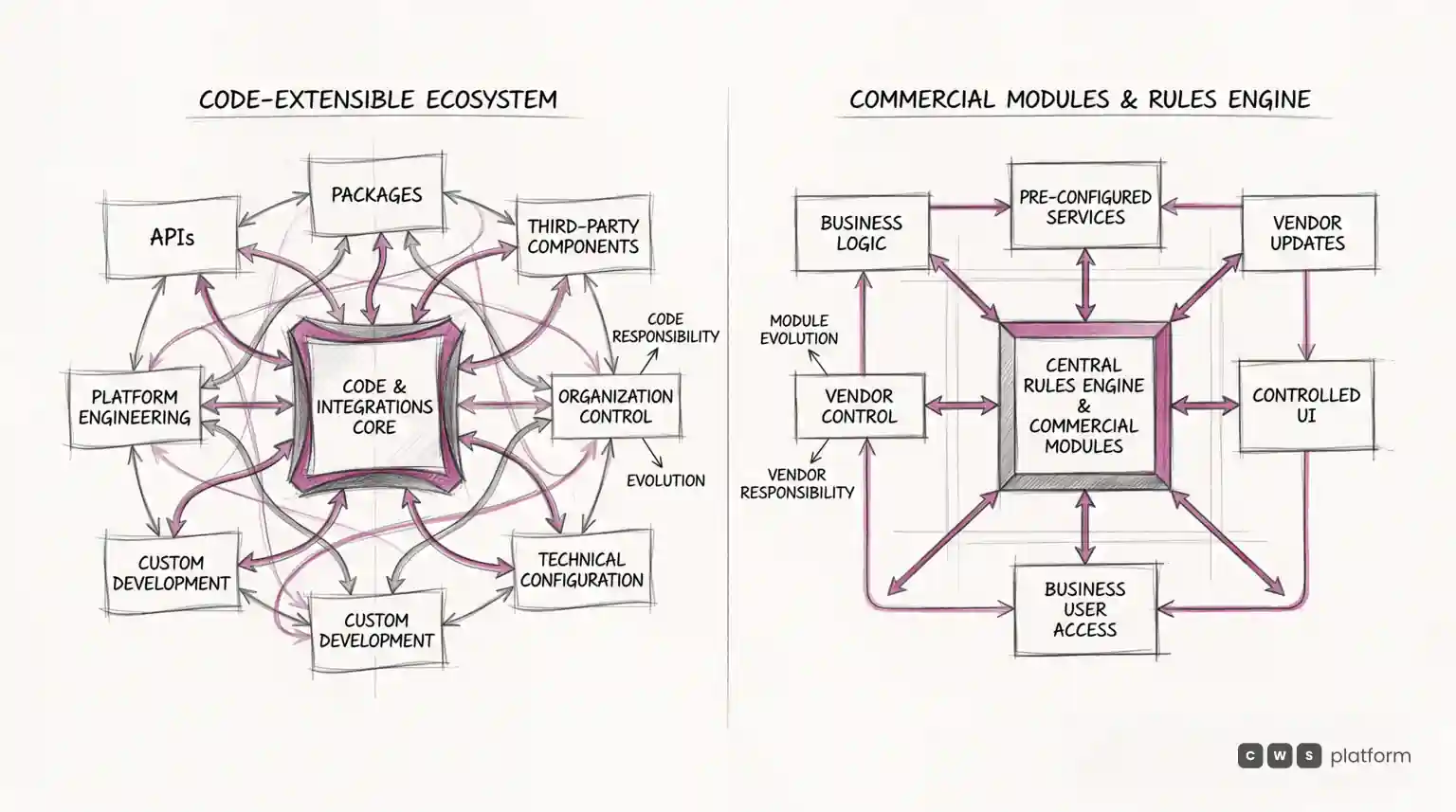
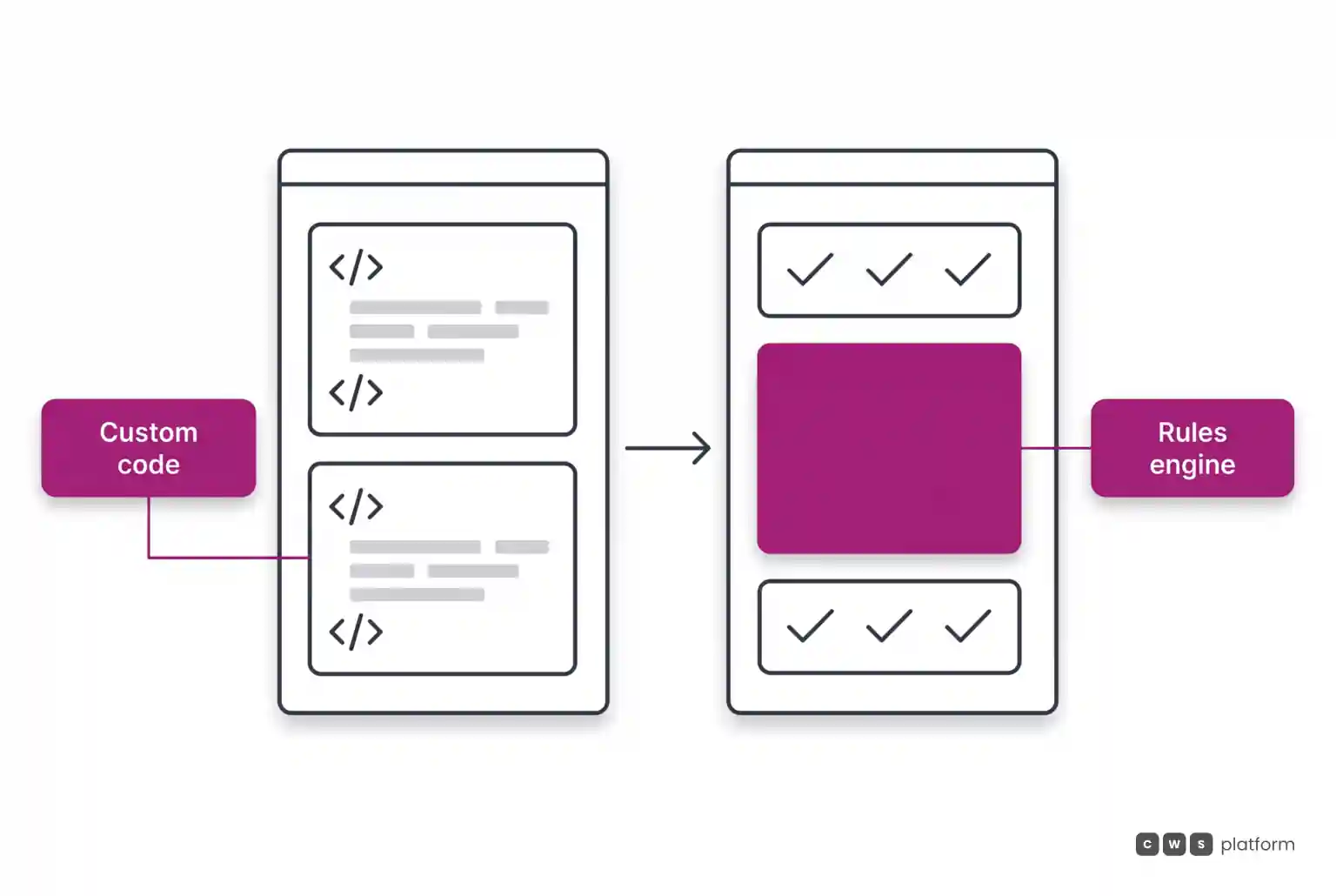
In CWS, the center of commercial change is the Commerce Rules Engine (CDL Workspace). Contextual Pricing (Pricing Engine) handles account- and transaction-specific pricing, Assisted Selling Platform (Sales Hub) supports sales-assisted negotiation, and Credit-First B2B Checkout (Checkout & Payments) brings credit and approvals into the transaction. The CWS Platform has 11 modules, 6 AI Agents, and 1,029 configurable parameters. The purpose of this design is to let a policy change be expressed as a traceable rule—with a reason and comment—instead of necessarily beginning with a code change.
The difference also appears in operational scope. The website, store, and store-view hierarchy organizes storefronts and determines how resources are shared within the instance, while inventory remains associated with the platform’s documented scopes. See how scopes are separated. In CWS, Distributed Inventory (Inventory Hub) centers operations on the warehouse and SKU, Shipping & Fulfillment (Logistics Engine) calculates delivery alternatives, and Order Management System (OMS / Seller Center) governs order progression through rules.
There is also a clear boundary in personalization. Adobe’s documented mechanism combines behavioral and profile signals to support experiences and journeys, including data sent to the experience platform. Review the data sources used for personalization. CWS centers its demonstrated value proposition on transactional commercial personalization: negotiated pricing, credit, availability, delivery, and approvals. Product Catalog & MDM (Catalog Engine) governs product data.
Adobe's own documentation records two points that weigh on this dependency:
- limitation recorded in the vendor's documentation on September 18, 2026: the security-only transitional period for versions 2.4.4, 2.4.5, and 2.4.6 is a one-time exception and will not be extended beyond the published dates ("The security-only transitional period is a one-time exception.", https://experienceleague.adobe.com/en/docs/commerce-operations/release/planning/lifecycle-policy).
- limitation recorded in the vendor's documentation on September 24, 2026: in Adobe Commerce as a Cloud Service customizations run as out-of-process App Builder applications, and rebuilding them is typically the most significant engineering effort of the migration ("typically the most significant engineering effort", https://experienceleague.adobe.com/en/docs/commerce/cloud-service/migration/overview).
| Decision | Adobe Commerce, based on its documented mechanism | CWS Platform |
|---|---|---|
| Where commercial policy is expressed | Policy combines commerce configurations, integrations, and extensions. | Policy runs in the rules engine and governs pricing, credit, and approvals. |
| What happens when a negotiation rule changes | The change may require technical configuration, a package, or code intervention. | The change updates parameters and records a reason and comment within the rule itself. |
| Where operational separation resides | Separation follows website, store, and store-view scopes. | Separation follows the warehouse, commercial context, delivery, and order lifecycle. |
| Extension path | Extensions use APIs, packages, events, webhooks, and ecosystem components. | Extensions connect modules while policy remains in the deterministic layer. |
| Scope of demonstrated personalization | Personalization combines behavior, profiles, orders, and browsing signals. | Personalization applies executable commercial terms to the B2B transaction. |
For the CEO, then, the comparison does not produce a universal answer about dependency. It reveals different dependencies. One architecture prioritizes storefronts, a technical ecosystem, and code-based extensibility. The other prioritizes sales service, negotiation, and the execution of commercial rules across modules. The choice depends on which kinds of change need to remain under the company’s day-to-day control.
What changes operationally, through the CEO’s lens
Speed of change does not mean deploying code faster. It means reducing the distance between a commercial decision and its safe execution. In CWS, the rules engine can change permissions, approvals, restrictions, and commercial criteria without turning every variation into a new ERP customization. Taking rules out of code changes the time scale of review. As a market reference, McKinsey documented a heavy-equipment distributor where account plans that took more than 10 hours dropped to minutes, and resolution time fell from 15 minutes to under 1 (Five ways B2B sales leaders can win with tech and AI, 2024). The rules-audit agent operates on this configured layer, while transactional decisions remain subject to deterministic mechanisms.
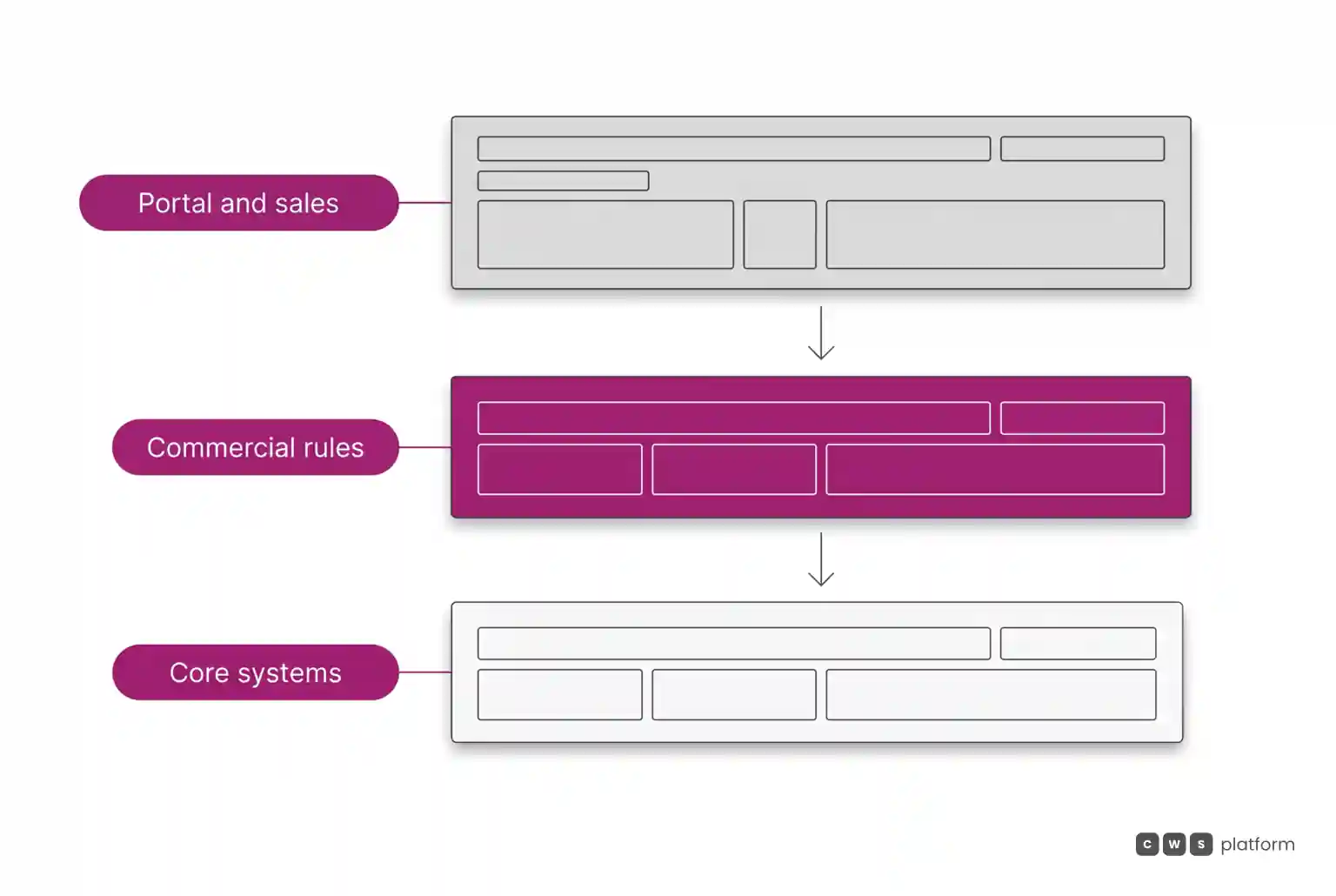
This separation preserves architectural responsibilities. The ERP can remain the system of record for financial and master data without being forced to control every buyer or sales-rep interaction. The pricing engine calculates contextual terms, inventory provides warehouse-level availability, checkout applies credit rules, and the order system controls state transitions. AI can orchestrate tasks, but the platform executes pricing, inventory, credit, and order decisions using transactional data rather than allowing those decisions to depend solely on a prompt.
The same logic extends to sales adoption. The assisted-selling platform’s shared cart places the sales rep and buyer in the same context, while Commerce Marketing & Promotions (Marketing Suite) connects campaigns to operational terms. No-Code Storefront Builder (CMS Builder) supports presentation changes without moving commercial rules into the visual layer. This allows the company to treat the digital channel as a platform for service and negotiation—not as an isolated online store that must be reconciled later.
This model does not eliminate the need for a vendor or systems integration. Instead, dependency is governed through concrete questions: who configures the rule, who approves the exception, where the change is recorded, which data comes from the ERP, and which service executes the transaction? For the CEO, that visibility is more useful than an abstract promise of independence because it makes the organizational cost of each change easier to anticipate.
When to choose Adobe Commerce
Adobe Commerce should be chosen when the dependencies the company is prepared to accept align with its engineering model, storefront requirements, and infrastructure strategy.
When the central requirement is a native multisite architecture. Choose this path when brands, languages, currencies, domains, and storefronts need to be organized through the website, store, and store-view hierarchy. The documentation shows how these scopes share or separate resources.
When autonomy means owning and modifying the code. This scenario favors an organization that wants repository access, Composer-based workflows, component-level modifications, and responsibility for maintaining dependencies. The open model allows direct contributions to the core.
When behavioral personalization is the center of investment. If the priority is using browsing activity, profiles, orders, and checkout events to personalize content, discovery, and journeys, Adobe’s documented data layer provides a specific mechanism. These signals can be sent to Adobe Experience Platform.
When managed infrastructure is a procurement requirement. The managed offering assigns infrastructure, monitoring, maintenance, scalability, recovery, and security responsibilities to the vendor while preserving customer responsibility for parts of the customized solution. The operating-responsibility matrix is described in the service documentation.
Where to go next
If your question is still which architecture fits your operation—not which vendor to select—the next step is the seven questions that separate B2B commerce architectures.
If the current obstacle is the business problem behind this scenario, When Channels Compete With Each Other examines it in depth without discussing any vendor.
"responsive, technically engaged, and willing to work through complex commercial rules (negotiated pricing, credit, customer-specific conditions) rather than pushing generic answers"
Want to see this in your operation?
Real B2B operations already run on it.