Agricultural Input Storefront Capabilities: What Sets the Platform Apart
Crop season, crop context, credit, prescription requirements, and bulk purchasing must be built into the workflow—not handled through side processes.

TL;DR
- A shopping cart digitizes order entry, but it does not handle the decisions specific to selling farm inputs.
- In agriculture, the workflow must account for crop season, credit, product-use documentation, crop type, and bulk purchasing.
- When these capabilities sit outside the platform, sales reps and managers become the manual link between the digital channel and the company’s sales policies.
- The priority is to establish decision governance. Automation and AI come later, supported by systems of record, clear action limits, and traceability.
Why Isn’t a Shopping Cart Enough to Sell Farm Inputs?
For sales leaders at farm input companies, the tension becomes clear when a digital channel exists, but an order still cannot move forward without separate inquiries, validations, and manual intervention.
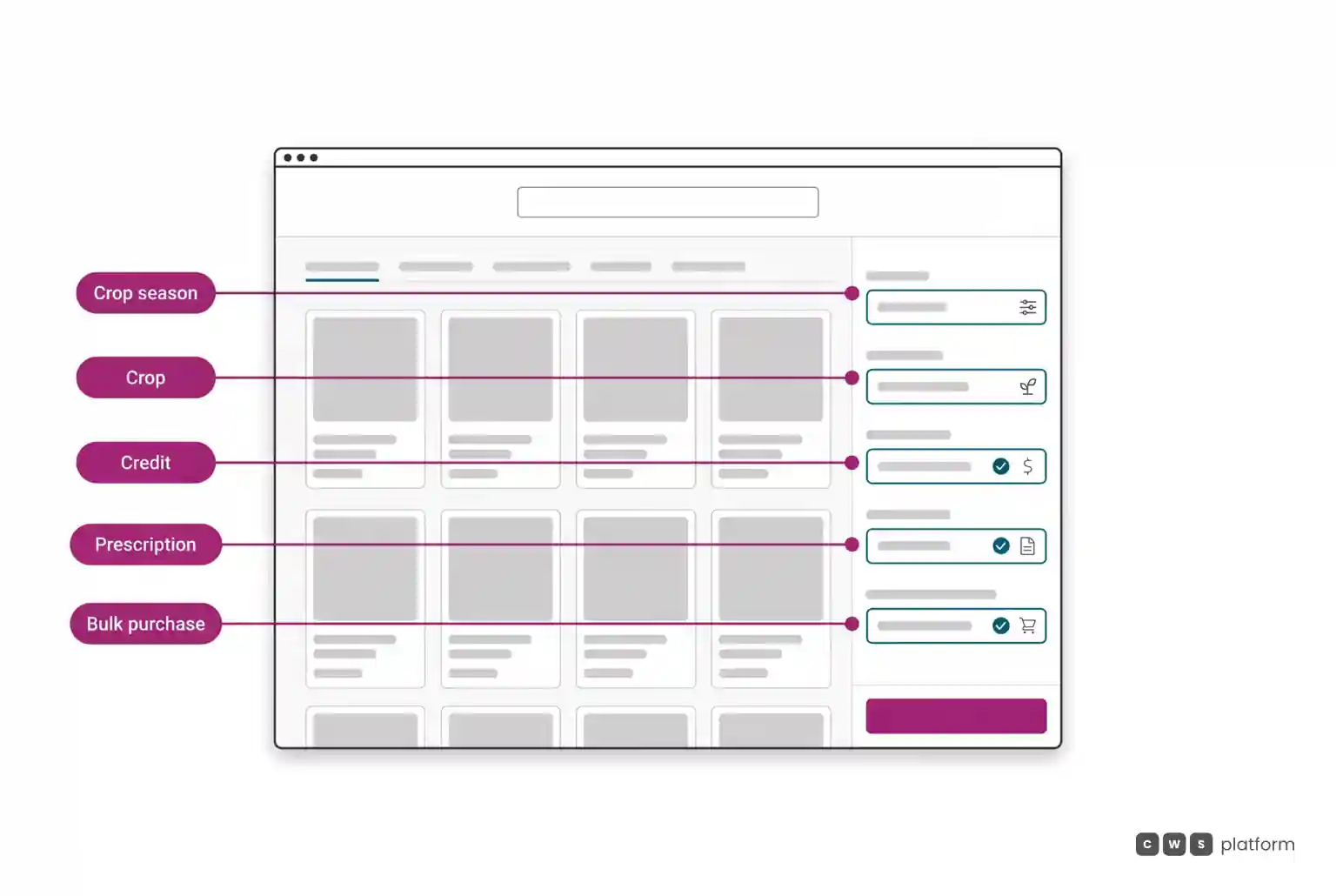
The buyer browses the catalog and signals an intent to purchase. From that point on, the operation must verify information that does not fit neatly into a generic shopping cart: crop season, crop type, credit terms, product-use documentation, and order scale. If these factors are not built into the workflow, the digital order simply transfers work to employees.
The team receives a seemingly structured request but still has to reconstruct the context before making a decision. The channel has been digitized. The sale has not.
This distinction is critical in agriculture. What differentiates a farm input front end is not the ability to add products to a cart. It is the ability to represent, within the customer journey, the conditions that make the purchase commercially and operationally valid.
The Decision Happens Before Order Confirmation
In a B2B operation, an order is more than a list of products. It also represents decisions about price, terms, credit, quantity, and fulfillment.
In agriculture, those decisions must reflect domain-specific capabilities:
- Crop season: The sales workflow must recognize the growing-season context in which the transaction occurs.
- Crop type: The purchasing journey must incorporate the crop associated with the order.
- Credit: Credit terms must be part of the decision rather than appearing only as a downstream check.
- Product-use documentation: When required, prescriptions, compliance records, or related documentation must be integrated into the workflow rather than handled as a disconnected step.
- Bulk purchasing: Volume and the corresponding commercial terms must be processed as part of the negotiation.
The problem is not the absence of another screen. It is the separation between the interface used by the customer and the logic that allows the company to accept, adjust, or route the transaction.
One account from the CWS archive describes an inside sales rep who, for every order received through the portal, checked the price in the system, consulted a spreadsheet, returned to the system, adjusted the terms, and only then confirmed the order. The portal existed, but the decision still depended on an individual.
In this scenario, the sales rep becomes a manual connection among systems, documents, and rules. The rep’s knowledge keeps the operation running, but it never becomes an institutional capability.
The Risk of Digitizing Only the Channel
The digital maturity of a sales operation cannot be measured solely by the presence of a catalog, portal, or electronic ordering capability.
CWS reference materials describe three stages for evaluating this evolution:
- First, digitize the channel: Orders enter with less friction, and the catalog becomes accessible.
- Second, digitize the decision: Pricing, credit, terms, and sales criteria become executable rules.
- Third, deploy agentic intelligence: Agents recommend and act within auditable boundaries, with human oversight.
An operation can create value while still in the first stage. The problem arises when the company treats that stage as the completion of its transformation.
In agriculture, this limitation is more visible because decisions depend heavily on context. If crop season, crop type, credit, product-use documentation, and volume are not part of the structure, the front end cannot conduct the sale. It only captures an intent that will later be processed manually.
Sales Policy Must Live in the Workflow
Every B2B company has a sales policy. The question is where that policy is recorded.
It may live in a sales rep’s experience, in shared spreadsheets, or as structured rules within the order workflow. In the first two cases, knowledge depends on employee availability, individual interpretation, and the circulation of off-system files.
Structuring pricing bands, approval levels, and decision criteria in the system turns individual knowledge into governance. For a farm input operation, this means connecting sales rules to domain-specific capabilities rather than treating them as exceptions after the fact.
Governance does not eliminate professional judgment. It defines what can be resolved automatically, what requires validation, and who has the authority to approve an exception.
As a result, sales reps spend less time reconstructing information and can focus on customer relationships, agronomic guidance, and negotiations that genuinely require human intervention.
The Cost of Inaction
Maintaining a shopping cart without incorporating agricultural sales logic creates the appearance of digitization while preserving the same dependencies.
The effects appear across the operation:
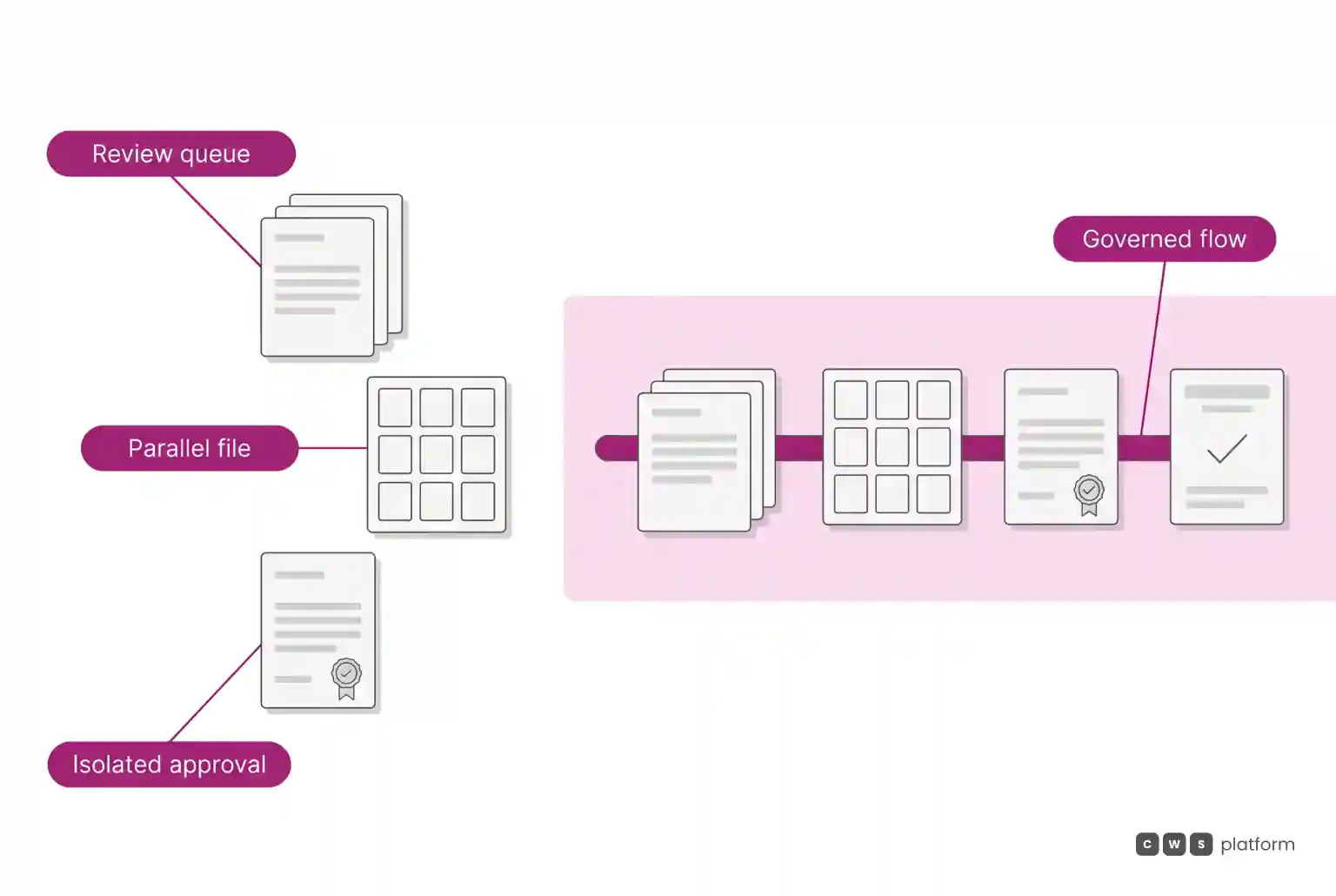
- Digital orders create new internal review queues.
- The business depends on experienced sales reps to interpret each situation.
- Sales policies are applied inconsistently.
- Pricing, payment-term, and credit approvals happen outside the workflow.
- The company struggles to trace why a particular term or concession was approved.
- The operation cannot scale without increasing manual work.
The cost is not limited to the time required to confirm an order. It also includes the company’s inability to turn accumulated sales knowledge into a repeatable asset.
Automating before organizing these decisions does not address the root cause. It only accelerates a workflow that remains fragmented.
Principles for Structuring an Agricultural Front End
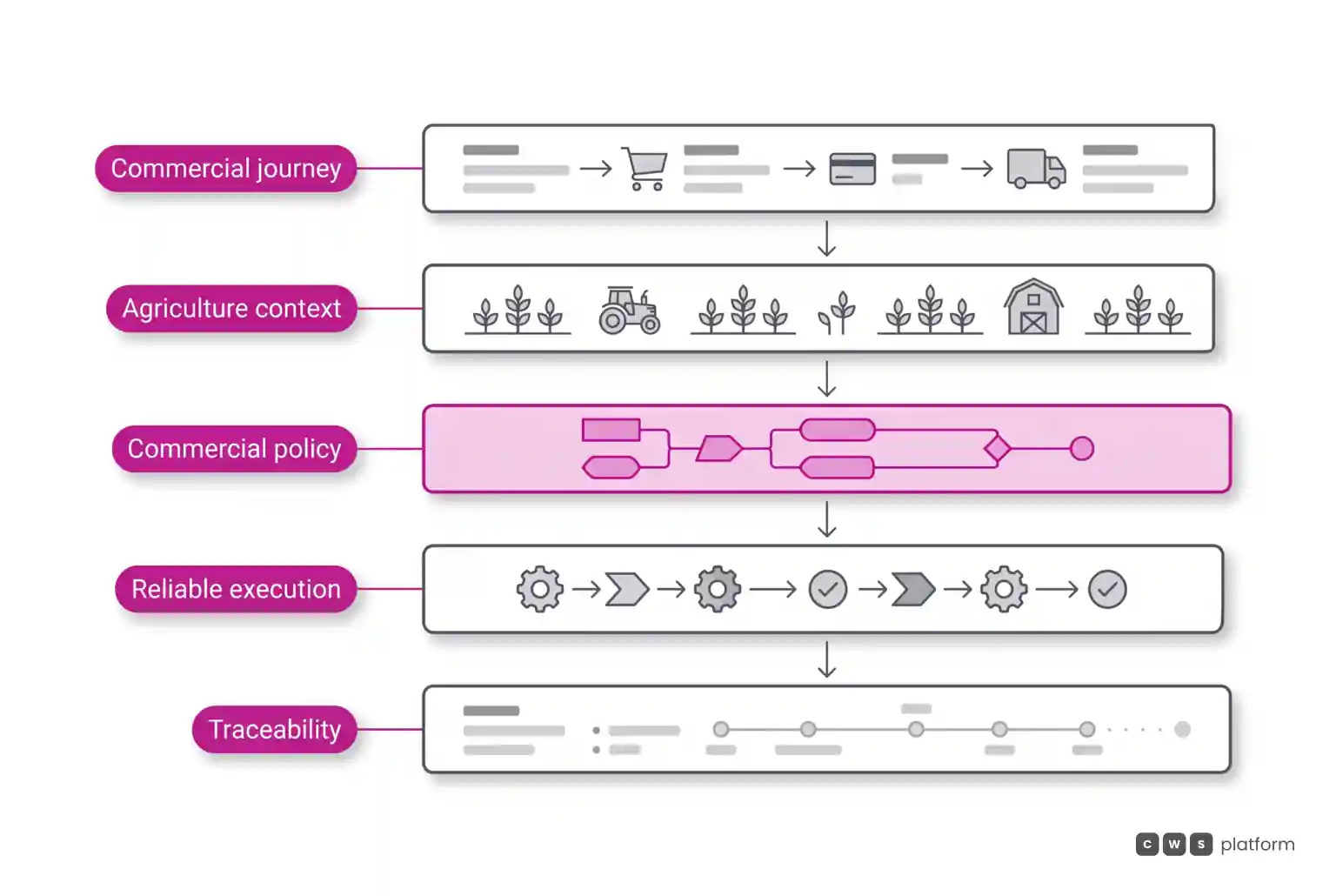
- Start with the decision, not the interface: Identify what must be known and validated before an order can move forward.
- Model domain-specific capabilities: Crop season, crop type, credit, product-use documentation, and bulk purchasing must be part of the workflow.
- Record the sales policy: Pricing, terms, criteria, and approval levels should not depend solely on team members’ memory.
- Preserve exception handling: Governance should specify when the system can resolve an issue and when a person must decide.
- Use systems of record: Recommendations depend on reliable identity, account, pricing, inventory, and order data.
- Ensure traceability: Decisions and interventions must remain documented.
- Establish governance before AI: Intelligence without controls cannot safely run a sales operation.
FAQ
Doesn’t a Digital Catalog Already Reduce Sales Work?
It can reduce friction when customers research products and submit orders. The benefit remains limited when pricing, credit, product-use documentation, volume, and other terms still have to be processed outside the workflow.
Does Embedding Rules Reduce Sales Rep Autonomy?
Not necessarily. Clear rules eliminate repetitive tasks while preserving human involvement for customer relationships, negotiations, and meaningful exceptions.
Where Can AI Contribute?
AI can interpret context and recommend the next action. Execution, however, must rely on trustworthy transactional data, action limits, traceability, and human oversight. AI orchestrates while a deterministic layer executes.
Who Is Already Experiencing This
Paulo R., a Digital Sales Manager, wrote on GetApp:
“An online store operating perfectly in sync with the entire traditional sales operation.”
The review highlights an important point: Digital commerce must operate in sync with the existing sales organization, not as an isolated channel.
A Case That Illustrates the Point
Case LI-966729 from the CWS archive indicates that low digital adoption in agricultural sales results less from a lack of channels and more from insufficient governance of the negotiation process.
By structuring quotes, contextual pricing, credit, and grain barter within an integrated workflow, the operation reduces transaction costs and enables field sales reps to work as trusted technical advisors. The case reinforces the central argument: The value does not come from the shopping cart alone, but from the commercial and industry-specific capabilities built into the customer journey.
About This Publication
The Cost of Sales is a CWS Platform publication about governance, technology, and efficiency in B2B sales operations.
For agriculture, the architectural answer is not to add another disconnected channel. It is to build a B2B Commerce Platform for Governed Negotiation capable of representing the decisions specific to selling farm inputs.
This structure reduces transaction costs by connecting context, sales policy, and execution within the same workflow. It also creates a safer foundation for AI, which can expand human capacity without replacing governance or removing professionals from the loop.
Sources
- Agricultural front-end capabilities and the central thesis from the CWS Platform archive regarding crop season, credit, product-use documentation, crop type, and bulk purchasing within the sales workflow.
- Materials LI-031, LI-039, and LI-041 from the CWS Platform archive regarding decision digitization, sales policy, and dependence on manual processes.
- Case LI-966729 from the CWS Platform archive regarding agricultural negotiation governance, quoting, contextual pricing, credit, and grain barter.
- GetApp reviews of CWS Platform, public review by Paulo R., Digital Sales Manager.
- Trading Desk: Incremental Revenue Through Reengaging Inactive Accounts, a CWS Platform article about structured data, sales rules, and governance before automation.
"responsive, technically engaged, and willing to work through complex commercial rules (negotiated pricing, credit, customer-specific conditions) rather than pushing generic answers"
Want to see this in your operation?
Real B2B operations already run on it.