B2B Account Activation in Wholesale: Why Reorders Stall When Reps Control the Order
Stagnant ordering accounts are not a sales effort issue, but a structural bottleneck when custom pricing and credit terms rely on rep availability.

"We activated 40% of our account base this month, again." This sentence echoes through almost every distributor sales meeting, and it almost always comes with the same caveat: it is the same 40%. Account activation, the percentage of active accounts that placed an order in a given period, looks like a metric of sales effort. In reality, it measures something entirely different: how many customers can buy without needing an outside sales rep or customer service agent to manually build the order for them.
When the only doorway for an order is a sales rep, the number of ordering customers hits a hard ceiling. It grows only as far as the sales team's calendar stretches, and it stops the moment their day is full. The small account, the secondary market, the low-dollar, high-frequency buyer, these accounts always get pushed to next week.
Why Account Activation Stalls Even When Sales Teams Are Maxed Out
The root cause usually follows this chain of events.
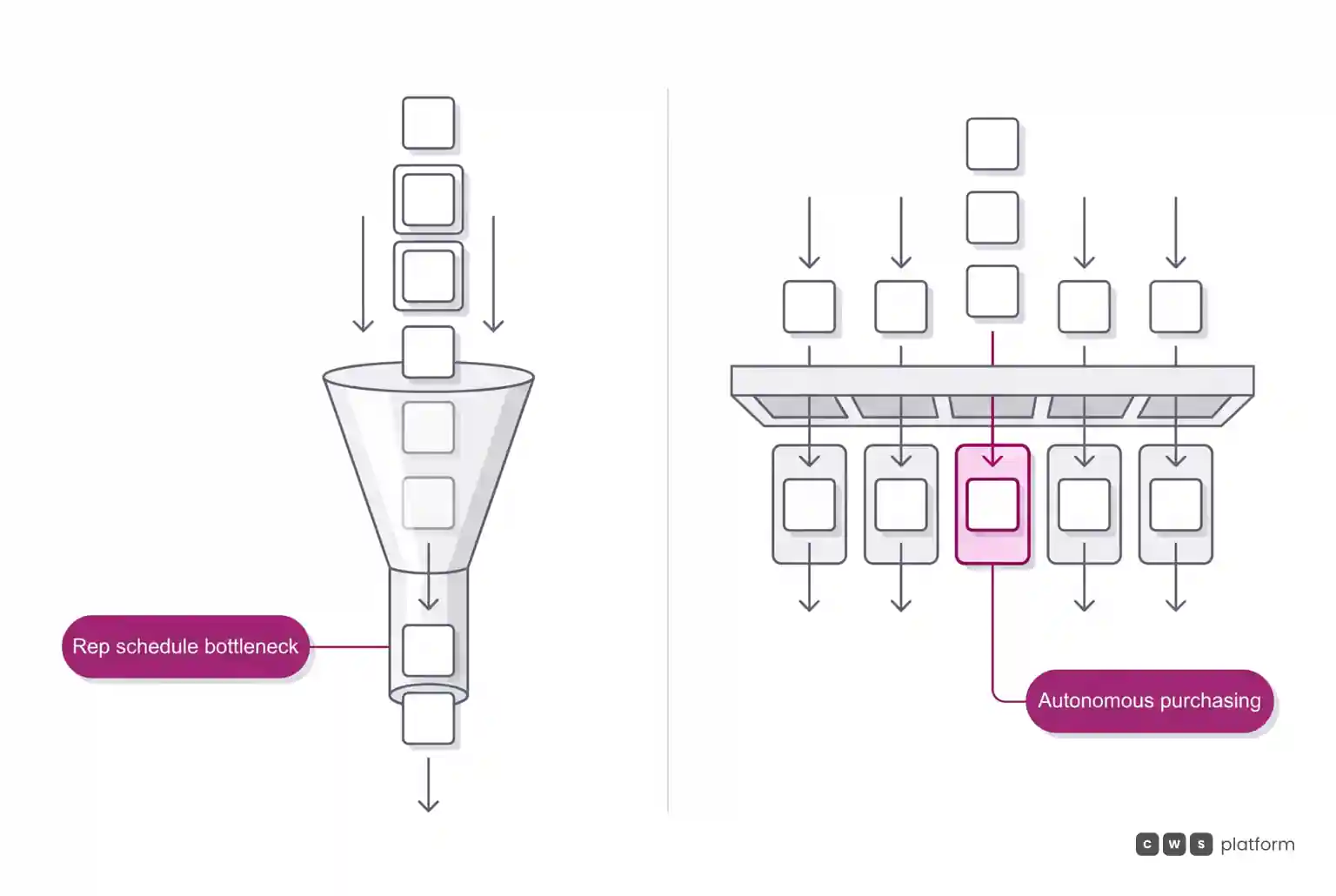
Why didn't the customer buy this month? Because nobody called them, and they have no way to place the order on their own with their negotiated pricing and net terms.
Why can't they order on their own? Because their custom price schedule, available credit line, and warehouse inventory only exist together inside the rep's head or locked in the ERP, never where the purchasing agent can actually see them.
Why can't the rep call everyone? Because a massive portion of their workday is spent typing up, reviewing, and correcting replenishment orders (at Imdepa, the case study detailed below, this ate up roughly 70% of rep time), and whatever bandwidth remains goes straight to the largest key accounts.
Why do reorders consume so much time? Because every single order is recalculated by hand: customer-specific contract pricing, multi-state sales tax, credit line limits, and regional inventory balances.
The root issue is not a lack of hustle from sales. It is that the customer's specific commercial terms are unavailable to the customer. As long as this remains true, increasing account activation means hiring more headcount.
The market has made its stance clear. According to Gartner research on B2B buyers published in 2025, 61% prefer a rep-free buying experience. Furthermore, McKinsey's B2B Pulse 2024 reports that B2B buyers now use an average of ten channels along their journey, double the number from 2016. An account that did not buy from you this month did not necessarily stop buying. Frequently, they simply placed the order with the competitor that let them check out on their own.
The Cost of Inaction
Leaving this bottleneck untouched carries a price tag with three components, and it is worth running the numbers for your own distribution business.
- Uncaptured revenue: Active accounts that did not order this month × average order value × gross margin.
- Inflated cost to serve: Inside and outside sales rep hours spent on basic replenishment × sales team hourly cost.
- Silent churn: B2B customers rarely announce their departure; they simply stop coming back, and every month without a transaction gives another supplier a chance to step in.
In a baseline portfolio of 3,000 active wholesale accounts where 40% order in any given month, 1,800 established accounts complete zero transactions every thirty days. If even a modest fraction of those dormant accounts placed small reorders, the incremental profit alone would easily justify a modern digital ordering channel.
What Shifts When Purchasing Stops Depending on Sales Rep Bandwidth
The operational transformation at Imdepa, an industrial and automotive parts distributor founded in 1960 operating across multiple regional hubs with roughly 16,000 commercial accounts, illustrates this dynamic. Within three years of deploying their B2B portal, the company onboarded 153 key digital accounts, processed approximately 60,000 self-service orders, and shifted rep time from roughly 70% administrative order entry to high-value advisory sales. An order spanning more than 250 SKUs is assembled in a single cart, running state and local sales tax, freight rates, and pre-approved trade credit limits within seconds. The complete Imdepa case study outlines three distinct user profiles, ranging from purchasing managers who made the portal their standard daily procurement tool to buyers who log in, verify availability, check out, and leave without picking up the phone.
The breakthrough is not merely adding an online storefront. It is that active ordering accounts can multiply without forcing the sales team to grow at the same rate.
Core Principles for Driving Wholesale Account Activation
Commercial pricing and terms must be accessible to the customer. Contract pricing, terms, and credit balance should appear the moment the buyer logs in, eliminating the need for a phone call or email thread to confirm rates.
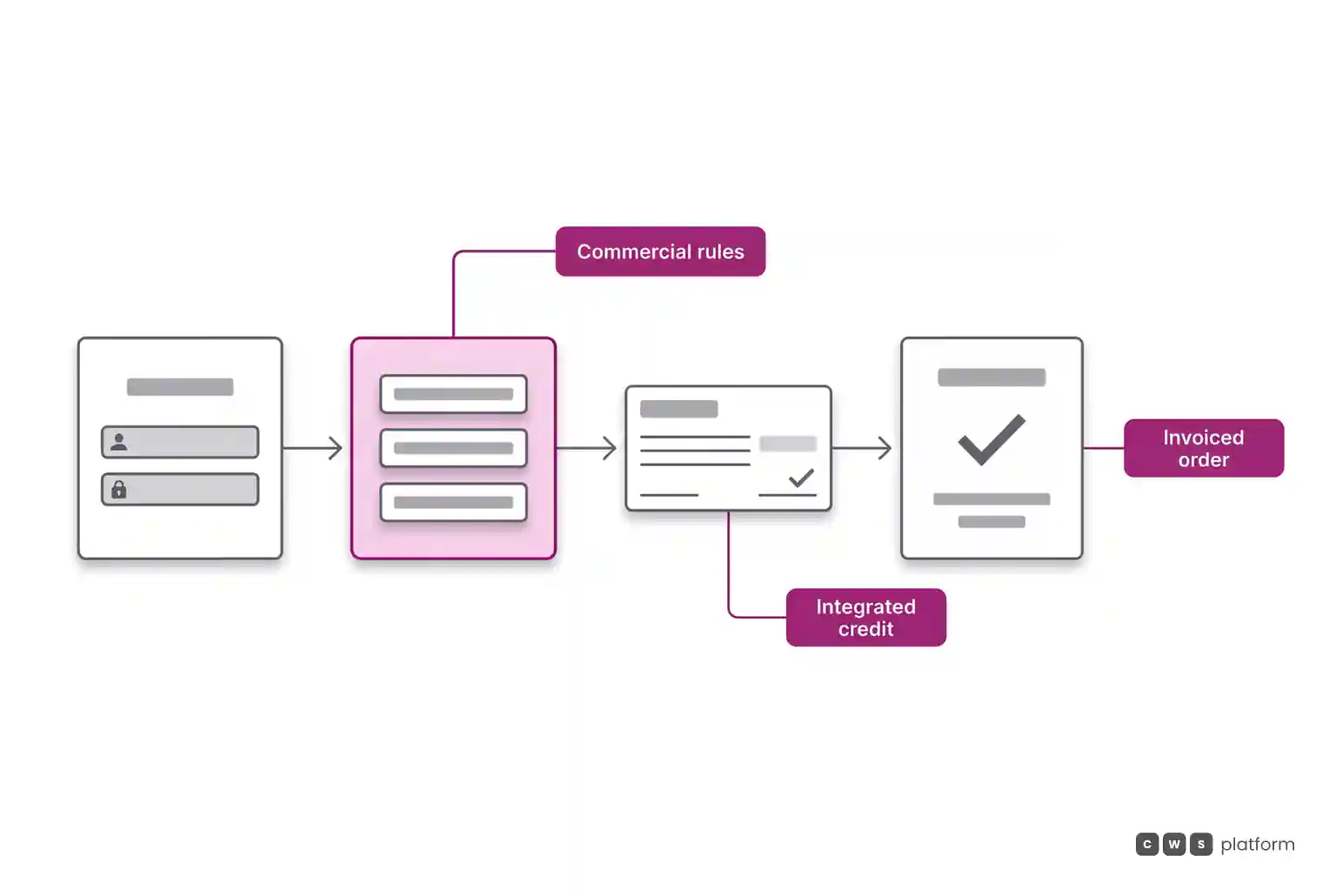
Trade credit is a native payment method, not a disconnected offline approval. When credit limits and payment terms are embedded directly into checkout, buyers can transact precisely when they need product, not days later when accounting replies. This fundamental design is what separates a high-converting wholesale portal from order-taking systems that generate quotes that never ship.
Reordering must be faster than calling an inside rep. Saved carts, SKU and part-number search, and bulk order uploads eliminate friction from replenishment without requiring human intervention.
The sales rep becomes the champion of the channel, not its victim. Sales reps guide accounts to the digital portal and step in to handle complex pricing and custom bids within the same workflow. Without rep alignment, the digital channel fights against internal incentives and fails. We dive into this approach in our guide on two-phase digital commerce adoption.
Account bases must be segmented by purchasing behavior, not just total spend. Customers who place daily replenishment orders, procurement teams that price-shop before issuing POs, and emergency spot-buyers each require different interventions from your sales team.
CWS Platform was built around these operational fundamentals: every authorized buyer sees their specific pricing tier and available credit line, while warehouse inventory, tax rules, and credit limits are validated simultaneously before the order routes to fulfillment. When custom negotiation is required, reps can collaborate inside the exact same cart. Learn how this operates on our B2B ecommerce for wholesale distributors page.
Next Steps
Segment your existing accounts into three buckets: accounts that purchased within the last 30 days, accounts with transactions between 31 and 90 days ago, and accounts inactive for more than 90 days. For each segment, calculate how many orders could have been submitted by the buyers themselves had their custom commercial terms been fully accessible online. That figure represents the real size of your revenue leakage.
Frequently Asked Questions
What is wholesale account activation?
Account activation is the percentage of total commercial accounts in your database that placed at least one order within a given period, typically monthly. It measures overall account engagement and purchasing breadth rather than gross revenue volume. If an account base has a 40% monthly activation rate, 60% of existing accounts transacted zero dollars during that window.
How can wholesale distributors increase account activation without adding sales headcount?
By removing replenishment ordering from the sales team's daily workload. When commercial accounts can self-serve using their assigned pricing tiers, credit lines, and payment terms, order frequency is no longer limited by how many outbound calls an inside sales team can complete each day.
Does a B2B ecommerce portal replace wholesale sales reps?
No. A self-service portal handles repetitive restock orders, freeing sales professionals to concentrate on field prospecting, relationship building, and complex custom bids. Successful distributors incentivize their reps to onboard accounts directly onto the digital platform.
How do you automate wholesale orders with complex credit lines and multi-warehouse inventory?
By integrating credit checks and inventory allocation directly into checkout rather than treating them as back-office validation steps. An order is finalized only after pricing rules, regional sales tax, credit availability, and line-item inventory are verified together, preventing unfulfillable orders from hitting the warehouse floor.
What is the most effective B2B ecommerce platform for wholesale distributors?
A platform that natively supports customer-specific contract pricing, net payment terms, location-based tax calculations, and large orders with hundreds of SKUs without requiring extensive custom development for every operational workflow. A standard retail storefront without deep wholesale business logic cannot solve this bottleneck.
About This Publication
The operational data referenced above is from Imdepa, a CWS Platform customer, shared with permission.
Brands mentioned in this article

- Gartner
- McKinsey & Company
Trademarks and logos belong to their respective owners. Mention does not imply partnership or endorsement.
"responsive, technically engaged, and willing to work through complex commercial rules (negotiated pricing, credit, customer-specific conditions) rather than pushing generic answers"
Want to see this in your operation?
Real B2B operations already run on it.