What It Costs to Grow: The License Tied to Volume Sold in SAP, Salesforce, and Adobe
What the public documentation records about licensing by GMV and by orders, and how CWS Platform charges.

Growing in sales is the goal of any B2B channel. The question the CFO and the CEO need to ask before signing the platform contract is a different one: when the channel grows, does the license grow with it? In three of the best-known commerce platforms on the market, the public documentation shows that it does, each with its own yardstick.
This text gathers what the vendors themselves publish about license measurement in SAP Commerce Cloud, Salesforce B2B Commerce, and Adobe Commerce, and describes how CWS Platform charges. Every fact about the three comes from their public documents, with the original excerpt and the address next to it.
What each vendor publishes about license measurement
The SAP Commerce Cloud license terms record two points:
- limitation recorded in the vendor's documentation on March 1, 2026: the GMV-based license is not reduced by returns, refunds, or cancellations ("will not reduce the GMV amount", https://assets.cdn.sap.com/agreements/product-use-and-support-terms/cls/en/sap-commerce-cloud-supplement-english-v3-2026.pdf).
- limitation recorded in the vendor's documentation on March 1, 2026: memory and database have a ceiling per GMV or order tier, and three consecutive months above it require buying scalability add-ons or the next tier ("SAP will require the Customer to purchase", https://assets.cdn.sap.com/agreements/product-use-and-support-terms/cls/en/sap-commerce-cloud-supplement-english-v3-2026.pdf).
Salesforce's pricing page for B2B Commerce records three:
- limitation recorded in the vendor's documentation on July 1, 2026: the B2B Commerce license is charged as a percentage of GMV ("We take a percentage of Gross Merchandise Value (GMV) based on commerce functionality needed.", https://www.salesforce.com/commerce/b2b-ecommerce/pricing/).
- limitation recorded in the vendor's documentation on July 1, 2026: orders from other channels or third-party systems require purchasing Order Management separately ("For orders taken on other channels or integrated from any other third-party system, you will need to purchase Salesforce Order Management standalone.", https://www.salesforce.com/commerce/b2b-ecommerce/pricing/).
- limitation recorded in the vendor's documentation on July 1, 2026: the Premier support plan costs 30% of net license fees ("30% of net license fees", https://www.salesforce.com/commerce/b2b-ecommerce/pricing/).
The Adobe Commerce on Cloud product description records how the order is counted:
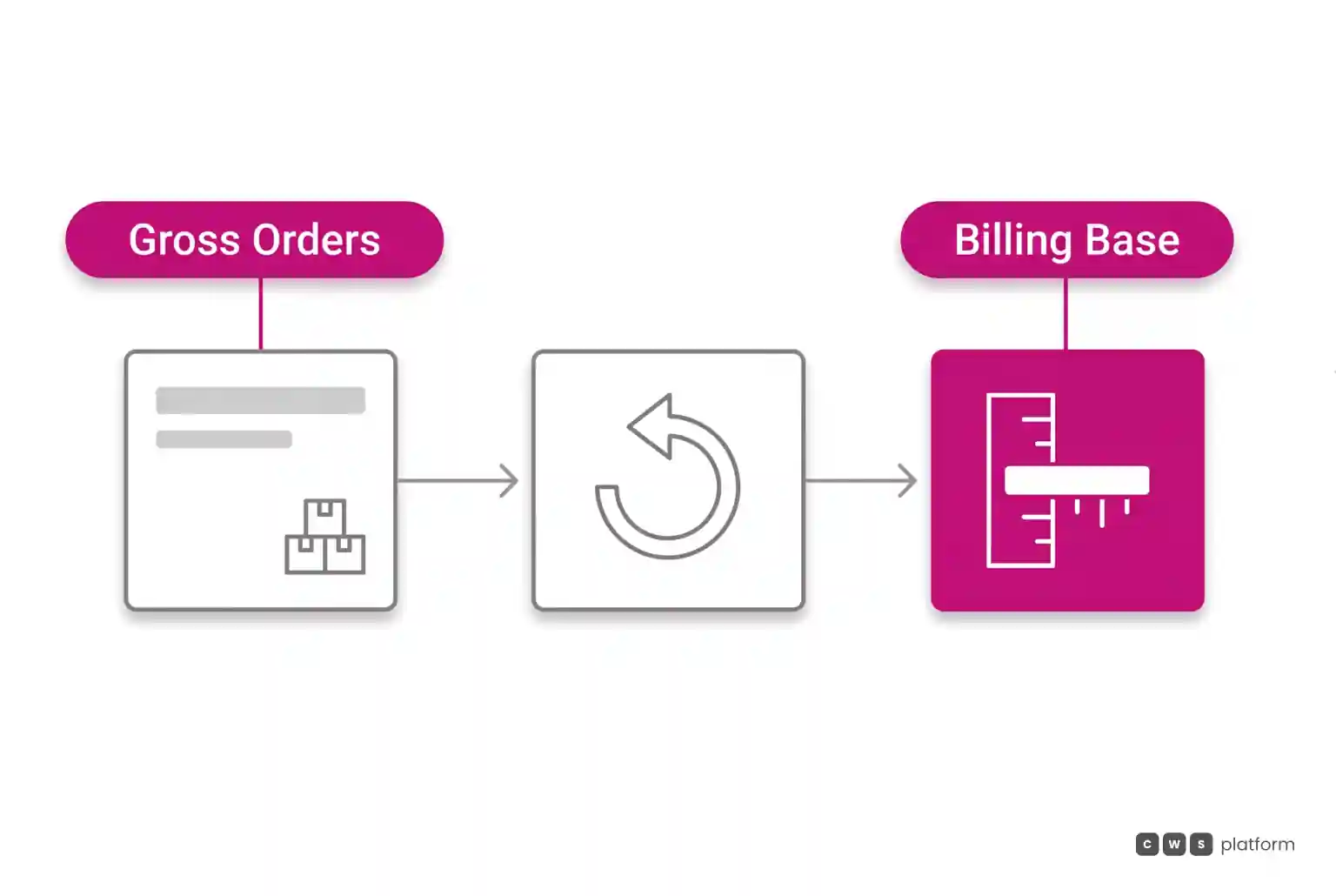
- limitation recorded in the vendor's documentation on April 30, 2026: every accepted order counts as a transaction, even if it is later refunded, returned, or charged back ("even if such order is later subject to a refund, return, chargeback", https://helpx.adobe.com/legal/product-descriptions/adobe-commerce-on-cloud.html).
The three texts have something in common: the license yardstick is the volume that goes through the channel, measured in value sold or in orders.
How CWS Platform charges
On CWS Platform, billing is a platform and integration license, with no percentage on sales or on GMV. The volume sold does not enter the calculation base.
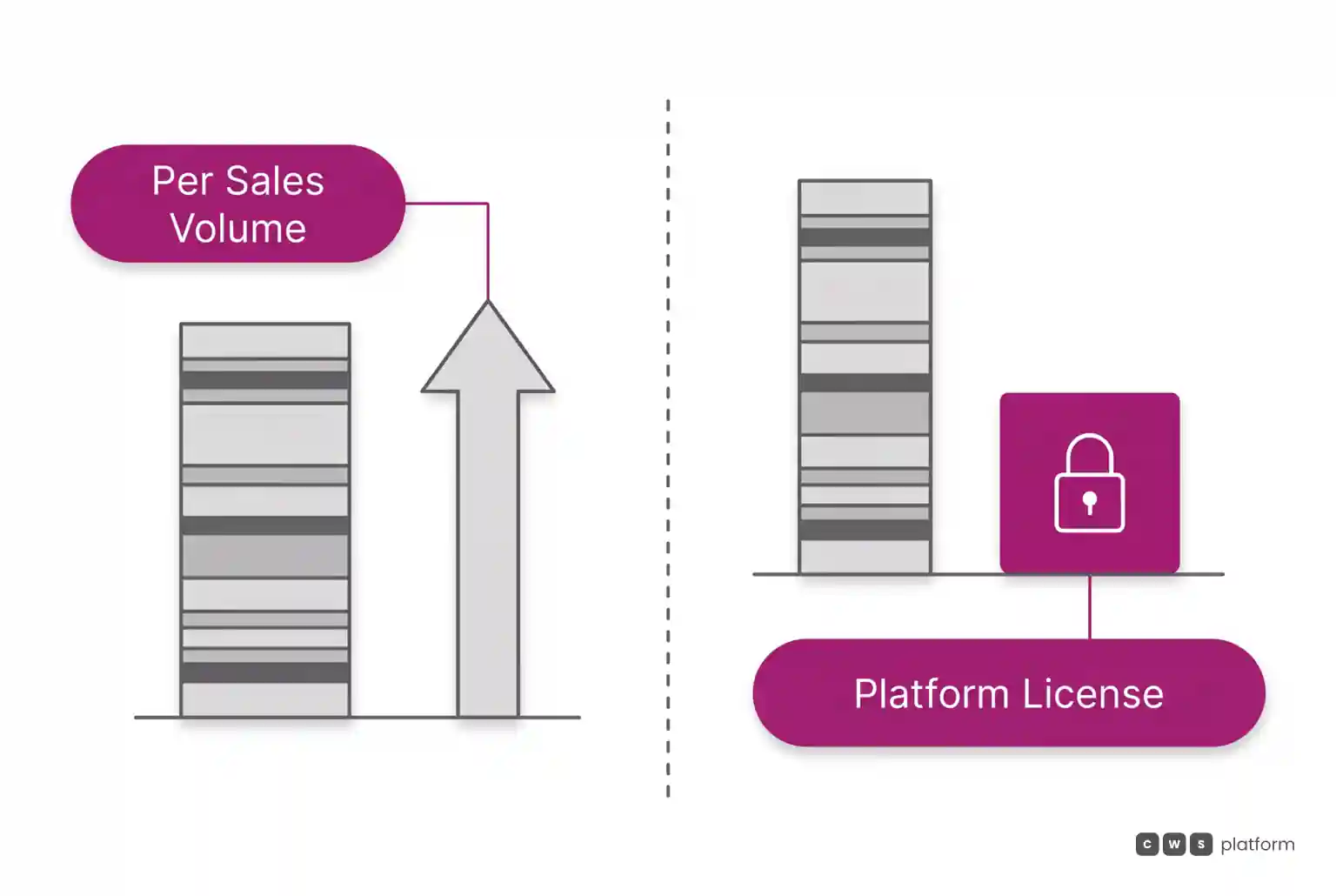
In marketplace operations there is a percentage in the payment split, and it is the marketplace owner's commission. It is the owner who chooses how to charge sellers and which payment methods to use; CWS charges only the platform license.
| question | what the vendors publish | CWS Platform |
|---|---|---|
| What the license yardstick is | Value sold (GMV) or number of orders, depending on the vendor. | Platform and integration license, with no percentage on sales. |
| Whether a returned order leaves the count | At SAP, returns and cancellations do not reduce GMV; at Adobe, the order counts even if it is refunded or returned. | The volume sold is not a calculation base for the license. |
| An order from another channel | At Salesforce, orders from other channels call for purchasing Order Management separately. | The license is not measured by order. |
What to ask before signing
The question left for whoever decides is not which model is the right one, but which of them your budget is able to project. It is worth taking four questions to any vendor: what the license measurement unit is; whether returns, cancellations, and chargebacks leave that measurement; what happens when the operation goes past the contracted tier; and what is charged separately, such as support and management of orders from other channels.
If your operation doubles in volume in three years, how much of the software line doubles with it?
When it makes sense to stay in the SAP, Salesforce, or Adobe ecosystem
Nothing above is, by itself, a reason to change platforms. There are scenarios in which staying in the ecosystem is the right decision.
A company already standardized on SAP. When the organization operates under global corporate guidelines and contracts already signed with the vendor, the edition connected to the back end synchronizes master data and invoices in a structured way, on the clean core strategy.
A commercial operation built on Salesforce. When pipeline, territories, and revenue splitting among teams already live in Sales Cloud, keeping commerce in the same ecosystem preserves that design.
A purchasing structure delegated to the customer, on Adobe. When the buyer company needs to manage its own divisions, users, and purchasing roles, the company accounts of Adobe Commerce resolve this natively.
Where to go from here
If your question is still which architecture fits your operation, and not which vendor to choose, the path is the seven questions that separate B2B commerce architectures.
Brands mentioned in this article

- SAP Commerce Cloud
- Salesforce
- Adobe Commerce
Trademarks and logos belong to their respective owners. Mention does not imply partnership or endorsement.
"responsive, technically engaged, and willing to work through complex commercial rules (negotiated pricing, credit, customer-specific conditions) rather than pushing generic answers"
Want to see this in your operation?
Real B2B operations already run on it.