Cost Per Order in Three Years: Salesforce vs. CWS Platform
An architectural comparison from the CFO's perspective to evaluate margin scalability, predictable TCO, and business rule orchestration.

Editorial note: Architectural comparison between Salesforce and CWS Platform, written for financial leaders. Every fact regarding Salesforce comes from its public documentation, with links provided.
In executive financial reviews, assessing an enterprise sales platform rarely ends with the initial software license. A CFO must forecast how the underlying cost structure will respond as transaction volumes scale: will the marginal cost per order decrease over time, or will each layer of pricing complexity, state tax variations, and multi-warehouse routing demand ongoing development and professional services?
Architectural choices determine whether digital channel expansion delivers operating leverage or merely shifts order desk friction into external systems integrator billable hours and brittle custom integrations. In complex sales models, the balance between subscription licensing and ongoing systems integration determines the medium-term sustainability of the investment.
When your commercial model requires handling orders across negotiated pricing agreements, trade credit terms, and regionalized fulfillment nodes, how your software handles business rules directly impacts transaction-level net margin.
What Salesforce Solves Well
Salesforce provides a robust ecosystem for global enterprises requiring unified corporate relationship management. Through Sales Cloud, its architecture structures enterprise pipelines, managing leads, accounts, revenue splits across territories, and multi-currency sales forecasting across large organizations.
Within digital commerce, Commerce Cloud enables B2B and D2C stores to operate on a shared Salesforce data model. It allows organizations to build customizable storefronts via Experience Builder and configure product catalogs using asynchronous batch imports or Data Loader. This provides a unified foundation for enterprises centralizing direct-to-consumer and corporate brand governance.
The platform is complemented by developer tooling such as Agentforce, which provides Agent Script, CLI tooling, and SDKs in languages like Python to orchestrate programmatic agent workflows via API. Additionally, Data 360 unifies enterprise data across Data Model Objects to enable event-driven automations at enterprise scale.
Where the Architectures Diverge
The fundamental architectural divergence lies in where commercial rules are processed. In CRM platforms extended into commerce, customizing checkout workflows and regional tax logic often relies on custom-developed components or third-party web calls, as enterprise B2B storefronts frequently require custom checkouts built by implementation partners.
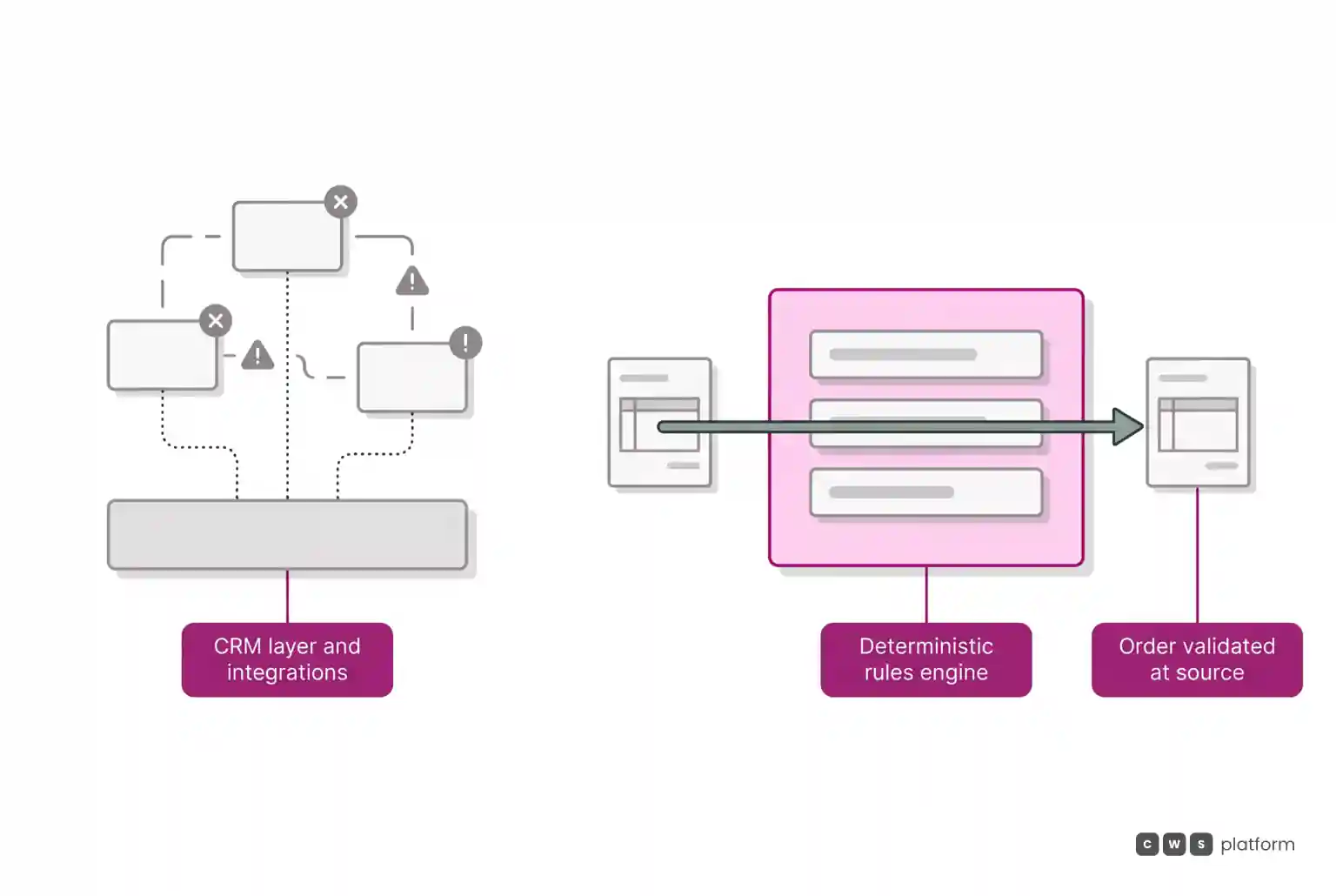
When B2B pricing relies on multi-layered variables evaluated at checkout, such as inventory stocking location, origin-destination sales tax, and customer-specific credit lines, maintaining point-to-point integrations introduces technical overhead.
When transactions require real-time validation of trade credit, localized inventory, and discount approval thresholds without slow API calls, the commerce layer must evaluate business rules natively. As noted in public issue trackers, edge cases in complex commercial terms can introduce operational hurdles.
Salesforce publicly tracks such cases in its known issues portal (issue opened and updated September 24, 2026): "Fixed-price promotion increases Total instead of the discounted price for products with a fractional step quantity" (https://help.salesforce.com/s/issue?id=a02g700000AY1NJAA1).
Salesforce's pricing page records another point that enters this math:
- limitation recorded in the vendor's documentation on July 1, 2026: orders from other channels or third-party systems require purchasing Order Management separately; the Premier support plan costs 30% of net license fees ("For orders taken on other channels or integrated from any other third-party system, you will need to purchase Salesforce Order Management standalone.", "30% of net license fees", https://www.salesforce.com/commerce/b2b-ecommerce/pricing/).
| Architectural Decision | Salesforce (Documented Model) | CWS Platform |
|---|---|---|
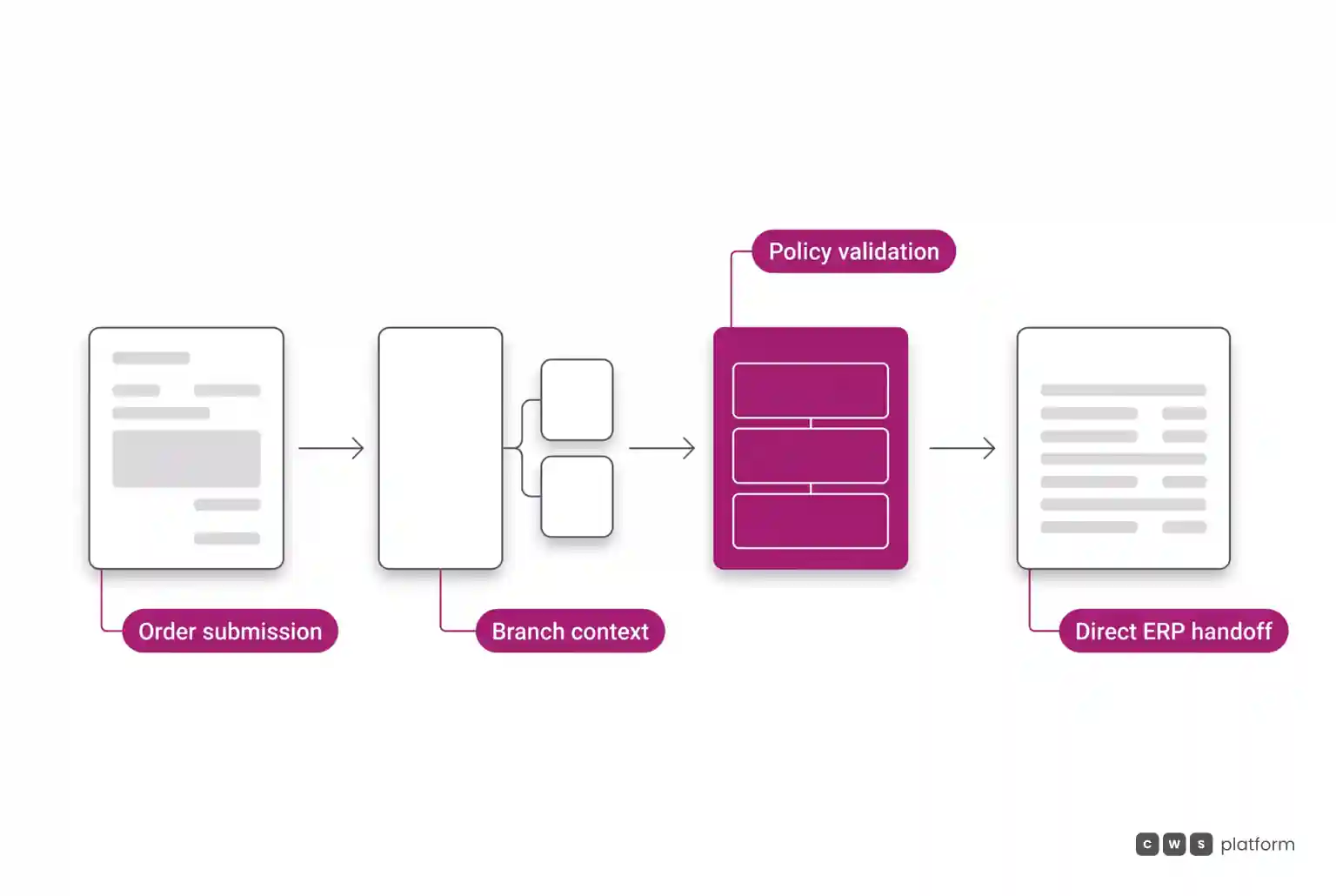
| Where commercial policy executes | Configured across CRM objects, checkout extensions, and custom integration layers. | Runs natively inside the Commerce Rules Engine (CDL Workspace) using deterministic business parameters. |
| Inventory origin and tax structure | Manages inventory and catalogs in unified objects shared across B2B and D2C stores. | Configures each distribution branch as an isolated container for catalog, tax, and price lists. |
| B2B order lifecycle governance | Orchestrates sales through CRM opportunity objects and custom checkout components. | Enforces strict transitions via Order Management System (OMS / Seller Center) locks requiring invoice and shipping data. |
| Buyer and sales rep interactions | Separates CRM opportunity pipelines from buyer navigation within standalone portals. | Unifies buyer and rep within the same order via the Assisted Selling Platform (Sales Hub) with full audit trails. |
The core financial decision is not interface polish, but where commercial constraints are processed and what it costs to update business rules without triggering heavy ERP customization.
Operational Impact Through a CFO Lens
Evaluating process costs requires identifying hidden transaction friction. According to APQC (American Productivity & Quality Center), 2025, the median total cost to manage sales orders stands at $8.48 per order for manual operations. Through digital ordering, APQC (American Productivity & Quality Center), 2025 notes that the median cost per order received electronically drops to $4.00.
Lowering baseline processing costs is critical when managing lower-margin accounts. Operations leaders recognize this friction: "On small replacement orders, the administrative effort to quote, enter, and invoice is identical to large orders. Sales desks naturally prioritize high-volume accounts, pushing smaller buyers to competitors." Shifting complex configurations to self-service helps preserve gross margins on small orders without requiring manual intervention.
This operational drag becomes more pronounced when AI capabilities are implemented without a deterministic foundation. A study by McKinsey & Company (QuantumBlack), 2026 found that roughly 20% of respondents identified operational AI costs, including API tokens, as a material constraint on enterprise AI expansion. Without foundational services resolving inventory and contract pricing deterministically, simple product inquiries become costly model inference calls.
Similarly, research from Gartner, 2024 revealed that over 90% of CIOs report cost containment limits their ability to capture enterprise value from AI. Embedding core business logic inside the commerce engine prevents query costs from compounding over time, avoiding recurring ERP customization cycles.
Common operational challenges and their architectural solutions:
| Operational Challenge | Root Cause | Architectural Solution |
|---|---|---|
| "Customer-specific contract pricing cannot be reflected accurately in our customer portal" | Negotiated pricing dynamically shifts by client account, fulfillment location, volume tiers, and local tax schedules, exceeding standard digital catalog attributes. | Resolves contextual pricing dynamically by shipping origin, buyer profile, and tax rules at runtime, maintaining contract accuracy without manual intervention. |
| "Buyers abandon checkout due to lack of trade credit terms" | Corporate procurement workflows require invoicing terms, purchase orders, and accounts receivable credit verification that retail gateways do not support. | Supports net payment terms, procurement purchasing accounts, and split payments governed directly by policy rules. |
| "Low-volume transactions consume too much overhead to process profitably" | Routine reorders demand identical quoting, validation, and manual data-entry cycles as large purchases, reducing margins. | Deploys self-service ordering backed by regionalized pricing rules that flow directly into fulfillment without ERP customization. |
| "Every update to our sales policy turns into an extensive consulting engagement" | Business rules reside in custom-coded checkout extensions rather than native platform configurations, requiring external engineering for simple pricing updates. | Treats commercial rules as native parameters processed within the engine, applying changes across sales channels without integration overhead. |
When to Choose Salesforce
Salesforce is well-suited for organizations focused on global CRM consolidation, combined enterprise retail operations, and broad ecosystem integration:
Enterprise CRM consolidation and corporate pipeline tracking. Best suited for organizations where the core strategic priority is managing multi-currency global accounts, territory revenue splits, and large, distributed sales teams. Sales Cloud provides comprehensive tools for revenue scheduling, Seller Home visibility, and pipeline cadence tracking.
Shared B2B and direct-to-consumer storefronts on one platform. Ideal when an organization maintains both business-to-business and direct-to-consumer stores that share a single data model and corporate asset directory. Commerce Cloud supports page customization via Experience Builder on unified back-end infrastructure.
Custom programmatic agent frameworks. Well-suited for engineering teams focused on building custom agentic workflows using developer-centric SDKs, command-line interfaces, and programmatic scripts. Agentforce provides dedicated tooling to orchestrate custom logic via enterprise APIs.
When CWS Platform Is the Right Strategic Fit
CWS Platform is designed for businesses focused on lowering marginal transaction costs in complex sales environments, removing order friction, and avoiding transaction-based revenue fees:
Multi-facility fulfillment and regional commercial autonomy. Selected when distribution hubs or regional warehouses require distinct catalogs, localized inventory, specific tax profiles, and regional price lists under centralized oversight. Each warehouse acts as a native operational container, maintaining localized contracts without requiring complex ERP customization.
Native B2B trade credit and multi-method payments. Designed for companies whose cash cycles depend on terms invoicing, commercial lines of credit, and combined payment methods on a single transaction. The checkout workflow manages net terms, purchasing cards, and corporate credit within native business rules before order submission.
Collaborative rep-and-buyer order drafting. Built for operations where sales reps and procurement buyers co-author transactions. Representatives can configure draft orders, select fulfillment sources, and hand off a verified checkout link to the customer, retaining a clear audit trail across both parties.
Headless commerce without transaction-based platform fees. Selected by organizations seeking long-term operational cost stability, integrating via REST APIs and webhooks into legacy ERP and tax calculating backbones. The platform operates as a headless engine using a fixed software consumption model, without taking percentage cuts on processed sales revenue.
Where to Go Next
If you are determining which platform design aligns with your fulfillment and sales model, explore the seven questions that separate B2B commerce architectures.
If current operational friction is impacting your day-to-day sales, our guides on When Selling More Does Not Mean Earning More and When Catalogs Turn Into Chaos detail these trade-offs without product-specific jargon.
Related Articles
- Your ERP Is Not the Problem. What Governs It Is.
- ERP and B2B E-Commerce Integration: Why the ERP Was Never the Problem (and the Real Cost That Appears in Year Two)
- Deploying AI Without Replacing Your ERP
"responsive, technically engaged, and willing to work through complex commercial rules (negotiated pricing, credit, customer-specific conditions) rather than pushing generic answers"
Want to see this in your operation?
Real B2B operations already run on it.