How to Cut the Cost of Every Recurring Contract Order Without Losing Procurement Control
Adobe Commerce vs. CWS Platform in a B2B supplies marketplace: where contracted pricing, approvals, net-terms credit, and warehouse-level inventory should live so every reorder costs less than the last.
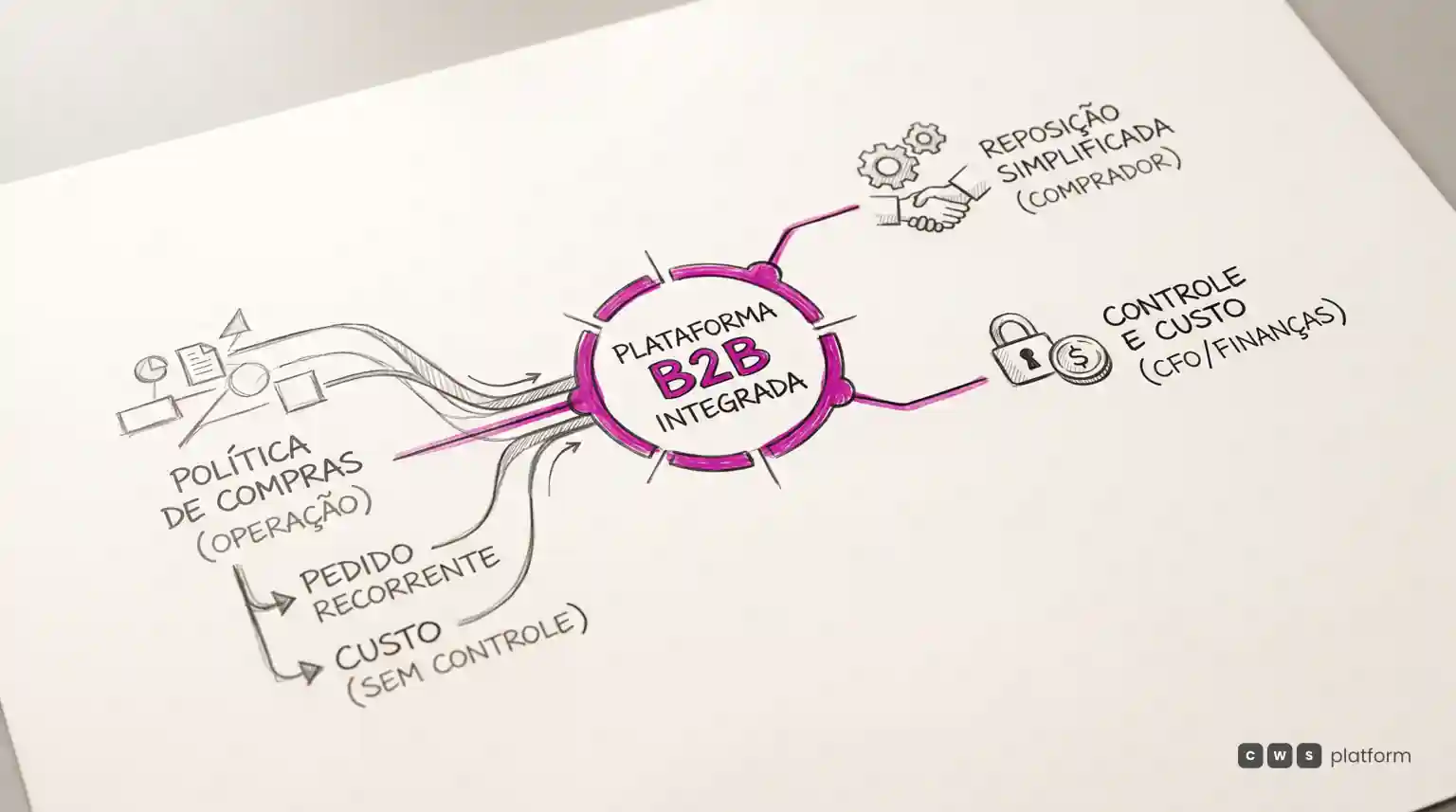
A B2B marketplace for supplies does not start with the storefront. It starts with an existing purchasing policy, contracts that define terms, and buyers who need to repeat replenishment orders without renegotiating the basics every time. Adobe Commerce enters this conversation as an architecture that brings B2B commerce capabilities, company accounts, shared catalogs, quotes, and ordering workflows together on one platform.
For the Commerce Director, the question is how to make repeat ordering simple for buyers without turning every exception into a side conversation. For the CFO, it is how to prevent pricing, lead times, and credit terms from being promised outside policy. For the CTO, it is how to decide where rules live, which system owns operational data, and how to keep the portal from becoming a delayed copy of the ERP.
The right benchmark is not the number of screens available. It is the cost of completing a recurring transaction with contracted pricing, the appropriate supplier, the correct shipping address, viable inventory, and payment that complies with commercial policy. When these elements come together only after the order is placed, the digital channel merely shifts work to customer service.
The scenario: contracted replenishment across a supplier and address network
Consider an operation that repeatedly purchases supply items. The buyer already knows what they consume, works with approved suppliers, has negotiated terms, and needs to route every replenishment order to a specific address or location. The order appears simple because demand is known, but execution involves a chain of checks that cannot depend on memory, spreadsheets, or post-order review.
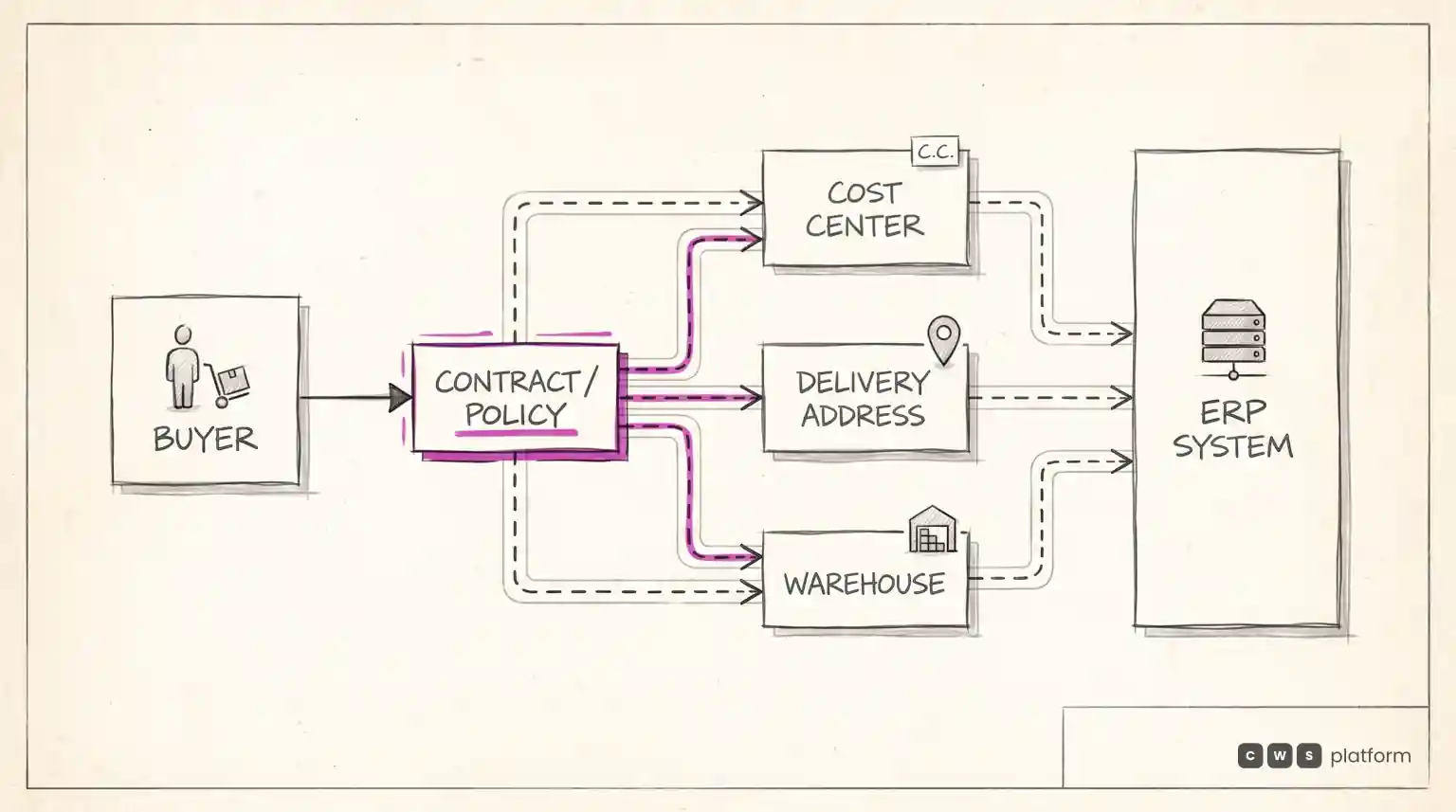
The challenge emerges when commercial policy varies by buyer, cost center, delivery location, contract, quantity, and availability. If the storefront displays only a generic price, it does not execute the existing policy. If it accepts only a payment method incompatible with corporate purchasing, it creates abandonment or sends the process back to the phone. If it promises aggregated inventory, it transfers the task of explaining why the selected location cannot fulfill the order to operations.
This scenario calls for a service and negotiation platform, not merely a self-service store. The marketplace becomes the result of digitizing decisions that already take place but previously depended on people consulting different systems. The channel creates value when a buyer can repeat an approved purchase without opening a path to an unauthorized condition.
The practical question is where each decision should live. Some information may come from the ERP, such as master data, contracts, or credit. The platform must still distribute those rules to buyers and sellers, apply restrictions at the time of the transaction, and return an order to the system of record that was already created in a way that fits the operation.
The six decisions this scenario requires
The decisions below define the architecture of a recurring replenishment channel. They are not isolated technology choices, because pricing, approvals, payment, inventory, catalog, and policy changes affect one another in the same order.
1. Where the agreed price lives. The contracted term must be retrieved or calculated based on the buyer’s context, quantity, and delivery operation. The critical point is preventing an offer displayed in the channel from contradicting a valid negotiation. When the rule is distributed without control, the sales team ends up correcting orders that the portal itself should have prevented.
2. Who applies the approval rule. Authorization cannot depend only on an approver’s memory or on message exchanges outside the transaction. The platform must recognize who is buying, which cost center the purchase belongs to, and which condition requires review. That way, the buyer knows whether they can complete the order, and the manager receives a decision that is already contextualized.
3. What the checkout accepts as payment. Checkout must reflect how companies buy, including when the commitment is invoiced on terms and subject to available credit. If checkout treats payment only as financial capture, it does not represent the commercial relationship that made the repeat purchase possible. The result is a digital journey that ends at the exact point of highest purchase intent.
4. What inventory truth is, and from which warehouse. Availability is not merely the existence of an item somewhere in the network. The answer must account for the warehouse that can fulfill the order, the requested address, the lead time, and the ability to split shipments when necessary. Without that view, the purchase appears complete to the user and becomes an exception for logistics and customer service.
5. Who creates and maintains the catalog. In supply purchasing, the description received from a supplier is rarely enough to make the choice obvious. Equivalencies, applications, attributes, and naming conventions must be governed so buyers can find the item they are allowed to order. A catalog without that maintenance shifts search back to people who know the operation from memory.
6. Who edits the rule when it changes, and how quickly. Purchasing policies change because of contracts, regions, credit risk, margin strategy, or operational changes. The question is whether the change can be configured with justification and an audit trail, or whether it requires a technical cycle that keeps the old rule in production. The more recurring the replenishment, the higher the cost of leaving an outdated policy in the channel.
What breaks today, in the words of the people operating it
The language from the field helps identify where the workflow actually breaks. Rather than assuming the problem is digital adoption, it is worth listening to the operational decision exposed by each statement.
“Every customer has their own price; nobody can put that on the website.” This statement reveals the decision about where the contracted term lives: publishing a price list is not enough; the channel must execute a rule that recognizes commercial context.
“The customer puts everything in the cart and drops out at checkout because there is no invoicing on terms.” This statement reveals the decision about what checkout accepts as a payment commitment. Abandonment does not necessarily result from the interface, but from the channel’s inability to complete a real B2B purchase.
“The portal shows inventory that no longer exists.” This statement reveals the decision about which availability is presented to the buyer. It points to the difference between displaying a generic balance and committing a warehouse, lead time, and fulfillment route that fit the order.
“I waste time looking for the right part; the fitment information is never complete.” This statement reveals the decision about who sustains catalog quality. When an item cannot be found by its attributes and equivalents, replenishment stops being repetitive and becomes a manual inquiry again.
How an enterprise suite builds this scenario: Adobe Commerce through its documented mechanisms
For B2B, Adobe documents company accounts that group buyers and allow user structures, roles, and permissions to be configured. Store administrators can make payment methods, pricing tiers, quote negotiation, and requisition lists available, while shared catalogs define custom product prices for companies or customer groups. The architecture places a meaningful portion of buyer organization and commercial terms within Commerce. Adobe Commerce B2B documentation
The documentation also describes a workflow in which authorized buyers initiate quotes from the cart and sellers can act through the administrative environment. Items, quantities, and discounts can be changed during negotiation, with messages exchanged between parties until an agreement is reached. When purchase orders are enabled for a company, orders are created in that format and can follow approval rules tied to the order and the role. Adobe Commerce B2B documentation
At the payment layer, the documented service centralizes payment and order data in the Commerce dashboard and provides test and production environments. Available methods depend on the region, and configuration can be organized by website in an architecture with more than one storefront. This mechanism centralizes payment-method integration within the commerce ecosystem. Payment Services overview
For discovery and personalization, Adobe documents the collection of storefront, back-office, and profile events, with those data sent to its experience network. The described integration can combine data from sources such as ERP, CRM, and point of sale into profiles and segments to guide campaigns, offers, content, and discovery. This design places emphasis on the experience and behavioral-data layer connected to commerce. Adobe Commerce personalization documentation
In a multi-destination architecture, Adobe organizes an instance into website, store, and store view levels. These levels can separate or share catalog, cart, checkout, shipping, payment, and presentation according to the selected configuration. It is a specific mechanism for operations that need to manage storefront contexts within a single instance. Websites, stores, and store views documentation
How CWS Platform builds it: purchasing policy as an executable transaction
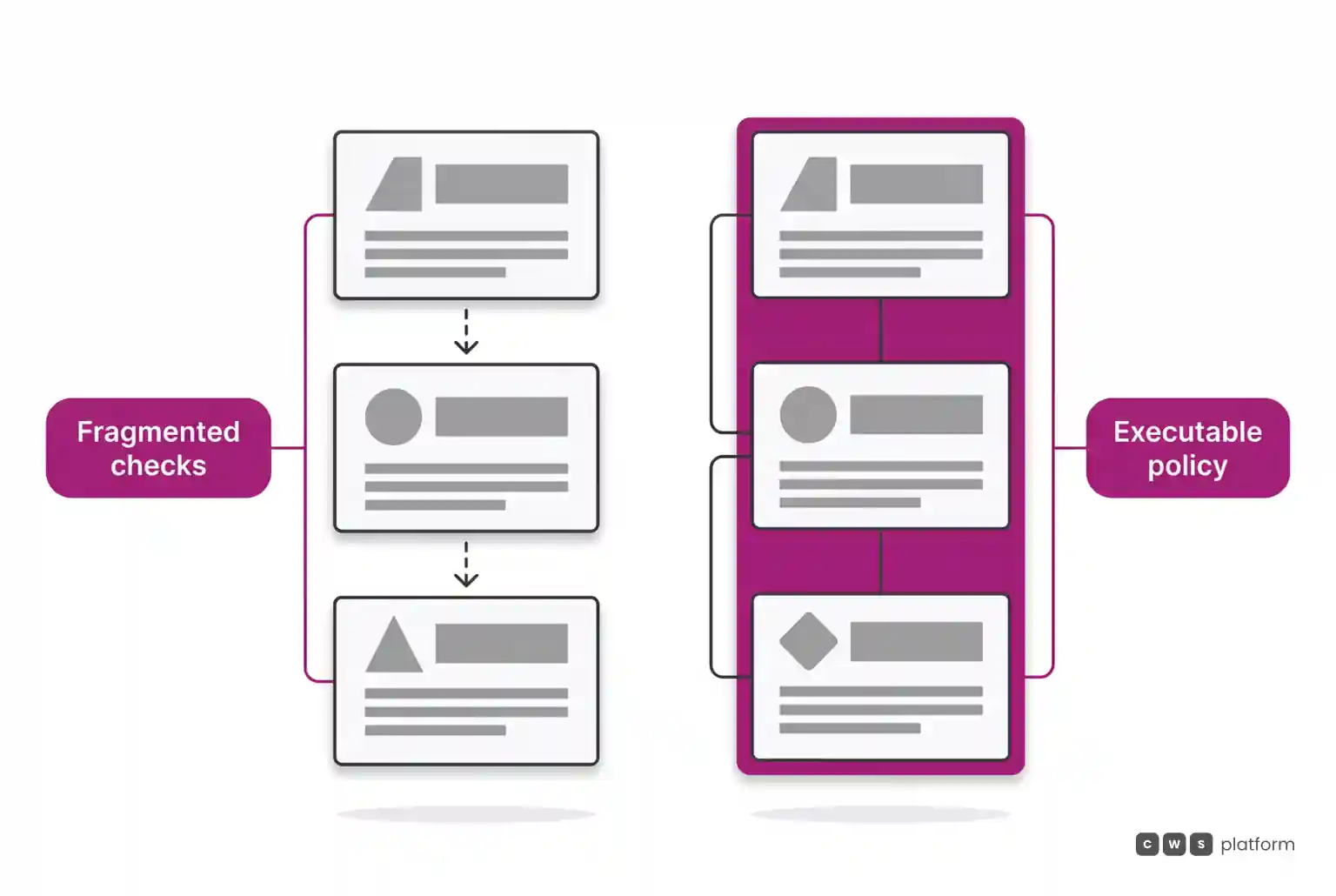
CWS begins with the premise that the marketplace is the result of digitizing the existing operation. In contract-based replenishment, the portal does not need to reinvent the negotiation at every visit. It needs to receive the buyer’s identity, identify the commercial context, present what can be purchased, and submit the order to the same rules that protect the operation outside the digital channel.
Contextual Pricing (Pricing Engine) supports pricing conditions by customer, region, and volume. Rather than reducing price to a static storefront field, the platform treats value as the outcome of a commercial rule. This matters to the Commerce Director because it brings a negotiated condition into self-service without giving the buyer access to the operational environment where the rule was originally assembled.
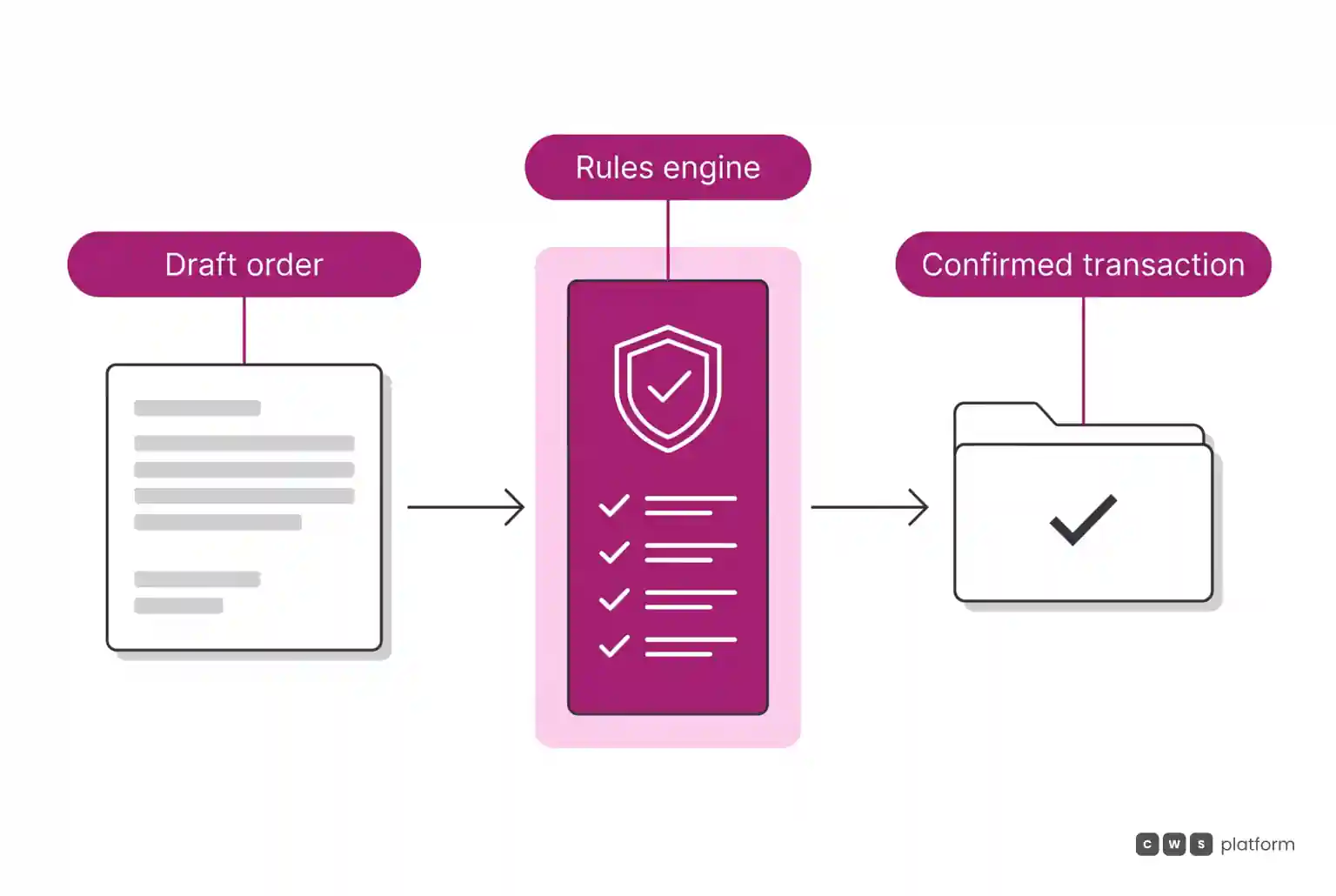
The Commerce Rules Engine (CDL Workspace) is the execution point for commercial policies. It applies deterministic rules for permissions, credit, tax compliance, restrictions, and approvals, and records justification and comments when a configuration changes. The CWS Platform has 11 modules, 6 AI Agents, and 1,029 configurable parameters. For the CFO, this moves control from manual post-order review to the point at which the transaction attempts to be created.
Credit-First B2B Checkout (Checkout & Payments) brings commercial review into checkout. The checkout can validate inventory, pricing, credit, and taxes in the same transaction, so buying on terms is treated as a business condition rather than an improvised adaptation of a retail payment. If a rule prevents completion, the order is never created as an inconsistent operational promise.
Distributed Inventory (Inventory Hub) adds visibility into physical inventory, logical inventory for controlled presales, and lead time by SKU and warehouse. This allows the response given to the buyer to account for the fulfillment location, rather than merely an aggregated balance. In a network of suppliers and addresses, availability becomes part of the commercial decision before the order moves to fulfillment.
Product Catalog & MDM (Catalog Engine) governs product data, SKUs, assemblies, and relationships between global and local information. The catalog enrichment agent can support improvements to data that make items easier to find and compare. For a supply operation, this reduces reliance on a service representative who knows how to interpret divergent supplier descriptions.
When a purchase requires conversation, the Assisted Selling Platform (Sales Hub) puts buyer and seller in a shared cart, with negotiation and service connected to commercial terms. The seller support agent can assist the service process, while the final decision remains subject to applicable policy. This flow is useful when repeat purchases fall outside the standard pattern, but it should not require every recurring order to go through human service.
After confirmation, the Order Management System (OMS / Seller Center) maintains the source of truth for order status between the platform and ERP. The operation tracks payments, taxes, tax documents, delivery, and tracking within the order lifecycle, and critical transitions depend on the conditions required for each stage. For the CTO, this continuity prevents the channel from simply capturing intent while leaving execution to a parallel chain of reviews.
The benchmark is transaction cost because contract-based replenishment scales only when every order requires less consultation, less correction, and less human intervention. The marketplace creates value by distributing the negotiation rule to buyers and sellers without turning them into ERP operators.
Where the architectures truly diverge
The architectures place different emphasis on this scenario. Adobe documents a B2B commerce foundation with company accounts, buyer structures, shared catalogs, quotes, and purchase orders. CWS concentrates its argument on transactional execution of commercial terms, credit, warehouse-level availability, and operational continuity of the order.
For contracted pricing, the issue is not choosing absolutely between data in the ERP or data in the portal. The ERP can remain the system of record for contracts and master data, while the platform distributes and applies the rule in the channel. Risk emerges when the storefront replicates values without recognizing the variables that make the condition valid.
For approvals, there is a distinction between structuring buyers by company and executing a contextual commercial policy within the transaction. At CWS, both happen in the same flow. On the buying side, an order placed by a buyer can wait for approval from a manager at the buyer's own company before it proceeds. On the selling side, discount authority by sales rep level and credit rules are applied before the transaction exists. This is governance at both ends, and it matters most when the operation has many buyers, many units, and different negotiated terms.
For payments, CWS treats credit on terms as a native condition of B2B checkout: 30, 60, or 90-day terms enter the transaction subject to the same rules that govern price and approval authority. The decision separates two needs, processing payment methods and approving and governing commercial credit, and CWS was designed for the second.
For catalog and discovery, CWS governs products and can enrich catalog information to reduce identification effort.
For multiple destinations, CWS organizes the ecosystem in three layers. The portal owner defines which inventories exist, who serves whom, and the general rules for finance, logistics, and payment. Stores, owned or third-party, operate within that freedom, and warehouses serve a store that has several stock locations. A store that takes part in more than one portal uses the same login and receives orders from all of them in the same OMS. The CTO should separate the need to isolate storefronts from the need to govern distinct commercial operations.
| decision | Adobe Commerce, through its documented mechanism | CWS Platform |
|---|---|---|
| Contracted pricing | Shared catalogs and pricing tiers by company or group. | Contextual pricing executed by customer, region, and volume. |
| Purchase approval | Purchase orders can follow rules by role and order. | Approval by the buyer's manager and seller approval authority, applied before the transaction. |
| Checkout payment | Service centralizes payments and orders in Commerce. | Credit on terms is a native condition of B2B checkout. |
| Inventory for replenishment | The material reviewed does not detail warehouse-level inventory in this flow. | Physical and logical availability, plus lead time, by SKU and warehouse. |
| Supplier catalog | Shared catalogs organize offering and pricing by company. | Governance of SKUs, assemblies, and global or local data. |
| Policy changes | B2B configurations are administered in the Commerce environment. | Configurable rule with justification and change comments. |
The decision should not begin with the question of which platform has more capabilities in the abstract. It should begin with which mechanism reduces the work required to complete a correct repeat purchase while keeping price, credit, inventory, and fulfillment under the same commercial policy.
When Adobe Commerce is the right choice in this scenario
There are scenarios in which Adobe’s documented architecture should be considered directly. They are specific and should not be reduced to a generic platform comparison.
Discovery driven by an experience layer and behavioral data. The choice makes sense when the project centers on content personalization, behavioral segments, discovery, and campaigns connected to an experience data platform. It also applies when the priority is exposing commerce data to assistants and external surfaces through mechanisms documented by Adobe.
Multiple storefronts with a native hierarchy. The choice makes sense when the primary problem is managing websites, stores, store views, domains, languages, and distinct presentations within the same instance. This requirement differs from separating pricing, credit, warehouse, and delivery policies.
Financial processing at the center of the decision. The choice makes sense when the priority is centralizing payment-method integration, payment operations, and financial management in the commerce environment. This scenario requires detailed validation of methods available by region, existing integrations, and required financial processes. CWS should enter the discussion when the focus is governing commercial credit and the B2B transaction.
Where to go next
If your question is still which architecture fits your operation, rather than which vendor to choose, the next step is the seven questions that separate B2B commerce architectures.
To deepen the diagnosis, continue with the pain-point pages on negotiated pricing in the portal, B2B checkout, inventory truth, and hard-to-search catalogs.
"responsive, technically engaged, and willing to work through complex commercial rules (negotiated pricing, credit, customer-specific conditions) rather than pushing generic answers"
Want to see this in your operation?
Real B2B operations already run on it.