Your digital channel is live, but the deal keeps slipping through the cracks
After going digital, the B2B distribution bottleneck moved from the channel to the governance of price, discount, and credit
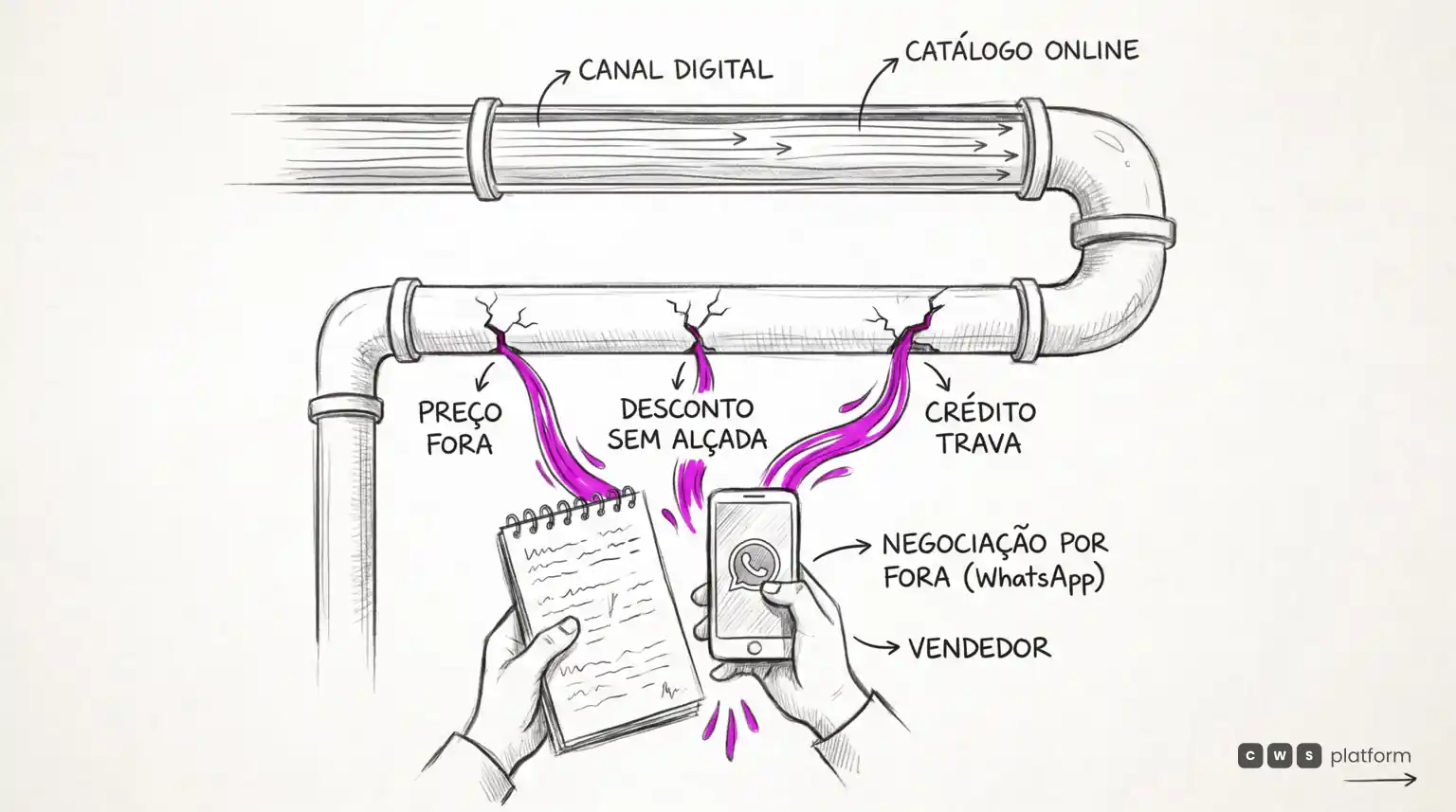
The digital channel is ready, but the negotiation keeps leaking out at the edges
You invested in the portal. The distributor has an online catalog, digital ordering, ERP integration. The channel exists and it works. And yet deals still close outside the customer's price list, discounts go through without the required approval, credit stalls the checkout at the worst possible moment, and reps keep negotiating over text messages and email, outside the system you paid for. Digitalization delivered what it promised, but the pain didn't go away: it moved.
TL;DR
- Once a distributor digitalizes, the bottleneck shifts from the lack of a channel to the lack of governance in the negotiation (a market pain articulated in outbound prospecting, August 2026).
- The signs are concrete: pricing outside the customer's list, discounts without the required approval level, credit stalling checkout, reps working around the portal.
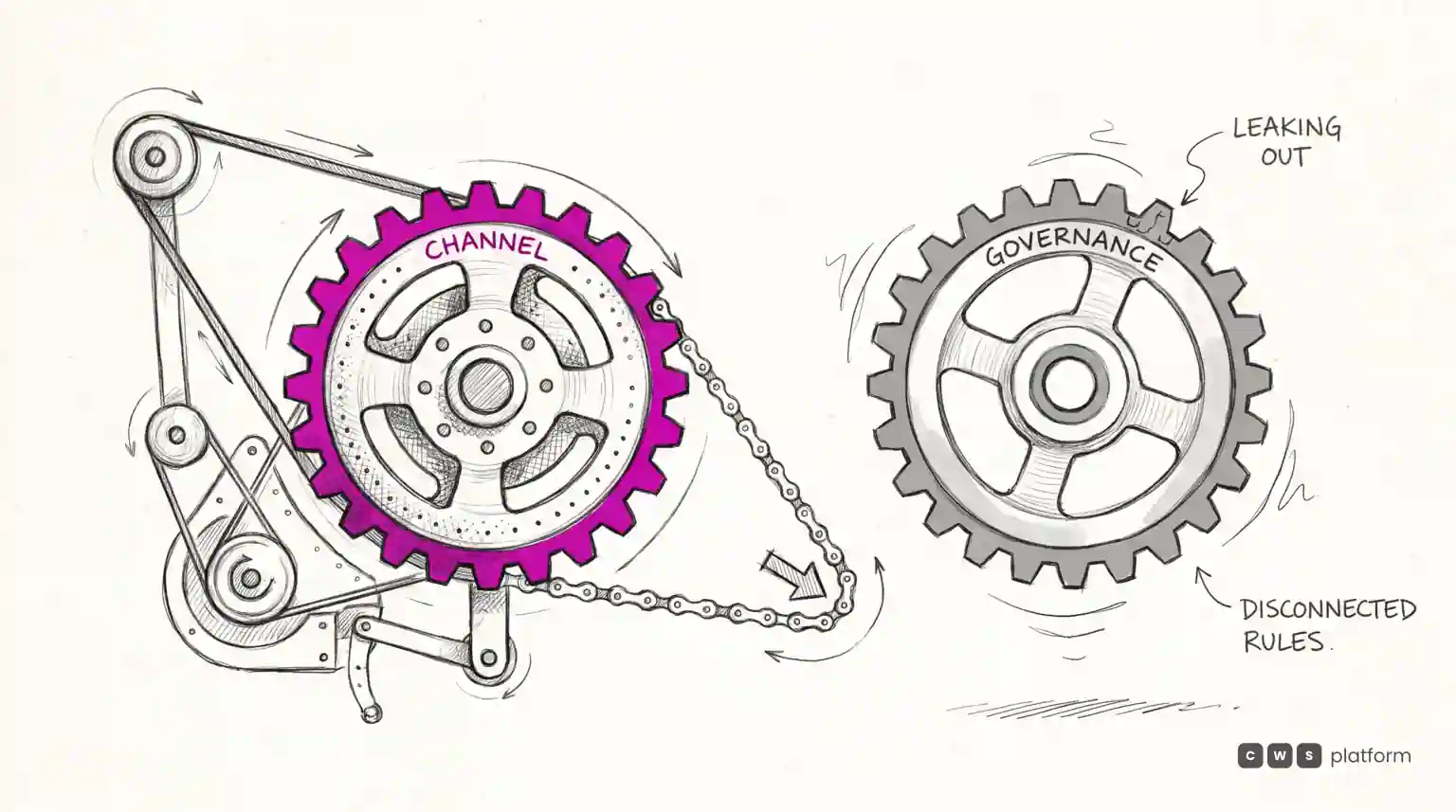
- A channel is not the same as control: a portal can record the order without governing the decisions that define margin and risk.
- The answer is not another channel, it's architecting the negotiation (pricing rules, approval thresholds, credit) inside the flow, reducing the cost of each transaction.
Why didn't the problem end when the channel was ready?
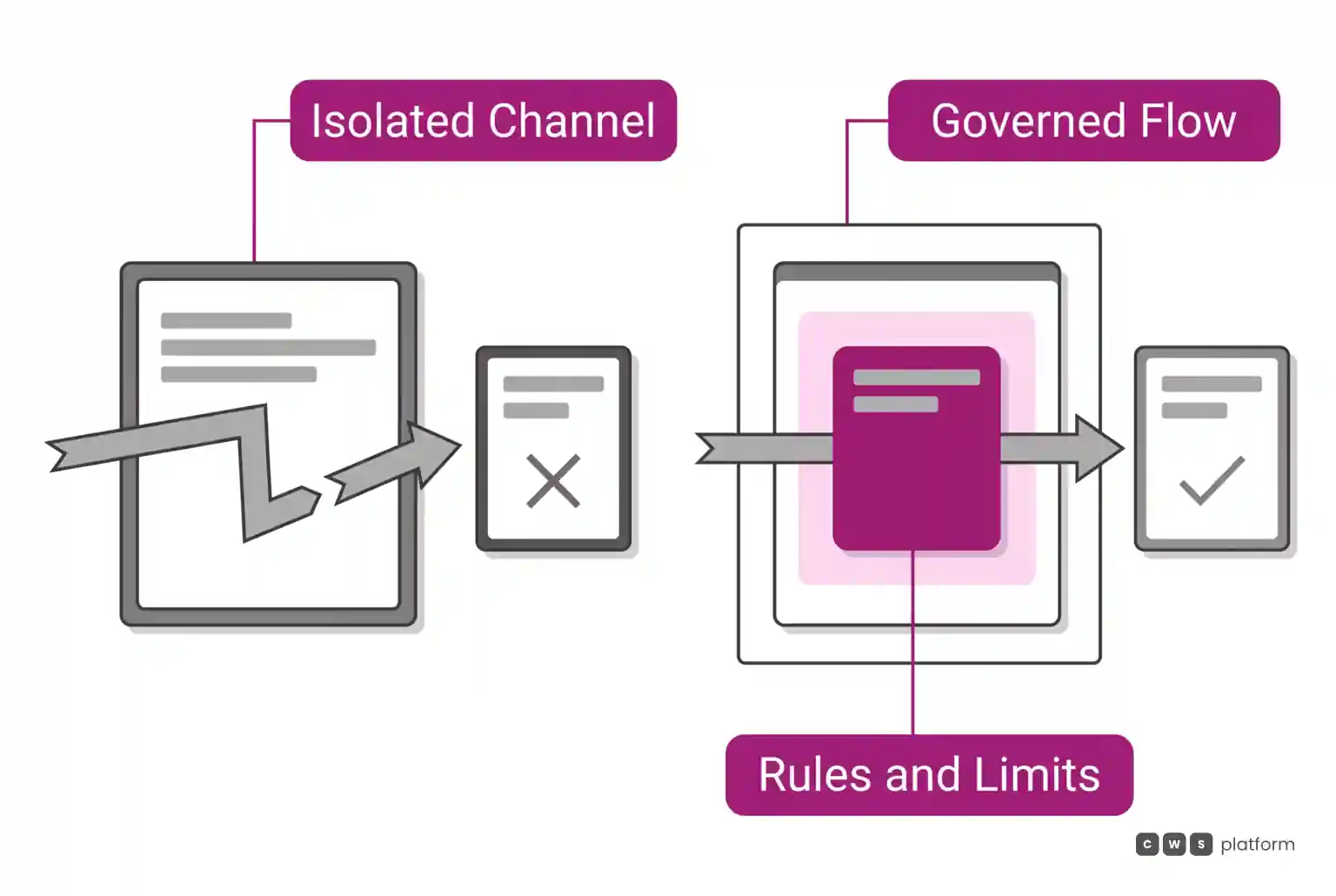
Because channel and governance solve different things. The channel answers "where does the customer buy." Governance answers "under what conditions can a sale close." Digitalizing the first without structuring the second creates an operation that looks modern on the surface and stays artisanal exactly where the money is decided.
The pattern reported by the sales team during outbound prospecting in August 2026 can be described without naming anyone precisely because it repeats from one distributor to the next. The signs are always the same four:
- Pricing outside the customer's price list: the portal accepts a price that doesn't match the policy for that specific buyer.
- Discounts without the required approval: someone granted a markdown that, under the company's own rules, would need sign-off from one level up.
- Credit stalling checkout: the risk review comes in late, at the wrong moment, and blocks a sale that was already negotiated.
- Reps working outside the portal: the real negotiation happens over chat, email and phone, and only the final result (sometimes) makes it back into the system.
Each of these signs is a leak. Not of technology, but of decision-making. The portal recorded the order, but it didn't govern the price, the approval or the credit that led to that order. The company knows what was sold and has lost control of how it was sold.
What "outside the portal" really costs
When a rep negotiates outside the system, the company loses more than traceability. It loses three measurable things.
It loses margin, because a discount without approval is margin given away without anyone accountable for the result having said yes. It loses risk predictability, because credit that stalls at checkout shows the risk policy isn't part of the flow; it shows up as an obstacle after the fact. And it loses its own negotiation DNA: the knowledge of how that customer buys, under what terms, with what history, stays in the rep's head and never becomes a company asset. The day the rep leaves, that commercial intelligence walks out the door too.
That's the point channel digitalization tends to miss. It treats a B2B sale like an off-the-shelf transaction, when in distribution a sale is a negotiation: customer-specific pricing, payment terms, credit review, and sometimes trade-offs and escalation. A channel that only accepts finished orders pushes all of that complexity outside itself, and it resurfaces in exactly the four signs of lost control.
A case that illustrates this
The same diagnosis shows up in a sector where the gap between channel and governance is even more visible. In agribusiness, low digital penetration is usually read as a lack of channels. The CWS archive points to a different reading: penetration is low less because channels are missing and more because the negotiation isn't governed. Structuring quotes, contextual pricing, credit and barter in a single integrated flow lowers transaction cost and frees the technical sales rep to act as an advisor instead of a spreadsheet-and-phone operator (case LI-966729, CWS archive).
The lesson holds for any distribution business: where the negotiation is complex, offering only the channel doesn't solve it. The decision has to be architected into the flow.
The Cost of Inaction
Leaving governance out has a cost that builds up quietly. It doesn't show up as a red line on the balance sheet; it shows up diluted: a few points of margin given away in discounts nobody approved, sales delayed by poorly positioned credit, rework to reconcile what was negotiated outside with what entered the system, and a growing dependence on specific people who carry the relationship in their memory.
The more the channel matures without governance, the more comfortable the parallel operation becomes. Reps get used to closing outside the portal because it's faster. The exception becomes routine. And the portal, which should be where the commercial operation happens, turns into a registry of orders already decided somewhere else. The digitalization investment stays on the books, but the return leaks out through the edge nobody is watching.
Principles for governing the negotiation, not just the channel
- Treat the portal as a place of decision, not just a record: price, approval and credit need to be resolved inside the flow, not afterward.
- Tie price to the customer's context: the right price list for that buyer should be the only one available to them, by design, not by rep discipline.
- Put approval before the discount, not after: if it requires approval, the system asks for it; it doesn't let it through to be reconciled later.
- Position credit at the start of the negotiation, not at checkout: risk assessed early doesn't block the sale, it shapes the quote.
- Turn negotiation DNA into a company asset: how each customer buys should live in the system, not in the head of whoever serves them.
FAQ
Was digitalizing the channel a mistake? No. The channel is a prerequisite. The point is that it solves where customers buy, not under what terms you sell. Governance is the next step, not a replacement.
Won't governance box in the sales rep? Quite the opposite. Clear pricing and approval rules take away the burden of the rep deciding alone what the company will approve. Reps negotiate with more confidence and less improvisation, within known limits.
How do I know I'm living this pain? If any of the four signs shows up in your operation (pricing outside the price list, discounts without approval, credit stalling checkout, sales closed outside the portal), the bottleneck has already moved from the channel to governance.
The architectural answer
Solving this doesn't call for another channel; it calls for treating negotiation as a governed part of the B2B commercial operation. That's what a governed B2B negotiation platform addresses: putting contextual pricing, discount approval thresholds and credit review inside the same flow where the order is placed, so the right decision is the natural path, not the disciplined exception. The practical effect is a lower transaction cost on every sale: less reconciliation, less margin given away without approval, less dependence on a parallel operation. The channel stops being a registry of orders already decided and goes back to being where the negotiation happens, with control.
Who already lives this
"Online store working perfectly in sync with the entire traditional commercial operation.", Paulo R., Digital Sales Coordinator, review on the GetApp portal (https://www.getapp.com/all-software/a/cws-platform/).
About this publication
The Cost of the Sale is CWS Platform's blog on B2B commercial operations and the transaction cost built into every negotiation. We write for the people who make decisions on margin, risk and sales productivity, with a focus on governance before automation.
Sources
- CWS Platform's own thesis on how the bottleneck moves from the channel to negotiation governance after digitalization (market pain articulated in outbound prospecting, August 2026).
- Archive case LI-966729, on digital penetration and negotiation governance in agribusiness.
- Public review by Paulo R. on the GetApp portal: https://www.getapp.com/all-software/a/cws-platform/
"responsive, technically engaged, and willing to work through complex commercial rules (negotiated pricing, credit, customer-specific conditions) rather than pushing generic answers"
Want to see this in your operation?
Real B2B operations already run on it.