How to Automate Wholesale Orders with Real-Time Credit and Inventory Rules
Stop accepting unfulfillable orders: validate customer terms, tax, and warehouse inventory before checkout.

"The order came in at ten, finance put it on hold at two, and the customer found out the next day." In wholesale distribution, this sequence is so common that many operations no longer see it as a flaw. Orders are accepted first and verified later: credit is reviewed after a commitment to the customer already exists, and inventory is confirmed only when warehouse picking begins.
Automating wholesale orders is not about making that broken workflow move faster. It is about flipping the sequence: validation happens before the order is created, leaving only true exceptions for human review.
Why wholesale orders stall after acceptance
Why are orders put on hold after being placed? Because credit limits and past-due invoices are only reviewed by the finance department in a queue completely separated from sales.
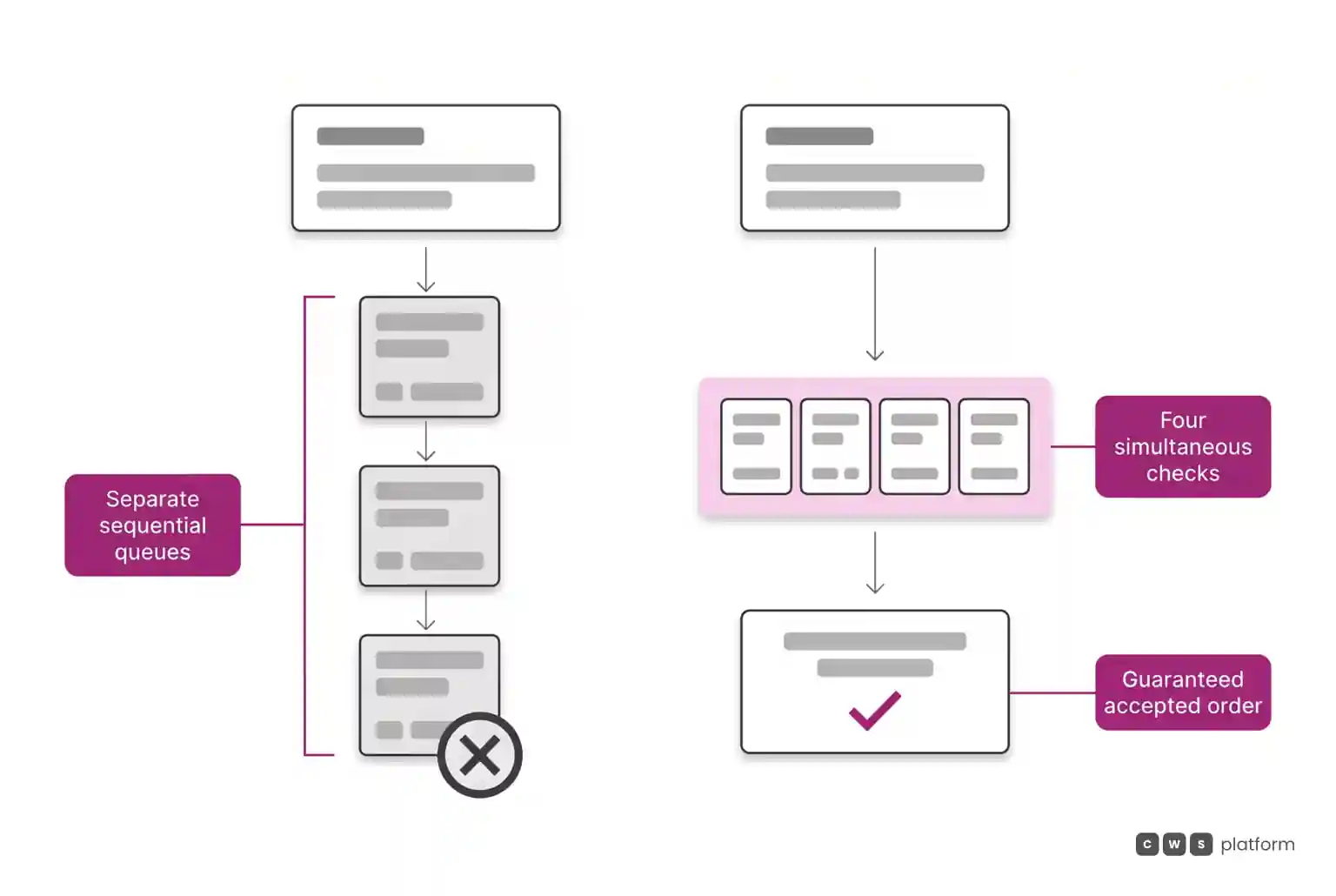
Why is credit in a separate queue? Because credit rules live inside the ERP or in a finance spreadsheet, and the ordering channel does not check those rules at checkout.
Why does inventory also fail? Because the order portal displays total company-wide inventory instead of available-to-promise inventory from the specific fulfillment center assigned to that account, factoring in units already reserved for other open orders.
Why has this not been solved? Because each validation check was automated in an operational silo: the ERP calculates taxes, finance reviews credit, and logistics verifies inventory. No system combines all four answers before saying yes to the customer.
The root cause: price, tax, credit, and inventory are decisions for a single order made across four separate moments. As long as they remain disconnected, every accepted order is an unverified promise. This is the exact pattern we described in B2B portals that accept orders that will never close and in the portal says in stock, the phone confirms it is not.
The cost of inaction
Every order that is accepted and subsequently placed on hold triggers, at minimum, a sales rep follow-up, a credit review by finance, and an order modification. A simple formula to calculate the monthly cost using your operation's numbers:
monthly cost = orders modified or blocked after acceptance × (rework minutes × per-minute labor cost of staff involved) + cancelled orders × average order value × margin
The second factor is usually the largest, and the least visible, because a customer who experiences two blocked orders will quietly split their purchasing with a competing distributor.
How to automate wholesale orders with credit and inventory rules
Validate all four answers simultaneously, before checkout acceptance. Customer-specific pricing, jurisdiction-specific sales tax, available trade credit, and stock at the servicing fulfillment center. If any check fails, the order cannot advance, and the buyer sees the reason immediately, not the following afternoon.
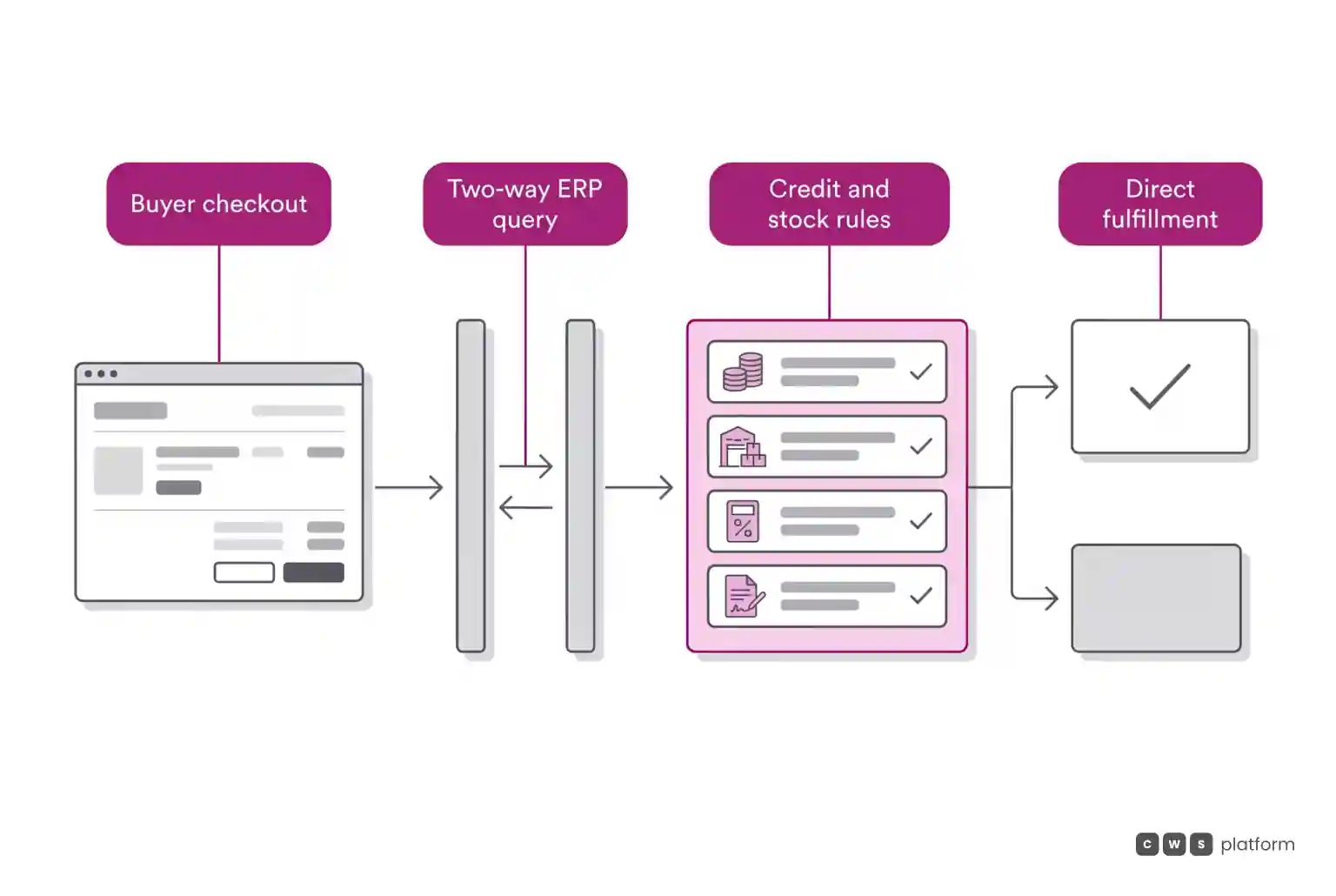
Treat trade credit as a native payment method. The buyer selects their approved payment terms (such as Net 30, Net 60, or Net 90) at checkout, just like choosing a credit card. The credit limit is verified and reserved in that exact moment. Finance shifts from manually approving routine orders to setting governance rules.
Validate stock against the correct fulfillment center. In multi-warehouse networks, the only inventory that matters is the available-to-promise balance at the warehouse fulfilling that specific customer, accounting for pending allocations. Aggregated inventory balances sell products you cannot deliver on schedule.
Automate the rule and route the exception. A discount exceeding a sales rep's tier limit, an overdue balance, or an out-of-stock SKU should not paralyze the entire transaction. The out-of-policy line item is routed directly to the authorized decision-maker with full context, while clean lines move forward. Clear governance on who approves what prevents automation from turning into a new operational bottleneck.
Integrate bi-directionally with the ERP. The sales channel reads credit, inventory, and tier pricing from the ERP and returns a clean, fully validated order ready for fulfillment. At Tracbel, a heavy equipment and parts distribution network with 40 branches serving 3,500 active accounts through digital channels in 2025, integration with SAP runs bi-directionally in real time, as detailed in the Tracbel case study.
What not to automate
Not every commercial decision should be removed from human oversight. Complex custom contract negotiations, credit underwriting for new commercial accounts, and term extensions for strategic enterprise clients still require human discretion. The difference is that requests now arrive fully structured, with complete margin and order context, rather than surfacing as an unexpected order hold after acceptance.
CWS Platform was engineered around this architecture: inventory, price, credit terms, and sales tax verified simultaneously before order submission, trade terms handled as a native checkout payment method, and every policy override logged with audit trails and business justification. See the complete distribution architecture on our B2B ecommerce for wholesale distributors page.
Next step
Export last month's orders that were modified, placed on hold, or cancelled after initial checkout and categorize the primary reason: pricing, taxes, credit limits, or inventory discrepancies. The distribution of those root causes will highlight exactly where your automation project should begin.
Frequently asked questions
How do you automate wholesale orders with credit and inventory rules?
By validating customer-specific pricing, local taxes, credit availability, and fulfillment center inventory simultaneously before order confirmation. The order only passes to fulfillment when all four validations clear, while exceptions route instantly to authorized managers.
What is credit validation during B2B order checkout?
It is the real-time lookup of a customer's available credit line and account status during checkout, where approved payment terms function as a payment method. It replaces manual, line-by-line order approvals with automated credit rules established by finance.
How do you prevent selling out-of-stock items in wholesale distribution?
By validating orders against available-to-promise inventory at the dedicated servicing warehouse, deducting stock already allocated to pending orders, rather than relying on total enterprise inventory. In multi-location distribution, this prevents stockout surprises.
Does wholesale order automation eliminate the credit department?
No. Finance transitions from manually clearing low-risk transactions to establishing credit policies, limits, and terms. They focus exclusively on high-value exceptions, incoming applications, and complex accounts delivered with full context.
What is the best B2B ecommerce platform for wholesale distributors?
A platform that validates pricing, taxes, credit terms, and inventory in real time at checkout, treats net terms as a native payment method, and routes out-of-policy exceptions directly to managers without requiring custom code for every business rule.
About this publication
Operational metrics cited are from Tracbel, a CWS Platform customer, and are published with permission.
Brands mentioned in this article


Trademarks and logos belong to their respective owners. Mention does not imply partnership or endorsement.
"responsive, technically engaged, and willing to work through complex commercial rules (negotiated pricing, credit, customer-specific conditions) rather than pushing generic answers"
Want to see this in your operation?
Real B2B operations already run on it.