Which Architecture Keeps Location-Level Inventory and Pricing Accurate in B2B Self-Service?
A comparison of CWS Platform and Adobe Commerce based on each location’s operating context.
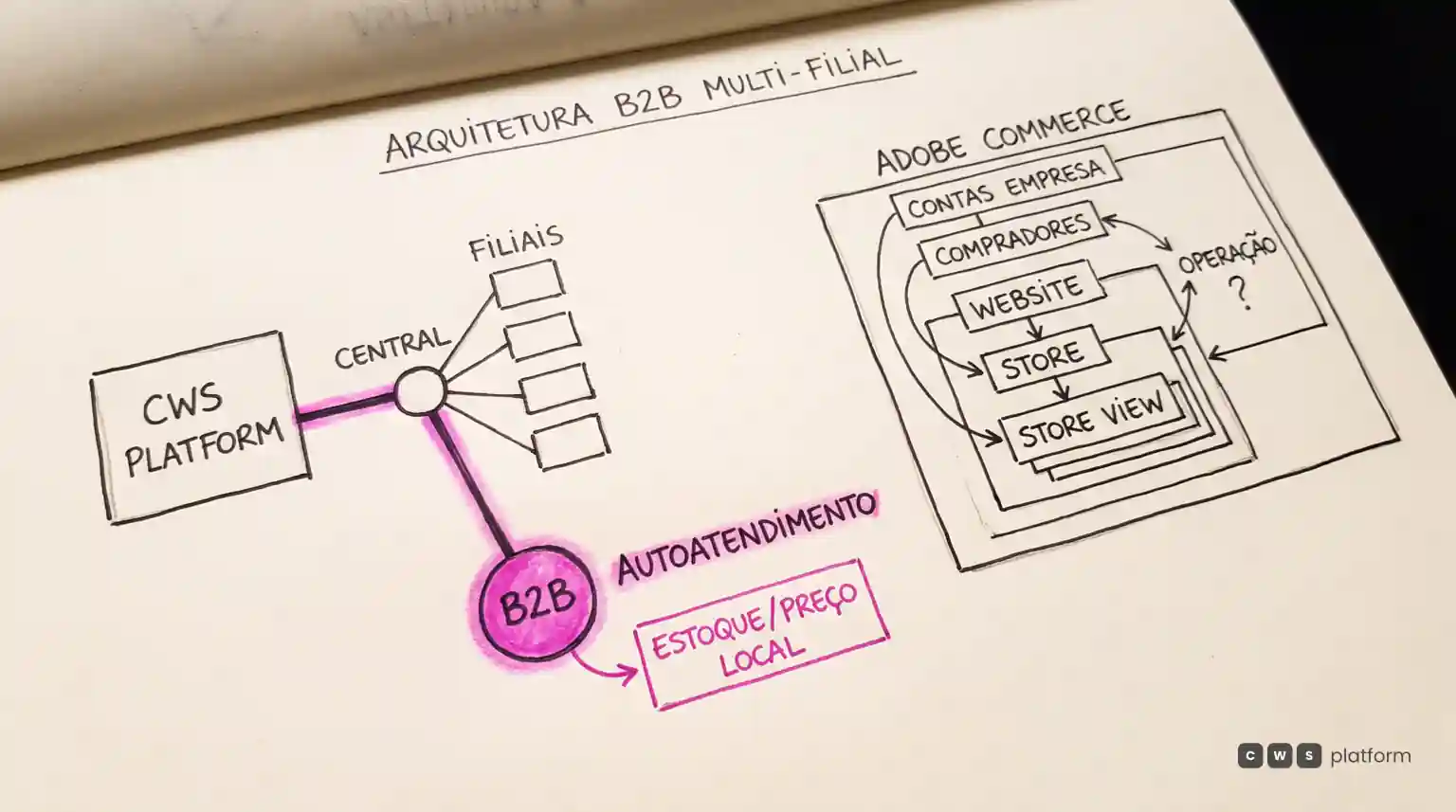
Comparing the CWS Platform with Adobe Commerce in this scenario requires starting with the operating model, not a feature checklist. Adobe Commerce organizes B2B around company accounts, buyers, permissions, shared catalogs, and website, store, and store view structures, as described in its B2B documentation. The decisive question is whether the primary complexity lies in the buyer’s corporate structure or in the sales execution requirements of each branch.
For the VP of Commerce, the portal must remove routine orders from the sales rep’s workload without inventing aggregated availability or flattening prices. For the CFO, that means protecting margin, credit, and tax policy in the digital channel. For the CTO, it means defining where identity, inventory, pricing, rules, and order states live so the storefront does not become a collection of exceptions.
The starting point is simple: self-service is not just allowing a buyer to build a cart. It is making B2B digital sales execute the same policy that determines which branch serves the customer, which warehouse commits inventory, which terms apply, and what must be validated before the order is created.
The scenario: the branch must continue to exist inside the portal
Imagine a distributor with stores or branches serving different territories, account portfolios, and customer segments. A customer enters the portal to reorder familiar items, but the operation cannot display an inventory balance created by adding together warehouses that would never jointly fulfill that order. The availability shown must represent an operational commitment the business can actually execute.
The same applies to pricing. The price list shown to the buyer may depend on identity, fulfillment warehouse, contract, territory, tax rules, and commercial terms. Flattening those inputs to simplify the portal shifts the cost to margin erosion, manual service, and downstream corrections.
In this model, the branch is not just a brand or a different page. It is an operating context. The architecture must carry that context from buyer identification through order creation, keeping catalog, pricing, credit, taxes, and inventory consistent throughout the transaction.
The sales rep remains relevant for negotiation and exceptions. Measurable self-service shifts predictable replenishment to the buyer and keeps human support focused on the points where policy requires judgment, configuration, or negotiation.
The six decisions this scenario requires
The portal’s architecture becomes visible in the decisions below. Each one defines where the operation places its commercial source of truth and what type of exception will continue to reach the sales rep.
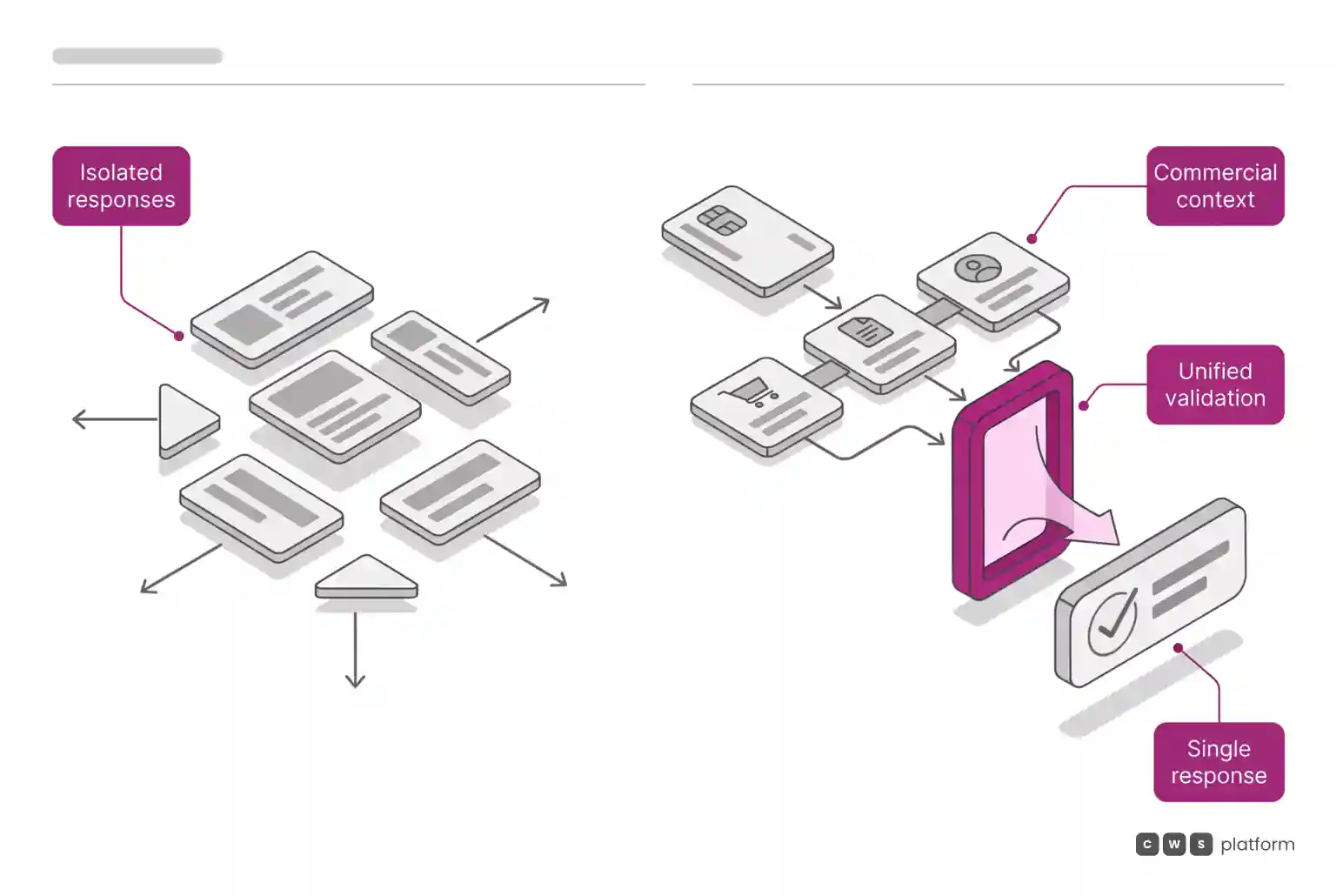
1. Which branch serves the customer. Buyer identification must select a fulfillment context before availability is displayed. The inventory balance shown must be tied to the warehouse that can pick and ship the item, keeping source and operational commitment within the same decision.
2. Where the customer’s price comes from. The displayed price must be calculated from the commercial inputs that apply to that transaction. Customer, warehouse, contract, territory, volume, and tax rules must contribute to the decision without turning a generic price list into a universal source of truth.
3. What the portal loads when the buyer signs in. Login must resolve more than authentication. It must retrieve the buyer’s commercial context so that catalog, terms, credit, and permissions follow the customer journey from the beginning.
4. How the buyer finds an item without assistance. Product discovery depends on the quality and governance of catalog identifiers. Customer part numbers, technical attributes, descriptions, and product relationships must be treated as usable commercial data rather than informal knowledge held by the sales desk.
5. What checkout validates before accepting the order. Submission must validate inventory, price, credit, and taxes within the same transaction. When a required condition fails, the order is not created, preventing finance or the branch from receiving an inconsistent commercial promise.
6. How a routine order gets repeated. Order history must function as the buyer’s operational memory. Lines, quantities, fulfillment sources, and previous states must remain accessible so replenishment can begin from a known purchase instead of depending on the sales rep’s memory.
What blocks the operation today, in the words of the people running it
Statements heard in the field help reveal the architectural decision hidden inside what appears to be an everyday problem.
“The portal shows inventory that is no longer available.” This statement exposes the decision about inventory scope: the channel can display an aggregated number or use the balance from the warehouse that will actually serve the customer.
“We flattened the price list because maintaining different prices by branch and customer became impossible to manage.” This statement exposes the decision about where commercial granularity will be governed: in a contextual rule or in a simplified price list that shifts exceptions to customer service.
“Every customer has a different price. No one can put that on the website.” This statement exposes the decision about what follows the buyer’s identity. The portal must execute the pricing rule, not merely publish a previously stored value.
“The customer puts everything in the cart and abandons checkout because invoice terms are not available.” This statement exposes the decision about the role of credit in the purchase. Trade credit must participate in the transaction alongside the other conditions that authorize the order.
“Every new customer costs more to serve than the previous one.” This statement exposes the decision about which orders should remain dependent on human labor. If every replenishment order requires consultation, data entry, and manual review, the digital channel merely changes the entry point for the same transaction cost.
How an enterprise suite builds this scenario: Adobe Commerce through its documented mechanism
Adobe Commerce structures B2B around company accounts that group buyers, divisions, subdivisions, roles, and permissions. The administrator configures activities such as orders, quotes, purchasing, credit, and company profiles, while shared catalogs apply custom product pricing to companies or customer groups, according to the B2B documentation.
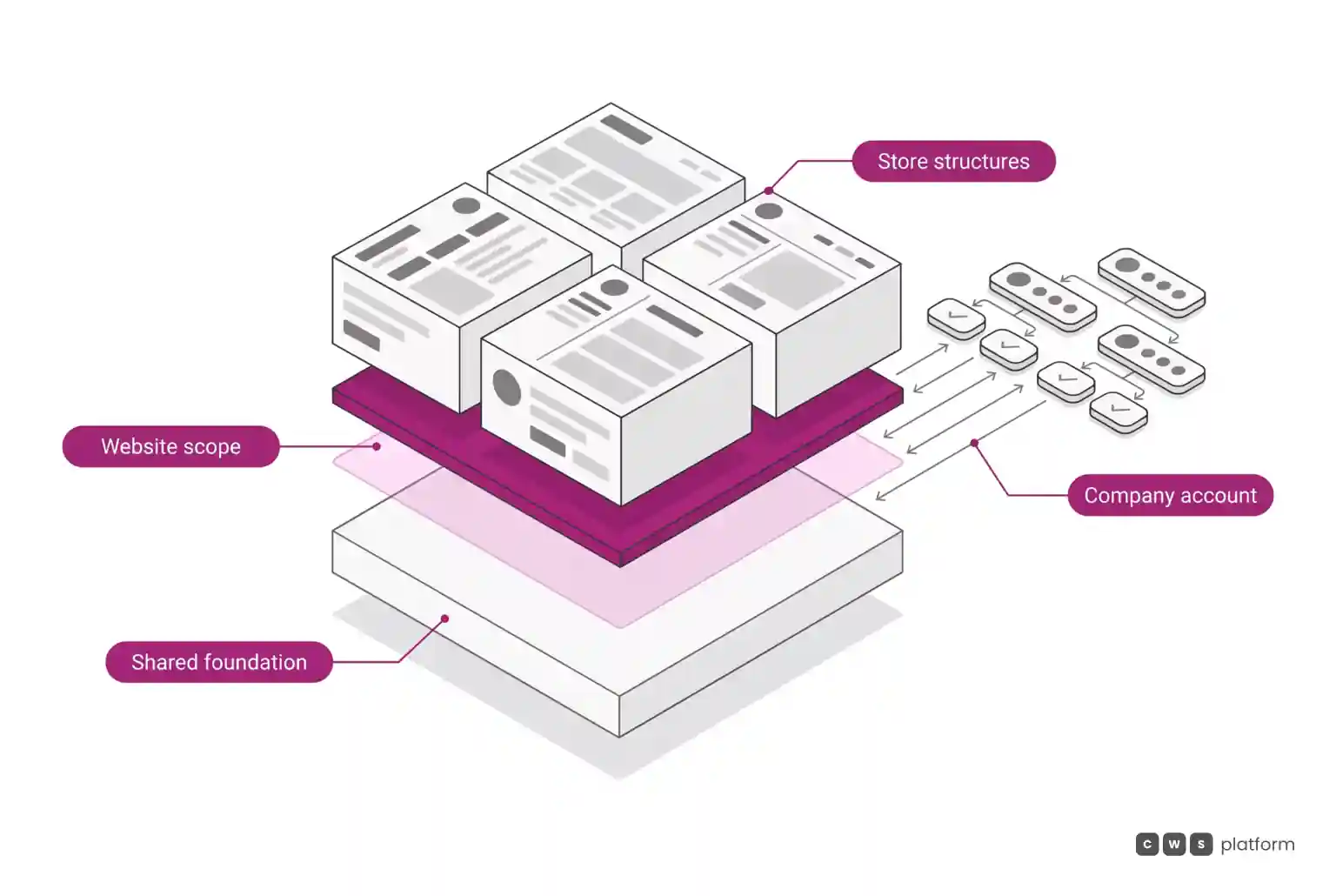
Multiple storefronts are organized through the global, website, store, and store view hierarchy. Each level controls a type of configuration, and the relationships among them determine what is shared or separated within the instance, as described in the website, store, and store view documentation.
A website acts as a container for configurations such as shipping and payment. When an operation needs separate carts, shipping options, and other resources, the documentation recommends creating separate websites. Customer accounts can be shared among websites in the same instance, according to the multi-site architecture overview.
Stores within the same website share a catalog, administration, and checkout, but they can offer different product selections, menus, and presentations. Depending on the selected configuration, the architecture can also maintain separate catalog structures and prices, according to the store scope documentation.
In the B2B relationship, authorized buyers can initiate quotes from the cart, while sales representatives can initiate them from the admin environment. The parties can change items and quantities, request discounts, and exchange messages. Requisition lists maintain sets of products for recurring purchases, according to the Adobe Commerce B2B introduction.
The mechanism therefore places significant weight on modeling the buying company, its users, and storefront scopes. For this scenario, the architecture work consists of mapping branches, domains, catalogs, prices, carts, and shipping to the documented website and store levels while preserving company-account permissions through the multi-site structure.
How the CWS Platform builds it: the warehouse as an executable context for commercial policy
In the CWS Platform, the starting point for this scenario is the warehouse serving the transaction. It acts as the context for availability, pricing, territory, and execution within a centralized policy. The branch therefore stops being merely a visual choice and begins to determine what the portal can promise the buyer.
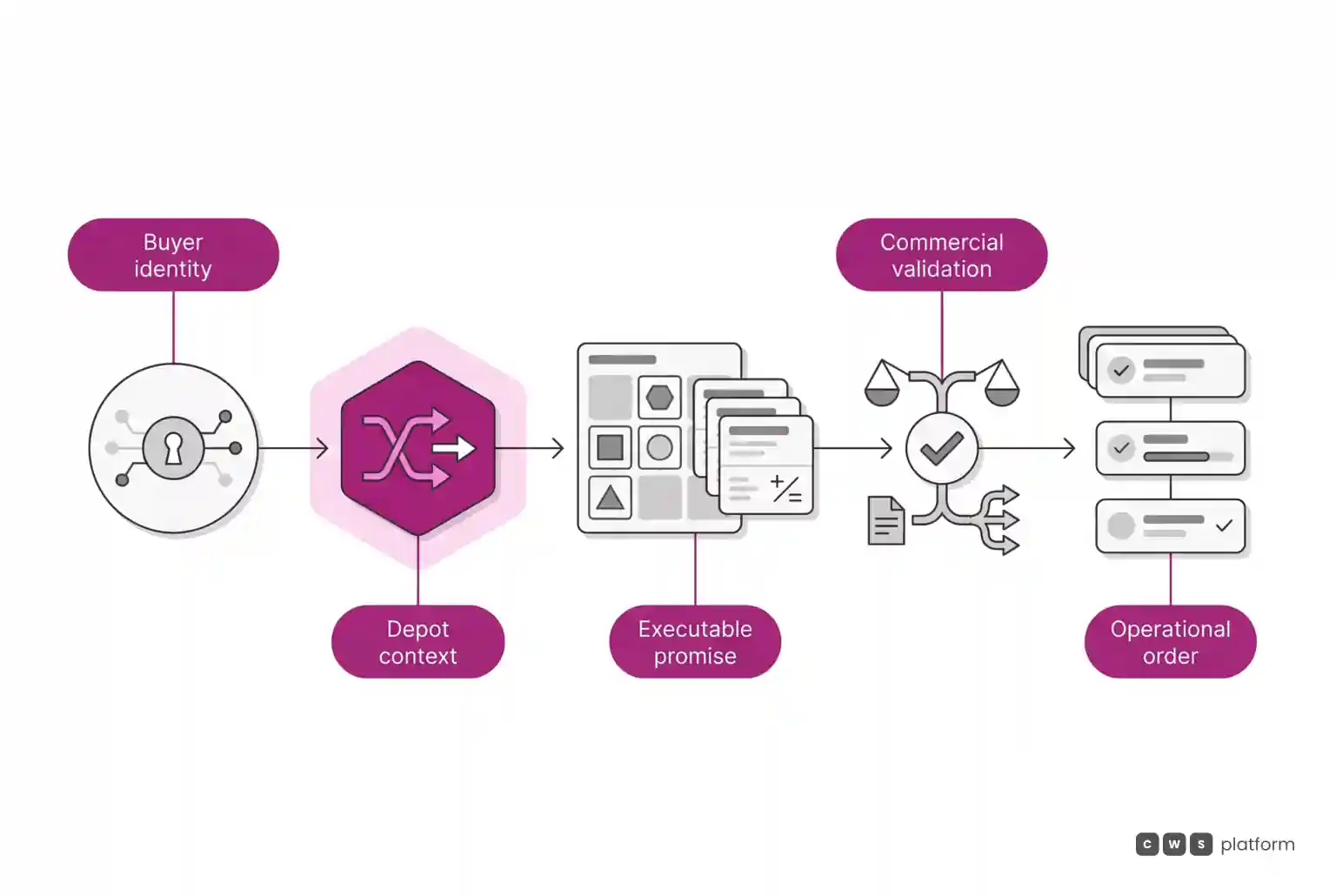
Distributed Inventory (Inventory Hub) maintains physical inventory, virtual inventory for controlled preorders, and lead time by SKU and warehouse. Identifying the fulfillment context makes it possible to query availability from the applicable source instead of creating a promise from disconnected operational balances.
Contextual Pricing (Pricing Engine) calculates prices by product, warehouse, customer profile, and tax rule. Precedence among contracts, rules, and price lists turns price into the result of a commercial function, allowing the same identity to receive the terms corresponding to the source that will fulfill the order.
Commerce Rules Engine (CDL Workspace) governs credit, tax compliance, permissions, and approval workflows through code. Rule changes require a reason and comment, creating an audit trail that helps the VP of Commerce distribute policy, the CFO monitor sensitive decisions, and the CTO keep governance out of scattered customizations.
Product Catalog & MDM (Catalog Engine) maintains governance across global and local data, traceable product compositions, and incremental imports. In this model, codes, attributes, and product relationships enter a governed catalog that can support buyer discovery, while the catalog enrichment agent helps improve the information used throughout that journey.
Credit-First B2B Checkout (Checkout & Payments) treats trade credit as a native B2B payment method. Before acceptance, the transaction validates inventory, price, credit, and taxes together, using the commercial rules that apply to the buyer’s identity and fulfillment context.
Order Management System (OMS / Seller Center) maintains the order as the operational source of truth between the platform and the ERP. The order view exposes the customer, shipments, payments, taxes, tax documents, and state-change records, while transitions depend on the corresponding operational evidence. This history creates an objective foundation for order lookup and replenishment.
The CWS Platform has 11 modules, 6 AI Agents, and 1,029 configurable parameters. In this scenario, modularity keeps inventory, pricing, rules, catalog, checkout, and orders as connected domains without reducing each branch’s operation to an independent copy of the same store.
The architectural result is a distributable commercial policy. The buyer accesses the channel with the appropriate context, the warehouse supports the fulfillment promise, the price is calculated for that transaction, and the order moves into execution with the conditions that authorized it.
The correct benchmark is transaction cost. A portal reduces that cost when a predictable order moves through identification, discovery, pricing, credit, validation, and execution without returning to the sales rep to reconstruct its context. People remain responsible for negotiation and exceptions, while repeatable rules become part of the commercial infrastructure.
Where the architectures truly diverge
The central difference is the unit used to represent complexity. Adobe Commerce documents company accounts and a hierarchy of websites, stores, and store views for separating or sharing experiences and configurations, according to its multi-site architecture. CWS organizes this scenario around the warehouse and the commercial policy it can execute.
The point where price gains context also changes. In Adobe Commerce’s documented architecture, shared catalogs associate custom product prices with companies or customer groups across one or more websites, as shown in the B2B documentation. In CWS, price is calculated using transaction inputs, including the customer, warehouse, and tax rules.
Identity also plays a different role. Adobe Commerce’s documented mechanism uses the company account to group buyers, divisions, roles, and permissions within the purchasing process, according to the B2B introduction. In CWS, identification activates the commercial context that drives pricing, credit, permissions, and fulfillment source.
The recurring-purchase journey also begins from different structures. Adobe Commerce documents requisition lists, order history, and quotes tied to the company account in its B2B solution. In CWS, operational order history preserves lines, shipments, payments, taxes, and state changes as the foundation for replenishment.
| Decision | Adobe Commerce, through its documented mechanism | CWS Platform |
|---|---|---|
| Where the operation gains context | Organizes context through the company account and website and store scopes. | Organizes context around the warehouse that executes the commercial policy. |
| Scope of availability | Connects the experience to the scopes configured in the multi-site structure. | Ties inventory to the SKU and warehouse responsible for fulfillment. |
| Where pricing policy is expressed | Associates product prices with companies or groups through shared catalogs. | Calculates price using the customer, warehouse, contract, and tax rules. |
| When identity enters the transaction | Uses the company account to apply roles, permissions, and purchasing capabilities. | Loads the commercial context that drives price, credit, and fulfillment source. |
| Where checkout applies control | Configures purchasing and payment capabilities for company users. | Validates inventory, price, credit, and taxes before creating the order. |
| Where reorder memory lives | Maintains requisition lists, quotes, and history within the company account. | Maintains line items and operational evidence in the order history. |
The choice does not depend on checking more boxes in a matrix. It depends on identifying which type of complexity dominates the operation: the corporate structure and storefront scopes, or the execution of inventory, pricing, credit, and orders by warehouse. That answer determines where the architecture must place governance.
When Adobe Commerce is the right choice for this scenario
Some operations have decisive requirements that directly call for this architecture’s documented structure. In those cases, fit should be evaluated through the mechanism supporting the requirement.
The buying company needs to manage its own user structure. Choose this architecture when the central requirement is to represent divisions, subdivisions, buyers, roles, and permissions within a single company account. The company administrator can structure users and control activities such as orders, quotes, purchasing, credit, and profile management through the B2B company account.
Brands, languages, or experiences require their own storefront scopes. Choose this architecture when the necessary separation involves websites, stores, and store views, with presentation, currency, catalog, cart, shipping, or payment configurations distributed across those levels. The documented hierarchy defines what each scope shares or separates within the multi-site operation.
Corporate purchasing requires bilateral quotes and role-governed purchase orders. Choose this architecture when buyers and sellers need to negotiate items, quantities, and discounts through message exchanges, or when every company order must begin as a purchase order subject to approval rules. These workflows are associated with the company account and the capabilities configured for its users in the Adobe Commerce B2B documentation.
Where to go next
If your question is still which architecture fits your operation—not which vendor to choose—continue with the seven questions that separate B2B commerce architectures.
If the real issue is the operational pain behind this scenario, When the Catalog Becomes Chaos and When Selling More Does Not Mean Earning More explore it in depth without discussing any vendor.
"responsive, technically engaged, and willing to work through complex commercial rules (negotiated pricing, credit, customer-specific conditions) rather than pushing generic answers"
Want to see this in your operation?
Real B2B operations already run on it.