Your Manufacturing Revenue Is Growing, but Margins Aren’t
AI agents recover margin only when decision rules, limits, and escalation paths are governed before automation.

TL;DR
- A manufacturer can have an ERP, CRM, and growing revenue while still relying on manual processes that consume margin.
- A Valor Econômico report cites the example of a middle-market manufacturer with annual revenue of R$50 million and 20 people dedicated to manual back-office tasks.
- AI agents can reduce that effort, but they need to know which decisions they can make and which ones they must escalate.
- Automating before governing pricing, terms, approvals, and exceptions only increases the speed of errors.
Why might automating the back office fail to recover your margin?
A recent report published by Valor Econômico highlighted the tension: manufacturers and distributors are generating more revenue while earning less profit.
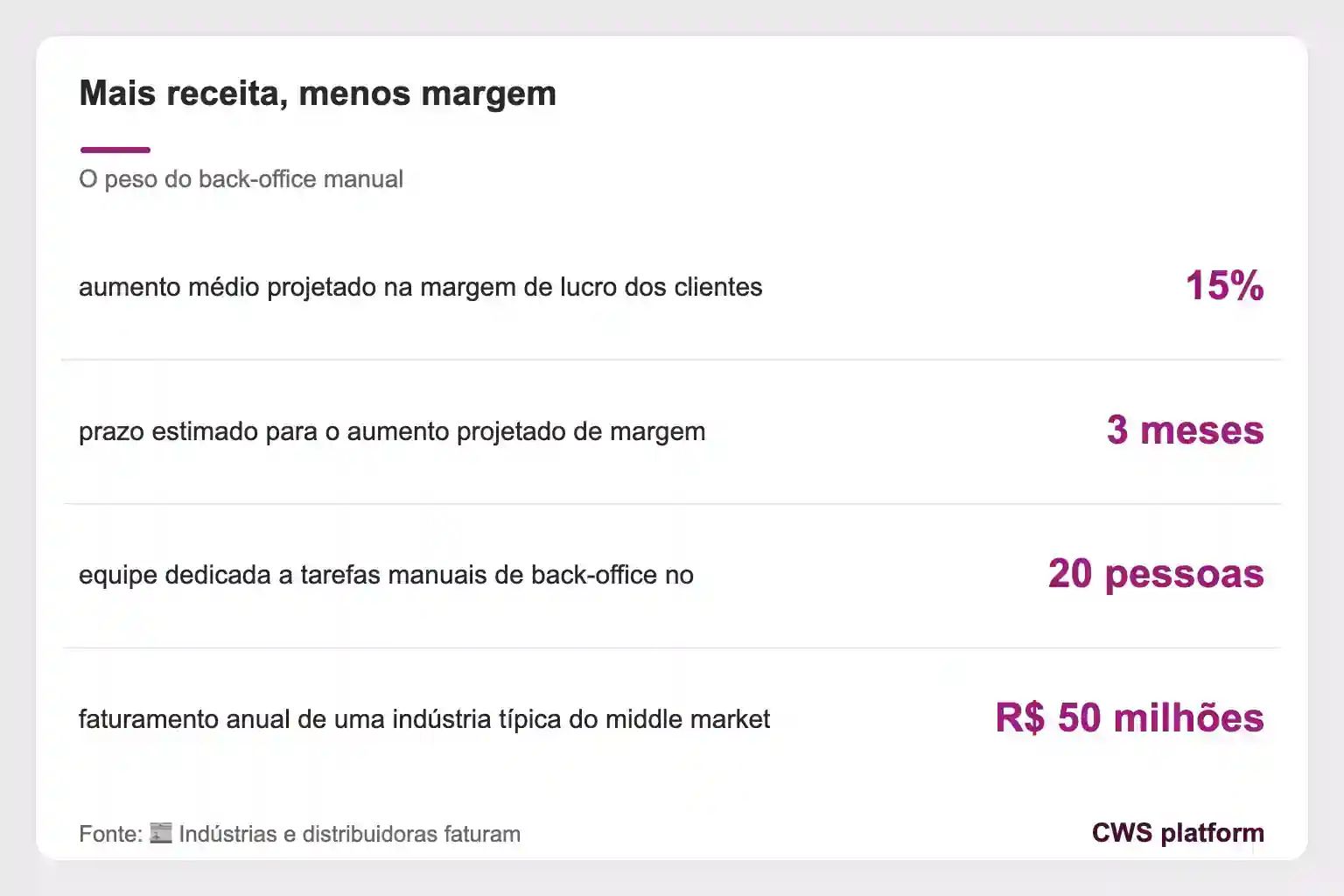
The article cites Beyond the Bytes and presents the example of a typical middle-market manufacturer with annual revenue of R$50 million and 20 people dedicated to manual back-office tasks. It also reports a projected average 15% increase in client profit margins, with an estimated timeline of three months.
For a CEO, the relevant data point is not just the size of the team involved. It is the operational contradiction: the company already has systems, yet it still depends on people to interpret information, transfer data, and decide how each situation should be handled.
The cause, therefore, is not necessarily a lack of technology. It is the amount of manual process layered on top of systems such as ERP and CRM platforms.
This situation often creates a false choice. On one side, keep adding people to absorb operational growth. On the other, rapidly hand the workflow over to AI agents. The first option preserves the cost structure. The second, when adopted without governance, can replicate the problem at greater scale.
The manual process may be hiding an unstructured decision
Not every repetitive task is simply execution.
When processing an order, applying commercial terms, or reviewing credit, the back office may be making small decisions that were never formalized:
- Are the terms within policy?
- Can the order move forward without another approval?
- Which discrepancy can be tolerated?
- When does the case need to be routed to a person?
- What qualifies as an exception?
- Which data supports the decision?
As long as those answers remain in the individual experience of team members, the operation runs on interpretation. The ERP and CRM store information, but the rule applied between information and action may still be scattered across people, messages, and habits.
That is precisely where an apparently simple automation becomes a risk. The agent can execute, but it cannot find an explicit boundary between making a decision and escalating it.
The critical boundary: when to act and when to escalate
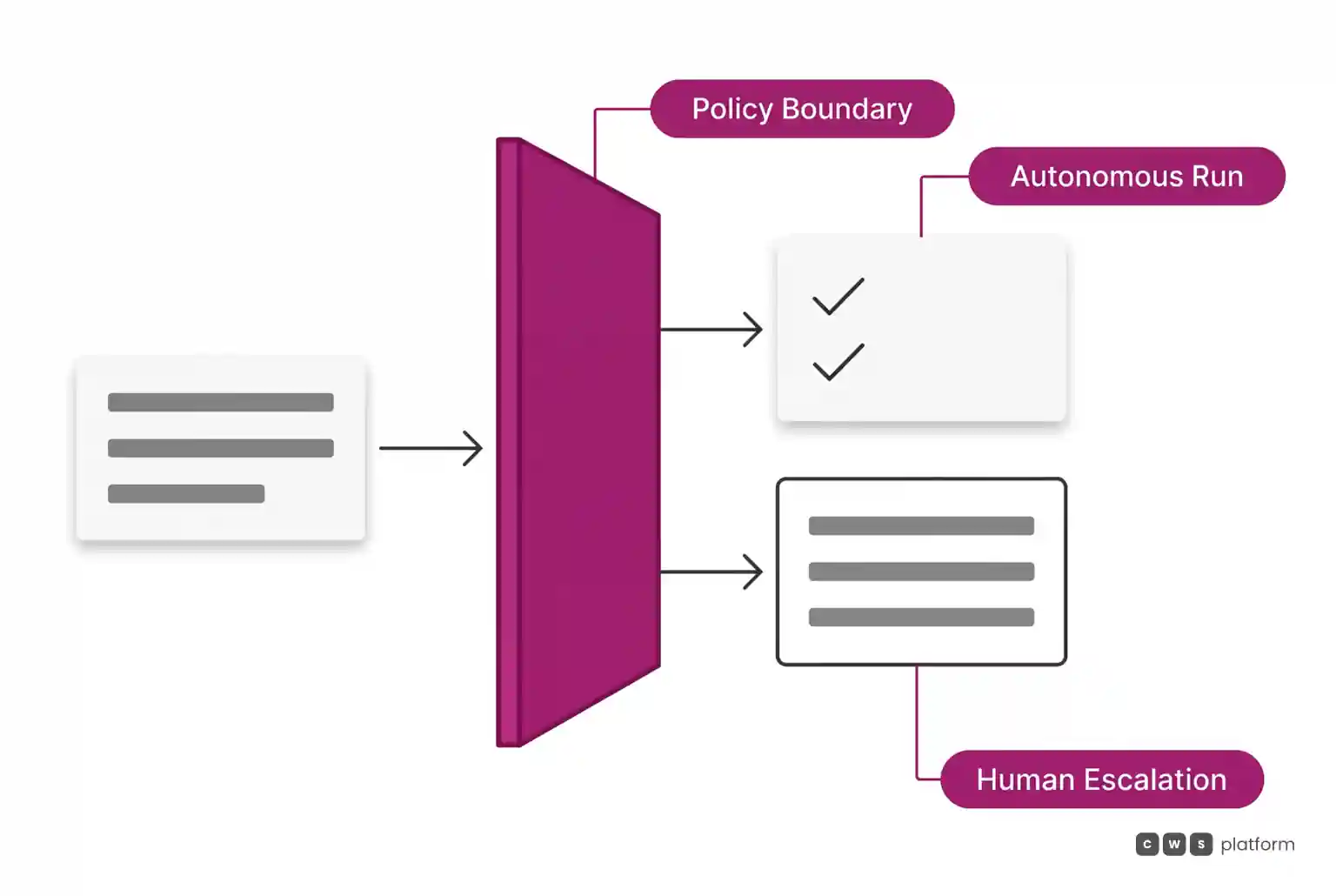
An AI agent operating invoicing, credit, or orders needs more than access to data. It needs to operate within a defined decision perimeter.
That means establishing in advance:
- which situations can be handled autonomously;
- which commercial limits cannot be exceeded;
- which exceptions require approval;
- which information must be recorded;
- when the agent must stop execution and escalate the case.
The sequence matters. First, the company structures the decision. Then, it delegates execution.
The relevance of this principle appears in other contexts. According to PCWorld, Claude completed a FreshDirect purchase with support from 1Password, authenticating the user, selecting items, and completing the order without direct browser interaction.
Autonomous execution is technically significant. Yet the economic questions remain: what price is acceptable, when can an item be substituted, and when should approval be requested?
In B2B, these questions carry more weight because each transaction can include negotiation history, commercial policy, and account-specific terms. The agent does not eliminate this complexity. It needs to receive it in a governed form.
The same principle appears in the case published by Finextra involving CaixaBank and Visa. The companies completed a transaction initiated by an AI agent within authorization and control models defined by the user. The central point was not merely allowing the agent to pay, but establishing the perimeter within which it could act.
The goal is not maximum autonomy
Evaluating AI agents solely by the number of tasks they automate can lead to the wrong conclusion.
The economic goal should not be to maximize autonomy. It should be to expand autonomous execution only where the decision is already sufficiently clear, while preserving human escalation for cases that concentrate risk, ambiguity, or financial impact.
This changes the question the board asks. Instead of, “How many people or steps will the agent replace?” the analysis should consider:
- which decisions are already formalized;
- where exceptions consume the most capacity;
- which errors have the greatest impact on margin;
- which situations can be executed consistently;
- which decisions still depend on unstructured context.
This approach also prevents the projected average 15% margin increase cited in the Valor report from being treated as an automatic outcome of AI adoption. The gain depends on the structure on which the agent will operate.
The Cost of Inaction
Failing to act keeps the company trapped in the paradox described in the report: more revenue, more operational effort, and a margin that does not keep pace with growth.
But acting in the wrong order also has a cost.
When a chaotic process is automated, the company may reduce execution time without reducing decision inconsistency. Errors begin moving faster, reaching more transactions, and requiring new layers of human review.
The cost of inaction, therefore, is not just failing to adopt AI. It is also delaying the formalization of commercial knowledge that is currently distributed across people.
That knowledge includes pricing criteria, terms, approvals, limits, and exceptions. As long as it remains implicit, every new automation effort must reconstruct it. When it becomes governed policy, it becomes a reusable operational asset.
Principles for introducing agents without automating chaos
- Diagnose the decisions hidden within manual tasks.
- Separate repetitive execution from commercial judgment.
- Define autonomy limits before deciding what to automate.
- Formalize pricing, terms, approvals, and exceptions as policies.
- Establish objective escalation criteria for people.
- Preserve records and traceability for executed decisions.
- Start with workflows whose logic can already be described clearly.
- Evaluate results by consistency and financial impact, not speed alone.
- Treat negotiation history as company knowledge.
- Expand autonomy only after validating the decision perimeter.
FAQ
Should every manual process be handed over to an AI agent?
No. Manual processes can combine simple execution with contextual decisions. The company needs to separate those two dimensions before automating.
Don’t ERP and CRM systems already provide this governance?
These systems are part of the infrastructure, but their existence does not mean that commercial criteria, exceptions, and escalation limits have been formalized. The Valor report illustrates the continued presence of manual work on top of those systems.
When should an agent escalate a decision?
When the transaction exceeds defined limits, involves an exception, lacks sufficient data, or requires a decision the company has not yet converted into an explicit policy.
Who is already experiencing this
“Native AI agents can answer technical catalog questions and support negotiation using the business’s real data.”
Carlos M., Head of Sales, in a review published on Capterra.
A case that illustrates the point
The JOKR case, published by Retail Tech Innovation Hub, reports that the quick-commerce company reached EBITDA break-even after a five-year rebuild centered on AI and automation.
The experience supports the central point: automation amplifies the existing structure. The outcome depends on well-designed rules, criteria, and processes before implementation.
Read the case on Retail Tech Innovation Hub.
About this publication
The Cost of Selling is a CWS Platform publication about the economics and governance of B2B commercial operations.
CWS Platform is a B2B Commerce Platform for Governed Negotiation. In this architecture, the commercial decision is structured before execution by agents. The goal is not to indiscriminately remove human involvement, but to reduce transaction costs where rules are clear and escalate, with discipline, what requires judgment.
By turning negotiation DNA into explicit policies, the company creates a governed foundation for AI to use real business data without operating through blind delegation. Technology then executes within commercial policy rather than trying to discover it during every transaction.
Sources
- Valor Econômico, Manufacturers and distributors generate more revenue but earn less profit: primary source for the manufacturing example, manual back-office work, and margin projection.
- PCWorld, Claude did my FreshDirect shopping, with help from 1Password: example of an agent autonomously executing a purchase.
- Finextra, CaixaBank initiates first agentic shopping transaction: case of a transaction initiated by an agent under defined authorization and control models.
- Capterra, CWS Platform: public review from Carlos M., Head of Sales.
- Retail Tech Innovation Hub, JOKR reaches EBITDA break even: related case on rebuilding operations around AI and automation.
"responsive, technically engaged, and willing to work through complex commercial rules (negotiated pricing, credit, customer-specific conditions) rather than pushing generic answers"
Want to see this in your operation?
Real B2B operations already run on it.