Off-Policy Discounting: How to Know If Your Sales Reps Are Giving It Away Behind Your Back
If your only evidence is the margin line at month-end close, you don't have controls — you have an autopsy. Discount governance has to live where the deal actually happens

The question almost always arrives in the same form: "how do I know if my sales rep is giving discounts outside our policy?" The person asking is usually a B2B sales leader or the owner of the business, and the question itself is the diagnosis. If you have to ask, it's because discount traceability doesn't exist in your process: the policy is written down in some document, but the actual negotiation happens over text, on the phone, in the rep's spreadsheet, and the final price only shows up once the order has already turned into an invoice.
TL;DR
- If the only way you discover an off-policy discount is by looking at margin at the end of the month, you don't have control, you have an autopsy.
- The problem is rarely the rep's character: it's process design. Where there's no measurable discount authority, discounting becomes personal judgment.
- B2B discount audits done by spreadsheet sampling arrive too late and don't change behavior; the control needs to live at the moment of negotiation.
- The path forward is turning your pricing policy into an operating rule: a band the customer can access on their own, a band within the rep's authority, and a record of everything that falls outside the band.
Why Can't You Answer This Question Today?
Start with an honest exercise. Pull your ten largest orders from last quarter and try to answer, for each one: what was the list price, what price was actually charged, who authorized the difference, and based on what criteria. In most B2B sales operations, this exercise doesn't end in answers, it ends in a meeting. The sales manager remembers "more or less," the rep justifies each case individually, and finance can only tell you how much margin dropped, not why.
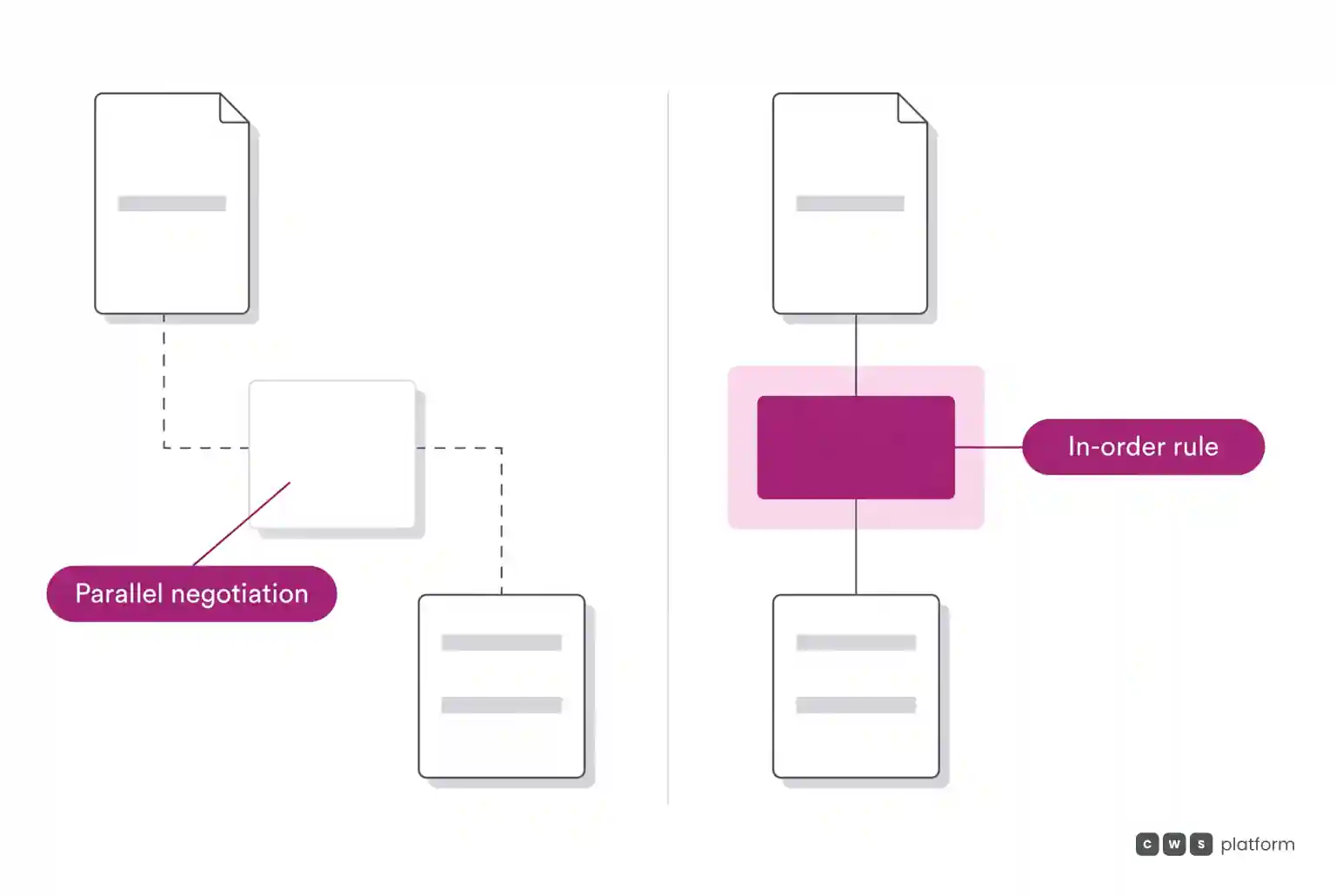
This happens because, in practice, your discount policy lives in three disconnected places:
- On paper: a document or email defining maximum percentages by customer tier or volume.
- In the rep's head: their personal interpretation of what counts as "a good discount to close the deal."
- In the system: the closed order, with the final price, with no history of how anyone got there.
Between the paper and the system there's a vacuum, and that vacuum is where the real negotiation happens. The rep doesn't need to break any rules: they simply operate where the policy doesn't reach. By the time the order hits the system, the discount is already a done deal. Any audit from that point on is retrospective: you discover the problem after the margin is already gone.
The Problem Isn't the Rep, It's the Roulette Wheel
Without a price band grounded in logic, without measurable discount authority, and without a visible target, good reps and bad reps become indistinguishable. Both close orders. The difference between the one defending margin and the one burning margin only shows up months later, diluted in aggregate results, when it's too late to attribute cause. The usual blame ("my team discounts too much") shifts onto the individual a problem that is really an absence of governance.
And there's an aggravating factor: when your pricing logic doesn't scale, your sales don't scale. If there's no measurable correlation between what the customer does (volume, repeat business, product mix) and what they pay, every negotiation becomes a manual spin of the roulette wheel. Every order is a brand-new decision, every rep is a walking pricing policy, and growing the team means multiplying variance, not revenue.
What an Operating Discount Policy Requires
The answer isn't more policing, it's moving the policy inside the transaction. Three components:
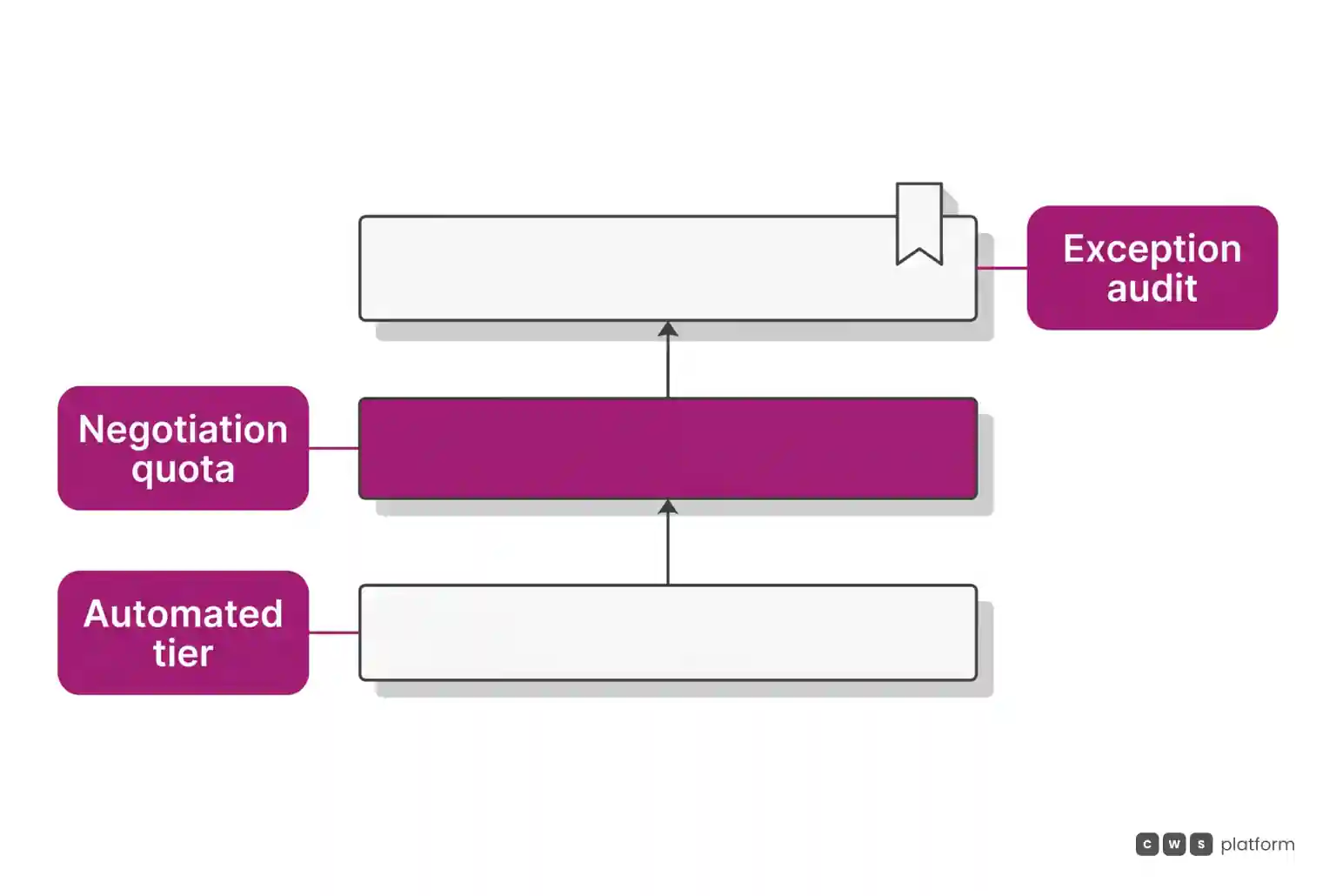
First, a price band with logic behind it. Price needs an explicit correlation to customer behavior: volume buys a discount, repeat business buys better terms. Within that band, the customer can self-serve, with no negotiation, because the rule is the rule. That takes everything off the negotiating table that never needed to be on it.
Second, measurable discount authority for the rep. The rep keeps negotiating, that's their job, and commercial judgment is an asset, but within a defined, recorded, visible space. The discount stops being an invisible favor and becomes a decision with an owner, a date, and a rationale.
Third, exceptions with a trail. What falls outside the rep's authority isn't forbidden, it's escalated: it goes up to someone with the authority to approve it, and the record shows who approved and why. The exception becomes data, not leakage. That's what makes a real B2B discount audit possible: not an annual spreadsheet sampling, but a continuous record, native to the process, where every deviation from list price leaves a trace.
The same reasoning applies to terms that function as disguised discounts: payment terms and credit limits. When net terms depend on the rep's gut feel or a side approval over the phone, they're an unrecorded financial discount. Treated as a rule embedded in the order, they become a consistent offer to the buyer and a controllable lever for risk and working capital.
The Cost of Inaction
Keeping the current model has a cost that doesn't show up on any single line of your P&L, but shows up across all of them:
- Margin leaking order by order, with no single order looking serious enough on its own to justify change.
- Identical customers paying different prices for the same product, which, once discovered (and B2B buyers talk to each other), erodes trust in your price list.
- No way to evaluate the team: without a yardstick, you don't know who negotiates well, so you promote and compensate in the dark.
- Growing dependence on specific people: the policy that lives in a rep's head walks out the door with them.
- Pricing decisions with no foundation: if you don't know which discount was given to whom and why, any price list revision is a guess.
Every month under this regime is a month in which your pricing policy exists only as an intention.
Principles for Governing Discounts Without Slowing Down Sales
- A policy that isn't in the flow of the transaction isn't a policy, it's a suggestion.
- Separate what's a rule (the self-service band) from what's a negotiation (the rep's authority): negotiating everything is as bad as negotiating nothing.
- Every exception must have an owner, a record, and a rationale; an exception without a trail is leakage.
- Evaluate reps by how they use their authority, not just by volume closed.
- Payment terms and credit are price: govern them with the same yardstick.
- Governance isn't distrust of your team, it's the condition that lets a good rep be recognized as one.
FAQ
How do you audit discounts in B2B negotiations? Retrospective auditing (comparing charged price against list price after invoicing) identifies the problem too late. The effective approach is structural: define the price band and discount authority inside the order flow itself, so every discount within authority is recorded with its author and context, and every exception generates an approval trail. The audit becomes a query against a continuous record, not an investigation.
What is discount governance in B2B sales? It's turning your pricing policy from a document into an operating rule: a band the customer accesses without negotiating, a measurable authority within which the rep decides, and a formal escalation path for exceptions. The goal isn't to prevent discounts, it's to guarantee every discount has logic, an owner, and a record.
Does discount traceability mean taking away rep autonomy? No. It means giving autonomy a boundary: the rep negotiates within a known authority, and anything outside it escalates with a record. That protects the good rep, who now has evidence of the quality of their decisions, and exposes only the pattern of whoever is systematically burning margin.
Why does margin fall even when no one openly violates the policy? Because the policy typically lives outside the negotiation flow. The rep doesn't break the rule, they operate where the rule doesn't reach: on the phone, in messaging apps, in a spreadsheet. On top of that, terms like net payment function as unrecorded financial discounts when they aren't governed.
About This Publication
The Cost of the Sale is the blog of CWS Platform, a B2B Commerce Platform for Governed Negotiation. The platform's premise is the same as this article's: B2B commercial negotiation is a company asset, not an individual improvisation, and the cost of each transaction drops when pricing policy, discount authority, and exceptions stop living in side channels and start operating inside the order flow itself, with records and governance. Technology, including AI, only multiplies results when the decision rule already exists: automating a roulette wheel just produces a faster roulette wheel.
Sources
- This article is an original analysis by the blog, built from a recurring question asked by B2B sales leaders ("how do I know if my sales rep is giving discounts outside our policy"); it does not cite third-party data or studies.
"responsive, technically engaged, and willing to work through complex commercial rules (negotiated pricing, credit, customer-specific conditions) rather than pushing generic answers"
Want to see this in your operation?
Real B2B operations already run on it.