Is Your Partner Integration Moving Fast Before It’s Ready to Scale?
Early governance, technical support, and post-launch feedback keep speed from replicating operational failures.

TL;DR
- Partner integrations can move faster when technical support and governance are involved from the earliest stages.
- Taking an integration live does not mean the process is ready to be replicated.
- Post-implementation feedback makes it possible to correct the workflow before exceptions become the operating standard.
- The goal is not to add control, but to define decisions, responsibilities, and criteria before automating and scaling.
How can you accelerate integrations without multiplying operational failures?
For B2B commercial leaders, the pressure is familiar: onboard partners quickly, preserve the sales experience, and prevent operations from depending on manual intervention for every order, commercial term, or exception.
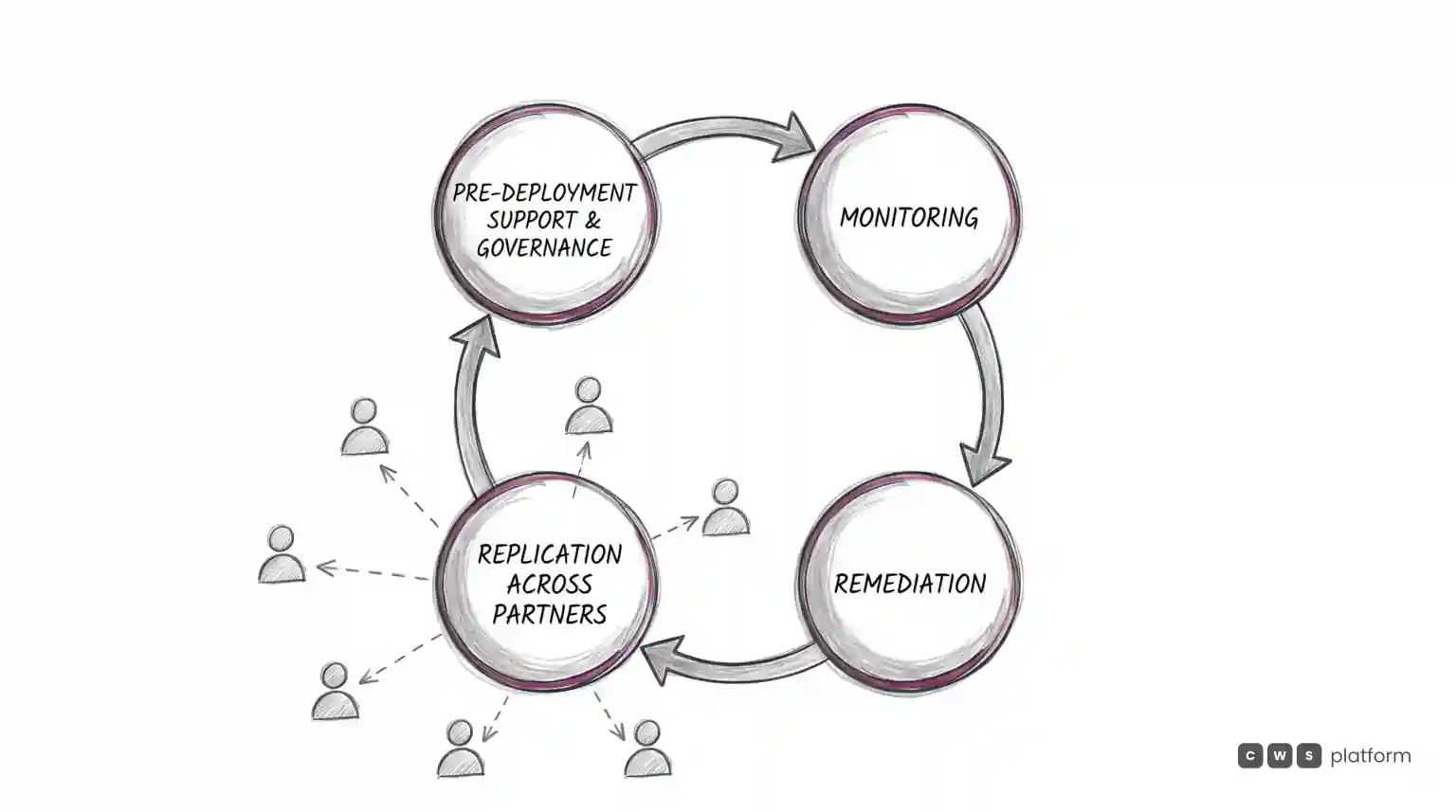
The risk appears when speed is interpreted solely as a technical timeline. The connection may be completed, data may begin to flow, and the workflow may go live. Yet fundamental decisions may still lack clear rules.
Who approves a non-standard commercial term? How should a correction be prioritized? What needs to be documented? Which lessons from the first implementation should be incorporated before the next one?
In a response forwarded by a customer, the principle was summarized directly: partner integrations can be accelerated when technical support and governance are involved from the earliest stages. The same contribution highlights that post-implementation feedback helps incorporate corrections before the process is replicated.
The thesis may seem straightforward, but it changes the execution model. Instead of treating governance as a later layer of control, it becomes part of the operating design. Instead of viewing implementation as the finish line, the company recognizes that the first cycle produces information needed to determine whether that process can actually be repeated.
The technical timeline does not represent the full risk
A B2B integration connects more than systems. It connects commercial policies, responsibilities, data, exceptions, and decisions that may previously have been distributed across sales reps, managers, technical teams, and partners.
When these elements are not discussed early, technology may simply move ambiguity faster.
This does not mean every situation must be anticipated before implementation. It means the company needs to define how it will handle what has not yet been anticipated. The distinction matters: a governed process does not eliminate exceptions, but it establishes who decides, based on what information, and how the learning feeds back into the workflow.
Without this design, technical support tends to become involved only when a problem occurs. Governance also arrives late—typically to control an operation that has already accumulated habits, workarounds, and dependencies.
The result may look agile at first, but it creates additional effort when the company tries to add new partners or expand transaction volume.
Early technical support reduces the gap between decision and execution
Early technical support involvement should not be confused with technology taking over commercial decision-making. Its role is to make operational dependencies visible while there is still room to refine the design.
A commercial rule may seem clear in a meeting and reveal ambiguity when it needs to be represented in a workflow. An exception considered rare may require a recurring decision. Information available to one team may not be accessible to the partner when it is needed.
By involving support and governance from the outset, the company can identify these tensions before they become automated behavior.
Decision governance should precede automation. Otherwise, automation gives technical consistency to a process that may not yet have operational consistency.
This discipline also prepares the company to use artificial intelligence responsibly. The opportunity for AI grows when decisions, context, and corrections are documented. Without that foundation, expanding automation does not solve the absence of criteria.
Implementation does not end the process design
Post-implementation feedback is the second component of the thesis.
After an integration begins operating, evidence emerges that was not available during planning. The partner encounters friction points, internal teams identify redundant steps, and exceptions begin to reveal their frequency and impact.
Listening during this period does not mean keeping the process in perpetual testing. It means establishing a deliberate cycle of observation, correction, and decision-making.
Before replicating the integration, leadership should be able to answer:
- What corrections were required after go-live?
- Were those corrections incorporated into the process, or do they remain manual interventions?
- Did responsibility for decisions change?
- Were exceptions documented in a usable way?
- Will the next partner receive the original workflow or an already corrected version?
- Is there an explicit criterion for considering the integration replicable?
The absence of these answers creates a quiet risk. Each new implementation can carry forward problems from the previous one while adding its own particularities. The operation grows, but its ability to explain and manage itself declines.
The Cost of Inaction
Delaying governance does not preserve simplicity. It only shifts complexity to a stage where correction tends to involve more people, partners, and live workflows.
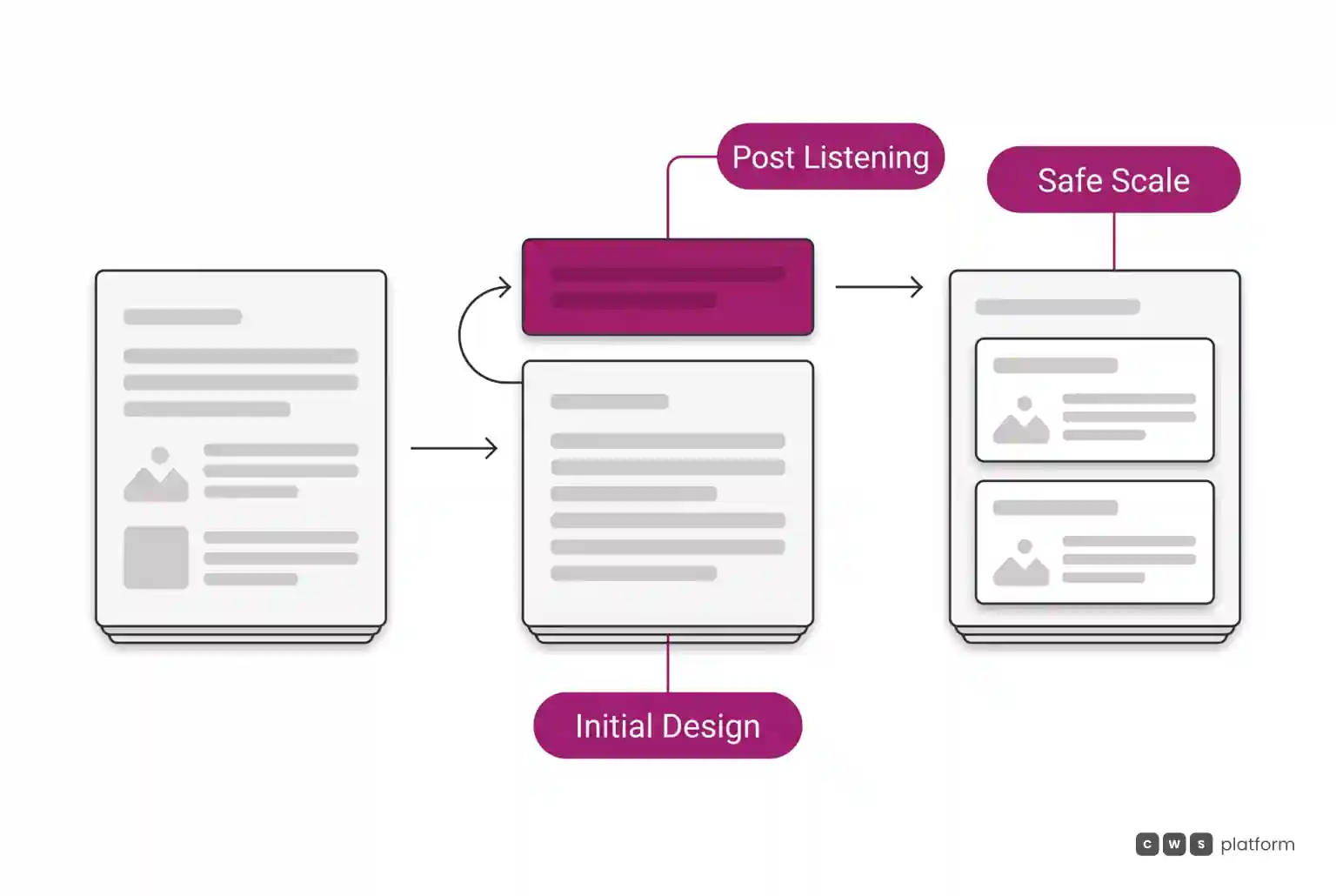
Inaction can appear in different forms:
- Technical support operates reactively, without participating in the design of decisions.
- The sales team compensates for process gaps with messages, spreadsheets, or parallel approvals.
- Corrections made after implementation do not feed back into the standard used for subsequent integrations.
- Exceptions remain tied to the memory of specific individuals.
- Leadership does not distinguish between a technically active integration and an operation that is truly ready to scale.
- New technologies accelerate steps without clarifying who is accountable for decisions.
The central problem is not the existence of adjustments. Real integrations require learning. The problem is allowing that learning to remain scattered and fail to reshape the process architecture.
Principles for integrating before scaling
- Define decision governance before automating the workflow.
- Include technical support in the early stages without removing commercial ownership of sales and negotiation policies.
- Make owners, approval criteria, and exception handling explicit.
- Treat the first implementation as a source of evidence, not as a model that can automatically be replicated.
- Create a formal post-implementation feedback stage.
- Incorporate corrections into the standard before connecting the next partner.
- Preserve the context behind decisions to build a negotiation DNA that operations can use.
- Evaluate AI and automation as amplifiers of governed processes, not as substitutes for governance.
FAQ
Does early governance make integration slower?
The thesis presented here suggests the opposite: involving technical support and governance from the earliest stages can accelerate integrations. The objective is to anticipate dependencies and decisions that, if discovered only later, would require reactive corrections.
Does every integration need to be complete before going live?
No. The point is to define how post-implementation learning will be captured and incorporated before replication. Going live and being ready to scale are different states.
Who should lead post-implementation feedback?
The material does not assign this to a specific function. The principle is to bring together the perspectives of those involved in operations, technical support, and governance, while keeping clear ownership for decisions and for incorporating corrections.
Where does AI fit into this process?
After criteria, context, and responsibilities are structured. AI can expand operational capacity, but it should not be assigned the task of compensating for decisions the company has not yet governed.
Who is already experiencing this
On the public Software Advice portal, Paulo Renan S. describes the experience with CWS Platform:
“Delivering consistent, scalable progress and agile course corrections.”
Source: Software Advice
A case that illustrates it
Case LI-966729, from the internal archive, applies the same thesis to low digital adoption in agriculture. The diagnosis is that the problem stems less from the absence of channels and more from a lack of governance in the negotiation process.
In this context, structuring quoting, contextual pricing, credit, and barter arrangements in an integrated workflow reduces transaction costs and frees the field sales representative to act as a technical advisor.
The case reinforces an important point: digitizing is not simply making a channel available. It is organizing interdependent decisions so technology reduces operational effort without removing the context required for negotiation.
Reference: LI-966729, with no access link provided.
About this publication
The Cost of Selling is a CWS Platform publication about efficiency, governance, and transaction costs in B2B commercial operations.
As a B2B Commerce Platform for Governed Negotiation, CWS helps companies structure negotiations across internal teams, partners, and customers. The architectural answer to scalable integrations does not begin with the technical connection, but with governance over the decisions that connection will execute.
When rules, exceptions, responsibilities, and corrections form a negotiation DNA, the company creates a more reliable foundation for integrating partners, reducing transaction costs, and expanding the use of automation and AI.
Sources
- Early governance in integrations, response forwarded by a customer: technical support and governance in the early stages, with post-implementation feedback before replication. No public link provided.
- Software Advice, Paulo Renan S.'s review of CWS Platform: public testimonial about scalable progress and course corrections.
- Case LI-966729, internal archive: governance of quoting, contextual pricing, credit, and barter arrangements in agricultural negotiations. No access link provided.
"responsive, technically engaged, and willing to work through complex commercial rules (negotiated pricing, credit, customer-specific conditions) rather than pushing generic answers"
Want to see this in your operation?
Real B2B operations already run on it.