Your sales team runs AI, but the data it needs is still inside the rep's head
Auto parts distributors and retailers adopting AI for quoting and sales support are finding the tool is only as good as the data structure feeding it — and that structure, in most operations, doesn't yet exist.

TL;DR
- AI tools for quote generation and sales support are already being used sporadically by auto parts distributors and retailers, but they run into a problem that predates the technology: fragmented pipeline data, undocumented pricing policies, and exception rules that exist only in the memory of senior salespeople.
- When the standard CRM cannot serve as a reliable source for AI agents, teams improvise by using spreadsheets, shared drives, and homegrown scripts as their primary repository of sales intelligence.
- The result is a paradox: the operation adopts AI to respond to customers faster, but the AI runs on a fragile foundation—limiting the quality of generated quotes and the accuracy of customer support.
- Solving this requires formalizing sales governance before scaling AI use, not afterward.
AI has reached the sales organization. The problem is what it finds inside.
A pattern is starting to repeat among auto parts distributors and retailers using artificial intelligence as a productivity tool: the technology works, the use cases make sense—quote generation, faster customer support, order qualification—but output quality depends entirely on input quality. And in most of these operations, the input is weak.
The situation is concrete: sales reps at auto parts distributors and retailers are beginning to use AI sporadically to respond to customers faster, build commercial quotes with less manual effort, and prioritize service requests. The reported problem is not the AI. It is the data feeding it. Standard, off-the-shelf CRM systems do not adequately serve as data sources for these use cases. The team’s solution is almost always to build a parallel repository—a spreadsheet in Google Drive, a shared file, or a homegrown script—that becomes the primary source of pipeline intelligence.
This solution works. At the same time, it clearly exposes the real bottleneck: it is not a lack of technical capability on the team or a limitation of AI. It is the absence of a commercial data structure that is reliable, structured, and accessible enough to feed agents consistently.
What happens when governance does not come before automation
In the auto parts sector, commercial complexity is inherently high: thousands of SKUs, pricing policies that vary by channel (distributor versus retailer), payment terms negotiated case by case, volume discounts requiring approval, and a history of exceptions that only the most experienced salesperson knows by heart.
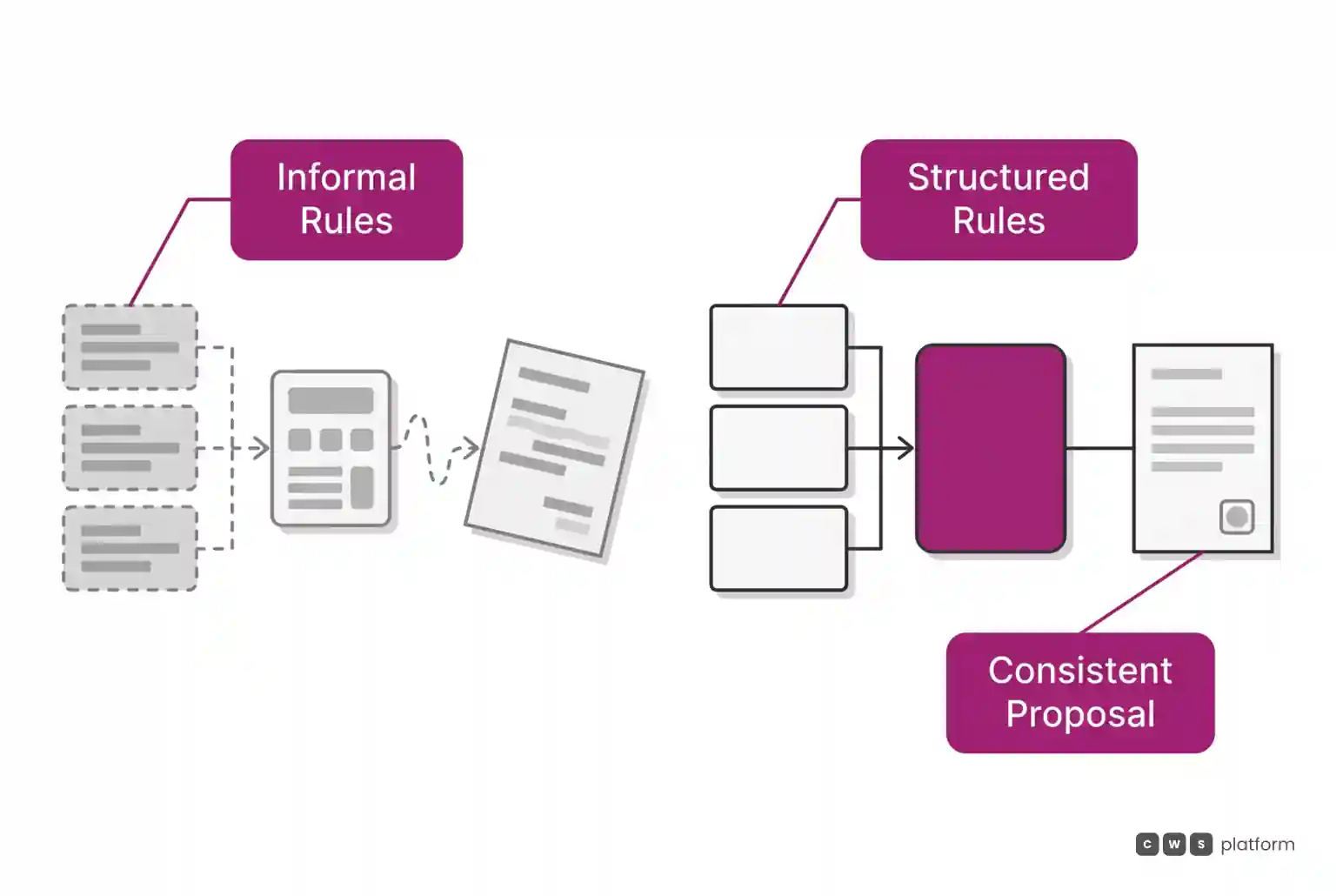
When an operation does not have these rules formalized in the system—when pricing policy lives in the senior salesperson’s head, exception criteria are undocumented, and negotiation history is scattered across emails and side spreadsheets—AI inherits that chaos. It does not create structure where none exists. It amplifies what it finds.
The practical outcome is familiar to anyone who has tried to automate a commercial process in this industry: AI-generated quotes arrive quickly, but with pricing inconsistencies that need manual correction. Automated support works for simple orders, but stalls when a customer asks about special payment terms or a volume discount because there is nowhere to look up the current policy. The salesperson takes back control, and the AI becomes a disposable draft.
The result is that AI operates as a productivity layer on top of an operation that still depends on the tacit knowledge of two or three professionals. Speed improves somewhat. Dependence on key people does not.
Why the standard CRM fails as a source for AI agents
Off-the-shelf CRMs were designed for humans to record and view pipeline activity. The interface is built for people. The data structure, fields, relationships between objects, and activity logs were designed for reporting—not for consumption by autonomous agents.
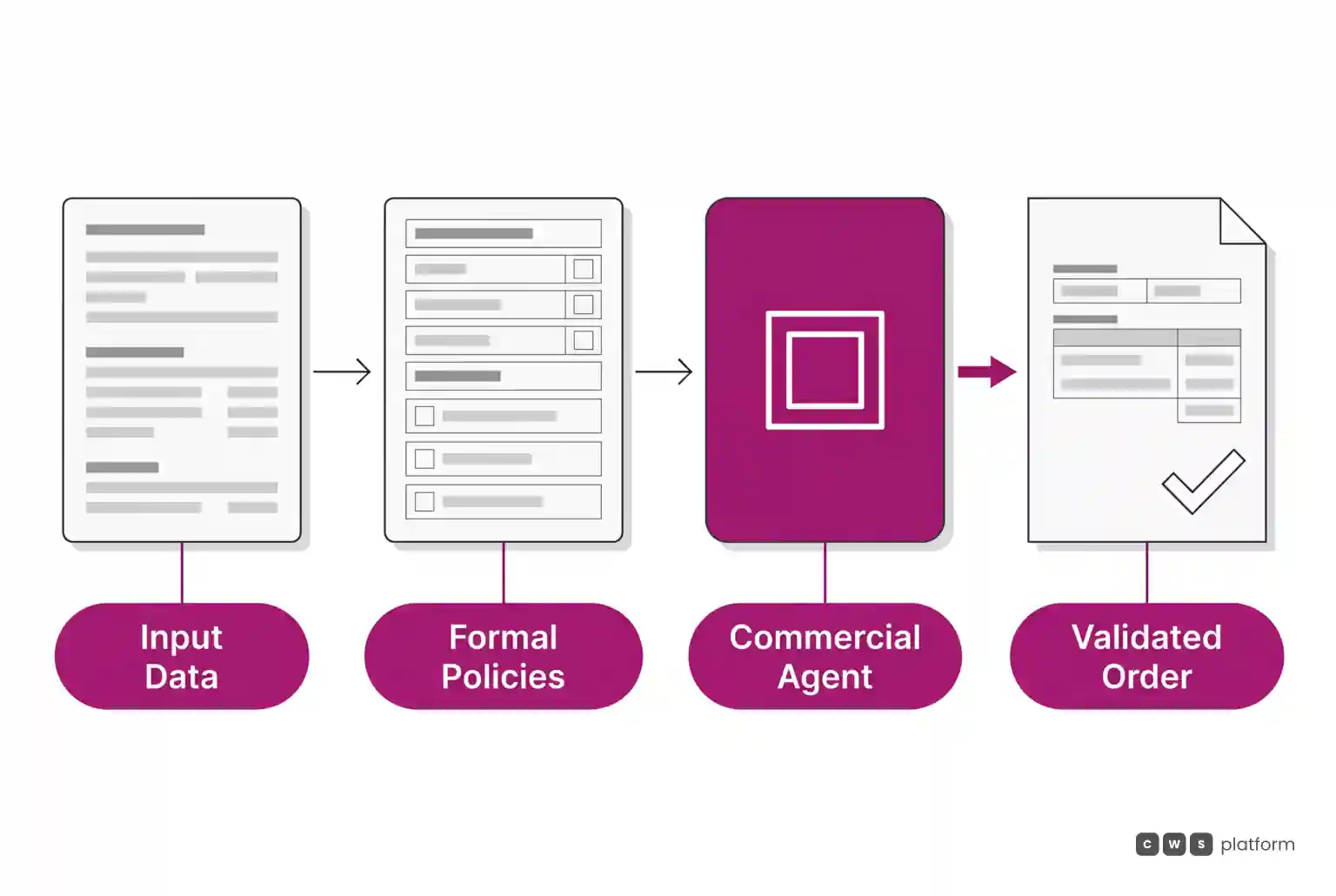
When an auto parts team uses AI to build a quote or handle an order request, the agent needs to understand the negotiation context: the commercial terms previously agreed with that customer, the customer’s purchase-volume history, and the approval level required for a payment-term exception. What the standard CRM offers is often insufficient: free-text fields where each salesperson writes differently, pipeline stages that do not reflect the actual decision process of an auto parts buyer, and no structure for capturing the variables that truly matter—the applicable price list, negotiated discount, and agreed return policy.
Building a parallel spreadsheet repository is pragmatic and smart. But it carries a cost: it is one more system to maintain, one more source of truth that can diverge from another, and one more point of failure when the person responsible for updating the spreadsheet is overloaded or leaves the company.
The Cost of Inaction
Leaving this structure as it is comes with a cost that grows as the operation scales. Every new salesperson requires more time to understand unwritten rules around channel discounts, SKU-specific return policies, or credit approval criteria for retail customers. Every quote generated from inconsistent data costs review time and creates risk to margin or the customer relationship. Every customer interaction that AI starts and a salesperson must take over erases part of the speed gain that motivated adoption in the first place.
And when the distributor or retailer decides to scale AI use, the problem multiplies: more agents fed by more bad data produce more outputs that require human validation. The productivity gain promised by AI turns into another layer of supervisory work.
The central point is not that AI fails. It is that formalizing sales governance—channel pricing policy, credit criteria, exception rules, and structured negotiation history—is a prerequisite for AI to operate well, not a consequence of operating it.
Principles for organizations at this stage
- Before scaling AI agents, map where the sources of truth for the commercial operation actually live: in the CRM, in side spreadsheets, or in the heads of specific people.
- Treat the formalization of commercial policy as an infrastructure project, not bureaucracy: every rule that moves from a salesperson’s head into the system becomes data AI can use reliably.
- In auto parts, formalize the variables that change most often and have the greatest impact on quotes first: channel-specific price lists, volume discounts, payment terms, and exception criteria.
- Assess whether the current CRM was designed for agent consumption or only for human use: that distinction matters when automation begins to depend on structured data retrieval.
- Parallel repositories—spreadsheets, shared drives, and homegrown scripts—solve the short term, but create technical and operational debt that must be paid eventually, usually at the worst possible time.
- AI speed becomes a real competitive advantage only when the data foundation it consumes is reliable, structured, and automatically maintained by the operation’s own workflow.
FAQ
Can AI work with imperfect data?
Yes, but its quality is proportional to the data quality. Quotes generated using inconsistent pricing policies arrive quickly—and incorrectly. The time spent on manual corrections eliminates part of the speed gain.
Doesn’t building a custom repository in Google Drive solve the problem?
It solves it partially and in the short term. The risk is creating one more system to maintain, with another possible layer of inconsistency when no process updates it automatically.
Where should an auto parts operation begin formalization?
Start with what varies most and appears most often in quotes: channel price lists (distributor versus retailer), volume-based exception terms, and credit approval criteria. These are the variables most dependent on whoever is available to answer at the time—and the ones most likely to stall customer support when that person is unavailable.
Who is already experiencing this
"We had been trying to implement a B2B solution for almost 2 years. With CWS, we implemented it in 60 days."
Edivaldo C., verified reviewer, automotive sector, company with 201 to 500 employees. Source: Software Advice
A case that illustrates the point
In B2B auto parts operations, the productivity bottleneck is rarely human capacity. It is the absence of rules formalized in the system. When channel pricing policies, credit criteria, and exception rules move from the salesperson’s head into the digital workflow, response time stops depending on human availability. This pattern, documented in the CWS library (LI-038), is exactly what makes AI adoption in sales dependent on an earlier step: formalizing negotiation governance as structured data, rather than an informal team practice.
About this publication
The Cost of Selling is CWS Platform’s publication on B2B commercial operations: negotiation governance, transaction costs, and the decisions that define margin. CWS Platform is a B2B Commerce Platform for Governed Negotiation.
Sources
- Commercial operations reports from auto parts distributors and retailers (CWS Platform internal communications): sporadic use of AI for quote generation and sales support; reports that standard CRMs are inadequate sources for agents and that parallel spreadsheet repositories are used as a workaround.
- Software Advice, Edivaldo C. testimonial: verified review from a CWS customer in the automotive sector, with 201 to 500 employees. https://www.softwareadvice.com/product/546664-CWS-Platform/
- CWS Library, LI-038: analysis of formalizing commercial rules in systems as a productivity lever in B2B operations.
"responsive, technically engaged, and willing to work through complex commercial rules (negotiated pricing, credit, customer-specific conditions) rather than pushing generic answers"
Want to see this in your operation?
Real B2B operations already run on it.