Salesforce vs. CWS Platform: Which Architecture Helps a B2B Portal Sell With Your Sales Team?
How to align account ownership, negotiated pricing, discount approvals, shared carts, credit, and orders across self-service and assisted sales.
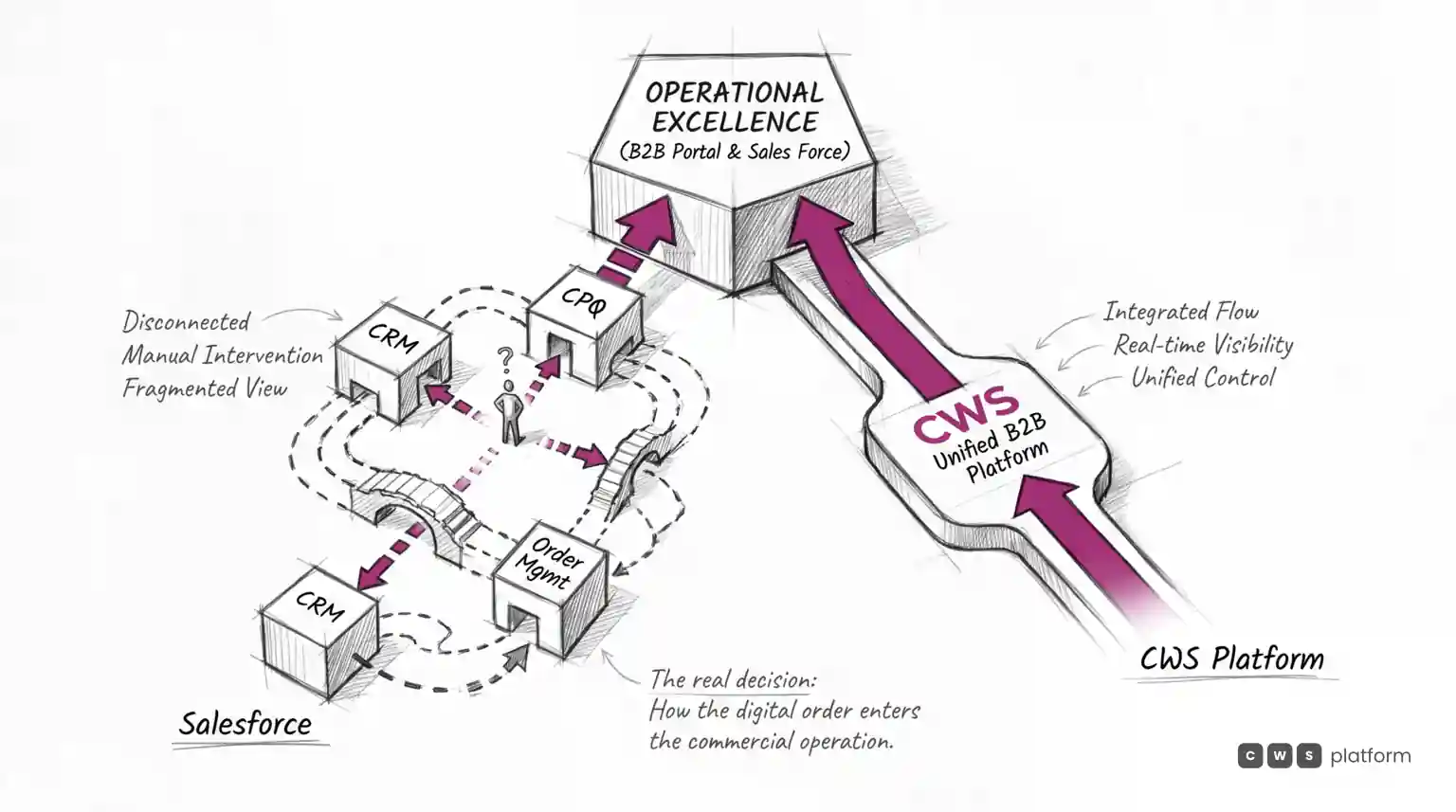
Editorial note: This is an architectural comparison of Salesforce and the CWS Platform for a B2B portal with sales operations. Every statement about Salesforce comes from its public documentation, with the source linked alongside it.
Comparing Salesforce and the CWS Platform in this scenario requires looking beyond launching an online store. The real decision is how a digital order enters the sales operation: who receives sales credit, which price the buyer sees, how an exception is approved, who follows the cart, and which rules must be satisfied before an order is created.
A B2B portal can reduce manual work and still create conflict with the sales team. This happens when customers gain a self-service channel while sales reps lose visibility, compensation, or the ability to intervene. The architecture must turn the portal into an extension of account management—not a parallel channel competing for the same order.
The primary perspective is that of the Commerce Director, who is responsible for connecting the digital experience, commercial policy, and execution. The CFO focuses on margin, credit, and traceability. The CEO wants scale without disrupting the sales model. The sales rep needs to see the digital channel as a better way to serve assigned accounts and participate in the deal.
The scenario: the customer buys independently, but the sales rep remains part of the sale
The scenario begins with a base of repeat customers, each with its own account record, assigned sales coverage, commercial terms, and history. Some buyers want to reorder without waiting for assistance. Others start on their own but need help selecting products, negotiating terms, or completing the purchase.
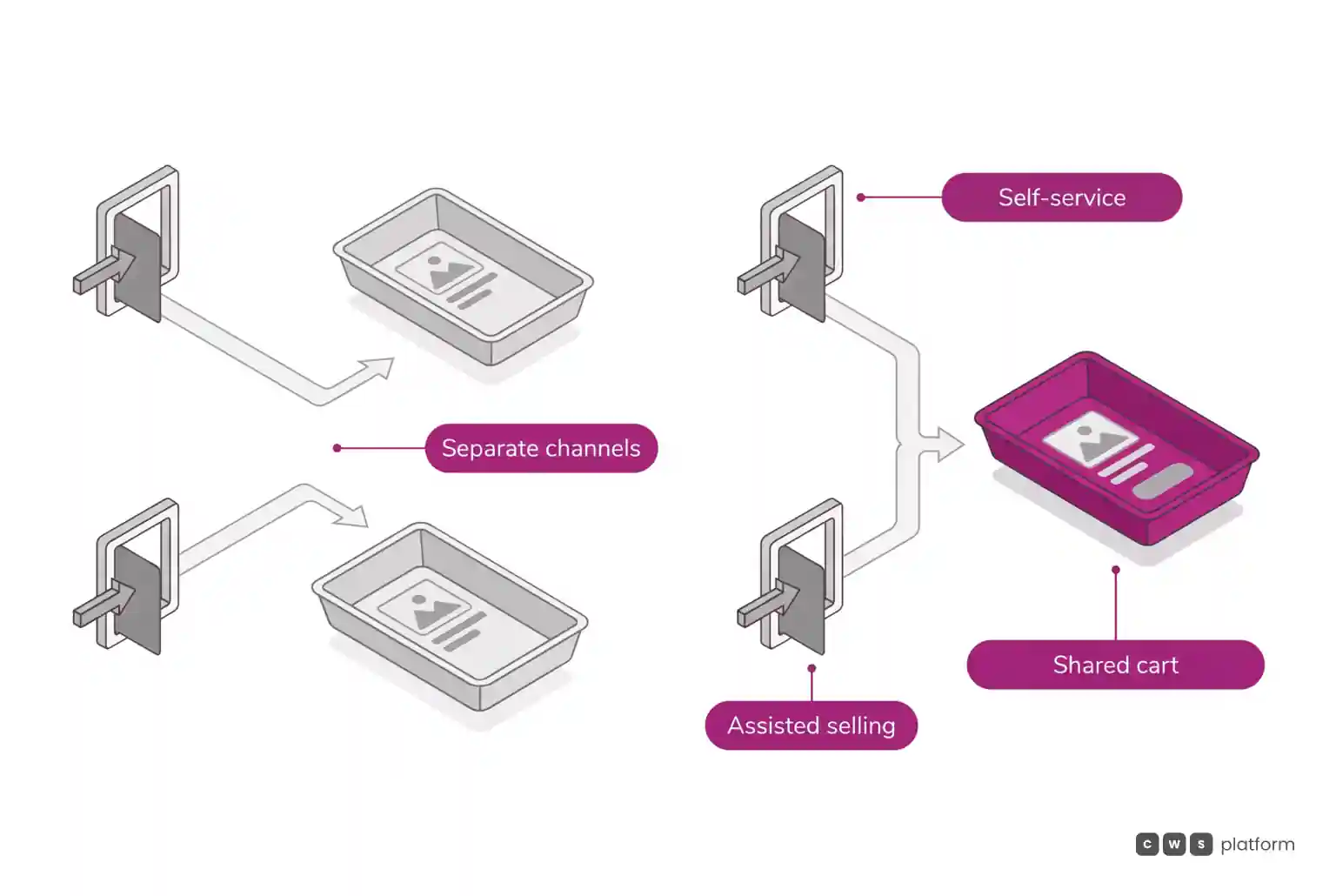
In this context, the portal cannot treat every purchase like an anonymous retail session. The buyer’s identity must retrieve the applicable commercial context, while the sales rep must be able to view and guide the same deal. The digital experience and assisted selling become two expressions of the same process.
That is the difference between publishing a storefront and operating a B2B digital sales channel. A storefront organizes navigation and captures a cart. A sales operation distributes negotiated pricing, approval criteria, credit, account ownership, and order status without requiring the buyer or sales rep to reconstruct that information outside the channel.
Conflict arises when the portal rewards only self-service while the organization compensates only orders entered by a sales rep. Under that model, encouraging customers to use the digital channel threatens the rep’s participation in revenue. Resistance is no longer a training issue; it becomes a rational response to the operating model.
The right architecture must recognize that self-service and assistance can happen within the same journey. The customer may build part of the order, the sales rep may review the product mix, a rule may route an exception, and checkout may validate credit terms. It remains one order even when control shifts between participants during the negotiation.
The six decisions this scenario requires
The choice should be guided by the decisions that determine whether the portal operates as a shared sales channel or as a store isolated from the sales organization.
1. Who owns the order when the customer buys through self-service. The authenticated identity should retrieve the responsible account owner and preserve that relationship throughout the journey. The compensation policy can then recognize the rep’s participation even when the buyer completes the purchase independently, removing the incentive to move the order back into a manual process.
2. Where negotiated pricing lives. The buyer needs to receive the terms that apply to their context—not a generic reference price that must be renegotiated outside the channel. When contracts, customer profiles, warehouses, and tax rules participate in the calculation, the portal distributes the same commercial policy already used by the sales operation.
3. Who approves an off-list discount. The exception must enter an identifiable workflow with an applicable threshold, a designated decision-maker, a reason, and a record of the change. This turns an informal conversation into a governed commercial decision and allows the CFO to distinguish a deliberate concession from margin leakage.
4. How the sales rep and customer build the same order. The buyer and sales rep need to work within the same transactional context. Assistance no longer creates another round of data entry; instead, it guides, corrects, or supplements the deal already in progress while preserving items, quantities, and identity.
5. What checkout will accept. Checkout must apply payment terms, credit limits, and other conditions before creating an operational obligation. If the transaction is not eligible, the workflow routes the required decision without generating an order that Finance must later unwind.
6. Who changes commercial policy, and how quickly. Commercial policy must be administered as a business rule with recognizable authorship, rationale, and effective dates. This allows a change to a limit or approval requirement to enter the operating workflow in a controlled way instead of depending on fragmented knowledge or an improvised channel change.
What is getting in the way today, in the words of the people doing the work
Comments heard in the field show that the impasse is not limited to the portal interface. Each one points to a commercial design decision.
“My sales reps say the portal will kill their commissions.” This statement reveals the decision around the economic ownership of the order. If account ownership continues to be recognized when the customer buys independently, the channel can extend the rep’s reach. If that relationship disappears, the organization creates internal competition.
“Every customer has their own price. No one can put that on the website.” This statement reveals the decision about where a negotiated arrangement becomes a distributable rule. The challenge is not just storing price books; it is calculating the relevant terms and presenting them to the buyer and sales rep at the time of purchase.
“Approving discounts is chaos. Everyone does it differently.” This statement reveals the decision around exception governance. When thresholds, justification, and decision ownership are not embedded in the workflow, deal velocity depends on phone calls, and an audit must reconstruct what happened after the fact.
“Our gross margin looks fine, but our net margin does not.” This statement reveals the decision about the boundaries of commercial policy. Discounts, credit, payment terms, and subsequent changes must be observed within the context of the transaction because price alone does not explain the full economic outcome.
“Our revenue depends on three hundred people remembering to call the right customers.” This statement reveals the decision about the sales rep’s role. The platform should bring account context and prepared deals to the team, allowing people to focus on advising customers, granting approvals, or handling meaningful exceptions.
What Salesforce handles well in this scenario
The documented architecture combines a commerce layer with sales records. In B2B Commerce, a storefront is created from templates, can be customized in Experience Builder, and receives search, cart, checkout, payment, and other configurations through Lightning components. This concentrates experience development within the storefront environment described in the documentation.
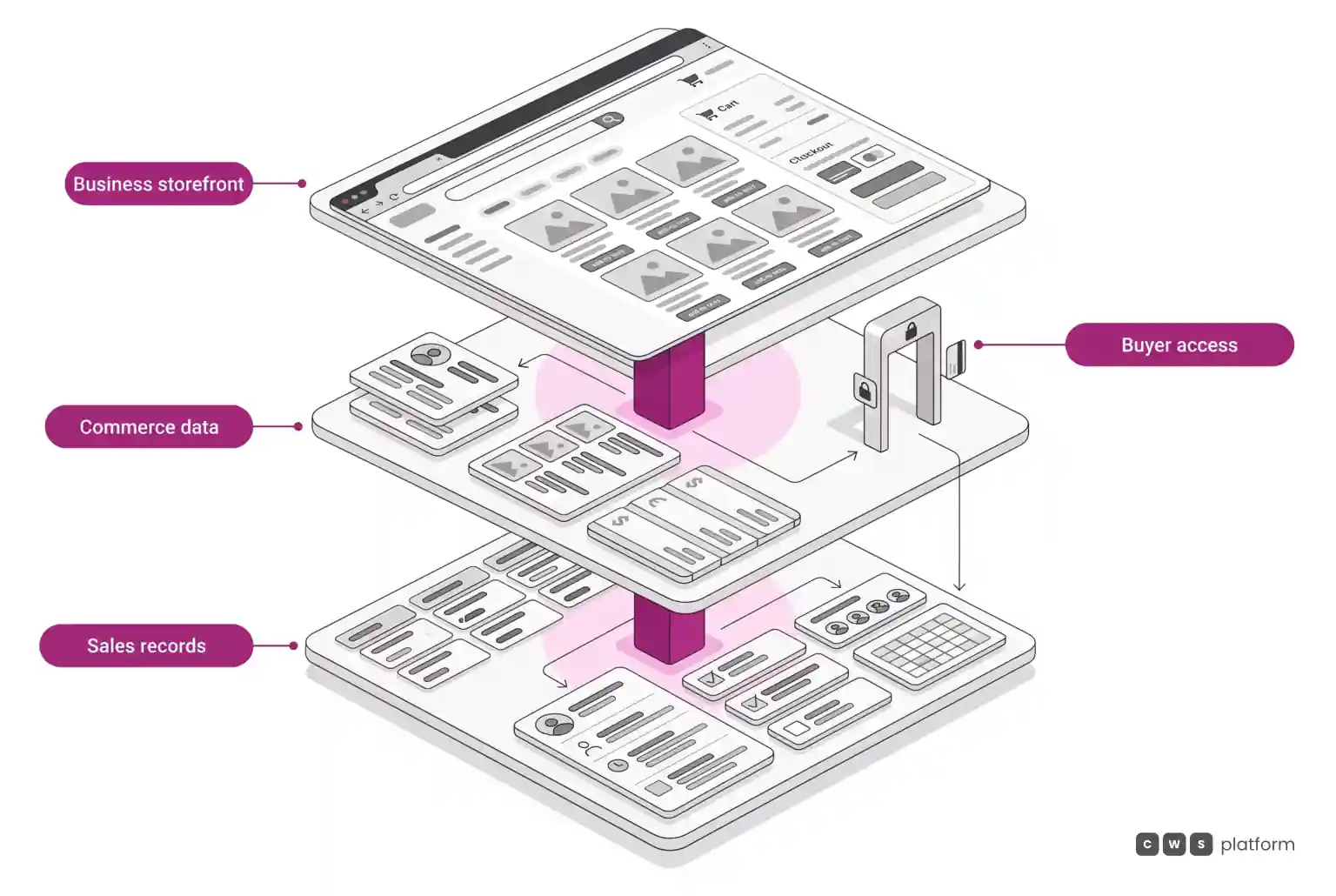
Store preparation includes accounts, products, price books, and entitlements imported through CSV files, with asynchronous processing and a recommendation to use Data Loader for larger imports. This mechanism supports operations that want to structure catalog, access, and purchasing terms using the objects provided by the commerce layer and its import processes.
B2B purchasing access is organized through profiles and permission sets. Buyers can be associated with accounts and groups, can use self-registration, and can also browse as guests. Identity and authorization are therefore tied to the access structure configured for the storefront according to the introductory page.
The documented B2B checkout is customizable, with the option to use third-party providers and adapt the interface. This places a significant portion of the transactional design within the checkout architecture and the integrations selected for the implementation as described by the published mechanism.
On the sales side, the core records leads, accounts, contacts, and opportunities; tracks opportunity progress; and records what is being sold and its value. Configuration also extends to territories, sales teams, pipeline-based forecasts, and revenue and credit splits, providing an enterprise structure for governing sales activity within the sales process.
The sales workspace brings together opportunities, accounts, leads, contacts, calendars, goals, tasks, and recent records. There is also an experience that prioritizes metrics and AI-powered tasks, while summaries and automated data entry support work involving sales records presented in the Sales core overview.
For organizations combining channel models, the same Salesforce org can operate B2B and D2C commerce with shared data and processes. This architecture is relevant when the primary decision involves managing storefronts for different audiences within a common data and process structure.
How the CWS Platform structures it: one shared negotiation, governed before it becomes an order
The CWS Platform focuses on the point where self-service and assisted selling meet. The Assisted Selling Platform (Sales Hub) keeps the buyer and sales rep in the same cart, associates the customer with the assigned book of business, and provides the service context. The rep can follow a deal initiated in the portal without opening a parallel version, while the customer retains everything already selected.
This architecture changes the channel’s role. Instead of capturing an order and handing it to the sales team afterward, the portal becomes the negotiation environment itself. Account ownership remains visible, and the compensation policy can recognize the responsible sales rep even when the customer completes the purchase through self-service.
Pricing is calculated dynamically, considering the product, warehouse, customer profile, and tax rule. Precedence across contracts, rules, and price books makes it possible to present the terms relevant to the context instead of publishing a generic reference and moving the real negotiation to a phone call.
Distributing this logic is a central part of the architecture. A pricing rule may reside in an ERP or another system of record, but buyers and sales reps need to use it without working directly in that system. The portal makes commercial policy available at the decision point and reduces the need to interpret spreadsheets, messages, or local instructions manually.
Exception governance runs through the Commerce Rules Engine (CDL Workspace). Commercial thresholds and approval workflows are applied during the negotiation, with a reason and a record of who changed the decision. When a condition exceeds what can be granted directly, the transaction is routed for approval. When it violates a blocking limit, the order is not created.
Checkout takes place in the Credit-First B2B Checkout (Checkout & Payments). Credit is a native condition of the transaction, and the mechanism validates inventory, pricing, credit, and taxes within the same transaction. Payment terms and credit limits are no longer Finance checks performed after the fact; they become part of order eligibility before confirmation.
After checkout, the Order Management System (OMS / Seller Center) governs the order through defined statuses and requires the operational elements associated with each transition. Invoices and tracking information enter the corresponding workflow, while integration with the ERP or back-office system preserves a shared source of truth about order progress.
The sales support agent can organize account context and prepare a commercial action, but transactional decisions remain subject to deterministic services. AI can guide the journey, suggest a product mix, or flag an opportunity. Pricing, rules, credit, and order status continue to be executed by the mechanisms responsible for them.
That boundary matters to the Commerce Director because it prevents a conversational experience from creating a parallel commercial policy. It also matters to the CFO, who can find the rule and its exception within the workflow. For the sales rep, the practical consequence is clear: serving a customer through the portal means working on the customer’s actual order—not competing over who gets to enter it.
The model also repositions the sales rep as an approver and advisor. In routine transactions, the buyer moves forward independently. When a technical choice, exceptional condition, or cross-sell opportunity arises, the team enters at the appropriate point and works on a deal that has already been prepared.
The right metric is the cost of a sales transaction. Every instance of rekeying data, looking up a price, requesting authorization, checking credit, and reconstructing context adds work without necessarily adding value for the buyer. A negotiation-centered architecture reduces these handoffs by putting the customer, sales rep, and business rules on the same transaction while preserving human intervention where it actually affects the decision.
Where the architectures truly diverge
The divergence begins with the center of gravity. One architecture defines the store through templates, Experience Builder, and Lightning components, while sales records organize accounts, opportunities, territories, and pipeline in a dedicated sales layer. The other starts with a shared cart and brings account ownership, pricing, approvals, and credit into the negotiation.
The point at which pricing acquires meaning also changes. Price books and entitlements are part of store preparation and can be imported with accounts and products through the documented commerce workflow. In the CWS Platform, contextual calculation occurs when the product, warehouse, customer profile, and tax rule meet the buyer’s identity.
Sales assistance follows different paths as well. The Sales core tracks opportunities, activities, forecasts, and revenue or credit splits within the sales process structure. In the CWS Platform, assistance happens inside the shared cart, where the customer and sales rep modify the same deal.
Checkout also reflects an architectural choice. B2B Commerce uses a customizable checkout with third-party services and an adaptable interface according to the storefront documentation. In the CWS Platform, credit and commercial validations are treated as native components of transactional eligibility.
Ultimately, the question is not which environment has more features, but which type of complexity must be absorbed. When the dominant requirement is to structure the storefront, access, and enterprise objects, templates, profiles, and permission sets carry the weight in the published mechanism. When the dominant requirement is to prevent the portal from breaking the B2B negotiation, the emphasis falls on account ownership, the shared cart, contextual pricing, business rules, credit, and governed orders.
Salesforce's own documentation records two limits that an operation with a sales team runs into:
- limitation recorded in the vendor's documentation, consulted on October 9, 2026: the account switcher degrades beyond 200 accounts and fails at 2 thousand ("At 2 thousand Buy For accounts the Account Switcher fails.", https://developer.salesforce.com/docs/commerce/salesforce-commerce/guide/b2b-b2c-comm-data-model-shopper-buyer-groups-accounts-limits.html).
- limitation recorded in the vendor's documentation, consulted on October 9, 2026: each pricing call evaluates at most 25 price books, and a store accepts 5 assigned price books ("Price books above the 25 limit are not included in the price evaluation.", https://developer.salesforce.com/docs/commerce/salesforce-commerce/guide/b2b-b2c-comm-data-model-price-book-limits.html).
| Decision | Salesforce, based on the documented mechanism | CWS Platform |
|---|---|---|
| Where commercial identity lives | Organizes buyers through accounts, groups, profiles, and storefront permissions. | Connects the buyer, assigned book of business, and sales rep to the negotiation context. |
| Where pricing policy is expressed | Prepares price books and entitlements within the commerce structure. | Calculates pricing by contract, rule, profile, warehouse, and tax context. |
| When the sales rep enters the journey | Guides the seller through opportunities, tasks, pipeline, and sales records. | Places the sales rep in the same cart initiated by the buyer. |
| Where commercial exceptions are governed | The B2B Commerce introductory page does not describe discount approval authority; the workflow remains part of the implementation design. | Applies thresholds and approvals during the negotiation, with a reason and audit trail. |
| When credit participates in checkout | Builds B2B checkout with customizable services and interfaces. | Validates payment terms and credit limits before creating the order. |
| Where order management lives | Shares data and processes across channels configured in the org. | Governs statuses, invoices, tracking, and integration with the back-office system. |
The decision should follow the operation that needs to be governed. A B2B portal with a sales force requires consistency across incentives, identity, pricing, approvals, credit, and orders. When these elements remain separate, the customer finds an online store, but the company continues negotiating outside it.
When Salesforce is the right choice for this scenario
In some scenarios, the central requirement lies in the enterprise structure, storefront development, or coexistence of different channel models. In those cases, fit should be evaluated based on the documented mechanism—not a generic feature list.
The project begins with enterprise sales governance. Choose this architecture when the priority is organizing leads, accounts, contacts, and opportunities together with territories, sales teams, pipeline forecasts, and revenue or credit splits. The documented mechanism concentrates these elements in the core sales process and gives the seller a workspace based on those records and activities.
The implementation requires a storefront built within the Lightning ecosystem. Choose this architecture when the requirement is to create the store from templates, customize pages in Experience Builder, and configure search, cart, checkout, and payment through Lightning components. It also supports projects that want to import accounts, products, price books, and entitlements using the processes provided for the B2B storefront.
The organization needs to share processes across B2B and D2C commerce. Choose this architecture when the same Salesforce org must operate B2B and D2C channels using shared data and processes. This mechanism is appropriate when combining channels and storefronts within the same enterprise environment is a central criterion of the commerce initiative.
Storefront access must follow a declarative permission structure. Choose this architecture when buyers need to be associated with accounts and groups, with access governed by profiles and permission sets. The architecture also supports self-registration and guest browsing, providing different entry paths based on the policy defined for the storefront in the documentation.
Where to go next
If your question is still which architecture fits your operation—not which vendor to choose—continue with the seven questions that separate B2B commerce architectures.
If the current obstacle is the business pain behind this scenario, When Channels Compete With Each Other and When Selling More Does Not Mean Earning More explore it in depth without discussing any vendor.
"responsive, technically engaged, and willing to work through complex commercial rules (negotiated pricing, credit, customer-specific conditions) rather than pushing generic answers"
Want to see this in your operation?
Real B2B operations already run on it.