Salesforce vs. CWS Platform: Which Architecture Supports Branch-Level B2B Self-Service?
The key difference is where inventory, pricing, credit, tax, and commercial rules are resolved before an order is created.

Editorial note: an architecture comparison between Salesforce and the CWS Platform for a multi-location, self-service B2B portal scenario. Every statement about Salesforce comes from its public documentation, with the source linked alongside it.
Salesforce and the CWS Platform can both play a role in a B2B portal project, but the relevant decision does not begin with a feature checklist. Salesforce documentation describes creating stores from templates, customizing the experience, and configuring search, cart, and checkout. The question for the Director of Digital Commerce is where the architecture will place the commercial complexity of each location, customer, and order within the commerce experience.
For a distributor with multiple branches or fulfillment locations, publishing a catalog is only the beginning. Buyers need to sign in, be recognized, check availability from the location that actually serves them, receive their negotiated pricing and terms, find products without relying on the distributor’s internal SKU, and complete a purchase that is already consistent with credit, tax, and inventory requirements.
The architecture decision should therefore follow the type of operation being digitized. If the portal standardizes prices, combines inventory that cannot actually fulfill the same order, or sends the order back to a sales rep for review, it digitizes the interface while preserving the transaction cost that kept routine orders on the sales desk.
The scenario: the portal must represent the location that actually sells
This scenario involves a distributor whose branches or fulfillment locations serve different territories, account portfolios, or customer segments. Each origin may operate with its own availability, pricing policies, credit terms, commercial conditions, and tax restrictions. For the buyer, however, the journey needs to feel simple: sign in, find the product, confirm the terms, and buy.
That external simplicity depends on internal granularity. The portal cannot treat the entire company as one virtual warehouse when picking, invoicing, and shipping take place at a specific location. Nor can it display a generic price list when the actual agreement depends on the customer’s identity and the location serving the account.
The primary lens is that of the Director of Digital Commerce, because this leader must decide whether the digital channel will be only a storefront or an executable extension of commercial policy. The CFO looks at credit exposure, pricing consistency, and cost to serve. The CTO evaluates where rules reside, how systems exchange context, and which component governs the order after checkout.
For a B2B digital sales operation, self-service does not mean removing the sales rep from every situation. It means allowing routine orders to flow without intervention while reserving people for negotiation, exceptions, and technical guidance. This separation also makes it possible to measure where buyers move forward without assistance and where the journey still returns work to the team.
The six decisions this scenario requires
Before comparing architectures, the company must answer the decisions that determine whether the portal will represent the real operation or a simplified version of it.
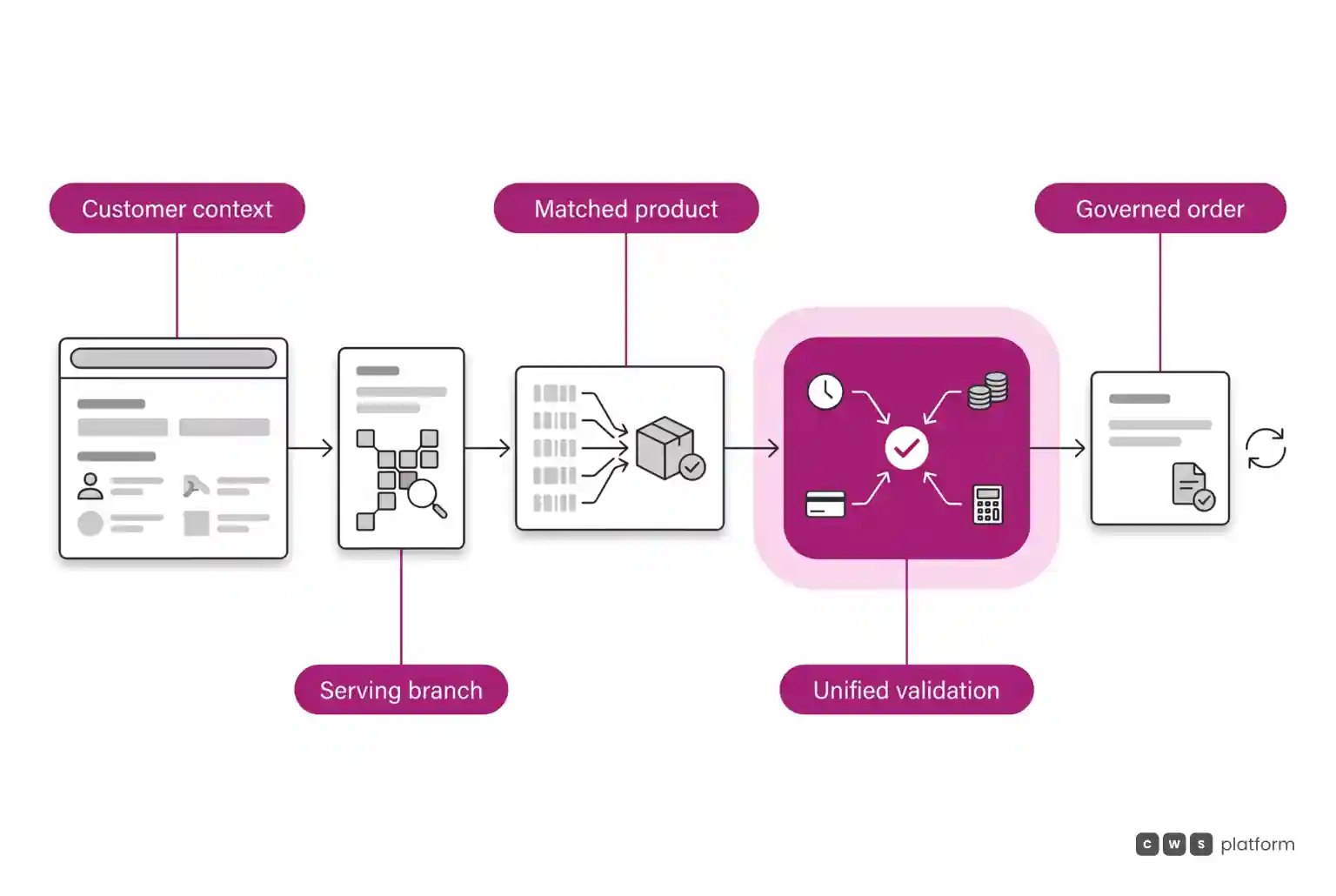
1. Which location serves the customer. The fulfillment origin must be resolved before availability is shown to the buyer. If the promise relies on an abstract total, the portal may offer inventory that cannot be picked at the location responsible for the order. The architectural decision is to connect identity, territory, or account assignment to the origin that will own the transaction.
2. Where the buyer’s price comes from. Commercial policy must account for who is buying and where the order will be fulfilled. A standardized price list reduces apparent complexity but erases intentional differences based on cost, territory, contract, and customer profile. The central issue is governing the rule that determines the price rather than publishing one generic value across the entire network.
3. What the portal loads when the buyer signs in. Authentication must retrieve commercial context, not merely grant access to private pages. Customer group, payment terms, available credit, and origin-specific parameters need to follow the session. When they do not, the portal transfers to the sales rep the task of reconstructing the deal outside the channel.
4. How buyers find products on their own. Product discovery should begin with the language buyers use. Manufacturer part numbers, customer-specific identifiers, and technical attributes need to converge on a governed product identity. Otherwise, self-service remains limited to buyers who already know the distributor’s internal SKU system.
5. What checkout verifies before accepting the order. Cart acceptance must be a single transactional decision. Availability, price, credit, and tax must be validated against the same context before the order is created. This prevents an on-screen confirmation from being followed by financial renegotiation or manual correction.
6. How routine orders are repeated. Replenishment should use context from previous orders without turning history into a blind copy. Items, fulfillment origin, and terms can provide a starting point while current rules are applied again. This allows recurring purchases to reduce effort without carrying forward outdated availability or pricing.
What creates friction today, in the words of operators
Statements heard in the field reveal architectural decisions that often appear disguised as operational problems.
“The portal shows inventory that is no longer available.” This statement exposes the decision about the scope of availability: promise a company-wide total or display the inventory at the origin that can actually fulfill and invoice the order.
“Every customer has different pricing. There is no way to put that on the website.” This reveals the decision about where pricing policy will be executed. The problem is not merely displaying a number, but distributing a rule that depends on identity and fulfillment origin without forcing the buyer into the distributor’s ERP.
“We standardized the price list because maintaining different prices by location and customer became impossible to manage.” This reveals that simplification was used as an operational workaround. The real decision is whether to preserve commercial granularity and make it governable in the digital channel.
“Every new customer costs more to serve than the one before.” This exposes the decision about where routine orders are handled. If identification, catalog access, pricing, credit, and validation still require human work, channel growth merely shifts the cost to the sales team.
How Salesforce structures the B2B store in this scenario
The documented architecture begins with creating a template-based B2B store. The experience can be customized in Experience Builder, while search, cart, checkout, payment, and other store settings are configured with Lightning components. The initial emphasis is therefore on building and administering the storefront within the commerce environment.
Store access is associated with accounts, buyers, profiles, and permission sets. Salesforce also supports self-registration and guest browsing, allowing different journeys to be designed according to authentication status and company affiliation. This mechanism organizes who can enter and what they can access through the identity and permission structure.
Accounts, products, price books, and entitlements can be imported through CSV files, and the documentation directs larger data loads to Data Loader. This places a relevant share of commercial and catalog preparation in the data import and administration processes that feed the store before the purchasing experience.
For B2B stores, checkout is documented as customizable, with the option to use third-party providers and customize the interface. In a multi-location project, this characteristic requires technical discovery to specify how the customization will receive fulfillment origin, availability, price, credit, and tax information—and how those data points will remain consistent throughout the transaction within the checkout flow.
The same organization can also operate B2B and direct-to-consumer channels with shared data and processes. When a company intends to manage business and consumer experiences in the same environment, this design shifts the discussion toward channel governance with shared processes.
How the CWS Platform assembles it: the location becomes the order’s transactional context
In the CWS Platform, the starting point is to treat the warehouse or fulfillment location as an operational configuration unit. Distributed Inventory (Inventory Hub) keeps availability connected to the origin serving the buyer. Instead of using an abstract total as the promise, the journey checks the operational scope that will own picking and delivery.
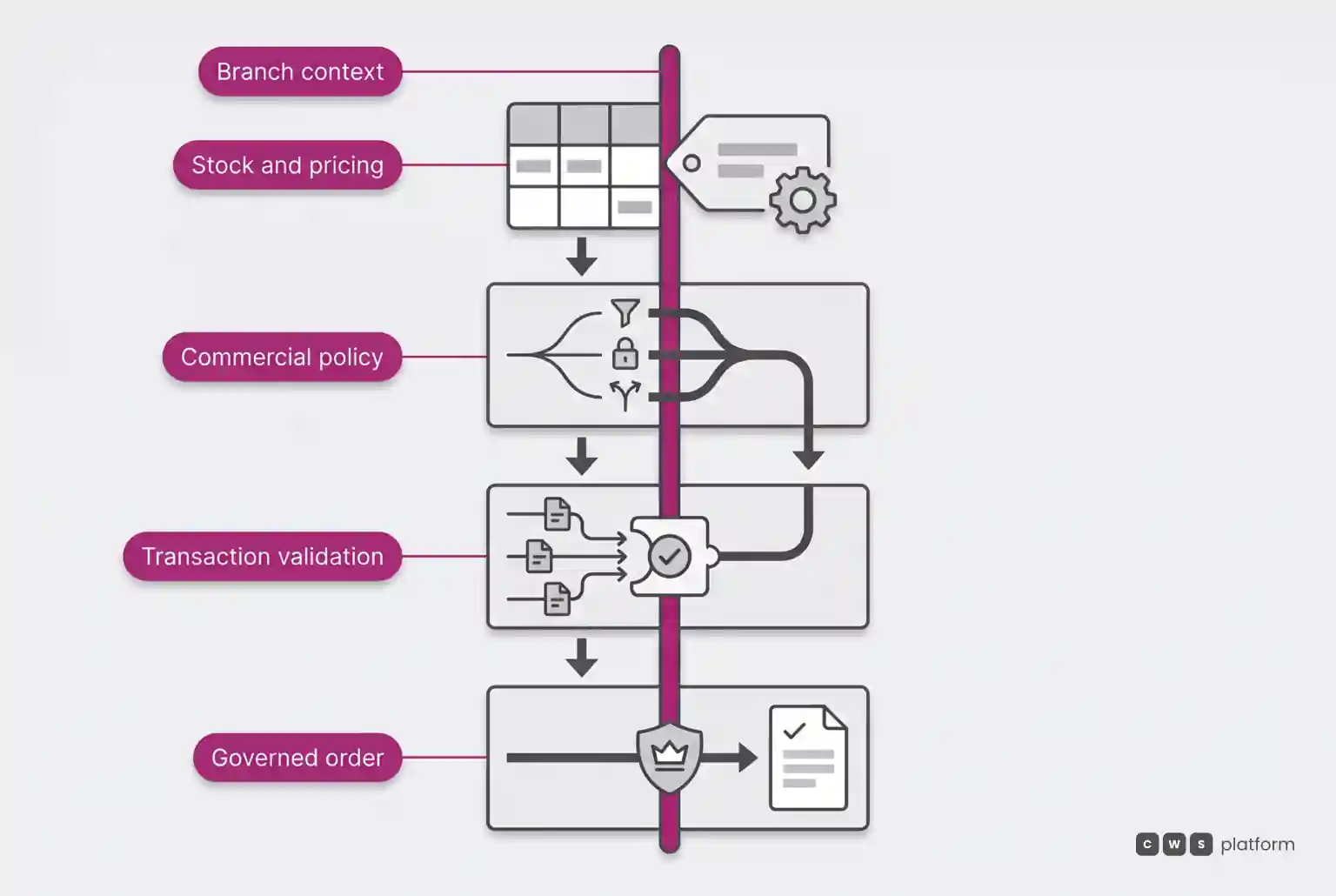
Contextual Pricing (Pricing Engine) calculates price based on the product, warehouse, customer profile, and tax rule. The displayed price is no longer a value from a general price list; it becomes the result of the transaction context. The governed source is not an isolated number but the rule combining identity, origin, and commercial terms.
Commerce Rules Engine (CDL Workspace) executes commercial rules as code and requires a reason and comment for changes. This layer receives the purchase context and governs permissions, credit, tax compliance, and commercial restrictions without transferring the logic to an agent prompt or improvised front-end decisions.
Credit-First B2B Checkout (Checkout & Payments) treats credit as a native part of B2B payment. Before accepting a purchase, the flow validates inventory, price, credit, and tax in the same transaction. When the context fails to satisfy the rules, the order is not created, preventing an apparent confirmation from returning to the finance team as a manual exception.
Product Catalog & MDM (Catalog Engine) structures the product truth used throughout the commercial journey. Its role is to maintain product identity and data in a governed layer so that search, cart, and order processes reference the same commercial item—even when the buyer, supplier, and system of record use different identifiers.
Order Management System (OMS / Seller Center) becomes the source of transactional truth after acceptance. The order progresses through governed states, and transitions require the corresponding documents and events, such as an invoice before fulfillment and tracking before shipment. Query APIs expose customer, delivery, payment, tax, invoice, and status-change records.
For reordering, the governed order history provides the previous context as a starting point, while availability, price, credit, and tax pass through current rules again. The operation preserves the convenience of repetition without turning an earlier purchase into permanent authorization.
The sales support agent can prepare context and recommend the next action when negotiation or an exception is involved. It does not replace deterministic mechanisms: catalog, inventory, price, rules, checkout, and order services remain responsible for executing and governing the transaction. The sales rep participates as an approver or advisor when the journey requires commercial judgment.
Transaction cost is the benchmark because the value of self-service appears when routine orders no longer require manual reconstruction. Every avoided inquiry to a sales rep, finance team, or branch represents a decision that is now resolved within the flow itself. The goal is not to remove people from the operation, but to focus them on the exceptions and negotiations where their involvement changes the commercial outcome.
Where the architectures truly diverge
One architecture places the emphasis on a configurable storefront, account and permission relationships, and checkout customization through services and interface components. The documentation also provides for importing accounts, products, price books, and entitlements to feed the experience through the store’s administrative mechanisms.
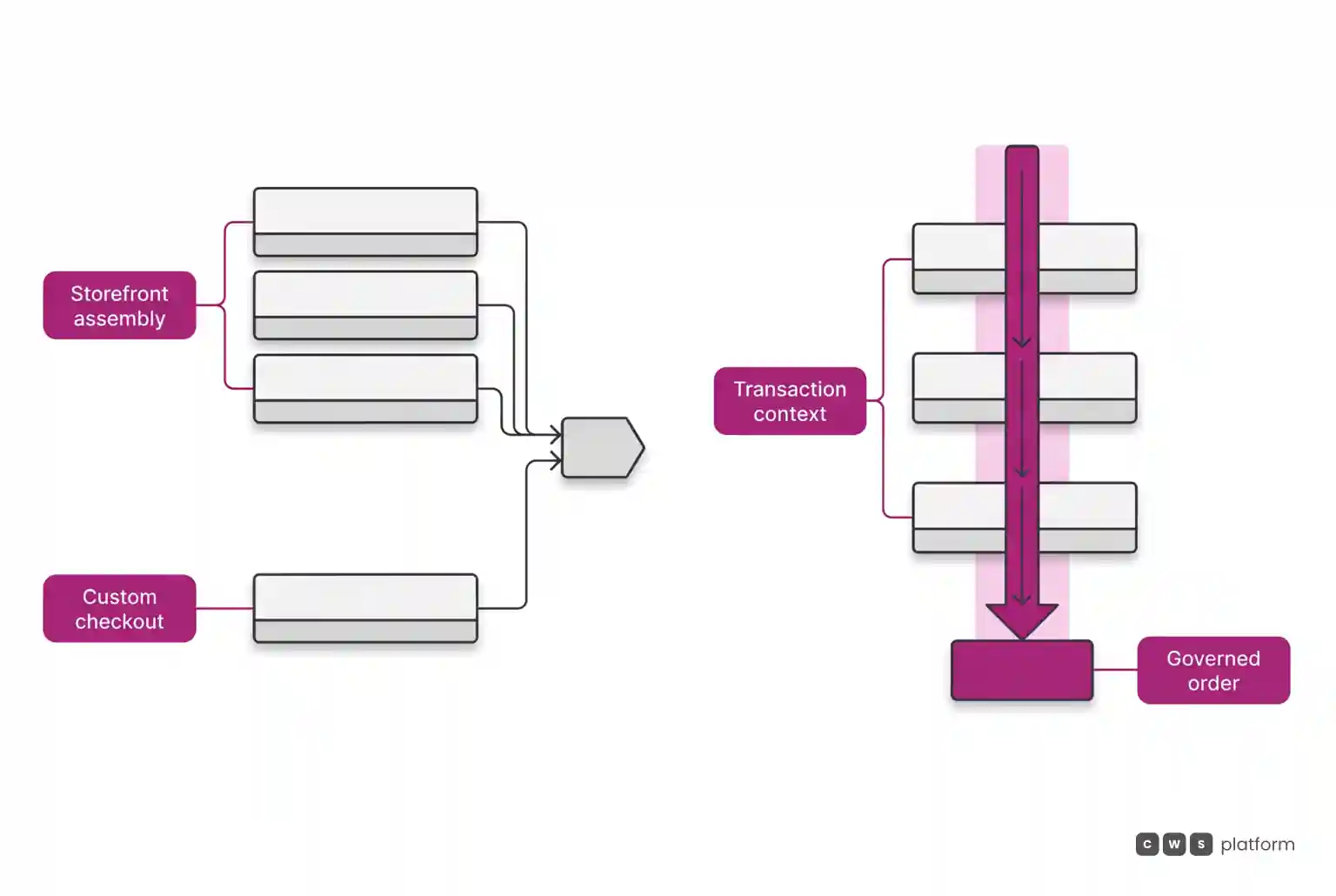
The other architecture places the emphasis on the transactional context of the fulfillment origin. Inventory, price formation, rules, credit, tax, and order states are executed by specialized mechanisms, while the portal presents the governed outcome to the buyer. The practical difference is whether the branch or fulfillment location is merely a segmentation of the experience or the unit that actually forms and owns the transaction.
This divergence changes the project agenda. Instead of asking only how to publish pages, catalogs, and checkout, the Director of Digital Commerce must map the serving origin, the data loaded through identity, and the checks required before order creation. The CFO can then examine price and credit exposure within the same flow, while the CTO defines clear contracts between experience and execution.
It also changes the role of reordering. Order history reduces work only when it can start a new journey without blindly reusing expired terms. The architecture must separate the convenience of repetition from commercial revalidation, preserving a short path for the buyer and governance for the operation.
Salesforce's own documentation records two limits in segmentation by buyer groups:
- limitation recorded in the vendor's documentation, consulted on October 9, 2026: search indexes only the first 2,000 buyer groups of a product ("During search indexing, only the first two thousand buyer groups for a product are included in the index.", https://developer.salesforce.com/docs/commerce/salesforce-commerce/guide/b2b-b2c-comm-data-model-entitlement-limits.html).
- limitation recorded in the vendor's documentation, consulted on October 9, 2026: extending buyer groups through Apex requires disabling the Salesforce CDN and Edge Network ("disable both the Salesforce Content Delivery Network (CDN)", https://developer.salesforce.com/docs/commerce/salesforce-commerce/guide/b2b-b2c-comm-data-model-shopper-buyer-groups-accounts-limits.html).
| Decision | Salesforce, based on the documented mechanism | CWS Platform |
|---|---|---|
| Where the location enters the transaction | The store expresses segmentation through accounts, access, and data loaded into the experience. | The warehouse defines the inventory, pricing, and rules context applied to the order. |
| Where commercial policy is expressed | The store receives price books and entitlements administered in the commerce environment. | The engine calculates price by product, warehouse, customer profile, and tax rule. |
| When checkout makes the decision | The customized checkout invokes services through an interface adapted to the project. | Checkout validates inventory, price, credit, and tax before creating the order. |
| Where the order truth resides | The experience routes the purchase through the flow configured for the store. | The orchestrator governs states, documents, delivery, and transition records. |
| When reorder uses prior context | The journey reconstructs the purchase according to the storefront experience that was implemented. | History starts the replenishment journey, and current rules recalculate the transaction. |
| How an order with several origins is paid | The customized checkout connects the payment providers selected for the project. | The same order accepts more than one payment method, with credit, restrictions, and receivable splits defined by rule for each origin and customer. |
The table should not be read as a scorecard. It shows where each design concentrates responsibility. The choice depends on whether the dominant complexity lies in composing channel experiences or in commercial execution by fulfillment origin, customer, and order.
When Salesforce is the right choice for this scenario
Some operations have a core requirement that calls for the other vendor’s documented architecture. In those cases, the fit should be recognized through the mechanism that serves the project rather than turned into a generic feature comparison.
The priority is building the storefront in the Lightning ecosystem. Choose this architecture when the team needs to start with templates and customize the store in Experience Builder while keeping search, cart, and checkout within the Lightning model. This requirement is especially concrete when administrators and implementation partners already organize the experience around these components documented for the B2B store.
The company wants to share processes across business and consumer channels. Choose this architecture when the program requires operating B2B and D2C channels in the same organization with shared data and processes. The documented mechanism supports a company-wide channel governance decision, not only a branch replenishment order within the same organization.
The project depends on a checkout assembled with third-party providers. Choose this architecture when the requirement is to design a customized checkout and connect external providers that deliver specific services during the purchase. The documentation provides for this composition and interface customization, which fits programs centered on building a proprietary journey on top of services selected by the company within B2B checkout.
Store data will be maintained through managed import processes. Choose this architecture when accounts, products, price books, and entitlements will be prepared and imported through CSV files, with Data Loader used for larger volumes. This mechanism serves organizations that already structure store publishing around administrative data routines connected to the commerce environment.
When the CWS Platform is the right choice for this scenario
The same test applies in the other direction. In some operations the dominant complexity is not composing the experience but executing each branch's transaction with the right rule, from inventory to payment. In those cases, what decides is the mechanism that forms the order.
Each branch has to operate as a commercial unit, not as a storefront filter. Choose this architecture when inventory, price, freight, payment methods, and credit change with the fulfilling origin. In the CWS Platform, the inventory origin is the unit of configuration: each branch carries its own catalog, pricing, logistics, payment, credit, and discount ceiling within the rules set by headquarters, and price contracts can be maintained per branch. Opening a new branch, or inviting a partner's inventory, becomes configuration rather than a new project.
One cart brings together several origins and several ways to pay. Choose this architecture when the buyer builds an order that ships from more than one distribution center and wants to pay for parts of it in different ways. The cart splits by origin, each fraction gets its own freight and tax, and the same order accepts more than one payment method: part on credit terms, part by bank slip, card, or Pix. The rules combine: credit types with limit and balance per customer, payment restrictions per customer group, contracts per branch, and receivable splits between participants, configured in the CDL Workspace or maintained through APIs, with or without the card and Pix services of integrated payment providers. Terms, limit, inventory, price, and tax are checked before the order exists.
Customer and sales rep need to work on the same order. Choose this architecture when the branch sale is hybrid: the buyer starts the cart, the rep adjusts price, terms, quantity, or payment method within their approval limit, and the buyer completes it. Both profiles use the same application, on the same order and the same rules engine, and the order records who built the cart and who selected the payment. The rep can also build a cart with the items and the origin of each one and send the link for the customer to close. There is no parallel quote to reconcile, and a commercial policy change made in the CDL Workspace applies to self-service and to the rep at the same time.
The operation needs to integrate without replacing what already works. Choose this architecture when the ERP remains the system of record and the company already has a CRM, a tax engine, and payment providers. The CWS Platform is API-first and headless: inventory and price per branch, customers and groups, credit limits, contracts, price rules, carts, and orders flow through REST APIs, and the platform notifies the company's systems through webhooks. Tax calculation can be delegated to the tax engine the company already uses, called at order time. The ERP remains the source for tax and finance, and the corporate CRM, Salesforce included, remains the source of the relationship.
Platform cost must not grow with digital sales. Choose this architecture when the plan is to bring more branches, more sales reps, and more integrated orders into the same channel. The CWS Platform charges for license use and technology consumption, with no percentage on transactions in its standard model, and an order taken by a rep or integrated from another system is the same order as a self-service one. The B2B Commerce pricing page describes a different design: a percentage of GMV and a separate charge, beyond the included limits, for orders processed outside the storefront with Order Management.
Where to go next
If your question is still which architecture fits your operation—not which vendor to choose—continue with the seven questions that separate B2B commerce architectures.
If the obstacle today is the underlying pain in this scenario, When the Catalog Becomes Chaos and When Selling More Does Not Mean Earning More explore it in depth without discussing any vendor.
"responsive, technically engaged, and willing to work through complex commercial rules (negotiated pricing, credit, customer-specific conditions) rather than pushing generic answers"
Want to see this in your operation?
Real B2B operations already run on it.