Salesforce or CWS Platform: Who Governs Commercial Execution Without Vendor Lock-In?
An architectural comparison from the CEO's perspective: CRM centralization versus deterministic commerce engines.

Editorial note: architectural comparison between Salesforce and CWS Platform, written for those answering as CEO. Every fact about Salesforce comes from its public documentation, with the URL alongside.
For executive leadership, choosing a commercial platform rarely comes down to a software feature checklist. The fundamental question the CEO must answer involves long term governance: which service delivery model does this architecture leave me dependent on, and how quickly can my commercial operation adapt when market conditions require new business rules?
When evaluating Salesforce, the board often encounters a comprehensive enterprise ecosystem designed to consolidate relationship records, sales pipelines, and multi channel automation. However, when distribution complexity demands dynamic commercial rules by branch, contextual price lists, and frontline autonomy without continuous code rebuilds, the ecosystem architecture imposes constraints that affect total cost of ownership and the pace of strategic decisions.
The comparison between Salesforce and CWS Platform must be framed through the lens of commercial execution. The critical challenge is not competing over who accumulates more horizontal CRM features, but identifying where the transactional source of truth lives and how each architectural design protects corporate margin and organizational agility under operating cost pressure.
O que a Salesforce resolve bem
Salesforce excels at centralizing enterprise records around leads, accounts, contacts, and opportunities within Sales Cloud. The underlying engine supports sales pipelines with detailed tracking of deal values, sales territories, revenue splits, structured forecasting, and multi currency operations. The unified interface across Seller Home and Sales Workspace organizes commercial routines with goals, tasks, and predictive automations powered by Einstein.
In the transactional commerce environment, B2B Commerce on Commerce Cloud provides the capability to launch digital storefronts using customizable templates and components within Experience Builder. The framework manages price books, products, and entitlements through profile and permission set controls, supporting authenticated account buyers as well as open guest browsing, alongside unified B2B and D2C channels within the same organization.
For intelligent process orchestration, Agentforce offers an extensible environment where agents select topics and subagents to trigger actions via Agent Script, blending natural language instructions with programmatic logic for conditional evaluation and variable handling. Developing and testing these workflows can be coordinated using the Salesforce CLI, a dedicated Python SDK, and session APIs.
Onde a arquitetura diverge
The fundamental architectural divergence lies at the boundary between customer relationship management and deterministic transaction governance. While Salesforce anchors its operations in the CRM data model, requiring custom objects and data schema extensions to capture complex market variations, CWS Platform builds governance directly from the transactional commerce engine.
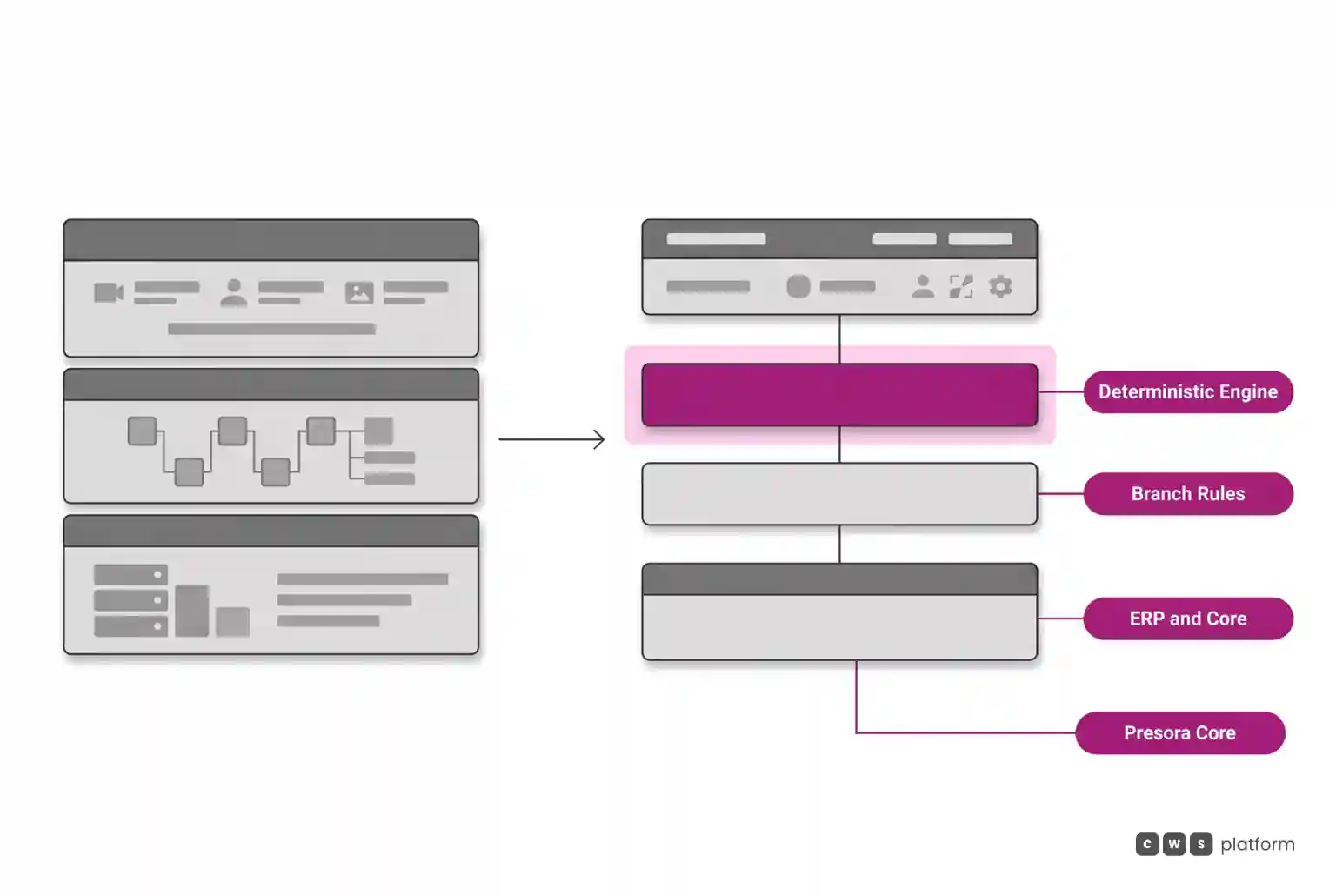
When an enterprise must enforce strict tax rules, buyer specific tiered pricing, and inventory distributed across regional warehouses, treating pricing as static CRM data creates ongoing friction. As noted by Gartner (2024), over 90% of CIOs report that managing costs restricts their ability to extract full value from artificial intelligence, warning that a lack of insight into generative model cost scaling can lead to estimation errors between 500% and 1,000%. If commercial validation requires unrestricted inference calls or heavy ERP integrations for every line item, runtime operating costs and latency undermine fulfillment speed.
At CWS Platform, the core thesis is that AI orchestrates the journey while the platform executes business rules deterministically. Modules such as the Commerce Rules Engine (CDL Workspace) and Contextual Pricing (Pricing Engine) enforce credit, tax, and margin controls in pure code before any order is submitted, eliminating backoffice rework and preventing logic fragmentation across third party custom scripts.
Salesforce's own documentation records two limits that weigh on whoever keeps the rule running:
- limitation recorded in the vendor's documentation, consulted on October 9, 2026: by default shipping carries no charge, and calculating it requires extending an Apex class ("By default, there's no charge for shipping", https://developer.salesforce.com/docs/commerce/salesforce-commerce/guide/available-extensions.html).
- limitation recorded in the vendor's documentation, consulted on October 9, 2026: the cap is 5,000 promotions per org, counting inactive ones ("This limit includes both active and inactive promotions.", https://developer.salesforce.com/docs/commerce/salesforce-commerce/guide/b2b-b2c-comm-data-model-promotions-limits.html).
| decision | Salesforce, per documented mechanisms | CWS Platform |
|---|---|---|
| Where commercial policy is expressed | Stores price books and entitlements linked to accounts and permission sets | Computes contextual rules directly in the engine combining branch, buyer, and contract terms |
| System extension and integration pathway | Requires development within a proprietary ecosystem using Apex, SDKs, and managed packages | Exposes an API first, headless architecture connectable to external ERPs and tax calculation engines |
| Where shared order management lives | Tracks opportunities in CRM while digital storefronts run custom checkouts via partner solutions | Records sales rep and buyer on the same transaction with explicit attribution audit trails |
| Cost model structure and predictability | Bases costs on user licenses combined with consumption credits and add on AI capacity packs | Structures billing on software licensing and technology throughput with zero revenue take rates |
This architectural distinction determines business dependency: entrusting transactional governance to an ecosystem that requires continuous custom proprietary coding slows executive leadership down when channel policies must pivot.
O que muda na operação, pela lente de CEO
In day to day wholesale and commercial operations, vendor lock in becomes apparent when simple adjustments to minimum margins, regional terms, or payment schedules require months of professional services validation. The CEO experiences the cost of this friction when the sales organization cannot support dynamic negotiations without manual ERP intervention.
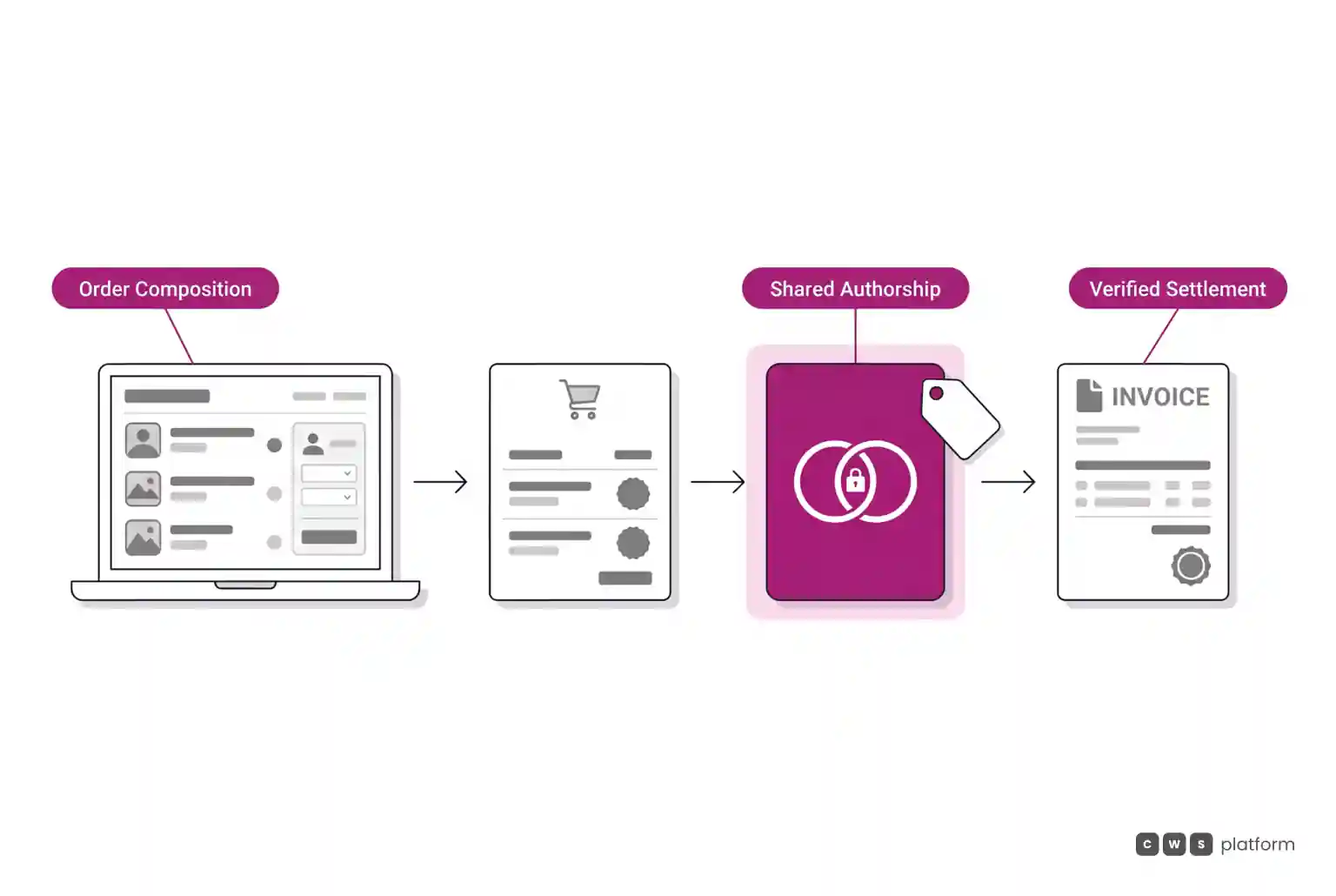
Research from McKinsey & Company (2025) indicates that a 1% price improvement drives an 8.7% lift in operating profit when sales volume remains steady. When a commercial platform forces teams to flatten price structures due to an inability to resolve complex warehouse and account conditions in real time, margin is surrendered at the source for the sake of operational simplicity.
Sustainable governance requires executive leadership to maintain strict control over commercial execution rules. Outside reps and self service digital buyers should transact under unified corporate policies without jeopardizing the accuracy of invoicing and sales tax compliance data.
Where the operational friction originates, and how the architecture solves it:
| pain point | why it happens | how the architecture solves it |
|---|---|---|
| “We flattened our pricing because the system cannot handle the matrix, leaking margin at checkout” | Legacy systems cannot process overlapping matrices across fulfillment centers, product tiers, and buyer classes, forcing artificial price leveling to keep administration manageable. | The platform configures catalogs, localized price books, and discount caps independently per facility and buyer, treating commercial policies with modular precision without manual updates. |
| “Our sales reps worry the digital portal will eliminate their commissions” | Field reps view online order channels as a direct threat to comp plans when systems isolate manual rep workflows from self service checkouts. | The platform explicitly tracks who built the order and who finalized the transaction, allowing account reps to build carts and share direct links with buyers while protecting rep commission attribution. |
| “Expanding AI across operations causes inference costs to spiral out of control” | Lacking a deterministic business rules layer, basic inquiries regarding credit caps, tax rules, and warehouse inventory get routed through high cost generative model prompts. | Policy checks, discounts, and tax lookups run natively in deterministic code and API services, preventing redundant LLM inference calls and maintaining predictable cloud budgets. |
Quando escolher a Salesforce
Salesforce is the recommended choice when the strategic objective is standardizing enterprise CRM pipelines, opportunity stages, and global customer support at scale.
Enterprises requiring global sales pipelines and enterprise workforce management. Choose this architecture when the organization needs structured pipeline tracking across global business units with revenue splits, advanced forecasting, commission structures, and multi currency territory management. The Sales Cloud engine delivers deep territory automation, forecasting hierarchies, and predictive guidance within Seller Home and Sales Workspace.
Large scale omnichannel contact centers and enterprise service desks. Choose this architecture when the core project centers on contact center governance, complex support routing, case management, and telephony integration. The Service Cloud platform provides Omni-Channel routing, specialized agent consoles, and structured escalation paths for high volume enterprise support teams.
Custom autonomous agent workflows built directly atop the CRM database. Choose this architecture when business logic is already deeply embedded in Salesforce records and the engineering team plans to deploy tailored programmatic agents. Agentforce offers the framework to chain topics, specialized subagents, and conditions via Agent Script, Salesforce CLI, and dedicated session APIs.
Quando a CWS Platform é a escolha certa neste cenário
Choose CWS Platform when the operational priority is multichannel commercial execution, decentralized distribution center autonomy, and enterprise margin protection.
Operations demanding decentralized pricing and business rules across fulfillment hubs. Choose this architecture when individual branch locations or distribution centers require independent catalogs, custom price books, credit terms, and fulfillment policies within a centralized governance model. Each regional entity functions as an independent configuration unit, enforcing customer contracts and discount guardrails without flattening national strategy.
Assisted sales workflows where the rep and buyer build orders collaboratively. Choose this architecture when outside reps and B2B procurement buyers need shared tools to finalize orders. Reps can assemble multi warehouse carts, structure custom discounts, and generate direct links for buyer review, while the platform maintains a clean audit trail of who created the cart and who authorized payment.
Complex B2B transactions requiring custom credit lines, terms, and payment splits. Choose this architecture when closing transactions requires flexible terms, such as splitting totals across trade credit, automated clearing house (ACH), wire transfers, or commercial credit cards. The transactional engine validates these combinations against enterprise credit rules, exposing clear API maintenance pathways and direct connectivity to financial platforms.
Modern enterprise architectures demanding headless flexibility and predictable software costs. Choose this architecture when IT leadership requires an API first, headless foundation using REST APIs and webhooks to integrate existing ERPs and specialized tax calculation engines. The model supports decoupled frontend innovation on transparent, usage based infrastructure pricing with zero gross merchandise value (GMV) revenue share fees.
Por onde continuar
If the primary evaluation is determining which architecture matches your operating model rather than choosing a software vendor, review as sete perguntas que separam as arquiteturas de comércio B2B.
If your immediate challenge stems from the operational pain points discussed here, the guides Quando Vender Mais Não Significa Ganhar Mais and Quando os Canais Brigam Entre Si analyze these root causes in depth, without commercial product positioning.
"responsive, technically engaged, and willing to work through complex commercial rules (negotiated pricing, credit, customer-specific conditions) rather than pushing generic answers"
Want to see this in your operation?
Real B2B operations already run on it.