SAP Commerce Cloud vs. CWS Platform: Does Your License Scale with Sales Volume?
A comparison from the CFO point of view: what enters the license calculation base and where commercial policy is maintained.

Editorial note: an architecture comparison between SAP Commerce Cloud and CWS Platform, written for those who answer as CFO. Every fact about SAP Commerce Cloud comes from its public documentation, with the address next to it.
At the CFO's table, the question about the B2B commerce platform usually arrives late, when the technical choice has already been made and the contract is in its final stretch: how does this license behave when the operation grows? There are two models in play. In one, the license amount follows the volume sold or the number of orders. In the other, the license is for the platform and does not depend on what goes through it.
This comparison looks at SAP Commerce Cloud and CWS Platform only from that angle: what enters the license calculation base, what happens with returns and cancellations, and where commercial policy is maintained. It is not a feature ranking.
What SAP Commerce Cloud solves well
SAP Commerce Cloud is designed for large-scale ecosystems that demand global standardization and close connectivity with the central management environment. The platform allows the catalog to be integrated with tables replicated from the back end or rules to be executed synchronously, with options such as disabling Synchronous Pricing for Catalog to enable batch updates through delta uploads.
For companies that use the cloud infrastructure on version 2211, the solution structures its customizations through extensions and AddOns on a Git repository, connecting commerce services through Omni Commerce Connect. This model serves multinational organizations that operate under strict standards of build control and corporate governance in software engineering pipelines.
In corporate self-service, the suite's Cloud ERP edition provides quote-to-order flows, catalogs customized by account, and integration with back-end invoice data, adopting the clean core strategy. For assisted service, the Assisted Service Module allows service staff with the agent role to start sessions in the storefront from the SAP CRM Interaction Center, locating carts and acting on behalf of customers.
Where the architecture diverges
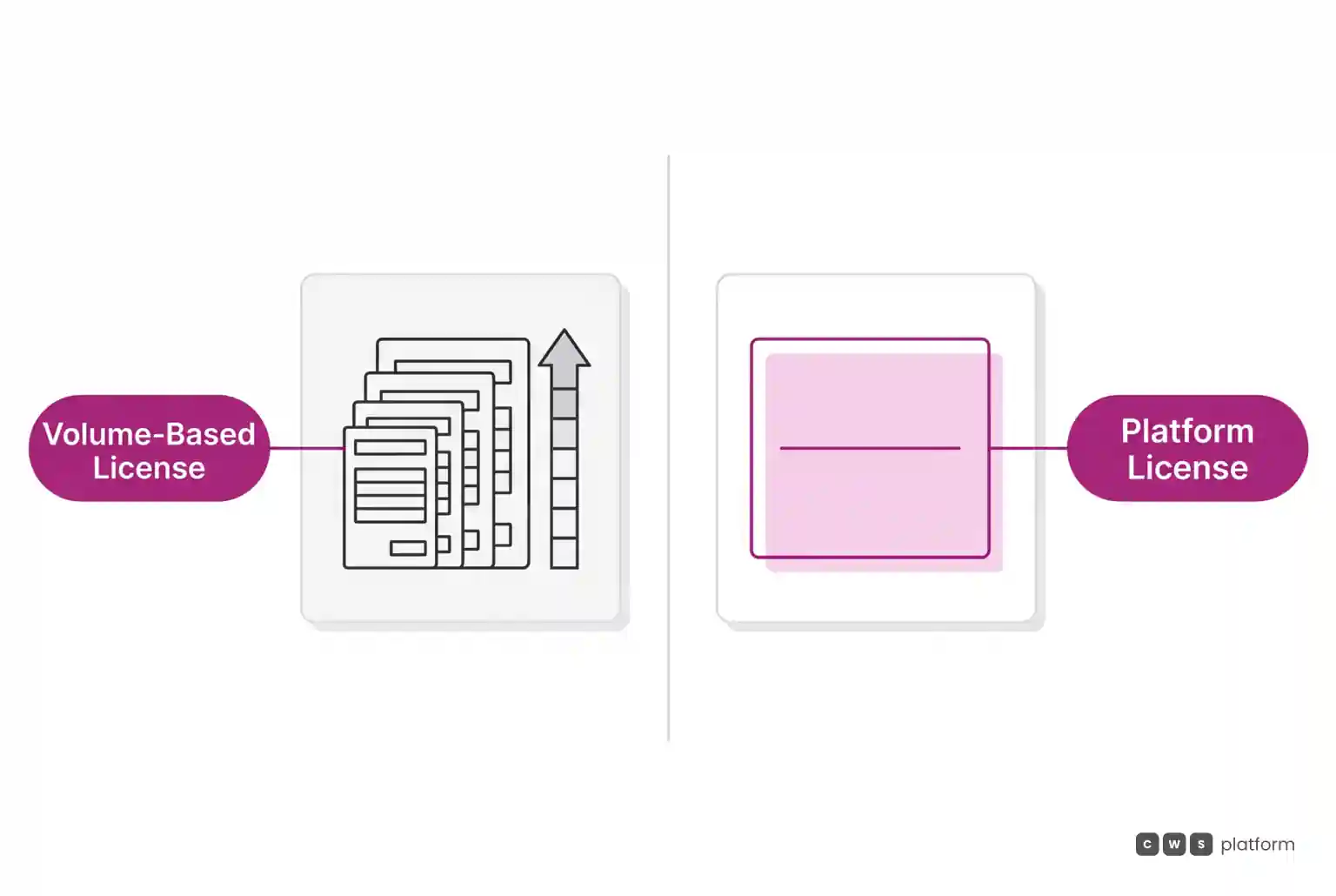
The divergence that matters to the budget is the billing unit. In the public terms of SAP Commerce Cloud, the subscription is measured by GMV or by orders, per contract year.
SAP's own license terms and product page record two points that enter this math:
- limitation recorded in the vendor's documentation on March 1, 2026: the GMV-based license is not reduced by returns, refunds, or cancellations ("will not reduce the GMV amount", https://assets.cdn.sap.com/agreements/product-use-and-support-terms/cls/en/sap-commerce-cloud-supplement-english-v3-2026.pdf).
- limitation recorded in the vendor's documentation on September 15, 2026: the cloud ERP edition is sold in blocks of 10,000 orders per year and has SAP Finance licenses as a prerequisite ("In blocks of 10000 Orders per year", https://www.sap.com/uk/products/crm/commerce-cloud-cloud-erp-edition.html).
On CWS Platform, billing is a platform and integration license, with no percentage on sales or on GMV. In marketplace operations, the percentage that appears in the payment split is the marketplace owner's commission, and the owner chooses how to charge sellers; CWS charges only the platform license.
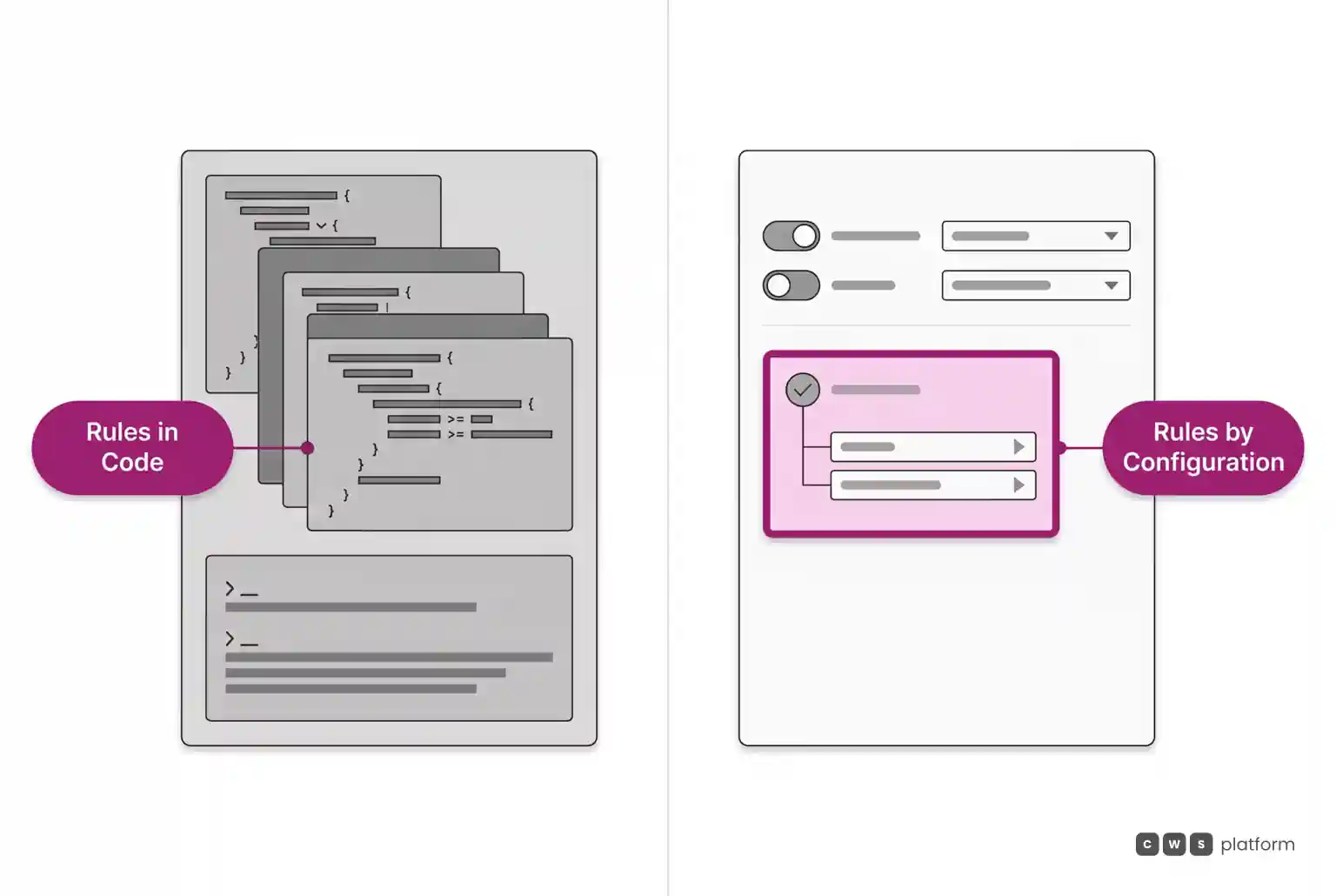
The second divergence is where commercial policy lives. In SAP Commerce Cloud, as described above, customization comes in through extensions and AddOns on a Git repository. On CWS Platform, commercial policy sits in parameters of the Commerce Rules Engine (CDL Workspace), on the principle of configuration over code, and all customers run the same version of the platform.
| decision | SAP Commerce Cloud, per the documented mechanism | CWS Platform |
|---|---|---|
| What the license billing unit is | Subscription measured by GMV or by orders, per contract year. | Platform and integration license, with no percentage on sales or GMV. |
| How returns and cancellations enter the measurement | Returns, refunds, and cancellations do not reduce the GMV counted. | The volume sold is not a calculation base for the license. |
| Where commercial policy is expressed | Runs through extensions in a Git repository or pricing calls to the back end. | Parameters in the Commerce Rules Engine (CDL Workspace), changed by configuration. |
The financial decision is choosing which variable will move the software line in the budget: the volume sold or the scope of the platform.
What changes in the operation, through the CFO lens
For a three-year budget, the difference shows up in predictability. When the license follows GMV or orders, growing in volume also moves the software line, and the two curves need to be projected together. When the license is for the platform, the software line does not depend on the channel's revenue.
Three questions help bring this point to the negotiation with any vendor: what the license measurement unit is; whether returns and cancellations reduce the volume counted; and what happens when the operation goes past the contracted tier.
On CWS Platform, the rules that weigh on the cost of each order sit in parameters. Price tables, rules, and contracts are configured on the platform and can come from the ERP, the CRM, or another system through an API. Tax per item is calculated by the customer's ERP tax API before the order closes. The credit limit works as a current account for the customer on the platform, granted in CDL Workspace or through an API.
Where the pains of this scenario come from, and how the architecture resolves them:
| pain | why it happens | how the architecture resolves it |
|---|---|---|
| "Every simple change takes six months of IT" | The commercial rule lives in custom code, and each change goes through development and deployment. | Commercial policy is parameterized in the Commerce Rules Engine (CDL Workspace) and changed by configuration. |
| "Each customer's negotiated price does not fit in the portal" | Price is treated as a fixed table field, without contract, rule, and customer profile. | Price follows the hierarchy of contract, rule, and table, with rules eligible by the customer's tax profile and by the origin and destination state. |
When to choose SAP Commerce Cloud
The SAP Commerce Cloud architecture serves corporate scenarios with specific operational demands:
Global ecosystem standardized on SAP Cloud ERP. Choose this architecture when the organization operates under global corporate guidelines with pre-existing contracts for the vendor's financial and supply chain services. The preconfigured package of the edition connected to the back end synchronizes master data and invoices in a structured way, keeping the accounting core unchanged according to clean core standards. This design serves companies whose global governance requires a single vendor at every stage of the corporate chain.
Centralized service through SAP CRM Interaction Center. Choose this architecture when the customer service center already operates on the vendor's relationship system. The assisted service module allows the operator to start authenticated sessions directly from the SAP CRM Interaction Center, locating accounts and generating carts without leaving the corporate support interface. This approach is suitable for phone support structures standardized on the same suite.
Front-end development based on Angular and Spartacus. Choose this architecture when the internal engineering team adopts the composable storefront and has consolidated pipelines in corporate JavaScript frameworks. The exposure of decoupled resources through Omni Commerce Connect allows custom storefronts to be built from Git repositories managed by the development team. This model serves companies with their own IT structure able to maintain the front-end infrastructure.
When CWS Platform is the right choice in this scenario
CWS Platform is the indicated choice when the budget calls for a software line that does not follow the volume sold and a commercial policy maintained by configuration.
A license that does not follow the volume sold. Choose this architecture when financial planning needs a software line that does not vary with GMV. Billing is a platform and integration license, with no percentage on sales. In a marketplace, the split percentage is the marketplace owner's commission.
One version for all customers. Choose this architecture when the company does not want to reserve budget for an upgrade project. All customers run the same version of the platform, and there is no framework change on the customer side.
Commercial policy by configuration. Choose this architecture when price, discount approval levels, and credit change frequently and the business area needs to change them without a development project. Tables, rules, and contracts are configured on the platform or received through an API, and the seller's discount goes through approval levels.
Tax calculated in the ERP. Choose this architecture when the ERP must remain the source of the tax calculation. Tax per item comes from the customer's ERP tax API before the order closes, and the platform integrates through REST APIs and webhooks.
Where to go from here
If your question is still which architecture fits your operation, and not which vendor to choose, the path is the seven questions that separate B2B commerce architectures.
If what is blocking you today is the pain behind this scenario, the pages When Selling More Does Not Mean Earning More and When Integration Blocks Everything cover it in depth, without talking about any vendor.
Brands mentioned in this article

- SAP Commerce Cloud
Trademarks and logos belong to their respective owners. Mention does not imply partnership or endorsement.
"responsive, technically engaged, and willing to work through complex commercial rules (negotiated pricing, credit, customer-specific conditions) rather than pushing generic answers"
Want to see this in your operation?
Real B2B operations already run on it.