When B2B Search Works Technically but Fails the Business Case
Why choosing a search engine requires evaluating business rules, exceptions, and ongoing costs—not just integration feasibility.
TL;DR
- A feasible integration is not necessarily an economically viable operation.
- In B2B, search must account for commercial complexity, including catalogs, pricing, credit, and authorizations specific to each context.
- Evaluating only the technical capabilities of a search engine shifts the problem to operations, which then absorbs exceptions, reconciliations, and manual decisions.
- Before automating, organizations need to define which rules govern the query and which systems remain responsible for each decision.
Why can a technically functional search become a problem for B2B operations?
For B2B commercial leaders, the tension emerges when two seemingly objective assessments lead to different conclusions.
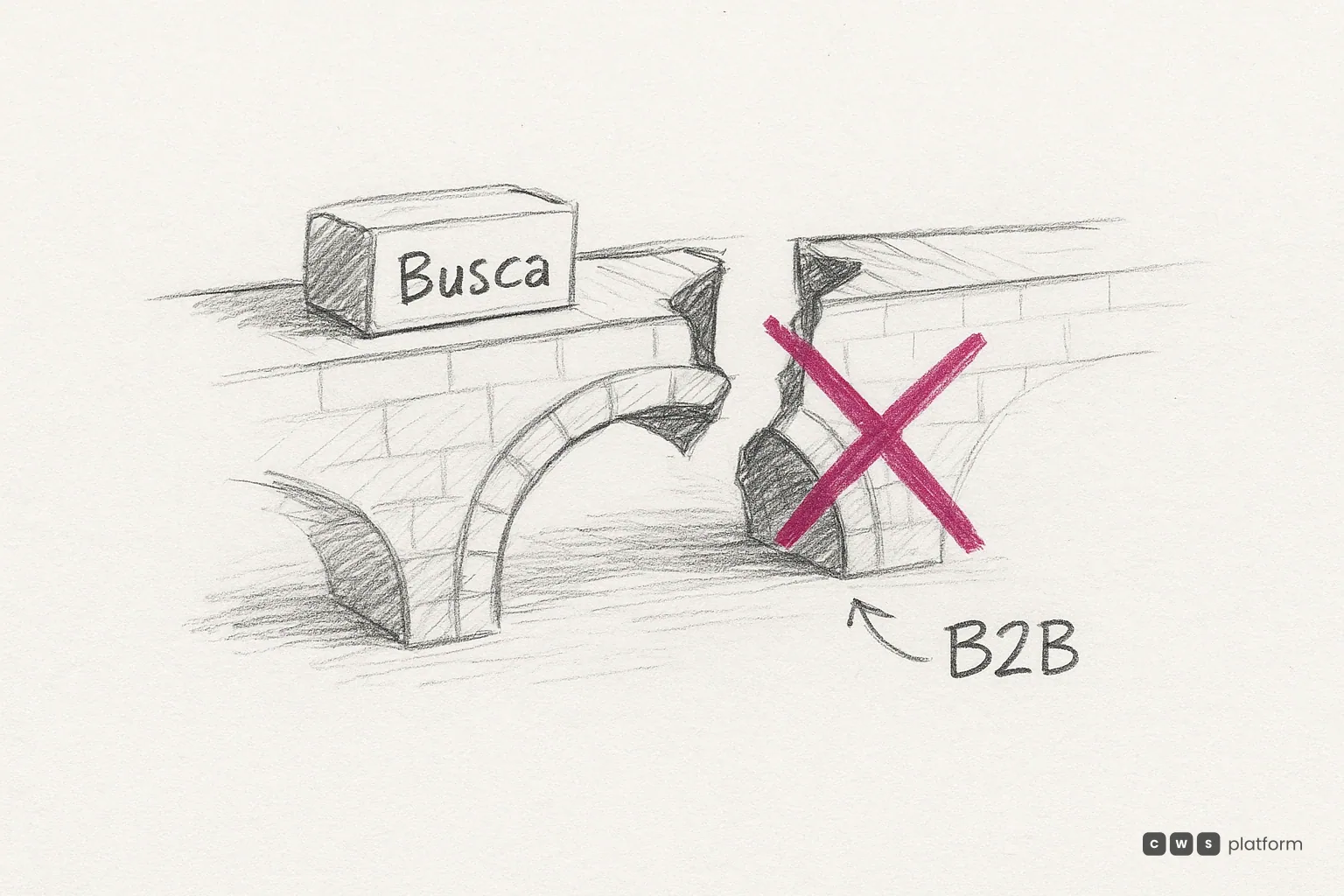
The technical team confirms that a search engine can be integrated. The connection is possible, data can be sent, and results can be displayed. Yet when the operation begins to account for the cost and commercial complexity that must be sustained, the decision is no longer straightforward.
This is the point documented in the meeting notes on the economic feasibility of B2B search, provided as source material for this analysis: the engine selection must account for cost and fit with B2B complexity. A technically feasible integration may be rejected when its economics cannot support the operation.
The distinction may seem subtle, but it changes the decision-making question.
Instead of asking only, “Can we integrate it?” the operations leader needs to ask: “What structure will be required to keep this search aligned with commercial rules, and is that structure economically sustainable?”
Search is not separate from the commercial decision
In a B2B sales operation, finding an item does not complete the journey. The result shown must make sense within the context of that specific transaction.
The LI-042 case material helps make this reality tangible. In operations with multiple ERP systems, pricing, credit, and catalog rules remain distributed across local systems. In addition, each location or channel should receive only what its context authorizes.
This means search cannot be evaluated as if every user should receive the same answer from a uniform data source. The challenge includes determining which information can be presented, under which rules, and within which commercial context.
If that governance is not defined, the search engine may respond quickly while still returning an answer that is inappropriate for the transaction.
The issue, therefore, is not simply finding an item. It is finding what can be offered in that context without overriding commercial decisions the company must already honor.
The cost often appears outside the integration
An analysis focused only on the technical project tends to see the most visible components: connectivity, indexing, and result presentation. Economic feasibility also requires examining the work needed to keep the solution aligned with operations.
Some questions help reveal this difference:
- Which rules must be checked before a result is displayed?
- Where do catalog, pricing, and credit data reside?
- How does the context of each transaction change what can be shown?
- What happens when local systems return conflicting information?
- Who decides which rule takes precedence?
- How many exceptions will need to be handled outside the primary workflow?
- Does maintenance preserve the autonomy of existing systems, or does it require duplicating their decision logic?
These questions do not assume a specific technology. They expose the operating model that any alternative will need to support.
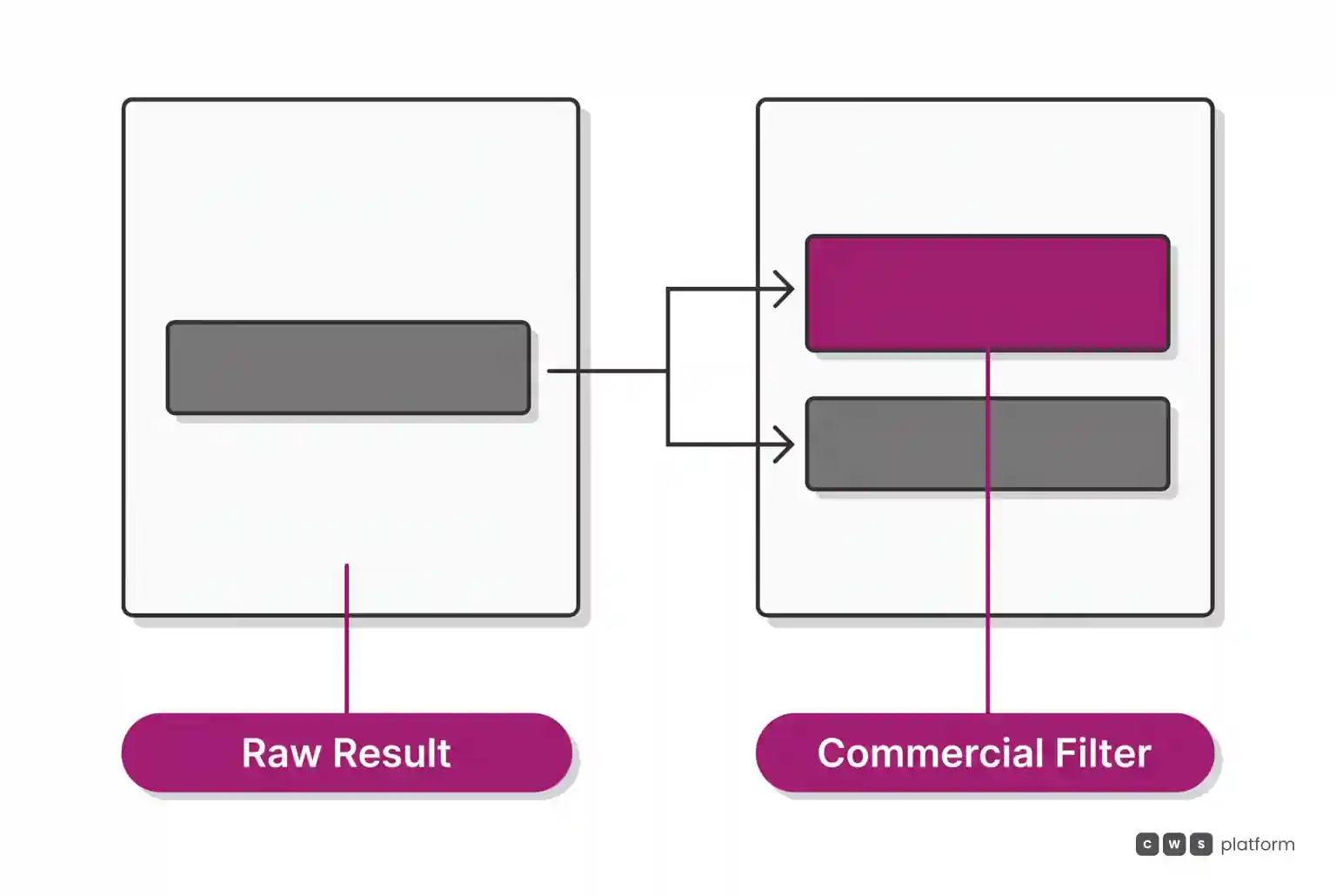
When that model is not considered, the integration budget may appear acceptable because part of the work has simply been shifted elsewhere. The cost reappears as reconciliation between systems, rule updates, response validation, and human intervention for cases the architecture did not resolve.
Technical feasibility and economic viability are different decisions
Technical feasibility answers whether two components can exchange information.
Economic viability answers whether that exchange can be maintained within the reality of the commercial operation.
A solution may pass the first assessment and fail the second. That does not necessarily indicate a limitation of the chosen engine. It may indicate a mismatch between the economics of that alternative and the complexity the company needs to govern.
For that reason, rejecting a feasible integration can be a rational decision. Continuing simply because it has already been technically validated turns work already completed into justification for expanding a commitment that has not yet demonstrated operational sustainability.
For executive leadership or the leader accountable for commercial performance, the criterion should not be the amount of work already invested. It should be the future ability to sustain the decision without multiplying costs and exceptions.
The Cost of Inaction
Delaying this assessment does not keep the operation neutral. It merely allows the architecture to be defined in practice by local decisions and successive workarounds.
Search may continue to function, but the cost of making it reflect commercial reality tends to remain dispersed. Some of it sits with technology, some with operations, and some with the people who must interpret discrepancies.
The leadership risk is being unable to see the full cost. The investment appears as technology, while the effort required to sustain it is absorbed across different teams.
Inaction also preserves an important ambiguity: no one knows clearly whether the engine is meant only to locate information or whether it is being forced to replicate commercial rules distributed across multiple systems.
Without that definition, every new exception increases reliance on manual decisions. The company may not stop operating, but it spends more energy ensuring that a technically correct response is also commercially valid.
Principles for Evaluating the Decision
- Start with decision rules: document what must be true before a result can be presented.
- Separate integration from sustainability: validate not only whether the connection works, but how it will be maintained.
- Account for commercial context: catalog, pricing, credit, and authorizations should not be treated as afterthoughts.
- Preserve clear responsibilities: define which decisions belong to local systems and which need to be coordinated above them.
- Evaluate exceptions: an architecture should also be judged by the work it leaves outside the primary workflow.
- Compare total cost: include the recurring effort of governance, updates, and reconciliation—not only implementation.
- Decide before automating: automation without governance accelerates responses but does not determine which response is valid.
Ultimately, the issue comes down to the transaction cost of the commercial operation. The more systems, rules, and contexts that must be consulted to complete an interaction, the greater the need for an architecture that coordinates those decisions.
This is where the CWS Platform approach connects to the problem—as a B2B Commerce Platform for Governed Negotiation. Its architectural contribution is not to replace ERP systems, but to help centralize the application of commercial rules and return to each context only what is authorized. Technology then supports governed negotiation rather than attempting to independently rebuild the company’s entire business logic.
FAQ
Does a more powerful search engine solve the problem?
Not necessarily. The central point in the source material is the combination of cost and fit with B2B complexity. Technical capability alone does not demonstrate economic viability.
Is the problem with the existing ERP systems?
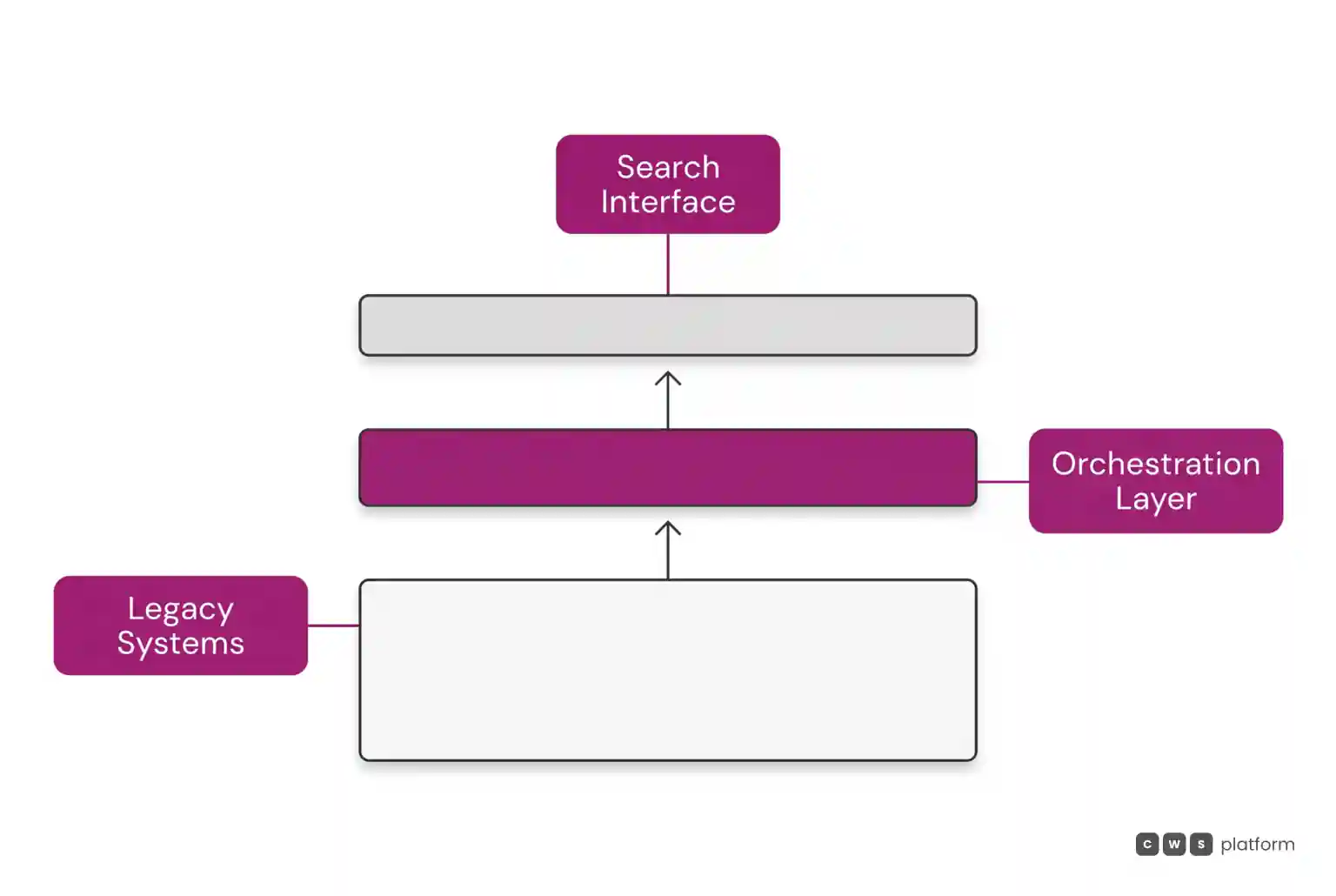
The LI-042 case does not attribute the problem to ERP systems. The diagnosis is architectural: there is a need for an orchestration layer above local systems, without requiring their replacement.
When should a feasible integration be rejected?
When the economics required to sustain it are incompatible with the operation. The decision should account for maintenance, rules, exceptions, and coordination across systems.
What should be defined first?
Which rules govern the response and which system remains responsible for each decision. That governance should come before automation.
Who Is Already Experiencing This
On Software Advice, Leonardo C., a verified reviewer in the automotive industry at a company with 1,001 to 5,000 employees, wrote:
“We work with B2B solutions on CWS”
Read the review on Software Advice
A Case That Illustrates It
The LI-042 case supports the thesis by showing that, in B2B operations with multiple ERP systems, the problem is not only technical. It is architectural: creating an orchestration layer that centralizes pricing, credit, and catalog rules, delivering to each location or channel only what its context authorizes, without replacing existing ERP systems.
No public link to the case was provided.
About This Publication
The Cost of Selling is a CWS Platform publication about decisions that affect the efficiency and transaction cost of B2B commercial operations. Its purpose is to examine how governance, architecture, and technology can support more consistent negotiations while preserving the company’s commercial DNA.
Sources
- Economic feasibility of B2B search, meeting notes attributed to gemini-notes@google.com: factual source on cost, fit with B2B complexity, and rejection of integrations whose economics do not sustain the operation. No link provided.
- LI-042 Case: reference on orchestrating commercial rules in B2B operations with multiple ERP systems. No link provided.
- Software Advice, review by Leonardo C.: public testimonial about using CWS in B2B solutions. Access the source
"responsive, technically engaged, and willing to work through complex commercial rules (negotiated pricing, credit, customer-specific conditions) rather than pushing generic answers"
Want to see this in your operation?
Real B2B operations already run on it.