When Every Business Unit Decides Differently, ERP Becomes a System of Record, Not Control
Commercial consistency requires separating local execution from centralized governance of pricing, credit, and catalog rules.

TL;DR
- In a B2B operation with 40 business units, different ERPs, and varying commercial terms, the problem was not the local systems—it was the lack of a shared rule set above them.
- An ERP executes and records transactions. It does not necessarily govern pricing, credit, and product catalogs by customer, region, and negotiation context.
- Replacing every system can increase risk without addressing the source of inconsistency. The alternative is to separate the system of record from the system of decision.
- Local autonomy can be preserved as long as it operates within centralized, explicit, and auditable rules.
Does Your ERP Control the Operation—or Just Record Decisions Made Elsewhere?
For the CEO of a multi-branch B2B operation, fragmentation rarely first appears as an architecture problem.
It shows up in margins that vary without a clear explanation, credit limits interpreted differently across locations, catalogs that change by channel, and commercial terms that depend on who is available to approve them.
The immediate diagnosis usually points to systems: different ERPs, accumulated integrations, and unique requirements in each business unit. The conclusion seems logical—standardize everything in a single environment.
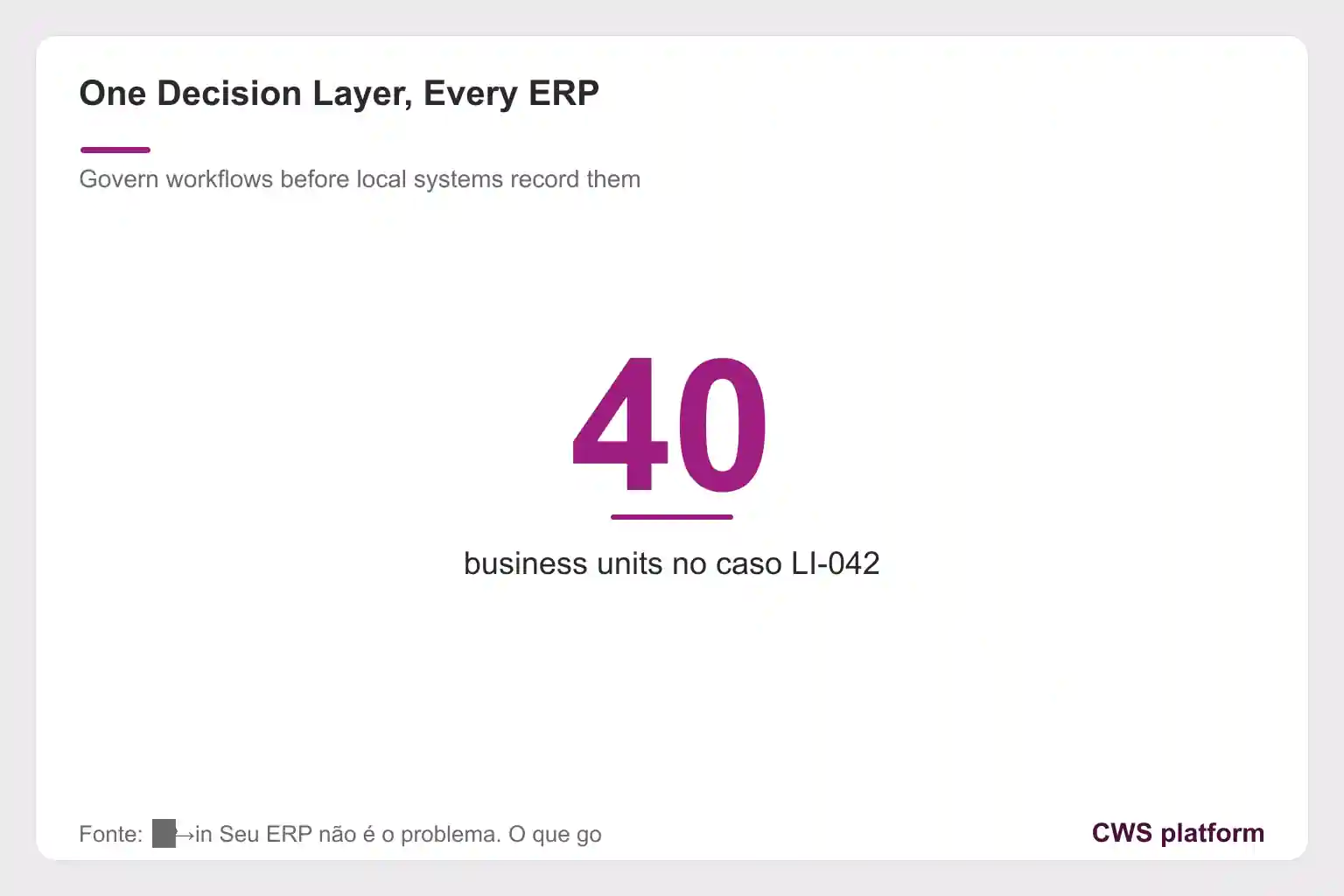
But a public case identified as LI-042 suggests a different interpretation. The operation had 40 business units, different ERPs, and different commercial terms at each branch. According to the account, this was not a disorganized operation. What was missing was something above the local systems to define what was allowed.
Each ERP performed its execution role. None had been designed to govern the others.
This distinction changes the investment decision. If the issue is treated only as technological diversity, the organization may begin a broad replacement program without answering the central question: who determines, consistently, which price, credit terms, and catalog are valid for each negotiation?
The Conflict Is Not Between Centralization and Autonomy
Price, credit, and catalog are not static data. In case LI-042, these three elements depended on who was buying, where they were buying, and when the negotiation took place.
That means a centralized price list alone does not solve the problem. The organization needs to connect commercial context with policy before a branch executes a term.
Without that capability, two extremes become common:
- Corporate headquarters tries to centralize every exception, creating queues and approval dependency.
- Branches gain freedom without a shared boundary, increasing variation and reducing traceability.
Neither extreme produces effective governance. Centralizing every action slows down the front line. Decentralizing rules makes outcomes unpredictable.
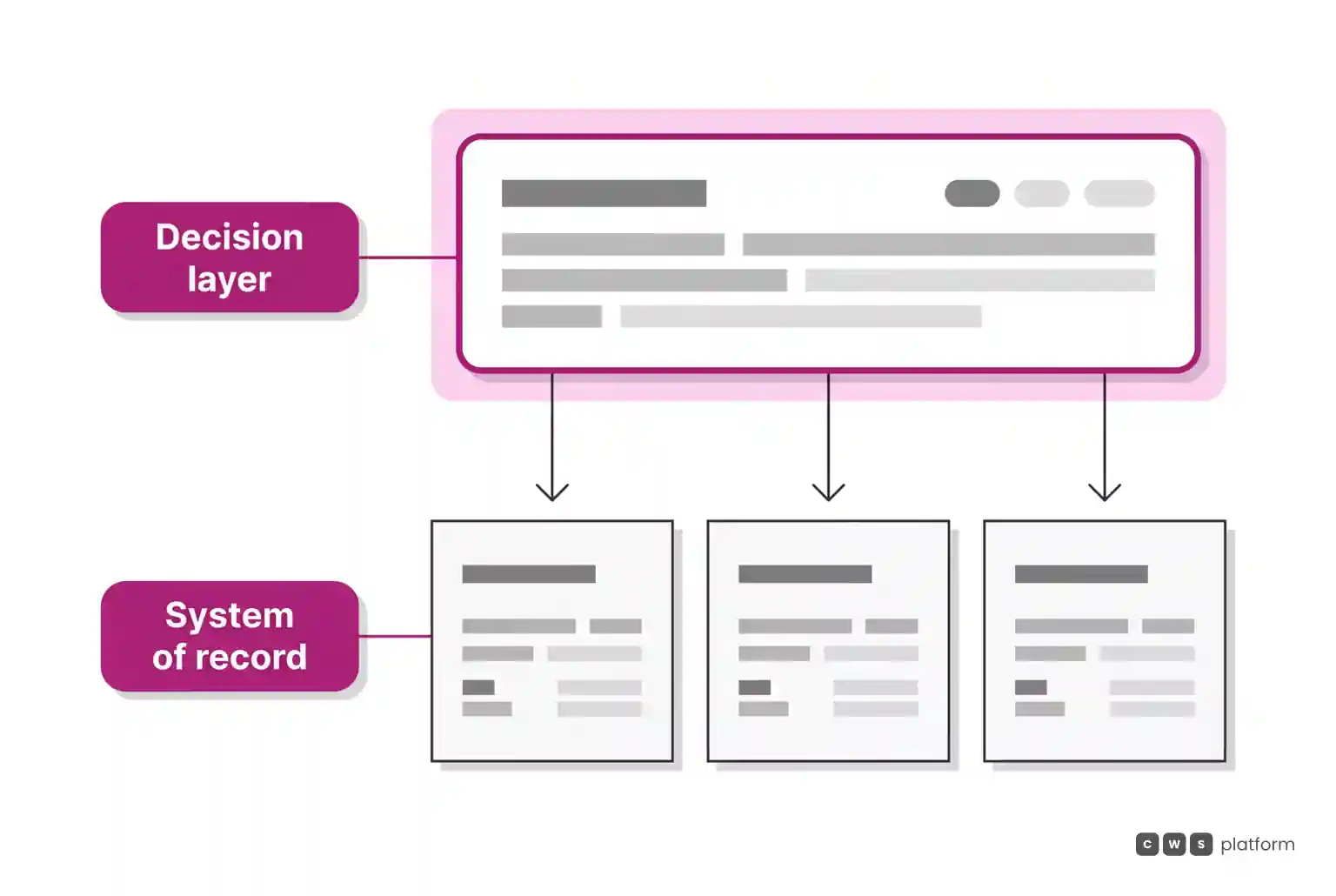
In case LI-042, the mechanism adopted was an orchestration layer above the existing ERPs. Local systems were neither replaced nor migrated. They remained the systems of record for each branch, while the upper layer centralized commercial and financial rules.
Before applying a commercial term, each branch consulted that layer. The response already accounted for what was authorized for a given customer, region, and point in time.
The reported outcome was consistency without eliminating local autonomy where it was needed.
Systems of Record and Systems of Decision Serve Different Roles
The ERP records inventory, orders, and other operational effects of a transaction. Commercial governance needs to act earlier—during the interval in which buying intent is still being converted into a possible commercial term.
That is where the questions relevant to the board arise:
- Is the price within the policy applicable to that customer and sales channel?
- Does available credit support that term?
- Does the catalog offered match the region and purchasing context?
- Is the exception authorized?
- Can the decision be reconstructed later?
CWS Platform’s article, “Your ERP Is Not the Problem,” supports the same separation: the ERP works as the system of record, while a governance layer determines pricing, credit, and approvals before the order is confirmed.
The architecture, therefore, does not need to compete with installed systems. It needs to define what those systems are permitted to execute.
Commercial Delays Can Also Be an Architecture Problem
The absence of formalized rules does not only create inconsistency. It turns every negotiation into a sequence of consultations.
Another public case in the collection, identified as LI-038, describes an operation where responding to a quote took five business days. The process required checking a price list, verifying inventory, requesting credit approval, and confirming lead time by email.
According to the case, when pricing, credit limits, and exceptions were formalized within a digital workflow, the cycle went from five days to minutes—without replacing sales reps and without requiring human intervention in most situations.
The comparison helps make the diagnosis more precise. The bottleneck was not a lack of effort from the team. The commercial logic existed, but it was distributed across people, spreadsheets, and informal approvals.
When a decision depends on who is available, the organizational chart becomes part of the technology infrastructure. To grow, the company must add people who can interpret, validate, and connect rules. Revenue may increase, but complexity grows alongside operating cost.
The Cost of Inaction
Delaying this separation between recordkeeping and decision-making does not keep the operation neutral. It keeps important decisions outside a shared governance framework.
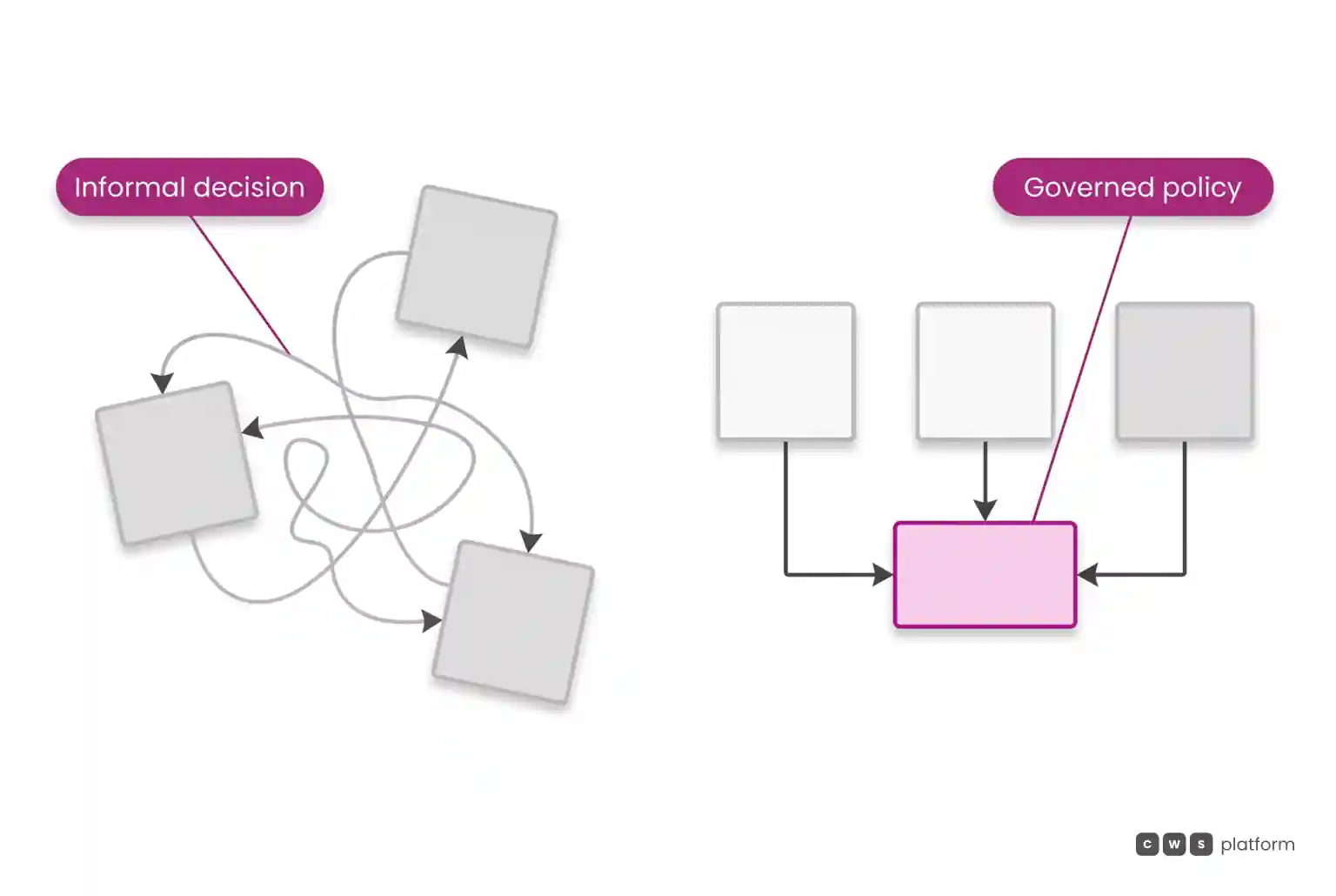
The effects tend to appear in fragmented ways:
- Different commercial terms for equivalent contexts.
- Response times determined by the availability of salespeople and managers.
- Exceptions without a clear approval history.
- Expansion into new branches accompanied by more consultations and approvals.
- Difficulty distinguishing legitimate autonomy from policy deviation.
- ERP replacement initiatives used to address a gap that does not exist in the system of record.
The financial risk is not limited to one incorrect term. It lies in the repetition of small decisions without a central reference point, making it difficult to measure the aggregate impact on margin, credit exposure, and productivity.
There is also an opportunity cost. While leadership discusses a possible system replacement, the operation continues to negotiate every day through the same informal paths.
Principles for Reorganizing Commercial Decision-Making
- Diagnose before migrating: determine whether the failure is in the ERP or in the absence of a shared policy layer above it.
- Separate rules from execution: local systems can execute transactions without owning all commercial logic.
- Centralize policies, not every action: the front line should act autonomously within predefined boundaries.
- Formalize what currently depends on individual experience: pricing, credit, catalogs, and exceptions need to be translated into explicit rules.
- Preserve context: a central rule should not ignore the customer, region, channel, or timing of the negotiation.
- Record the decision, not only the order: the organization needs to know which policy authorized each commercial term.
- Govern before automating: accelerating a workflow without clear criteria only makes inconsistency happen faster.
- Prepare for responsible AI use: AI can expand analysis and response capacity, but it must operate on verifiable rules, permissions, and records.
FAQ
Is it necessary to replace the ERPs used by each branch?
Not according to case LI-042. Existing ERPs were retained as local systems of record. The change came from adding an upper layer to govern commercial and financial rules.
Does centralized governance eliminate business-unit autonomy?
Not necessarily. In the reported case, the operation gained consistency without giving up local autonomy. The difference was that action occurred within what had been authorized for each context.
Does a single price list solve the problem?
Not when price, credit, and catalog depend on the customer, region, and timing. The organization needs rules capable of interpreting those factors before execution.
Is automating approvals enough?
No. First, the organization needs to formalize criteria, approval authority levels, and exceptions. Automation should execute defined governance—not replace policy definition.
Who Is Already Living This
On the public Capterra portal, Rodrigo S., Commercial Manager, summarizes the relationship between commercial governance and existing infrastructure:
“The platform unified our sales channels and integrated with our ERP without replacing it.”
Source: Capterra
About This Publication
“The Cost of Selling” analyzes how decisions, approvals, and exceptions affect the financial efficiency of B2B commercial operations.
In this context, the cost of a transaction is not limited to order processing. It includes the time and structure required to determine price, validate credit, check the catalog, and obtain approval.
CWS Platform operates as a B2B Commerce Platform for Governed Negotiation. Its approach is designed to work alongside existing ERPs, structuring a decision layer so negotiations operate with explicit rules, context, and traceability.
The architectural goal is not to remove decision-making from people. It is to transform a company’s negotiation DNA into a governed asset—one that can support sales teams, branches, and new AI applications without turning every commercial variation into more queues, consultations, and human dependency.
Sources
- LI-042, public case on ERP and orchestration: account of an operation with 40 business units, different ERPs, and commercial rules centralized above local systems. No link was provided in the source material.
- LI-038, public case on formalizing commercial decision-making: case in which the quote cycle went from five business days to minutes. No link was provided in the supporting material.
- CWS Platform, “Your ERP Is Not the Problem. What Governs What Happens”: analysis of the separation between systems of record and B2B negotiation governance. Access the publication
- Capterra, public review by Rodrigo S., Commercial Manager: testimonial regarding ERP integration without replacement. Access the review
"responsive, technically engaged, and willing to work through complex commercial rules (negotiated pricing, credit, customer-specific conditions) rather than pushing generic answers"
Want to see this in your operation?
Real B2B operations already run on it.