When the Catalog Turns Chaotic, AI Starts Deciding on a Truth That Doesn’t Exist
Without clear authority over pricing, inventory, credit, and terms, agents can execute coherent but commercially invalid decisions.

TL;DR
- General-purpose agents amplify a problem that existed before AI: the mismatch between what systems report and what is actually valid in a B2B transaction.
- If pricing, inventory, credit, and terms are fragmented, an agent may execute confidently without validating the correct source.
- The CTO must define data authority, context, and traceability before delegating commercial decisions to automation.
- The opportunity for AI lies in operating within explicit governance, not in replacing commercial rules with probabilistic responses.
Who Ensures the Agent Consulted the Truth Before Making a Decision?
For the CTO, the arrival of agentic AI creates an uncomfortable tension: the company wants to accelerate decisions and reduce manual work, but the catalog that should support that automation often does not represent a single source of truth.
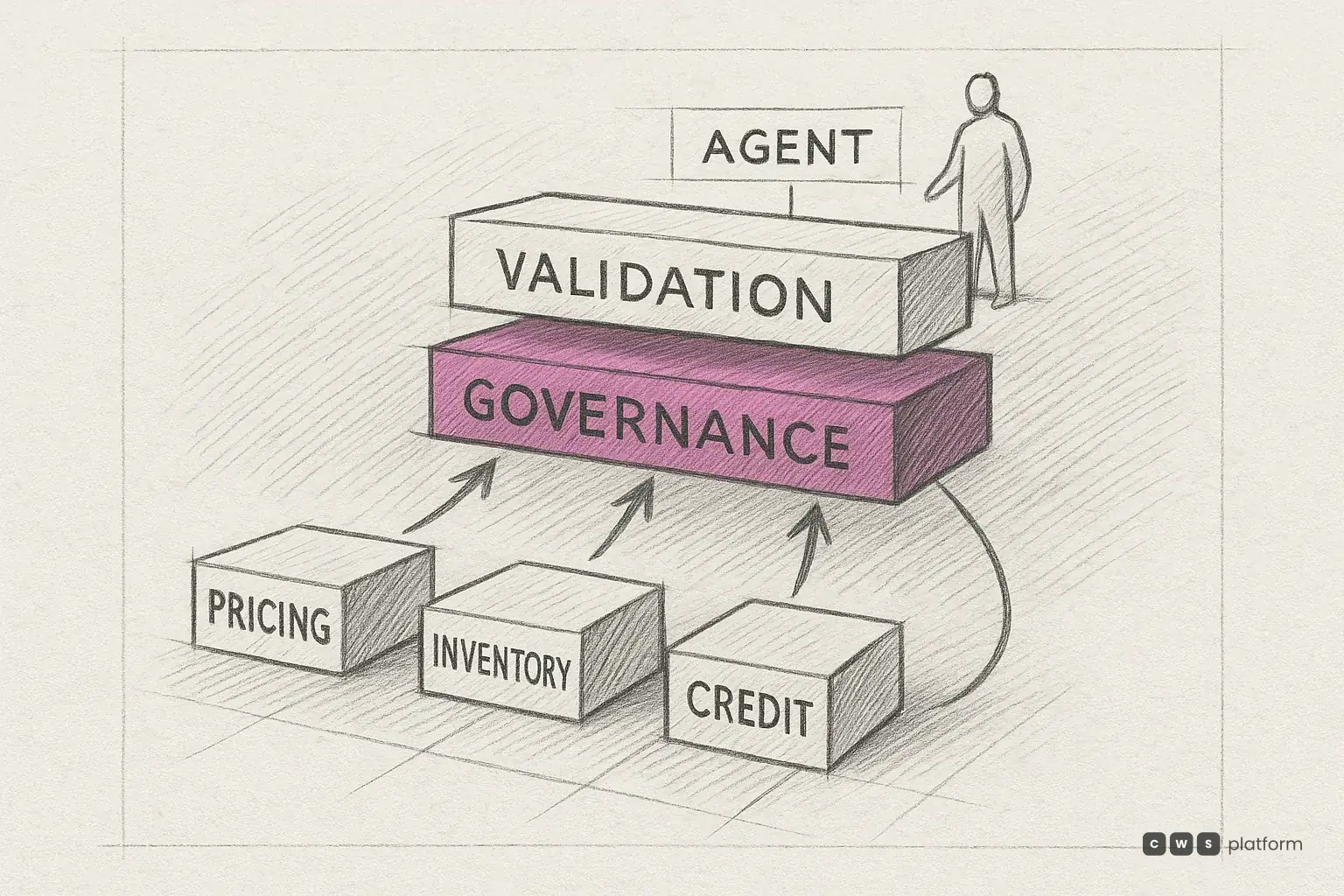
The issue emerges when a system displays a price while the valid term depends on the customer, credit status, inventory, location, negotiated agreement, or a rule maintained in another environment. Each piece of information may be correct in isolation and still lead to an incorrect commercial decision when combined outside its proper context.
The thesis “When the General-Purpose Agent Arrives Before Catalog Truth” captures this risk: the proliferation of general-purpose models amplifies the mismatch between what the system says about price, inventory, and terms and what is actually valid in a B2B transaction.
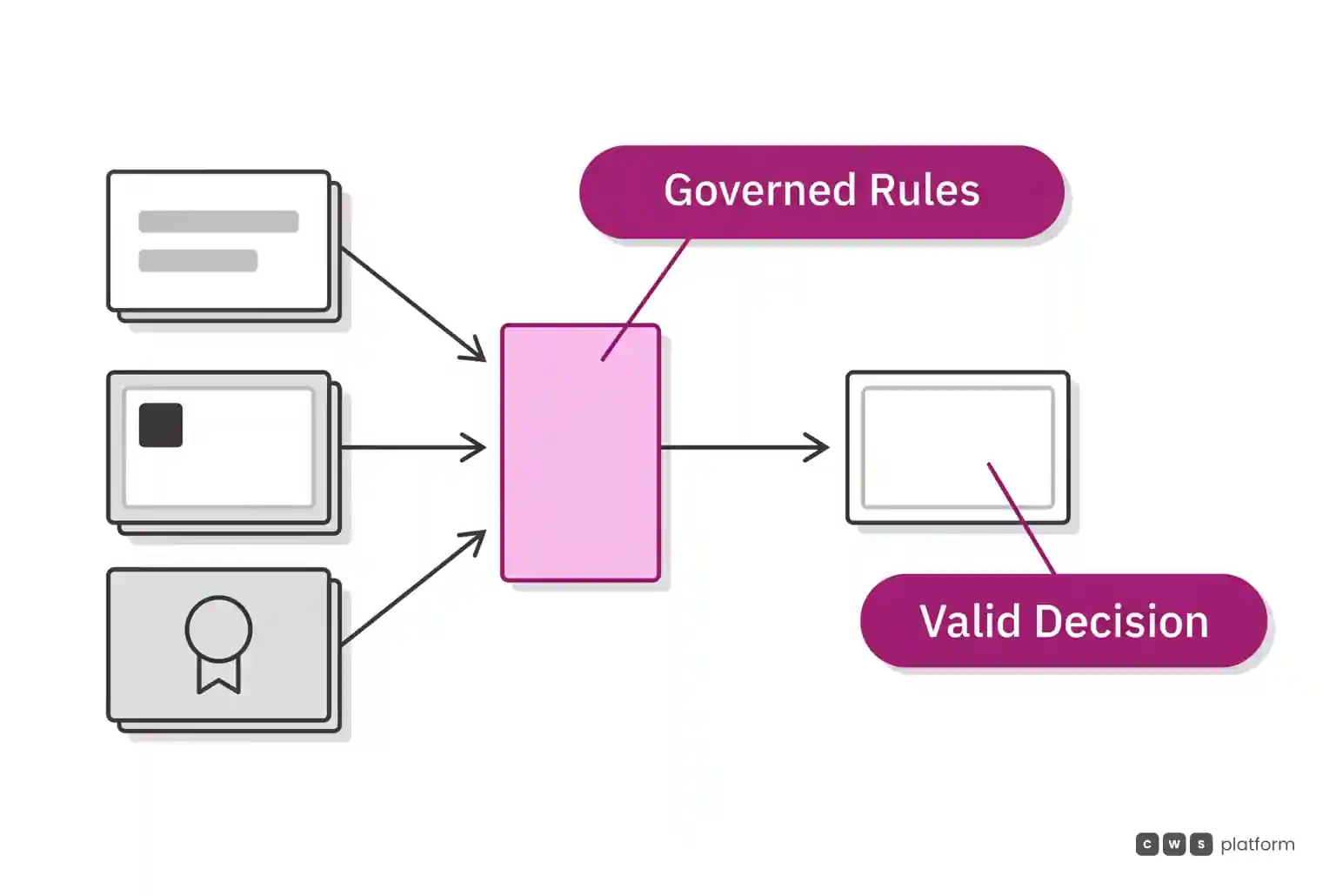
An agent trained or guided by outdated or fragmented data may execute orders with complete confidence based on information its architecture never validated. In this scenario, the problem is not simply model quality. The preceding question is architectural: who ensures the agent consulted the correct source before making a decision?
The Catalog Is No Longer Just a List
In a B2B operation, a catalog is not merely a list of available products. It represents the combination of what can be sold, to whom, under which terms, and within which commercial context.
That is why two concepts must be separated:
- Data availability: the agent can access a piece of information.
- Data authority: the architecture can prove that the information is valid for that specific decision.
The first makes it possible to generate an answer. The second makes it possible to trust the execution.
When this distinction does not exist, connecting an agent to more systems does not necessarily solve the problem. Access may increase, but so does ambiguity. The agent finds multiple versions of pricing, inventory, catalog data, or terms and must act without a clear rule for precedence, validity, and authorization.
AI does not create this fragmentation. It removes some of the human friction that previously slowed its conversion into an order, quote, or commercial commitment. Without governance, increased speed also shortens the path from an inconsistency to its operational impact.
Model Confidence Is Not Commercial Validity
There is an important difference between producing a coherent response and making a commercially valid decision.
An agent may correctly interpret a request, locate an item, and compose a plausible response. None of that proves that the price is current, that inventory can be committed, that the customer qualifies for those terms, or that the combination was authorized.
For the CTO, the question should not be only, “Which model should we use?” Before that, the organization needs to answer:
- Which source has authority over each data element?
- How are conflicts between sources resolved?
- Which context determines the applicable terms?
- What can the agent recommend?
- What can it actually execute?
- Which decisions require additional validation?
- How can the data and rules used later be reconstructed?
Without these answers, the autonomy given to the agent may exceed the maturity of the architecture supporting it.
The Problem Is Not Solved by Choosing One More Single Source
In organizations with local systems, attempting to declare one system as the universal source may ignore how the operation actually works. One source may control inventory, another may maintain commercial information, and another may contain terms applicable to a specific context.
The central point is not necessarily to replace all these systems. It is to establish governance capable of determining which information is valid, at what moment, and for which decision.
This requires treating commercial rules as an explicit part of the architecture. Pricing, credit, catalog data, and terms cannot remain implicit knowledge distributed across systems, spreadsheets, and human interpretations while an agent is expected to reconstruct the correct logic on its own.
The company’s negotiation DNA resides precisely in these rules: limits, exceptions, approval authorities, and combinations that turn an available product into a valid commercial offer. If this knowledge is not represented in a governed way, AI may reproduce fragments of it without necessarily preserving the operating logic.
The Cost of Inaction
Delaying catalog governance does not leave the company in the same place. As agents begin to consult data and execute tasks, old inconsistencies gain speed and scale.
The cost of inaction appears on three fronts.
First, reliability. If sales teams or customers realize that prices, inventory, and terms vary depending on the channel they consult, automation loses credibility. The tendency is then to manually confirm every decision, reducing the expected value of AI.
Second, accountability. When there is no clear authority over data, an error can circulate among the model, integration layer, ERP, and commercial team without making it possible to identify where the decision ceased to be valid.
Third, expansion. An agent may work within a limited scope but become difficult to scale when each new business unit, system, or policy adds another possible interpretation of the catalog.
The risk, therefore, is not only executing an incorrect transaction. It is building automation that depends on parallel checks and a growing number of exceptions to remain operational.
Principles for Governing Agents Over B2B Catalogs
- Define authority before expanding access: every relevant data element needs a clear rule for source, validity, and precedence.
- Separate recommendation from execution: the agent can support a decision without being granted the authority to finalize it from the start.
- Preserve commercial context: product, customer, credit, inventory, and terms must be evaluated as parts of the same decision.
- Make rules explicit: exceptions and approval authorities should not depend solely on team memory.
- Record the decision: it must be possible to reconstruct which data and rules supported an action.
- Treat conflict as an expected scenario: divergent sources are not an anomaly to ignore, but a condition the architecture must resolve.
- Automate after governing: speed creates value only when the accelerated decision remains valid.
FAQ
Is the problem with general-purpose models?
Not in isolation. The risk arises when an agent receives autonomy over fragmented or outdated data without an architecture that validates the correct source.
Is it enough to integrate the agent with ERPs?
Integration provides access. It does not, by itself, define which commercial rule prevails or which information is authorized in each context.
Is it necessary to replace existing systems?
The material analyzed points to another path: an orchestration layer can centralize commercial rules and return to each touchpoint only what the context authorizes, without replacing existing ERPs.
Where does AI create value in this scenario?
In interpretation, assistance, and task execution within clear limits. The opportunity grows when AI operates on authorized data, explicit rules, and traceable decisions.
Who Is Already Experiencing This
On the Software Advice website, Leonardo C., a verified reviewer in the automotive industry at a company with 1,001 to 5,000 employees, states:
“We work with B2B solutions on CWS”
The testimonial is brief and should be read within that limitation, as a public reference to the use of CWS in B2B solutions.
A Case That Illustrates the Issue
Case LI-042, from the archive, shows the architectural dimension of the issue: in B2B operations with multiple ERPs, the challenge is not merely technical. What is missing is an orchestration layer above local systems, capable of centralizing commercial rules—including pricing, credit, and catalog data—and returning to each touchpoint only what that context authorizes.
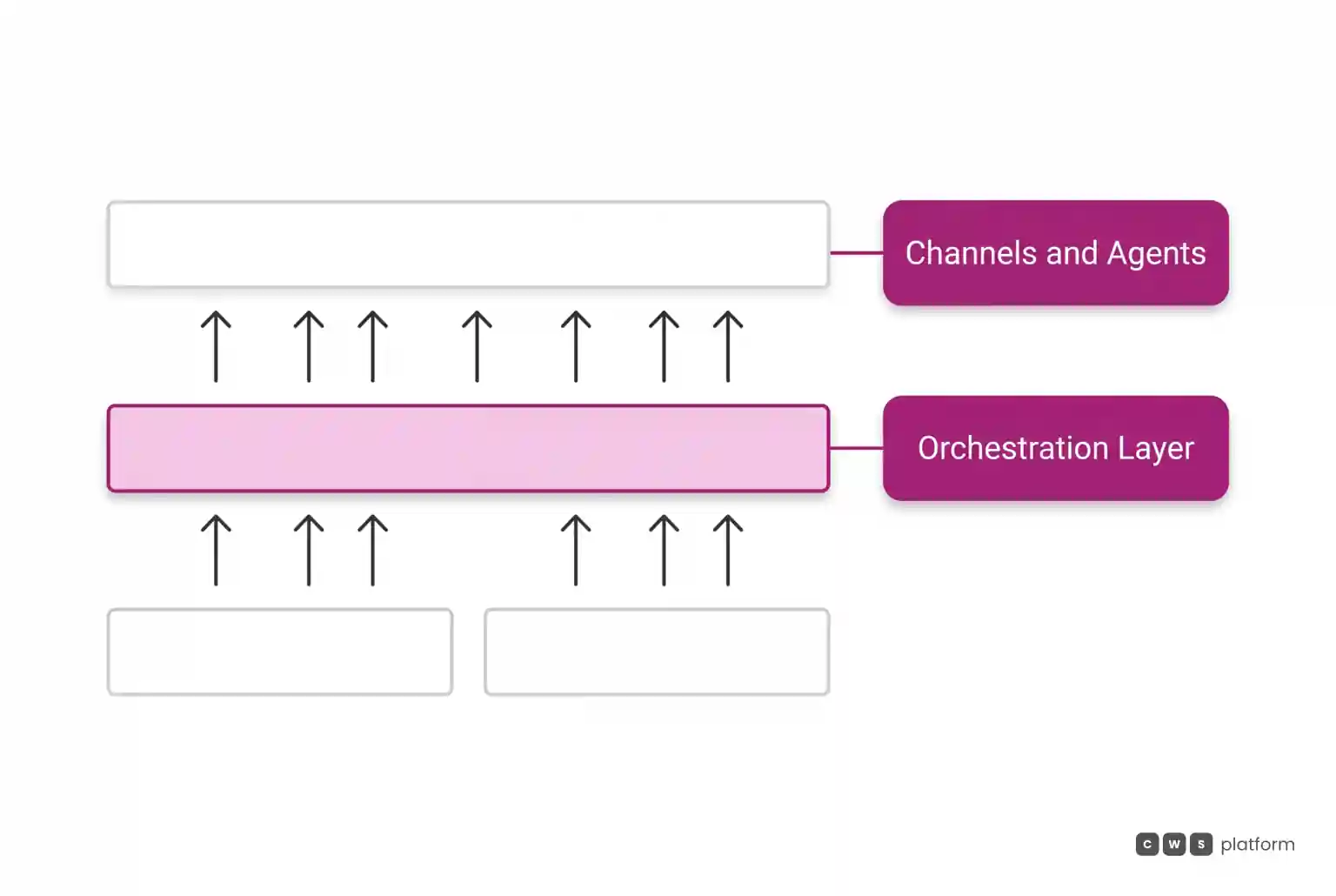
This approach does not require treating a general-purpose agent as the arbiter of truth or replacing every ERP. It establishes a governed boundary between source systems, commercial rules, and decision channels.
This is where transaction cost becomes relevant. Every manual inquiry, reconciliation between sources, term validation, and order correction adds effort to the operation. A B2B Commerce Platform for Governed Negotiation can reduce this cost by organizing negotiation around authorized data and rules.
CWS operates at this architectural layer, helping B2B commercial operations preserve their negotiation DNA while incorporating automation and AI. The goal is not to make the agent decide at any cost, but to enable it to participate in decisions whose validity can be explained, controlled, and audited.
About This Publication
“The Cost of Selling” is a CWS Platform publication about the architectural, operational, and financial factors that increase transaction costs in B2B commercial operations. This draft discusses why catalog governance must precede AI agent autonomy.
Sources
- When the General-Purpose Agent Arrives Before Catalog Truth, proprietary thesis provided as the primary factual source on the mismatch of price, inventory, and terms in agent-led decisions. No public link was provided.
- Software Advice, public review by Leonardo C., Verified Reviewer, Automotive, 1001-5000 employees: https://www.softwareadvice.com/product/546664-CWS-Platform/
- LI-042, related case from the archive on orchestrating commercial rules in B2B operations with multiple ERPs. No public link was provided.
"responsive, technically engaged, and willing to work through complex commercial rules (negotiated pricing, credit, customer-specific conditions) rather than pushing generic answers"
Want to see this in your operation?
Real B2B operations already run on it.