When Negotiations Live in Spreadsheets, the Crop-Season Window Is at Risk
In B2B agriculture, digital channels are not enough when pricing, credit, barter, and approval authority remain fragmented.
TL;DR
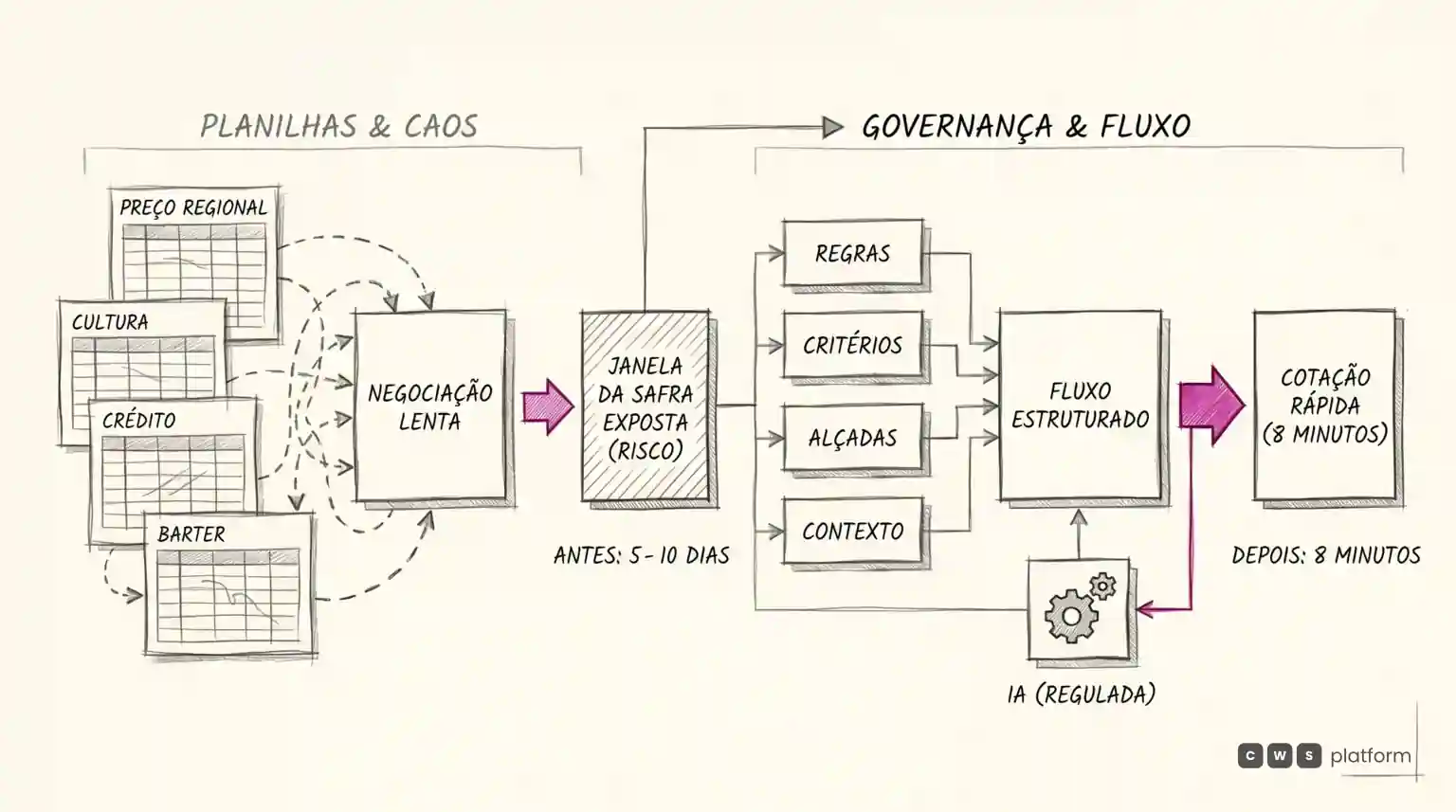
- In the public case LI-966729, a large quote could take 5 to 10 days because regional pricing, crop requirements, credit, and barter were managed in spreadsheets.
- After the workflow was structured, a quote that took five days was completed in eight minutes.
- Speeding up an unstructured negotiation does not solve the problem: rules, criteria, approval thresholds, and context must be documented first.
- AI can expand field sales productivity—as long as it operates on governed, auditable decisions within company-defined limits.
Why Does Your Operation Digitize Orders but Remain Slow to Negotiate?
In agriculture, a sale is rarely as simple as presenting a catalog and receiving an order. A proposal may depend on the crop, region, current campaign, agronomic recommendation, available credit, and a barter transaction.
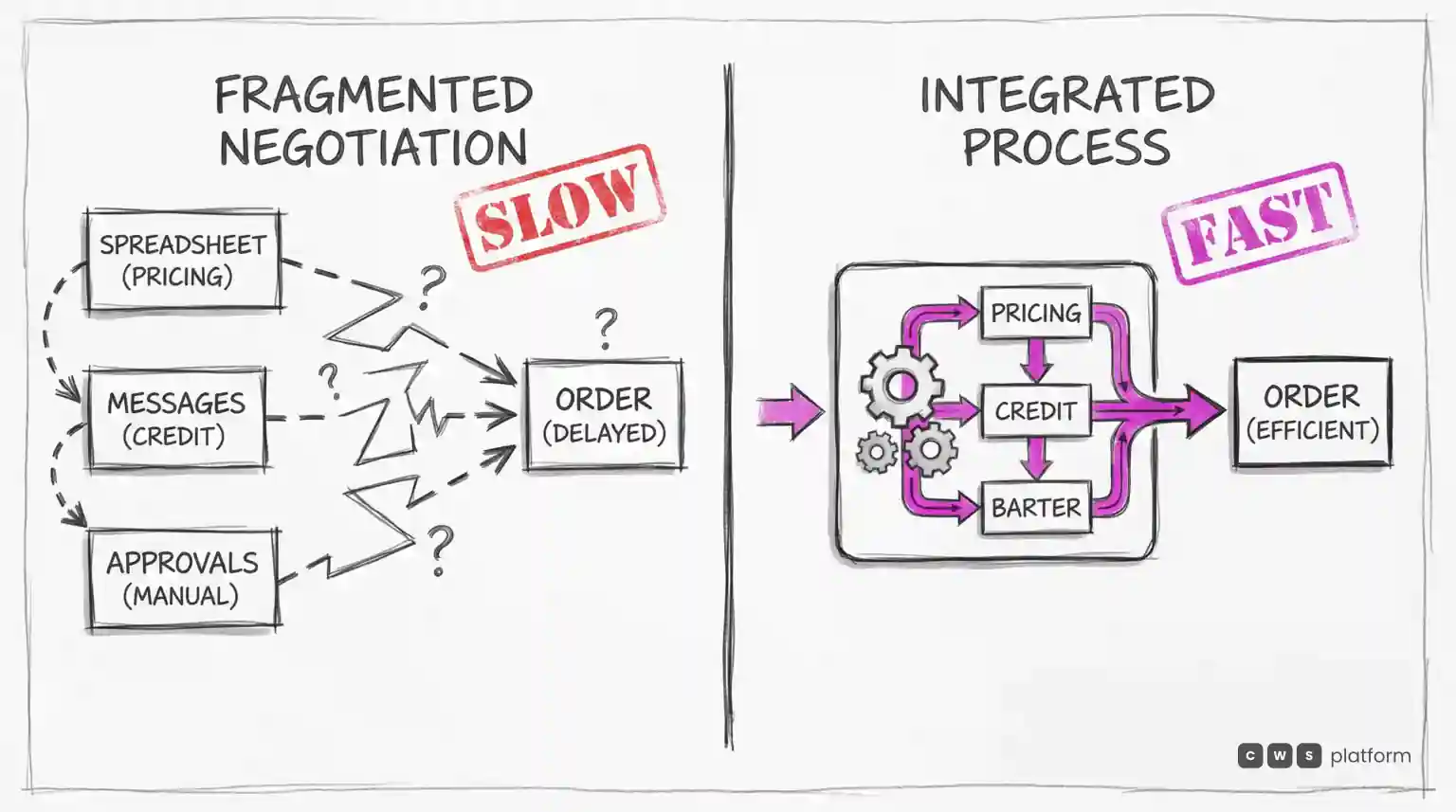
When these variables live in spreadsheets, messages, and individual knowledge, the channel may be digital, but the commercial decision remains manual.
This tension is clearly illustrated by the public case LI-966729. According to the published account: “A large quote takes 5 to 10 days: pricing by region and crop, credit tied to barter, all in spreadsheets.”
For the sales leader, the issue is not just response time. During those days, the team has to locate information, validate terms, check limits, and reconstruct the context of each negotiation. The field sales representative, who should be providing technical support to the grower, ends up managing spreadsheets and coordinating approvals.
The result is an operation that knows the final price but may not be able to clearly reconstruct how that price was reached.
The Five-Day Timeline Is Only a Symptom
A slow quote can appear to be an individual productivity issue. However, when pricing, credit, and barter must be reconciled manually, the delay reveals a structural failure.
The decision is fragmented.
Pricing depends on context, but context is not embedded in the workflow. Credit affects the terms, but its review happens in another stage. Barter is part of the purchase’s feasibility, but it is managed in a separate spreadsheet. The agronomic recommendation influences the proposal, but it may exist only in the field rep’s memory.
In this setup, every meaningful sale requires a small-scale reconstruction of the company. People need to determine which rules apply, who can approve the deal, and how to document the final terms.
The risk increases as the operation grows. More salespeople, territories, crops, and campaigns mean more combinations. Without a common structure, scaling depends on replicating people who know the exceptions and can navigate them.
That is not executable commercial policy. It is dependence on institutional memory.
The Productivity Leap Starts Before Automation
In the same public case, a quote that took five days was reduced to eight minutes. The case also reported the execution of a BRL 1 million CPR transaction through barter at checkout.
The comparison between five days and eight minutes is striking, but the most important fact is what had to change to make that speed possible.
The workflow came to incorporate:
- contextual pricing by crop and region;
- campaign-related terms;
- credit within the negotiation;
- barter as part of execution;
- AI agent activity on top of a previously defined structure;
- documentation of the process, not just the final outcome.
Technology gained the ability to execute because the decision was no longer scattered.
This is what separates automation from governance. Automating a spreadsheet does not determine which price should apply, which terms are acceptable, or when human approval is required. It only makes faster a routine whose logic may still be implicit.
Governance means turning that logic into visible, executable, and auditable criteria.
AI Autonomy Depends on Company-Defined Limits
The announced partnership between Lianlian DigiTech and UnionPay International for AI agent payments in international commerce reinforces this principle in another B2B context.
According to the announcement, the first use case will be global procurement. AI will be able to find suppliers, refine selections, and generate payment orders, but human approval will take place before funds are moved. Authorizations and settlements will remain subject to deterministic, fixed, and auditable limits.
The architecture reveals an important sequence: the governance decision comes before agent autonomy.
In agriculture, the same reasoning applies to quoting. An agent can execute combinations and reduce operational work, but it needs to know which prices, credit terms, regional parameters, and barter options are valid. It must also recognize when a decision exceeds its approval authority.
Without that foundation, AI simply moves faster through an ambiguous process.
Claude’s integration with Excel and PowerPoint, reported by the Jamaica Observer, offers another signal. Anthropic made it possible to work directly inside tools already used in companies’ daily operations. That expands access to automation, but it does not independently solve the quality of the data, rules, and history on which the model operates.
The durable differentiator is not access to the model alone. It is the quality of the structure guiding its actions.
The Cost of Inaction
Keeping negotiations distributed across spreadsheets and individual knowledge creates effects that do not always appear in a single line of the income statement.
- The growing season window is exposed while the quote moves between teams.
- The field sales representative spends time on administrative work instead of acting as a technical advisor.
- The customer may receive different terms depending on who conducted the negotiation.
- Finance knows the final number but loses visibility into the criteria that produced it.
- The company repeats analyses because history does not become executable learning.
- AI adoption speeds up tasks but does not necessarily improve decisions.
The main cost is not only the number of hours spent on a quote. It is the sum of every interaction required to turn purchase intent into terms that are approved, financeable, documented, and executable.
The more exceptions depend on manual consultation, the higher the transaction cost. The less traceability there is, the harder it becomes to protect margin, compare decisions, and improve commercial policy.
Principles for Governing Negotiation Before Automating It
- Map the complete decision, including pricing, crop, region, campaign, credit, and barter.
- Separate stable rules from exceptions that require human approval.
- Document approval authorities, criteria, and limits within the operating structure.
- Preserve the history of how the final price and terms were reached.
- Allow AI to execute tasks only within auditable parameters.
- Measure productivity by the time freed up to improve the grower’s decision.
- Treat the company’s negotiation DNA as an asset that must be structured, not replaced.
A B2B Commerce Platform for Governed Negotiation can consolidate these principles into a shared workflow. In this architecture, governance comes before automation, while AI takes on operational activities within the rules defined by the company.
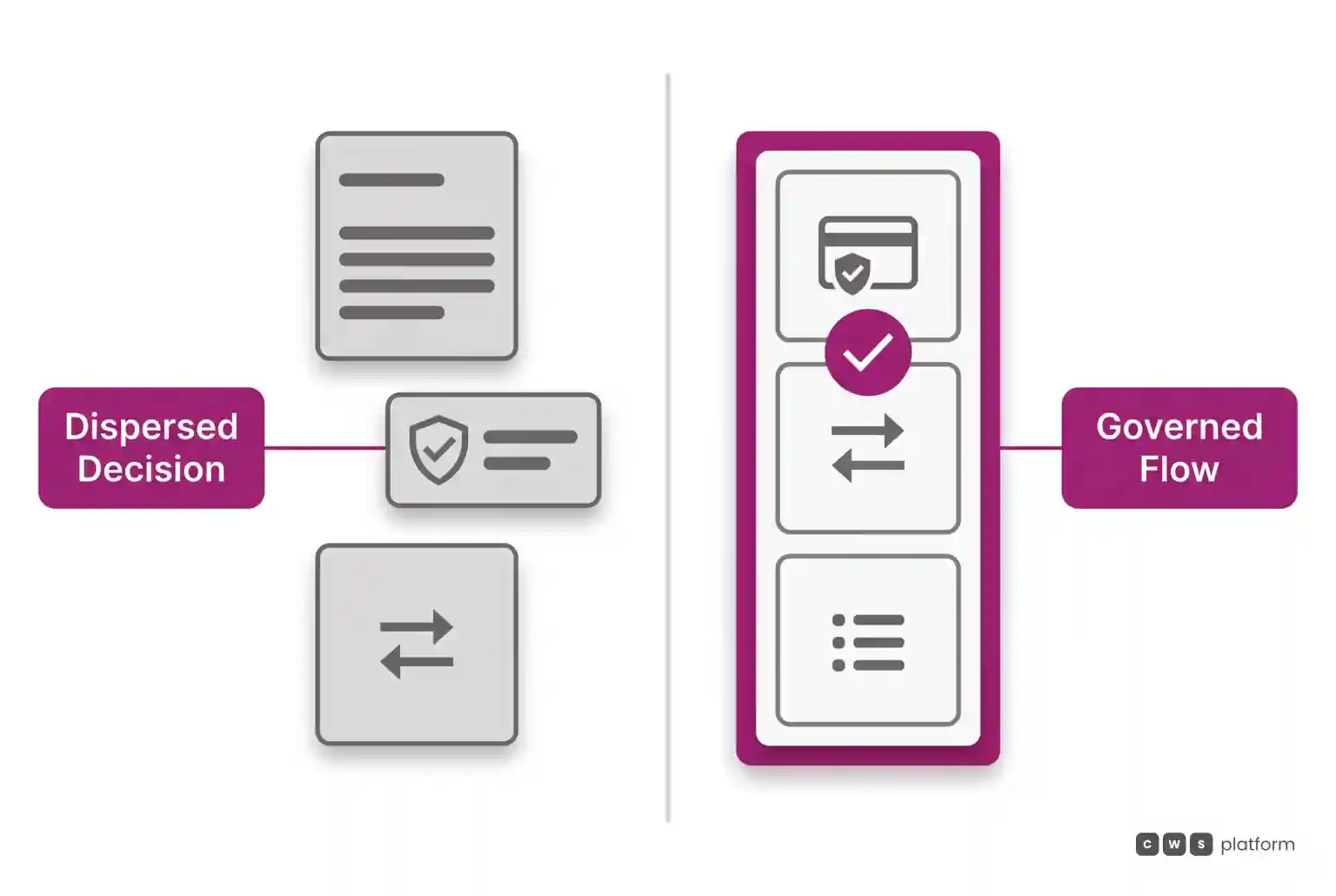
This is where the CWS Platform addresses the pain point: transforming scattered commercial knowledge into a governed, scalable, and auditable process. The objective is not to remove the field sales representative’s ability to negotiate, but to give that person back time to apply technical and commercial expertise where it truly adds value.
FAQ
Does governance reduce commercial flexibility?
No. It defines where autonomy exists, which limits must be respected, and when an exception requires approval. Flexibility stops depending on improvisation and becomes controllable.
Is it enough to integrate existing spreadsheets?
Integration can reduce rework, but it does not replace rule definition. If pricing, credit, and barter continue without shared criteria, the company will only connect sources of ambiguity.
Where does AI create the most value in this workflow?
In executing quotes, combining variables, and preparing decisions within defined parameters. Sensitive approvals and fund movements can remain under human control.
Which metric shows whether the change worked?
The LI-966729 case provides a direct comparison: a quote that took five days was reduced to eight minutes. Beyond timing, leadership should monitor how much time field sales representatives recover to work directly with growers.
Who Is Already Living This
“The auditability of AI agents is a positive point for our compliance team.”
Beatriz N., Commercial Coordinator, on Capterra.
About This Publication
The Cost of Selling is a CWS Platform publication about negotiation governance, sales productivity, and transaction costs in B2B operations. Its analysis starts from one premise: technology creates sustainable value when decision rules are structured before automation.
Sources
- Public case LI-966729, account of governed negotiation in agriculture, reducing a quote from five days to eight minutes and processing a BRL 1 million CPR transaction through barter. No link was provided in the source material.
- Lianlian DigiTech and UnionPay International, partnership to develop AI agent payments in global procurement, with human approval before payment: PR Newswire Asia.
- Jamaica Observer, article on Anthropic’s Claude integration with Excel and PowerPoint: From Excel to slides in minutes.
- Capterra, public testimonial from Beatriz N., Commercial Coordinator, on the auditability of AI agents: CWS Platform on Capterra.
"responsive, technically engaged, and willing to work through complex commercial rules (negotiated pricing, credit, customer-specific conditions) rather than pushing generic answers"
Want to see this in your operation?
Real B2B operations already run on it.