Adobe Commerce vs. CWS Platform: Which Architecture Does Auto Parts Distribution Require?
A comparison of where each architecture places fitment data, commercial rules, inventory, credit, fulfillment, and after-sales operations.
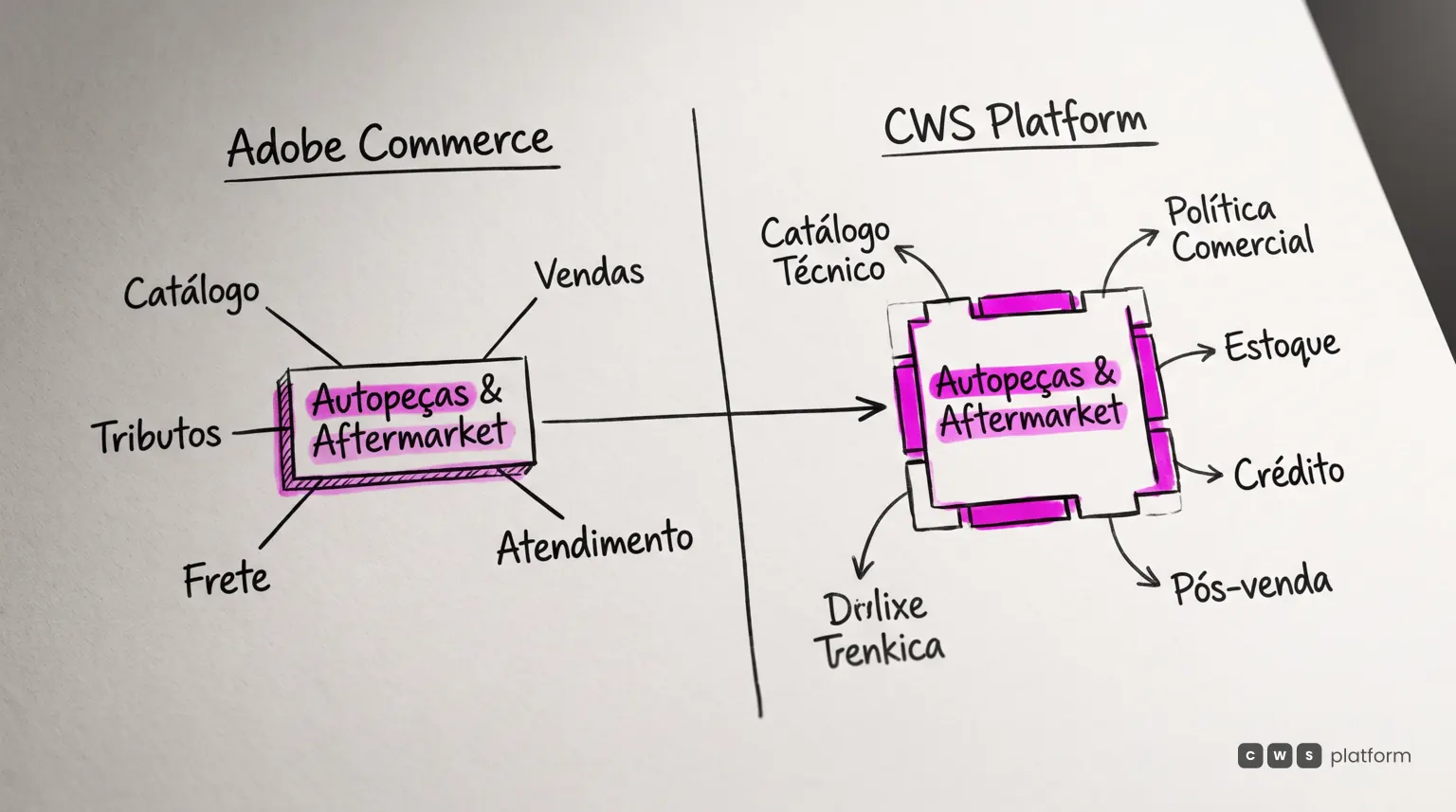
Editor’s note: This is an architectural comparison of Adobe Commerce and the CWS Platform for the auto parts and aftermarket industry. Every statement about Adobe Commerce is based on its public documentation, with the source linked alongside it.
Choosing between Adobe Commerce and the CWS Platform for auto parts requires looking beyond the digital storefront. The central question is where the architecture places technical catalog data, commercial policy, taxes, inventory, shipping, credit, after-sales service, and assisted selling when every order can consume part of the margin.
In the aftermarket, buyers may know the vehicle and application but not the part number. At the same time, price, availability, taxes, and payment terms vary by customer, region, and inventory source. If those variables are resolved in separate steps, the digital order merely transfers work to the sales counter.
The primary lens is the CEO’s: which design enables growth without multiplying the cost of every transaction? The Head of Commerce, CFO, CTO, and counter sales rep view the same choice from different angles, but all of them depend on a consistent answer across discovery, negotiation, ordering, and after-sales service.
The scenario: Margin depends on resolving complexity within the order
An auto parts distributor operates a large catalog with equivalent part numbers, brands, vehicle applications, kits, superseded items, substitutes, and data that changes over time. A buyer may start with a part number, VIN, license plate, year/make/model, informal description, or the sales rep’s memory. The architecture must turn those inputs into a commercially reliable selection.
Pricing is also contextual. The amount shown may depend on buyer identity, region, warehouse, volume, cart composition, payment timing, and payment method. In B2B, price is the result of a rule, not merely a field stored in the product record.
Complexity continues after selection. State and local sales taxes, tax exemptions, shipping, credit, returns, warranties, and reverse logistics can change the order’s economics. When those decisions sit outside the transaction, the sale returns to spreadsheets, messages, and manual reviews.
The sales counter remains relevant because its staff understands fitment, urgency, and customer history. Digital commerce must capture reorders and after-hours demand, while human service handles questions and negotiations that genuinely require intervention. How those channels coexist determines whether digital reduces work or merely redistributes it.
As market context, APQC, 2025 reports a median cost of $8.48 to perform the process “manage sales orders” in its benchmarking database. The figure does not measure any specific distributor, but it helps the CEO treat every intervention, recalculation, and system handoff as part of the transaction’s economics.
The six decisions this scenario forces
The architectural choice appears in six operating decisions. They should be examined in the order the transaction actually unfolds, from part discovery to the final effect on margin.
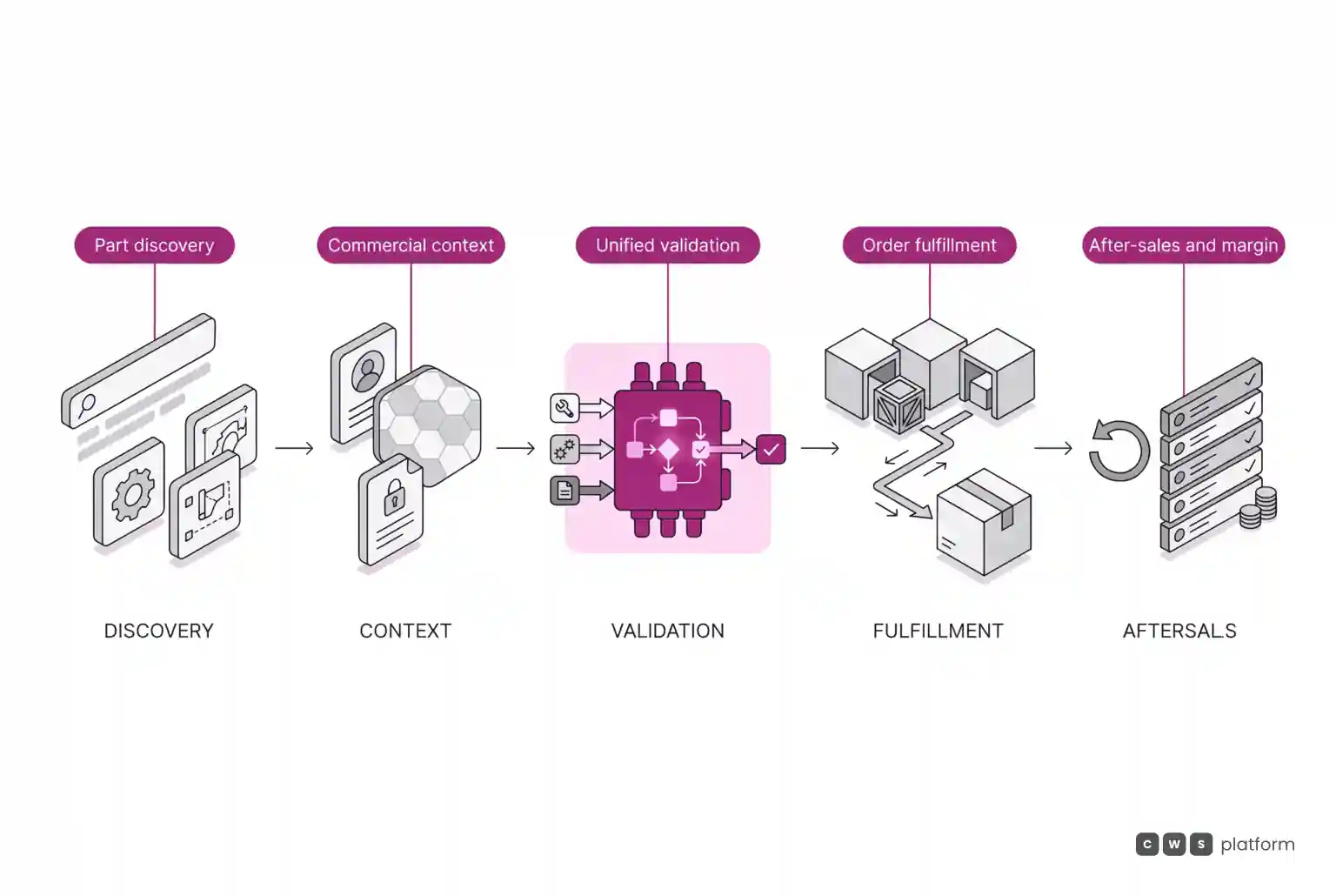
1. How buyers find a part without knowing the part number. Discovery must begin with the technical context provided by the buyer. Vehicle and application data guide selection, while structured compatibility data exposes items that would be difficult to find through an exact part-number search.
2. How negotiated pricing stays out of the public storefront. The negotiated price must be calculated for that buyer’s identity and commercial context. The storefront stops functioning as a universal price sheet and instead displays the result authorized by the pricing policy.
3. Where sales tax and exemption rules are calculated. The economically valid total must be created within the transaction. Taxes, exemptions, shipping, and credit must participate in the same decision that confirms the items, fulfillment source, and commercial terms, preventing the order from being reinterpreted later.
4. Who handles returns, warranties, and return shipping. Returns, warranties, and reverse shipping must be treated as commercial and operating conditions of the order. That allows after-sales service to follow a known policy instead of depending on an improvised negotiation after delivery.
5. How the sales counter coexists with digital commerce. The digital channel should absorb reorders and after-hours demand, preserving sales staff for technical guidance and negotiation. Buyers can proceed independently or share their context with the person who takes over the interaction.
6. Where margin is lost at the SKU level. Margin must be measured at the level where the decision occurs. Changes to price, discounts, shipping, credit, and after-sales service must carry a reason and an audit trail so that sales volume does not hide the cost to serve each item-and-customer combination.
What creates friction today, in the words of operators
The statements heard in the field rarely describe the problem in technology terms. Each one reveals an architectural decision that must be made before selecting a platform.
“I waste time looking for the right part; the fitment data is never complete.” This statement reveals the decision about how buyers and counter sales reps find a part when the exact part number is missing or differs across manufacturers.
“Every customer has a different price, and nobody can put that on the website.” The decision is where commercial policy will be executed: within the order, using customer and regional context, or in a negotiation that takes place outside the portal.
“To close a complex order, I have to open five systems.” This statement reveals the orchestration decision. Catalog, pricing, inventory, credit, tax, and shipping can either compose one transaction or force the sales rep to reconstruct the answer manually.
“My gross margin looks fine, but my net margin doesn’t.” The underlying decision is how concessions and post-sale costs enter governance. Discounts, freight, returns, and warranties must be connected to the order that generated them.
“Every new customer costs more to serve than the previous one.” This statement reveals the CEO’s decision about scale. If every commercial variation returns to a person for resolution, growth increases transaction costs instead of distributing the negotiation rules.
What Adobe Commerce handles well in this scenario
The B2B architecture organizes buyers within company accounts. A company administrator can structure divisions, subdivisions, users, roles, and permissions for orders, quotes, purchases, credit, and profiles, while store configuration determines the payment methods, pricing levels, and requisition lists available to each company according to the B2B documentation.
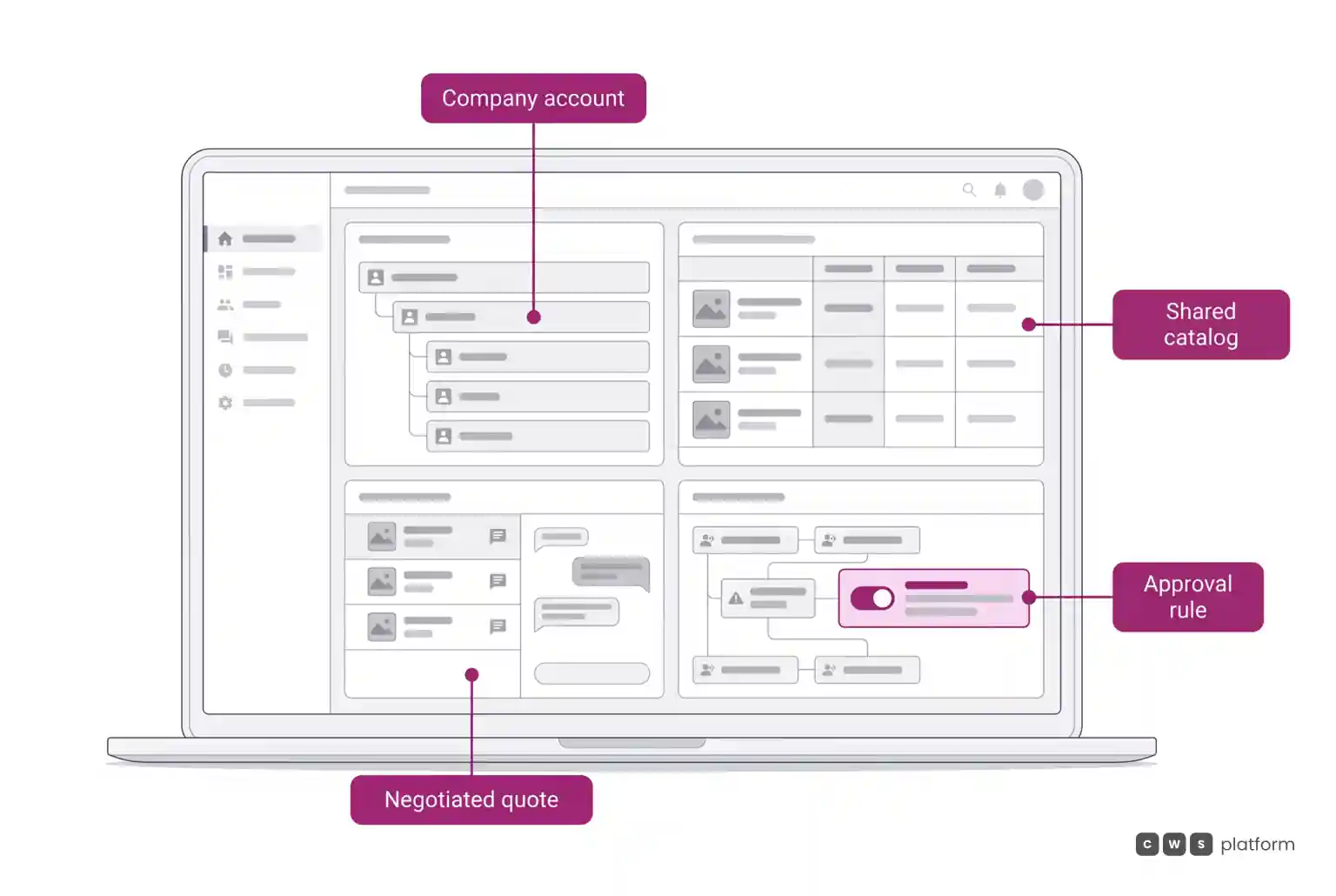
Shared catalogs associate custom product pricing with specific companies or customer groups. Negotiation can begin from the shopping cart or the Admin, allowing users to change items, quantities, and discounts and exchange messages until an agreement is reached within the documented B2B commerce workflow.
When purchase orders are enabled for a company account, orders use that format and can be subject to approval rules related to the user’s role and the order. This mechanism places governance within the buying company’s organizational structure and its authorized users as described in the documentation.
For decoupled discovery and merchandising, a SaaS layer can ingest data from commerce platforms, PIM systems, or ERPs, organize it into catalog views and policies, and serve storefronts through GraphQL APIs. Cart and checkout remain in the connected transactional system, while full or incremental synchronization updates catalog, pricing, and category data according to the Optimizer overview.
For operations with multiple digital destinations, an instance is organized into websites, stores, and store views. Each level controls different scopes for catalog, checkout, shipping, payment, language, currency, and presentation, allowing elements to be shared or separated according to the selected structure in the documented website and store architecture.
How the CWS Platform is assembled: Commercial rules follow the part from catalog to after-sales service
In an auto parts operation, discovery begins with vehicle and application search. It addresses orders from buyers who do not know the exact part number and presents compatible items they would be unlikely to request on their own. Product Catalog & MDM (Catalog Engine) supports the governed catalog, while the catalog-enrichment agent helps transform incomplete data into usable technical content.
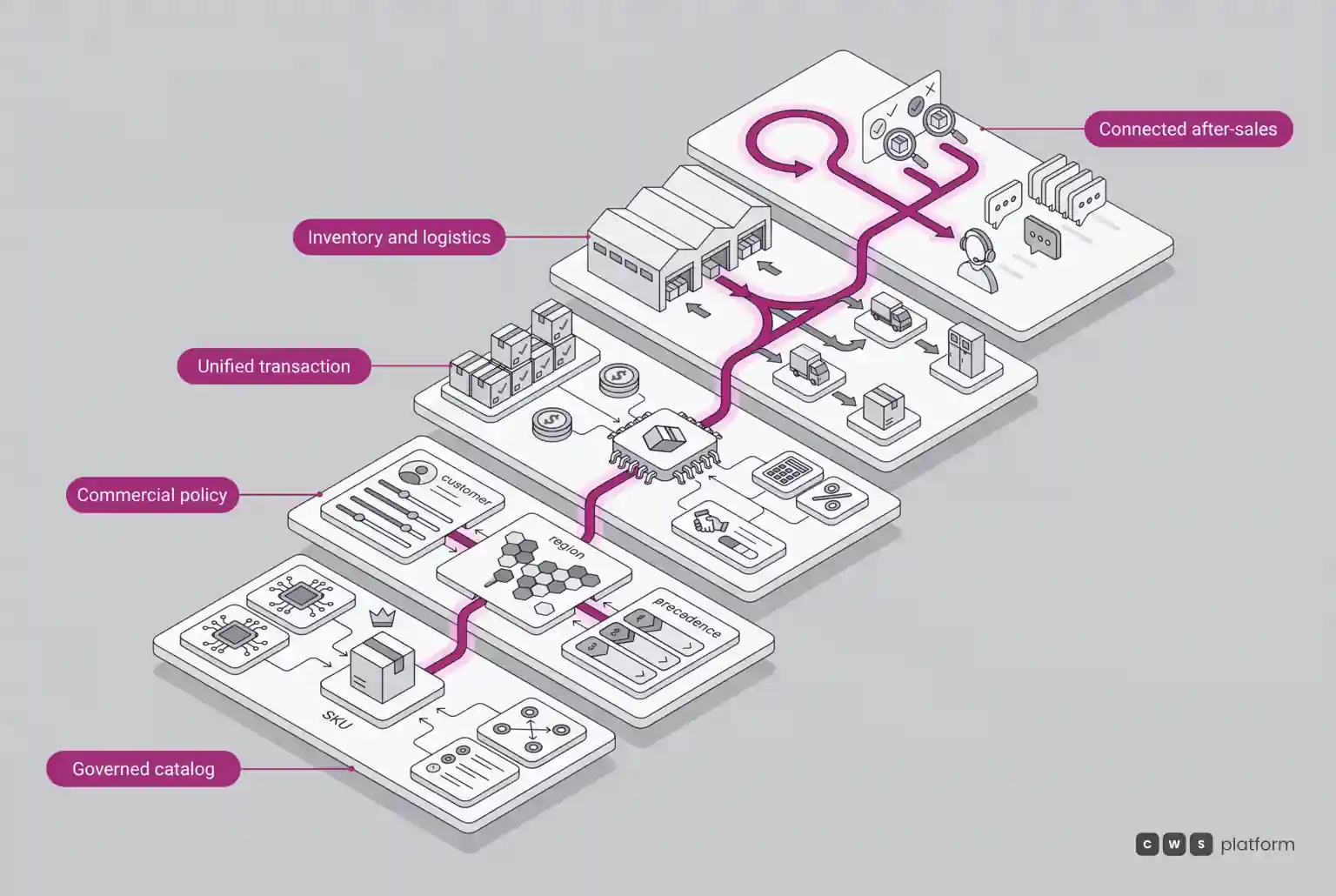
This design starts from the premise that managing catalog data makes a SKU sellable. Part number, brand, naming, image, and vehicle application must form an updatable structure instead of remaining in isolated files. For the CEO, the architectural consequence is direct: discovery and service no longer depend exclusively on the individual memory of counter staff.
Contextual Pricing (Pricing Engine) calculates price by product, warehouse, customer profile, and tax rule. Precedence among contracts, rules, and price lists turns negotiated terms into an executable decision. Pricing by customer, region, and profile remains governed so each buyer sees the appropriate terms.
CDL Workspace (Commerce Rules Engine) centralizes deterministic commercial policy. Rule changes require a reason and comment, making it possible to connect a concession to the person and context that produced it. The rule-auditing agent supports interpretation of that configuration, while financial decisions remain subject to the policies defined by the operation.
Credit-First B2B Checkout (Checkout & Payments) applies credit during the transaction. Within the same order, the operation validates inventory, pricing, credit, and taxes, while applicable sales tax, exemptions, and shipping make up the displayed total. If a combination violates commercial policy, the order is not created.
Distributed Inventory (Inventory Hub) brings warehouse- and SKU-level availability into the commercial decision. Shipping & Fulfillment (Logistics Engine) calculates fulfillment alternatives, sourcing, split shipments, prepaid or collect terms, and shipping rules. Price and lead time can therefore reflect the operation that will actually fulfill the buyer’s order.
Return shipping, exchanges, and warranties enter as rules associated with the same order. This connection matters to the CFO because post-sale costs stop being events disconnected from the original negotiation. Policy can account for how merchandise returns, which conditions apply, and how service should proceed.
Assisted Selling Platform (Sales Hub) functions as a digital negotiation desk. The sales rep and buyer can work in a shared cart, with pricing, credit, and commercial rules applied to the specific context. The sales-support agent assists the interaction without replacing human judgment in commercial exceptions.
The sales counter takes on a different role. Predictable reorders can proceed digitally, including after business hours, while counter sales reps step in when buyers have fitment questions, urgent requirements, bundle needs, or a negotiation. The same policy follows both paths, reducing the need to rebuild the order across separate screens and messages.
The CWS Platform has 11 modules, 6 AI Agents, and 1,029 configurable parameters. The significance of this composition is that it connects catalog, rules, pricing, inventory, credit, logistics, and service around the transaction, with each module handling an explicit part of the commercial decision.
The final yardstick is the transaction cost across the value chain. For the CEO, digitizing the storefront only makes sense when it also reduces unproductive searches, recalculation, review, rework, ungoverned exceptions, and disconnected after-sales service. The architecture should make recurring orders distributable across digital channels and reserve human intervention for decisions that genuinely require technical knowledge or negotiation.
Where the architectures truly diverge
The first difference is the unit used to organize commercial policy. One architecture starts with the company account, including buyers, divisions, roles, permissions, shared catalogs, and quote processes documented in the B2B core. The other starts with the contextual transaction, connecting product, warehouse, customer, tax rules, credit, and logistics.
The second difference appears in discovery. A merchandising layer can receive catalog and pricing feeds, normalize them, and expose queries to storefronts while the cart remains in the connected system according to the Optimizer model. In the auto parts scenario, the other architecture emphasizes vehicle fitment and continuity among the part found, the terms negotiated, and order fulfillment.
The third difference lies in operating scope. The website, store, and store-view hierarchy defines where catalog, checkout, payment, presentation, and other storefront elements are shared or separated in the multi-site configuration. The alternative uses warehouses, regions, and commercial rules as context for availability, pricing, credit, and delivery.
The fourth difference is how negotiation is handled. A company account can initiate quotes from the cart or the Admin, exchange messages, and change items, quantities, and discounts until an agreement is reached in the official quote workflow. The other architecture uses a shared cart, contextual decisions, and recorded reasons to connect the sales rep’s work to an executable order.
The fifth difference appears at the boundary of the order. One architecture concentrates corporate governance in users, permissions, and purchase-order approvals as described for company accounts. The other evaluates commercial terms, inventory, taxes, credit, shipping, returns, and warranties within the same transactional chain.
Adobe's own documentation records two limits that auto parts distribution runs into:
- limitation recorded in the vendor's documentation on October 8, 2026: prices loaded with more than two digits of precision are rounded to two ("Commerce automatically rounds all prices to two digits", https://experienceleague.adobe.com/en/docs/commerce-admin/stores-sales/site-store/taxes/taxes).
- limitation recorded in the vendor's documentation on October 6, 2026: using the Bulk API requires installing and configuring RabbitMQ ("you must install and configure RabbitMQ", https://developer.adobe.com/commerce/webapi/rest/use-rest/bulk-endpoints/).
| Decision | Adobe Commerce, based on the documented mechanism | CWS Platform |
|---|---|---|
| Where commercial policy is expressed | Expresses policy through the company account, roles, permissions, and shared catalogs. | Expresses policy within the transaction by combining customer, warehouse, pricing, credit, and logistics. |
| When the part is discovered | Organizes catalog and merchandising for search through the connected digital experience. | Connects vehicle and application data to the technical catalog and carries the selection into negotiation. |
| Where pricing gains context | Associates custom pricing with companies or customer groups through shared catalogs. | Calculates price based on product, warehouse, customer, region, and tax rules. |
| Where assisted negotiation takes place | Conducts quoting between the cart and the Admin, with changes and messages. | Conducts negotiation through a shared cart, with rules, credit, and human service. |
| Scope of operating configuration | Distributes settings across websites, stores, and store views according to the digital destination. | Distributes decisions by warehouse, region, availability, payment, credit, and shipping. |
| When after-sales service enters the margin calculation | Keeps primary governance in the account, purchasing process, and administrative workflow. | Includes returns, warranties, and return shipping as conditions connected to the order. |
The table should not be read as a feature inventory. It shows where each design concentrates decisions and governance. For an auto parts distributor, the choice depends on whether the dominant complexity lies in the buyer’s corporate structure and the storefront—or in the transactional combination of fitment, pricing, inventory, credit, taxes, logistics, counter sales, and after-sales service.
When Adobe Commerce is the right choice for this scenario
Some operations have requirements that point toward an architecture centered on corporate structure, decoupled merchandising, or the administration of multiple digital experiences. In those cases, fit should be evaluated through the specific mechanism supporting the project.
The buying company requires detailed corporate administration. Choose this architecture when the central requirement is to group buyers within a company account with their own divisions, subdivisions, roles, and permissions. The mechanism can control activities such as ordering, quoting, purchasing, credit, and profile management according to the buyer’s organizational structure described in the B2B documentation.
The process depends on role-based purchase orders. Choose this architecture when all orders for a particular company must be created as purchase orders and follow approval rules associated with the role and order. This workflow is enabled by company account and integrates governance into the buyer’s corporate purchasing process according to the documented mechanism.
The project prioritizes decoupled SaaS merchandising. Choose this architecture when the requirement is to ingest catalog data from a commerce platform, PIM, or ERP, organize it into views and policies, and query it through GraphQL APIs. Cart and checkout can remain in another connected system while feeds update catalog, pricing, and category data according to the Optimizer architecture.
The digital structure must separate brands, languages, or destinations. Choose this architecture when the project requires a website, store, and store-view hierarchy to control presentation, language, currency, catalog, checkout, or destination-specific configurations. The mechanism makes it possible to define what is shared and what remains separate within the instance in the website and store documentation.
Where to go next
If your question is still which architecture fits your operation—not which vendor to choose—continue with the seven questions that separate B2B commerce architectures.
If your immediate problem is the operational pain behind this scenario, When the Catalog Turns Into Chaos and When Selling More Doesn’t Mean Earning More explore it in depth without discussing any vendor.
"responsive, technically engaged, and willing to work through complex commercial rules (negotiated pricing, credit, customer-specific conditions) rather than pushing generic answers"
Want to see this in your operation?
Real B2B operations already run on it.