Assisted Sales and Digital Counter: Salesforce or CWS Platform?
An architectural comparison between enterprise CRM relationship governance and real-time transactional counter execution.

Editorial note: architecture comparison between Salesforce and CWS Platform in an assisted selling and digital counter scenario. Every fact about Salesforce comes from its public documentation, with the URL alongside.
B2B operations combining field sales reps, inside sales reps, and walk-in branch counters face a technological crossroads when modernizing trade operations. On one hand, broad ecosystems such as Salesforce organize the corporate sales lifecycle around accounts, opportunities, and enterprise pipeline stages. On the other hand, platforms built for distributed execution focus on frictionless transactional trade directly between buyer and seller.
The fundamental question for commercial leadership is not tallying isolated features on a spreadsheet, but identifying where the core complexity of the business model actually lives. If the priority is governing vast territories, aggregating revenue forecasting, and designing enterprise CRM workflows, the technical path leads in one direction. When the challenge is unifying physical inventory across distribution branches, enforcing margin governance within the active session, and sharing live carts without rekeying orders, the architectural requirements shift entirely.
This article reviews the practical architecture decisions supporting assisted selling and the digital branch counter. We examine how each model handles sales rep autonomy, net margin control, and order fulfillment, highlighting contexts where traditional enterprise infrastructure is ideal and scenarios where a specialized distributor portal and transactional engine become the natural fit.
The scenario: B2B negotiations between physical counters and the digital portal
In day-to-day wholesale distribution and trade operations, assisted selling operates right where headquarters pricing policy meets corporate buyers with distinct tax jurisdictions, varied credit lines, and local logistics demands. The customer walks up to the branch counter, calls an inside sales rep, and checks negotiated contract pricing on a self-service distributor portal. When these touchpoints run on disconnected systems, the sales rep spends valuable time acting as an administrative order re-keyer across clunky legacy screens, chasing fragmented quotes.
For finance leaders and digital commerce managers, the critical failure point in this model is losing governance over transaction-level profitability. Off-book discounts agreed over phone calls, untracked verbal approvals, and override terms granted without real-time credit limit checks create a dangerous gap between top-line revenue and net operational margin. Complexity scales fast when branch facilities operate under local sales tax rules and segregated physical warehouse inventory.
Transforming a traditional branch counter into an integrated digital counter means buyer and seller collaborate on the exact same order in real time. In this assisted selling framework, the sales rep shifts from reactive order entry to guided selling supported by automated validation guardrails, while enterprise governance ensures every price concession, payment term, or freight waiver remains strictly audited within assigned approval tiers.
The six architecture decisions the scenario forces
Building a modern assisted trade operation requires definitive answers to six operational dilemmas that directly affect net profit margins and team responsiveness:
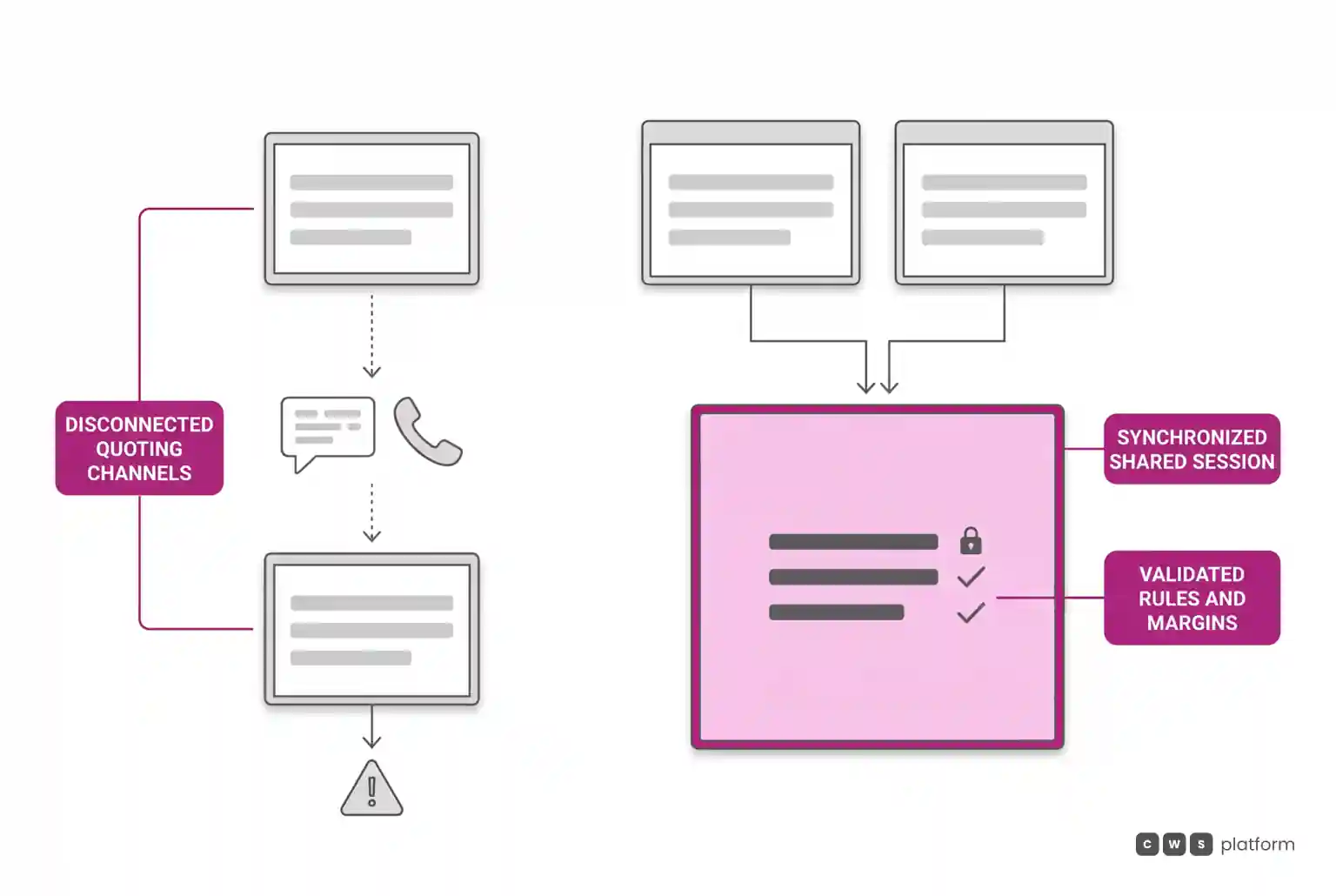
1. Who approves off-tier pricing concessions. Off-tier pricing approvals must execute as deterministic business logic directly inside the transaction, not via informal backchannel chats. Rather than relying on phone calls or rogue text threads, the system must enforce programmatic discount thresholds tied to user permission profiles. Any exception requires a mandatory structured reason code and an immutable audit trail to protect company profitability.
2. How rep and buyer build the same order. Quoting becomes vastly more efficient when customer and account executive collaborate directly within the same live purchase session. Instead of the customer compiling a draft list on a distributor portal only for the rep to manually re-type SKUs into a green-screen back office ERP, both parties manipulate identical items, pricing tiers, and quantities synchronously. This workflow eliminates redundant data entry and avoids costly discrepancies between quote and final invoice.
3. What the sales rep knows about the account in real time. Access to transaction history, open accounts receivable, available trade credit, and buyer tax exemption certificates must happen the moment the sales conversation begins. When an inside rep quotes line items without instant visibility into past-due balances or credit holds, the deal risks stalling later in downstream billing. Contextual data delivery removes customer friction and cuts internal administrative rework.
4. Who sees which account. Customer account visibility requires strict territory segregation to protect sales alignment and data integrity. Territory reps and independent agents should access only their assigned accounts, viewing order histories and open quotes relevant to their commercial territory. Strict multi-tenant scope governance prevents territory overlap, protects confidential pricing, and keeps sales teams focused on authorized target accounts.
5. What stops stacked discounts. Guarding net margins requires deterministic validation rules that block unauthorized discount stacking on top of contracted catalog pricing. If gross margin leakage is only analyzed during month-end financial reviews, profit has already drained away at the register. Enforcing upfront cart validation checks ensures no order converts below minimum net margin thresholds.
6. What the sales rep stops doing. A sales rep's daily schedule must be stripped of manual quoting chores and administrative data entry. Instead of spending hours rekeying standard replenishment items and parsing static PDF price books, reps should receive predictive reorder reminders, churn risk alerts, and AI-suggested draft carts delivered by their distributor portal. The rep steps into the role of a strategic deal evaluator operating with assigned authority.
The operational friction, in the words of front-line teams
Interviews conducted across wholesale distribution networks capture the daily disconnect between boardroom strategy and counter execution:
When confronting field margin erosion, commercial leadership states: "Approving discounts is pure chaos. Everyone handles exceptions their own way." This directly mirrors Decision 1, showing how reliance on informal manual approvals degrades financial governance.
Describing daily counter workflows, customer service reps report: "To close a complex order, I have to open five different systems." This captures the operational friction outlined in Decision 2 and Decision 3, where jumping across disconnected applications inflates order servicing costs.
Leads and repeat orders regularly slip through the cracks, with executive management noting: "Our baseline revenue relies on three hundred reps remembering to call the right accounts every week." This reflects Decision 6, highlighting the vulnerability of operations that depend entirely on individual memory without algorithmic workflow guidance.
During morning pickup peaks at regional hubs, branch counter staff warn: "The POS system freezes the moment the line reaches the front door." This bottlenecks back to Decision 2, proving that heavy web apps tightly coupled to complex core ERP routines fail under intense counter traffic.
Finally, unmanaged margin erosion surfaces when controllers point out: "Our gross revenue looks healthy, but our net operating margins are bleeding out." This statement underlines the absence of preventive transaction guardrails discussed in Decision 5, where cumulative discount stacking erodes profitability before management can react.
What Salesforce solves well in this scenario
The Salesforce ecosystem supports enterprise trade management by organizing client relationships across leads, accounts, contacts, and opportunities inside Sales Cloud. This architecture centralizes deal-stage tracking, linking pipeline forecasting with tools to administer multi-tiered sales territories, global currencies, and team revenue splits. Seller Home and Sales Workspace present sales reps with prioritized action items and AI-generated account summaries.
For cross-departmental automation and AI-driven interactions, the platform provides Agentforce, which utilizes Agent Script to combine natural language processing with programmatic logic such as if-else branching, state transitions, and direct variable assignments. Engineering teams can build and test custom service topics using the Salesforce CLI and dedicated SDKs, deploying assistants across web chat, mobile apps, and external portals via the Agent API.
At the digital storefront layer, Commerce Cloud enables customizable digital storefronts via Experience Builder using Lightning components. The platform manages complex price books, products, and customer entitlements ingested via CSV files or Data Loader. It controls access for verified B2B buyer accounts, supports blended B2B and D2C models on a shared data model, and relies on third-party ecosystem integrations for custom checkout payment flows.
Internal collaboration and customer service workflows extend through tools like Slack, sharing opportunity updates directly inside team channels, and Service Cloud for customer support ticketing, Omni-Channel routing, and buyer self-service knowledge bases. To harmonize external analytical data, Data 360 ingests enterprise lakehouse records, converting Data Lake Objects into unified Data Model Objects to trigger automated marketing workflows based on calculated customer lifetime value metrics.
How CWS Platform builds it: Assisted selling architecture focused on transactional execution
CWS Platform engineers assisted selling by completely decoupling the frontline sales counter from back-office administrative tasks, treating the local branch warehouse or fulfillment distribution center as the primary business unit. Through its Assisted Selling Platform (Sales Hub), branch operations run on a specialized digital counter interface designed for high-concurrency order entry, connected directly to customer accounts through a synchronized shared cart. Account reps and buyers view the exact same catalog items, real-time quantities, and applicable sales taxes without manual synchronization delays.
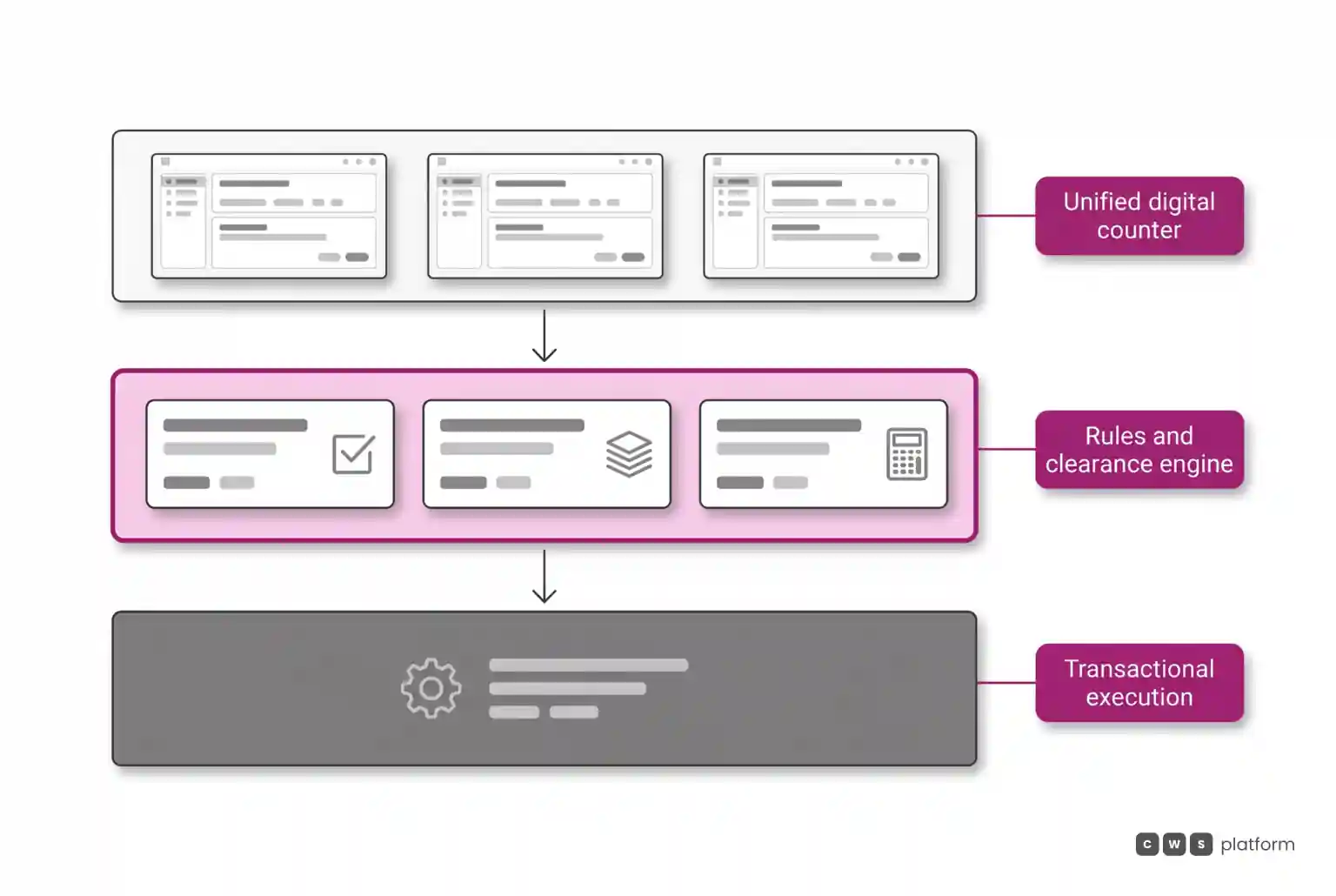
Pricing rules and margin thresholds run deterministically through the Commerce Rules Engine (CDL Workspace). This engine enforces tier-based discount limits by rep role, blocks stacking conflicting promotions, and evaluates approval routing within the active transactional checkout call. Any price concession outside pre-set guidelines mandates an audit reason code, ensuring total traceability across pricing, freight concessions, and payment terms.
Dynamic pricing calculations execute via the Contextual Pricing Engine, computing net prices on the fly based on the fulfilling branch location, customer contract agreements, and local destination tax codes. Simultaneously, the Product Catalog and MDM (Catalog Engine) provides structured technical attributes, dynamic search filtering, and cross-reference schematics, helping counter reps identify parts rapidly across large, complex SKU catalogs.
During order finalization, the Credit-First B2B Checkout processes the transaction against simultaneous checks covering physical shelf inventory, local tax rules, and active B2B trade credit balances. The purchase is orchestrated through the Order Management System (OMS and Seller Center), managing sequential lifecycle states and gating any transition that requires manual credit department review or net-terms verification before inventory release.
The true test when evaluating these platforms comes down to transaction cost across the commercial pipeline. When your sales reps waste valuable billable hours toggling across disconnected screens or rekeying handwritten quotes, margins leak before an invoice is ever created. A modern assisted selling engine proves its value by cutting administrative friction from every transaction, converting routine counter conversations into automated, governed order capture.
Where operational friction originates, and how targeted architecture resolves it:
| operational pain point | root business cause | how the architecture resolves it |
|---|---|---|
| "Gross margin looks healthy, but net margins are bleeding out" | Caused by unmonitored promotion stacking, missing approval logs, and unpredictable freight write-offs hidden within gross revenue reports. | The rules engine enforces deterministic transaction controls, stopping discount stacking and requiring recorded reason codes for manual overrides. |
| "Approving discounts is pure chaos; everyone handles it differently" | Stems from ad-hoc email chains and phone authorizations lacking user-level authority limits. | The distributor portal validates cart discounts automatically against assigned rep authority before order submission. |
| "I use four or five screens to process a single complex customer order" | Caused by fragmented operations across separate CRM, legacy ERP, warehouse, and tax billing screens. | An integrated assisted selling sales hub unifies account history, customer catalog pricing, and branch inventory into one workspace. |
| "The POS counter system crashes during peak morning pickup hours" | Occurs when frontline trade interfaces run direct, synchronous queries against legacy ERP databases during peak load. | A decoupled, headless architecture keeps the counter UI operating smoothly via fast APIs, buffering high-volume branch traffic. |
| "Reorder sales only happen if the rep remembers to call the account" | Relies entirely on manual rep discipline rather than data-driven alerts to detect churn patterns and replenishment cycles. | The platform flags replenishment cadences, delivering pre-built reorder carts so sales reps act as strategic deal validators. |
Where the two architectures fundamentally diverge
The core architectural divergence between these platforms is the specific layer where business logic and operational policies execute. In CRM-centric ecosystems, priority centers on pipeline velocity, cross-departmental lead tracking, and macro-level revenue rollups across global enterprises.
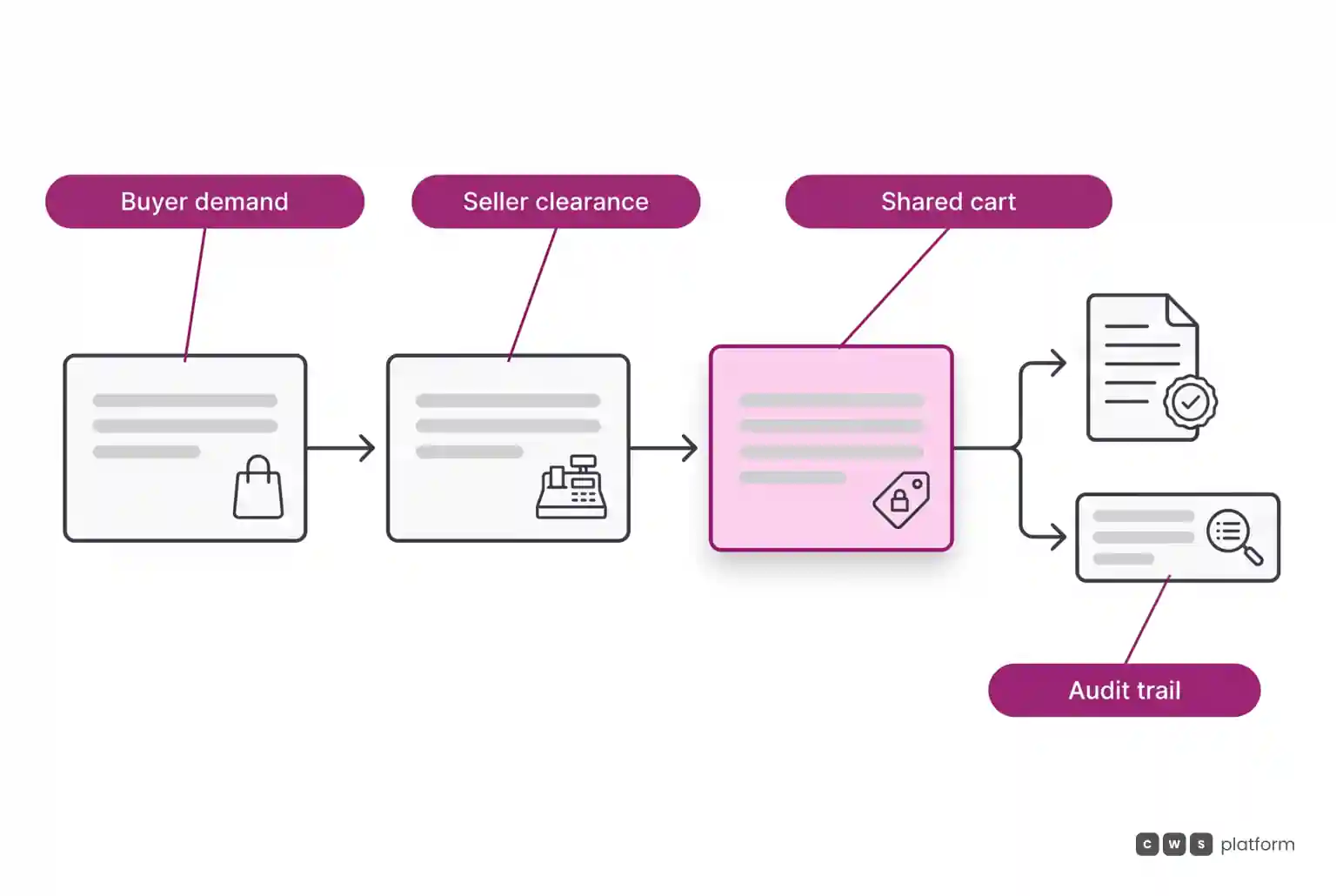
Conversely, an execution-first distributor portal architecture concentrates on the point of trade. Available physical inventory, branch-level tax rules, buyer credit lines, and net margin thresholds validate deterministically during cart construction, guaranteeing every submitted order adheres to commercial policy.
Salesforce's own documentation records two limits that show up in assisted selling:
- limitation recorded in the vendor's documentation, consulted on October 9, 2026: the account switcher degrades beyond 200 accounts and fails at 2 thousand ("At 2 thousand Buy For accounts the Account Switcher fails.", https://developer.salesforce.com/docs/commerce/salesforce-commerce/guide/b2b-b2c-comm-data-model-shopper-buyer-groups-accounts-limits.html).
- limitation recorded in the vendor's documentation, consulted on October 9, 2026: most stores limit the cart to 500 line items per order, and reaching 2,000 requires enabling large cart support ("Most stores limit cart size to 500 line items per order.", https://developer.salesforce.com/docs/commerce/salesforce-commerce/guide/b2b-b2c-comm-data-model-cart-limits.html).
| architectural criteria | Salesforce, via documented mechanisms | CWS Platform |
|---|---|---|
| Approval governance and discount rules | Configured through CRM opportunity approval stages, validation rules, and Lightning Flow automation. | Enforced in real time by the rules engine directly inside the cart checkout, requiring structured reason codes. |
| Shared rep and buyer order collaboration | Handled through custom B2B storefronts linked to CRM account objects or custom opportunity stages. | Built on a live shared cart session enabling real-time co-authoring between rep and customer. |
| Catalog, warehouse, and inventory structure | Synced via CSV files, Data Loader, and price books mapped to buyer accounts and storefront entitlements. | Managed natively at the branch level, isolating regional price books, sales taxes, and local inventory. |
| ERP and sales tax integration approach | Connected via REST or SOAP APIs, middleware connectors, and AppExchange integration packages. | Delivered via headless REST APIs and real-time webhooks, delegating tax math to specialized engines. |
| Technology software pricing model | B2B Commerce is priced as a percentage of GMV, and Order Management charges separately for orders processed outside the storefront (pricing page). | Priced on license usage and technology consumption, with no percentage of sales in the standard model. |
Choosing the right platform is not a matter of comparing generic feature checkmarks. It depends entirely on where your commercial friction lives: in top-of-funnel pipeline forecasting across massive teams, or in frontline order execution across physical branches and self-service distributor portals.
When Salesforce is the right choice for this scenario
Salesforce enterprise architecture is the recommended option when organizational priorities center on macro-level customer relationship workflows, enterprise lead distribution, and unified global sales reporting:
Complex corporate territory management and global pipeline forecasting. Choose this infrastructure when your enterprise requires complex hierarchical territory mapping, complex deal-split commissions across account teams, and multi-currency pipeline projections rolled up across global operating units. This capability is exceptionally mature within Sales Cloud, giving senior leadership granular governance across multi-layered business organizations.
Advanced AI agent development using custom scripts and declarative rules. Select this framework if your organization plans to engineer custom AI agents that blend conversational prompts with programmatic control structures like if-else conditions and multi-topic state machines. With Agentforce, enterprise engineering teams can build, test, and deploy programmatic service agents via official CLIs, dedicated SDKs, and the Agent API across web and mobile platforms.
Enterprise analytics consolidation and customer identity resolution. Choose this platform when the primary objective is ingesting disparate enterprise touchpoints into a unified data lakehouse, resolving customer identities across legacy business silos. The Data 360 data model maps disparate system data to standard Customer 360 schemas, orchestrating targeted customer engagement workflows driven by computed account-level insights.
When CWS Platform is the right choice for this scenario
CWS Platform is the optimal fit when core business complexity revolves around multi-branch trade execution, upfront net margin governance, and rapid-fire counter operations:
Multi-branch distribution networks with regional catalogs and logistics. Choose this architecture when distributing products across regional fulfillment centers, each with its own local tax profiles, segregated branch inventory, and territory-specific contract price sheets. The platform treats the branch as a native operating unit, allowing local facilities to manage freight conditions, discount caps, and pickup cutoffs while maintaining corporate margin oversight.
Live co-browsing and shared cart order authoring. Select this model when the commercial sales cadence relies on sales reps and trade buyers negotiating items, dynamic pack sizes, and net terms simultaneously. The account rep can initiate a draft proposal, apply assigned discounts, and email a secure digital link populated with selected branch inventory so the customer can review, sign off, and complete checkout on their distributor portal without data re-entry.
Flexible B2B checkout with trade credit validation. Choose this platform when branch trade requires multi-tender payments combining purchase orders, commercial trade credit, corporate credit cards, or instant automated clearing house transfers on the same order. The platform calculates credit rules and available trade lines natively within checkout, recording every step in an audit log and holding orders that fail margin requirements.
Decoupled headless ecosystem with open APIs and specialized tax engines. Select this framework when your IT roadmap calls for a composable, headless approach that connects sales counters to backend ERP backbones while delegating complex calculations to dedicated tax calculation platforms. Asynchronous webhooks keep order lifecycle states aligned across business systems, while a transparent infrastructure-based pricing model protects technology margins with zero percentage-based order cuts.
Where to go from here
If you are still mapping which technical model matches your operational structure rather than picking software vendors, continue with the seven questions that separate B2B commerce architectures.
If your current challenge centers on the underlying friction driving this scenario, our deep-dive reviews on When Selling More Does Not Mean Making More and When Integration Breaks Everything explore these operational dynamics without focusing on platform vendors.
Further reading
- Which Architecture Keeps Location-Level Inventory and Pricing Accurate in B2B Self-Service?
- Your B2B portal accepts orders that will never close
- ERP and B2B e-commerce integration: why the ERP was never the problem (and the real cost that shows up in year two)
- B2B customer portal and self-service orders
"responsive, technically engaged, and willing to work through complex commercial rules (negotiated pricing, credit, customer-specific conditions) rather than pushing generic answers"
Want to see this in your operation?
Real B2B operations already run on it.