B2B Customer Portals: Why Buyers Still Call and How to Fix It
Generic storefronts fail in enterprise commerce when they ignore customer-specific pricing, credit limits, and regional inventory.

"We launched the portal, but customers still call to confirm the price." Anyone who has heard this knows the problem is not the lack of a B2B portal. It is what the portal fails to do. A long list of B2B ecommerce features guarantees nothing: buyers only trade the phone for the screen when the screen answers what the sales rep used to answer, with the same terms and the same reliability.
The useful question, then, is not how many features a platform has. It is which ones eliminate the reason for the call.
Why Buyers Keep Calling
Why do they call? To confirm pricing, lead times, and whether the item will actually ship.
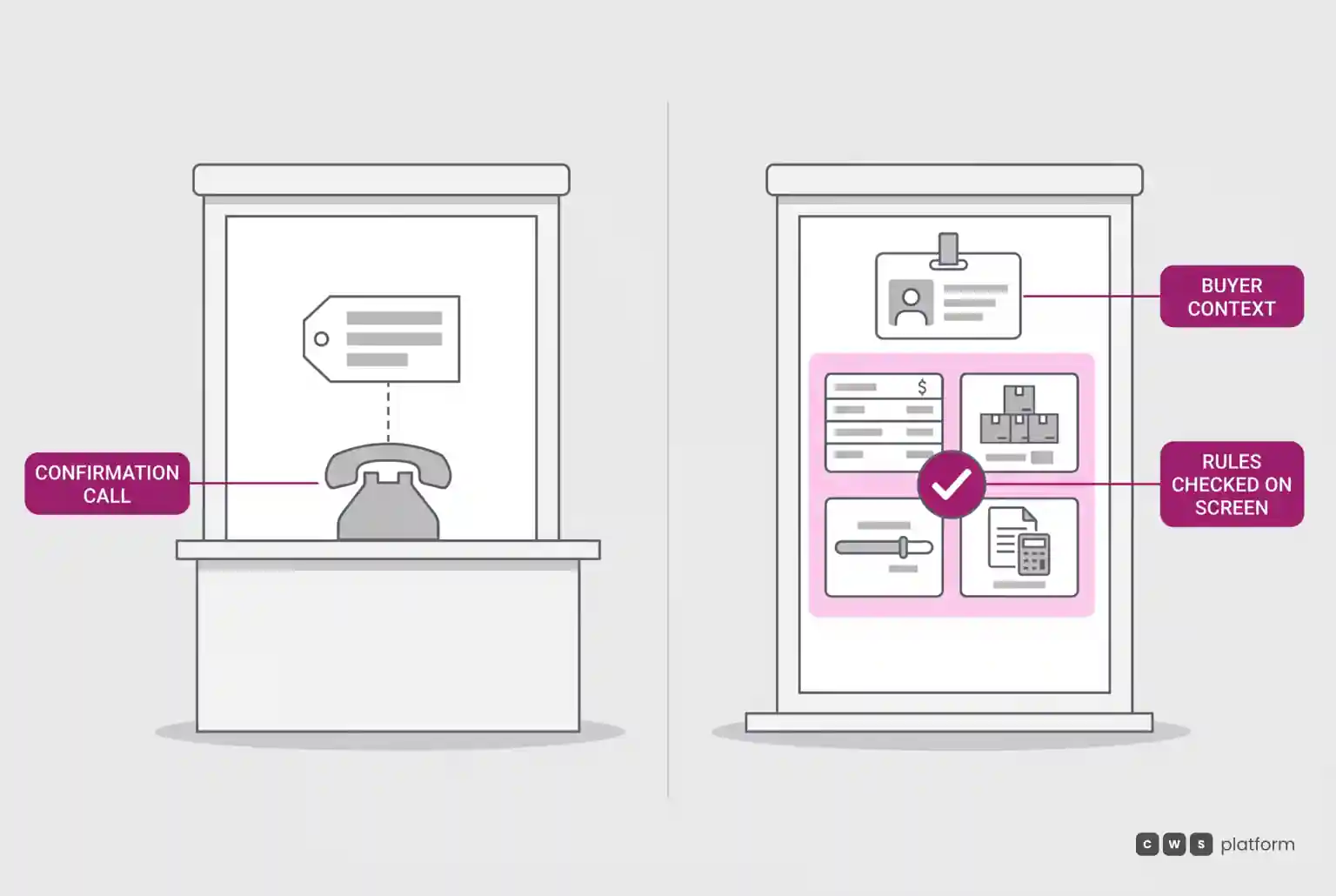
Why do they need to confirm? Because the portal shows standard list prices instead of their negotiated terms, or displays aggregate inventory rather than what is available at their assigned regional warehouse.
Why does the portal show list prices? Because it was built like a retail online storefront: identical prices for everyone, waiting for a click.
Why does that fail? Because in B2B, selling is a negotiation. Pricing depends on the customer, order volume, shipping location, and payment terms; payment runs on trade credit; orders contain dozens of line items.
The root cause: the portal was designed as a digital catalog, and a simple catalog does not enforce commercial logic. As long as commercial logic lives exclusively with the sales rep, buyers will keep calling them. We explore this topic in B2B pricing is not just a number.
The market is not waiting. According to Gartner research on B2B buyers published in 2025, 61% prefer to buy without speaking to a sales rep, yet 69% report inconsistencies between supplier digital channels and sales reps. Buyers want self-service, provided the screen tells the truth.
The Capabilities That Eliminate the Phone Call
1. Customer terms applied upon login. The buyer logs in, and the portal instantly loads their custom price list, customer group, credit limits, and negotiated terms. Without this, everything else is just an online showcase.
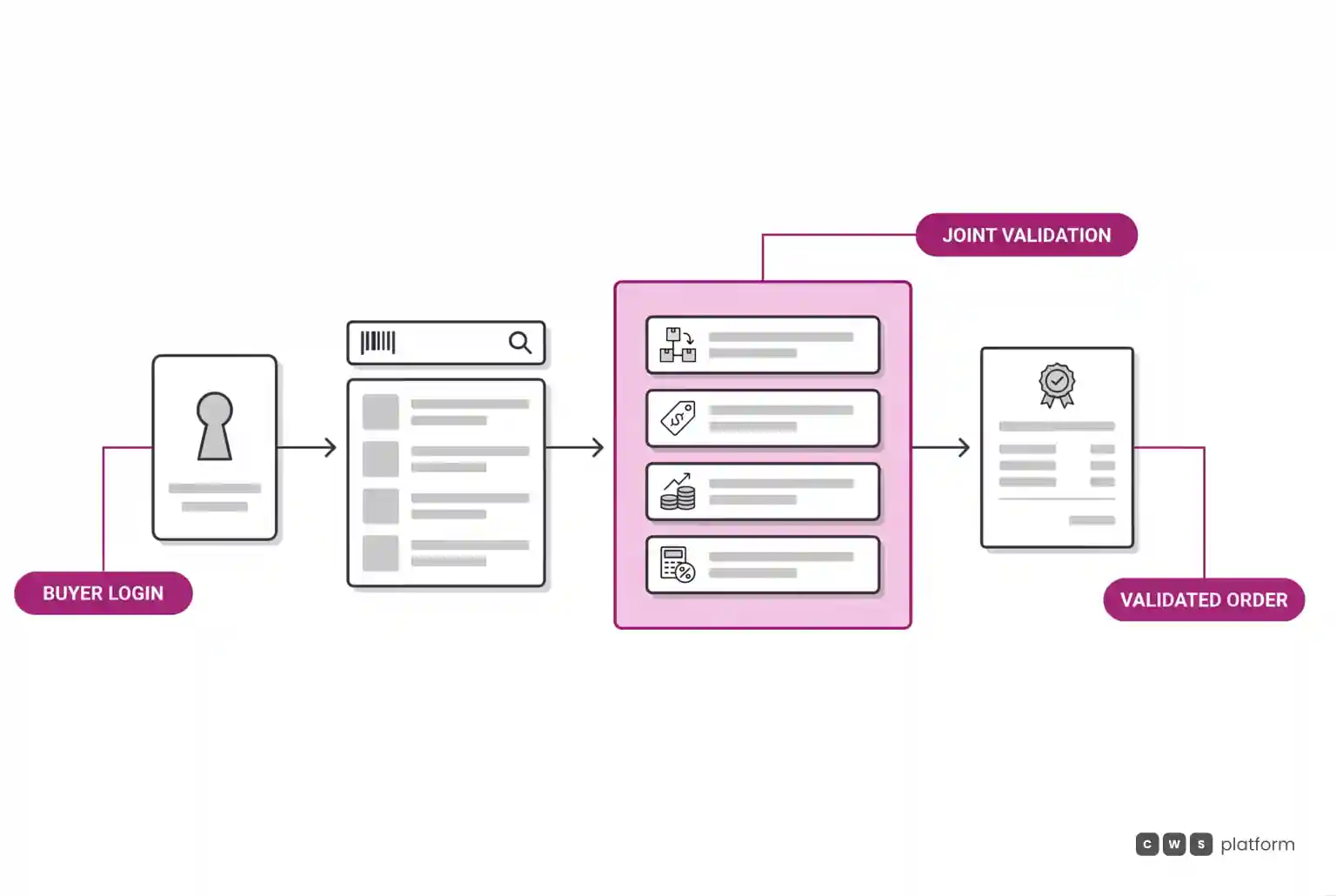
2. Search by the buyer's own part numbers. OEM numbers, internal customer SKUs, or technical specifications. B2B procurement professionals do not browse categories: they know exactly what they need and want to find it in seconds.
3. Real-time dynamic pricing rules. Tiered volume, payment terms, and product mix should adjust pricing instantly within pre-approved commercial policies, without waiting for an email quote.
4. Trade credit as a payment method. Buyers place orders on account within their approved credit limits (such as Net 30, Net 60, or Net 90), with credit limits validated at checkout. Accepting an order only for finance to reject it later sends the customer straight back to the phone.
5. Simultaneous checks on inventory, price, credit, and sales tax. All four checks must clear before order submission, with sales tax calculated based on the specific shipping warehouse and destination. This distinction separates viable B2B ecommerce features from a portal that accepts orders that cannot be fulfilled.
6. Frictionless reordering. Saved carts, bulk upload (CSV or quick paste), and one-click reorders. Most B2B volume consists of routine replenishment, which consumes the largest share of a sales team's daily bandwidth.
7. Sales reps collaborating on the same portal. When a complex negotiation arises, the sales rep can access the buyer's live cart under identical business rules. Digital self-service and assisted sales must share unified commercial terms, otherwise they compete with each other.
8. Ordering across multiple locations. A central purchasing department often needs to place orders for multiple facilities or branches, each with distinct delivery addresses and regional terms, from a single master account.
Private Portals, Marketplaces, or B2B2C
Common B2B digital commerce models are defined by who sells and to whom. In a private B2B portal, a company sells its own catalog directly to its existing commercial accounts. In a B2B marketplace, multiple vendors sell to a shared buyer base under rules established by the platform operator. In B2B2C, wholesale distributors and end consumers purchase from the same digital platform under different price schedules. Essential B2B ecommerce features apply across all three architectures; what changes is who governs the rules. We discuss transitions between these models in a marketplace is an output, not an objective.
The Cost of Inaction
Missing capabilities create operational costs that rarely appear on digital project balance sheets: time spent by reps answering routine calls, unbudgeted discounts offered to offset delays, and buyers who split orders with competing suppliers. A straightforward way to measure this loss is to track how many orders arrive by phone, email, or message from accounts that already have portal logins. Every manual order from an existing user highlights a missing operational capability.
What Happens When Commercial Rules Live in the Portal
At Imdepa, an industrial parts and automotive distributor, the B2B portal onboarded 153 key accounts over three years and processed roughly 60,000 orders. Usage analytics revealed three distinct buyer behaviors: procurement teams that turned the portal into their daily ordering routine, research-oriented buyers who verify specs online and convert at 70%, and transactional buyers who log in strictly when reordering and convert 63.6% of sessions, without contacting a sales rep. Full operational details are covered in the Imdepa case study.
CWS Platform was engineered around these mission-critical B2B ecommerce features: buyers log in to immediate contract pricing and credit balances, stock, pricing, credit limits, and sales taxes validate simultaneously before checkout, and sales reps can collaborate directly within the customer cart. See the full architecture on our B2B ordering portal page.
Next Steps
Review the last 20 manual orders or inquiries from customers who already possess portal logins, and document why each buyer reached out. Compare that list against the eight capabilities above: the most frequent reason identifies the first missing capability in your digital channel.
Frequently Asked Questions
What are the essential B2B ecommerce features for wholesale ordering?
Customer-specific terms loaded at login, search by buyer part numbers, dynamic rule-based pricing, Net terms and credit limit validation, simultaneous checks for stock, pricing, credit, and tax, bulk reordering tools, sales rep cart sharing, and multi-location account management.
How does B2B ecommerce work?
A verified business buyer logs in, views personalized wholesale pricing and contracted terms, builds an order (often containing dozens of line items), and completes checkout on trade credit. The order syncs directly to the ERP with verified rules, while sales reps step in only when complex negotiations require intervention.
What are the main B2B ecommerce business models?
The three most common models are private customer portals (where a company sells direct to its own accounts), B2B marketplaces (where multiple vendors supply a shared customer base), and B2B2C portals (where wholesale dealers and retail end-users purchase through the same infrastructure with segmented pricing).
How does B2B self-service improve customer retention?
By freeing replenishment orders from sales rep availability. When buyers can accurately place routine reorders on their own terms at any hour, purchase cycles shorten, order accuracy rises, and accounts are far less likely to turn to competing suppliers for off-hours orders.
Read More
- B2B ordering portal and self-service
- Which architecture preserves warehouse-level inventory and pricing in B2B self-service?
About This Publication
Operational performance metrics cited in this article originate from Imdepa, a client of CWS Platform, and are used with permission.
Brands mentioned in this article

- Gartner
Trademarks and logos belong to their respective owners. Mention does not imply partnership or endorsement.
"responsive, technically engaged, and willing to work through complex commercial rules (negotiated pricing, credit, customer-specific conditions) rather than pushing generic answers"
Want to see this in your operation?
Real B2B operations already run on it.