How to Modernize B2B Sales Without Migrating Your ERP
Empower digital channels, sales reps, and AI agents by decoupling complex commercial logic from your legacy ERP system.

"To digitize sales, we will have to replace our ERP." Many distributors delay launching a digital channel because of this single sentence. A core system migration is one of the most expensive and risky initiatives an enterprise can undertake: it disrupts tax compliance, inventory, accounting, and daily operations across every department. When commercial digitization is made contingent on that migration, sales growth waits years for an IT project that was never really about selling.
In most cases, wholesale operations can digitize sales without replacing the back office. What actually needs to change is where the commercial decisions take place.
Why Replacing the ERP Feels Mandatory
Why do executives think a replacement is necessary? Because the legacy system lacks a self-service customer portal, offers no mobile tool for field reps, and cannot handle modern, dynamic pricing rules.
Why do teams expect the back office to handle this? Because for decades, every new business requirement was assigned to the exact same system of record.
Why does a brand-new ERP also fall short? Because while it records transactions more cleanly, customer negotiation remains a secondary module inside software fundamentally engineered for general ledger accounting.
Why do these migrations take so long? Because migrating requires transferring historical data, rebuilding custom integrations, and re-engineering internal workflows, leaving digital sales waiting at the back of the line.
The root cause: commercial decision-making was treated as a feature of the accounting core, when it should live in an independent operational layer connected directly to your existing system.
Modernizing Without Migrating: What Changes
The back office remains the single source of truth. Master records, baseline pricing, inventory counts, credit limits, invoicing, and tax logic stay right where they are. Nobody needs to overhaul financial accounting just to sell online.
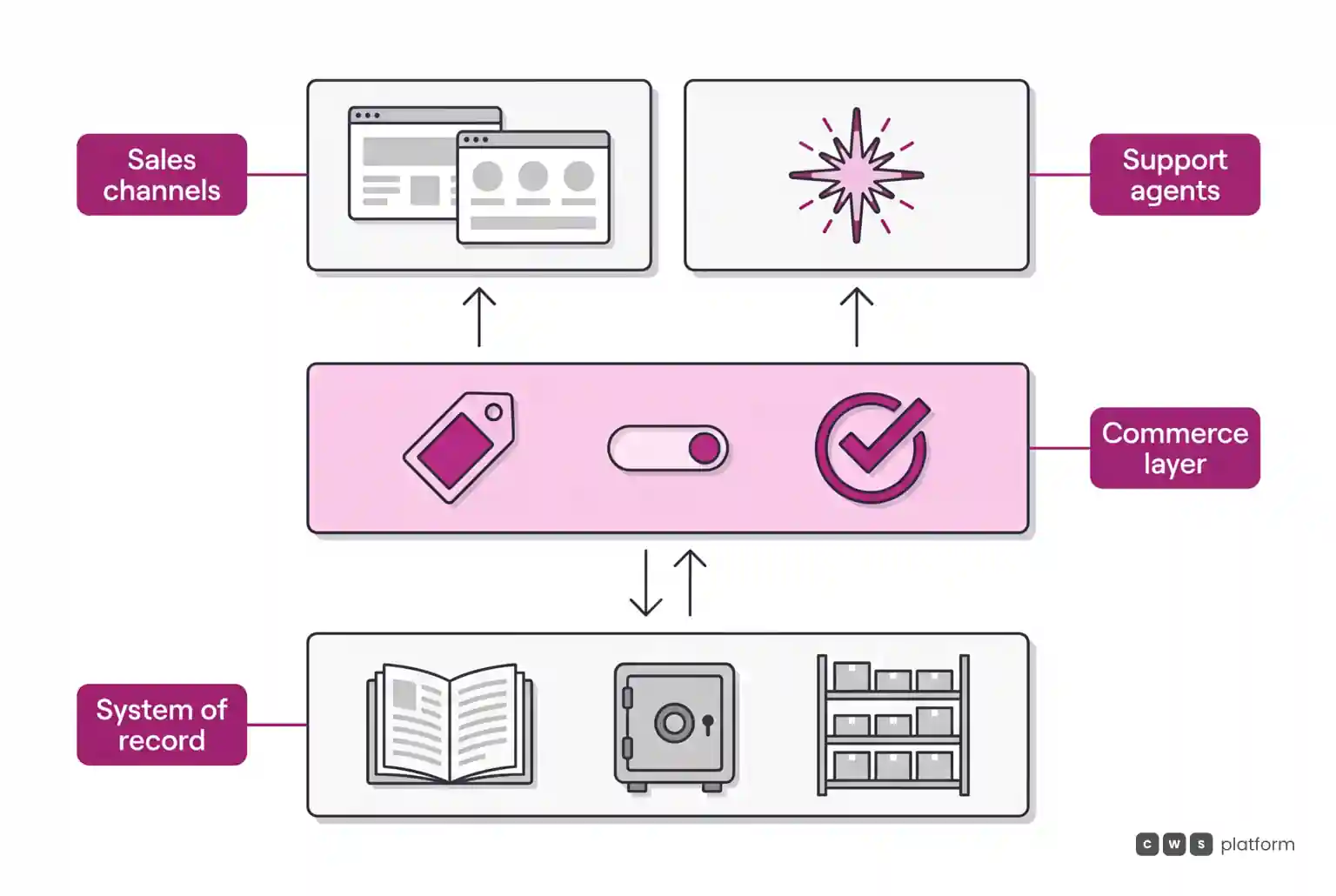
The commercial layer manages negotiation. Customer self-service portals, sales rep applications, discount approval matrices, payment terms, and credit check rules all live here. Everything your buyers and account reps interact with is handled within this dedicated environment.
Integration bridges the gap. The platform reads required reference data from the back office and writes back clean, validated orders ready for fulfillment. You can review the true cost dynamics of this setup in where ERP and marketplace integration breaks down.
AI enters through the front door. Autonomous agents that assist customers or empower sales reps operate on top of this commercial layer under the exact same policies, rather than touching the core ledger directly. This approach bypasses the operational hazards detailed in the AI agent is in the ERP, but the project never ends. Through this decoupled architecture, pragmatic ERP modernization delivers immediate commercial agility without disrupting accounting stability.
How to Start Without Halting Daily Operations
1. Map commercial decisions instead of user screens. Clarify who approves special pricing, tier discounts, extended terms, and credit limits, including when those calls happen and what data they require. This decision tree is what the commercial layer will govern.
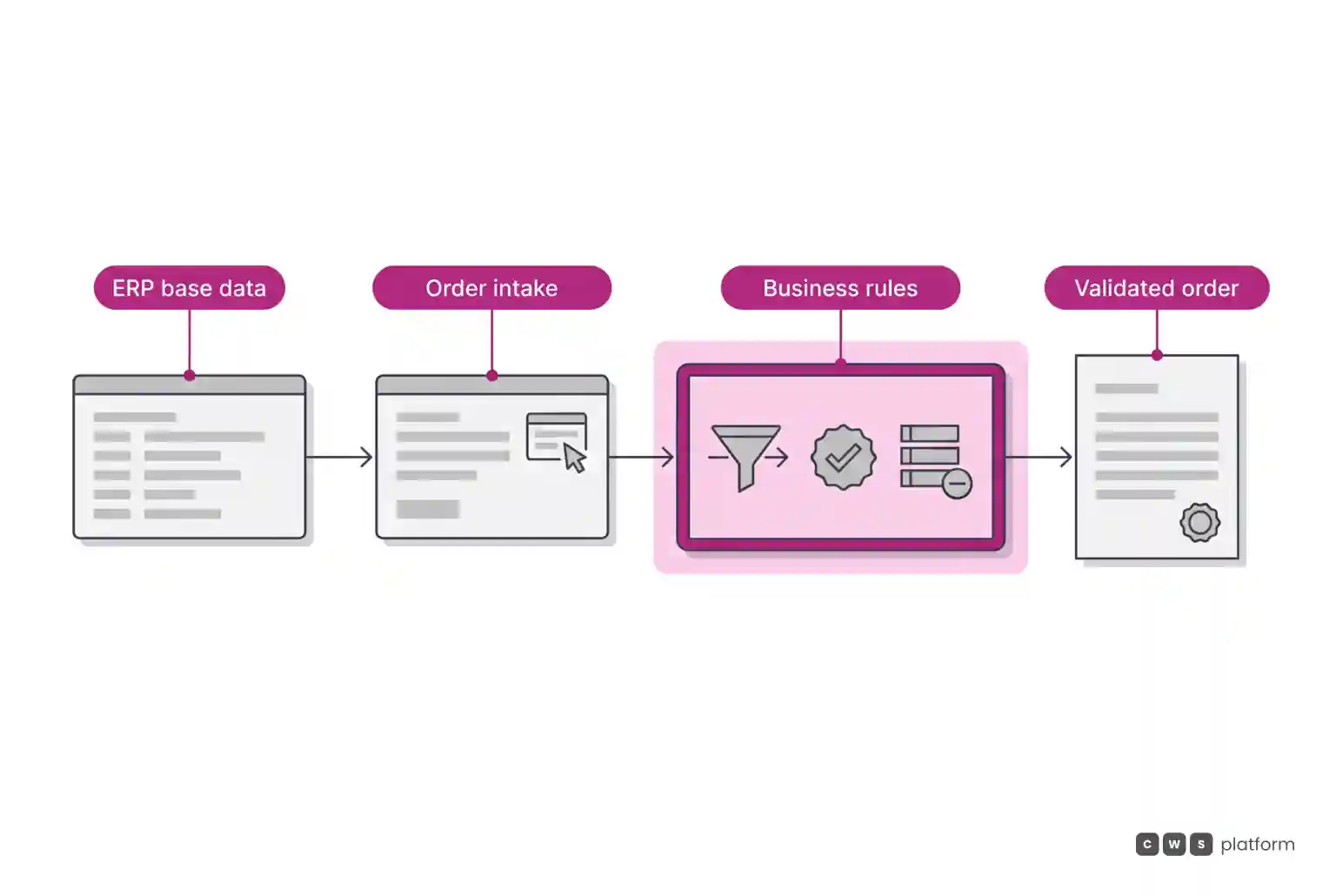
2. Define inbound and outbound data flows. In most architectures, the core ledger pushes master accounts, standard price lists, inventory, and credit balances, while receiving fully validated purchase orders ready for billing.
3. Launch with a focused cohort of accounts. Target the repeat buyers who call customer service most frequently. Their order volume will quickly validate whether your commercial policies are mapped correctly.
4. Equip your sales reps inside the digital channel. When field reps build quotes using the same shared cart as their customers, digital adoption accelerates. This approach follows the framework of two-phase digitalization.
5. Postpone back-office replacement until accounting demands it. If corporate governance or compliance eventually mandates an infrastructure overhaul, your commercial storefront remains untouched, requiring only updated connector endpoints.
The Payoff of the Right Sequence
A dedicated digital ordering channel can go live in months rather than stalling behind a multi-year IT overhaul. Commercial policies become configurable business rules rather than custom-coded ledger modifications. Crucially, your go-to-market strategy stops waiting on core technical roadmaps.
CWS Platform was engineered to serve as this orchestration layer: driving modern commerce over your existing back office through open APIs and webhooks without rewriting legacy business logic. Review the complete architecture on our APIs and integrations page.
Next Steps
Ask your enterprise architecture team how long a full core upgrade will take and what it will cost. Then ask sales leadership how much revenue is lost each month without a dedicated B2B portal. If the lost revenue exceeds the timeline of the infrastructure roadmap, your modernization sequence is backward.
Frequently Asked Questions
How can a distributor digitize sales operations without replacing their ERP?
By keeping the legacy database as the central system of record and placing a specialized commercial layer above it. This layer runs the customer ordering portal, sales rep mobile tools, pricing matrices, and credit workflows. It queries master data, stock availability, and account status from the back end and submits complete, audit-ready orders for fulfillment.
How do you achieve B2B ERP modernization without a disruptive system migration?
By decoupling your transaction records from front-end customer negotiations. The back office manages inventory control, general ledger accounting, and compliance, while commercial workflows run in an API-connected orchestration layer where rules are configured without modifying legacy application code.
Can you implement AI in B2B sales while keeping your existing ERP?
Yes. AI copilots and autonomous agents operate within the commercial layer under standard margin, discount, and credit restrictions, rather than querying the ERP directly. The back office simply receives the final, validated purchase order.
What is the best way to deploy sales AI without replacing core back-office systems?
Begin with governance rules rather than autonomous agents. Pricing policies, tier approvals, and payment terms must be configured in the commercial orchestration layer before agents begin handling quotes. This keeps automated negotiations strictly aligned with sales rep guidelines without requiring custom development on the legacy core.
Read More
About This Publication
Published by CWS Platform. Learn more at cws-platform.com.
"responsive, technically engaged, and willing to work through complex commercial rules (negotiated pricing, credit, customer-specific conditions) rather than pushing generic answers"
Want to see this in your operation?
Real B2B operations already run on it.