Where ERP Marketplace Integration Breaks Down
Why direct connections fail and how to build a scalable architecture for enterprise commerce

TL;DR:
- ERP marketplace integration is where most B2B digital expansion projects stall: not on the storefront, but in the challenge of synchronizing core management rules across multiple channels.
- Treating the enterprise resource planning system as a direct interface for external buyers introduces severe performance bottlenecks, security liabilities, and breakdown in inventory and credit controls.
- The sustainable path isolates central governance while distributing operational logic through a transaction layer built for high-volume, multi-party commerce.
- Data exchange must run through structured APIs, ensuring external touchpoints never execute direct queries against the core database.
The decision to expand digital channels often runs into a silent obstacle: ERP marketplace integration. While the visual storefront and product catalog appear straightforward to deploy, actual operations demand account-specific pricing tiers, segmented credit policies, multi-jurisdiction sales tax calculations, and distributed fulfillment nodes. When leadership attempts to force a legacy corporate system into behaving like a high-frequency, customer-facing commerce engine, the architectural foundation cracks.
Why the connection between core management systems and multi-channel sales routinely fails
The enterprise resource planning platform was conceived historically as a locked general ledger, designed to record events that already occurred or to safeguard internal transactions executed by trained operators. Any major system can model complex pricing rules internally. The real breakdown occurs when distributing those rules across hundreds or thousands of external buyers and sellers without exposing the infrastructure to unauthorized access and without forcing outside users through back-office workflows.
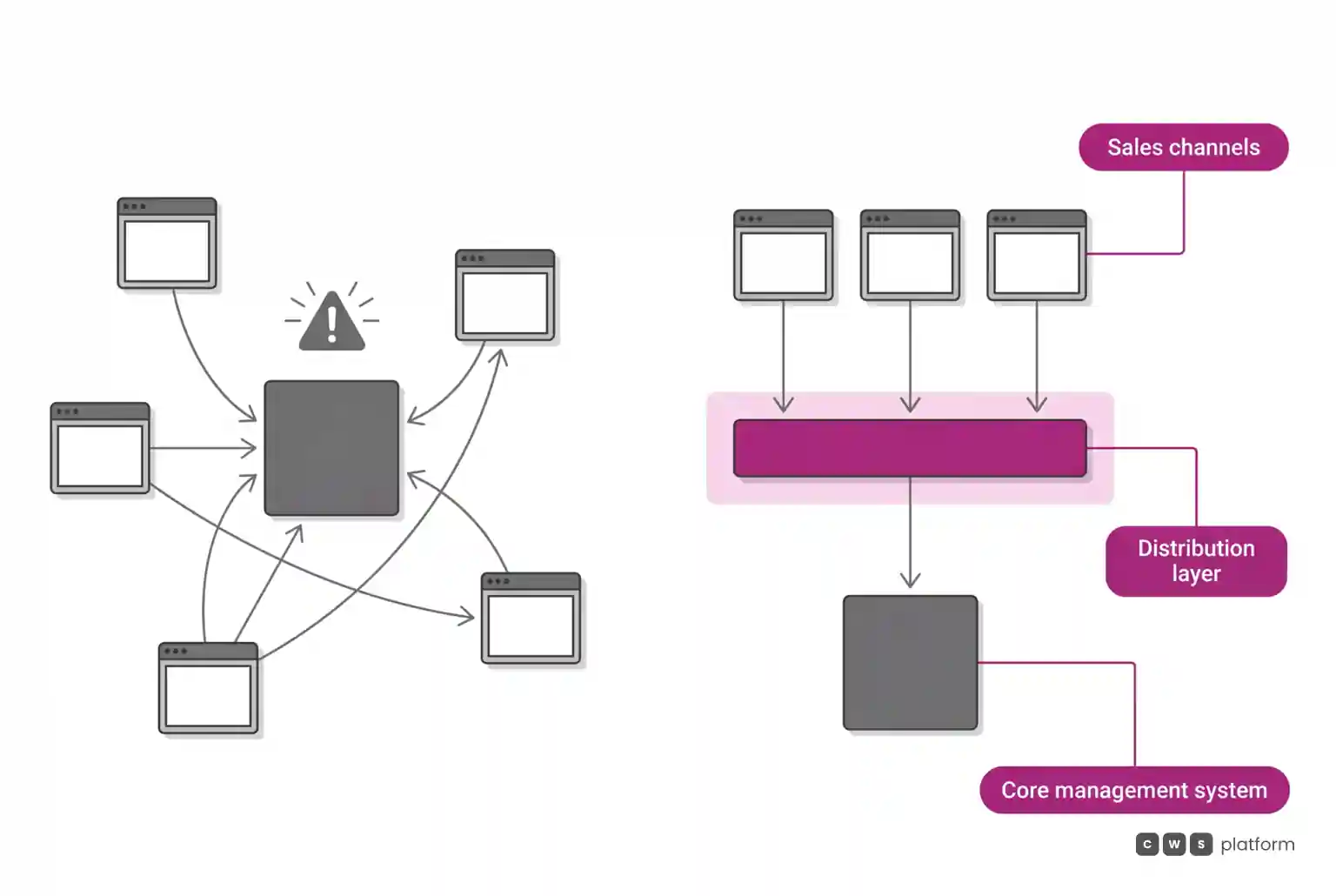
When an organization designs an industrial marketplace or coordinates multiple trading partners, predictable structural challenges emerge:
- Latency and record locking: simultaneous queries for customer-specific price books and real-time credit checks overwhelm core database performance.
- Inventory dispersion: synchronizing on-hand counts across disparate production plants and fulfillment centers in real time without causing out-of-stock cancellations.
- Tax and regulatory friction: inbound orders placed digitally that fail to account for destination-based sales tax rules, exemption certificates, or state-level validation requirements at the moment of capture.
- Access governance: granting external vendors or customers direct access credentials into central software multiplies security vulnerabilities and complicates compliance audits.
Many organizations realize too late that you are trying to build a marketplace when what you really need is a sales ecosystem. By attempting to turn the central back office into the front-end user engine, leadership burdens engineering teams with fragile customizations that break whenever software updates roll out.
In workflows requiring multi-seller B2B coordination, this friction scales with every added vendor. If the architecture demands point-to-point connections lacking a standardized schema, maintenance overhead wipes out the commercial gains of the initiative. The challenge is not writing business logic from scratch, but deploying an ERP marketplace integration architecture that distributes operational guidelines securely.
The cost of inaction
Postponing the modernization of your integration architecture leaves operations chained to manual data entry and recurring invoice corrections. Every order trapped in staging due to mismatched data between front-end channels and back-end records creates commercial friction, extends days sales outstanding (DSO), and burns hours across customer support and IT.
Over time, reliance on disconnected spreadsheets and improvised batch scripts halts digital expansion. While competitors with decoupled architectures plug in new channels and strategic partners effortlessly, an immobilized business exhausts resources reconciling duplicate orders, fulfillment failures, and tax mismatches. Understanding how to build a viable B2B marketplace: the 4 core operating conditions requires resolving this middle data tier before structural friction stalls revenue growth.
Architectural principles for sustainable B2B transactions
To keep the integration layer from turning into an operational bottleneck, mature enterprises build projects on clear principles:
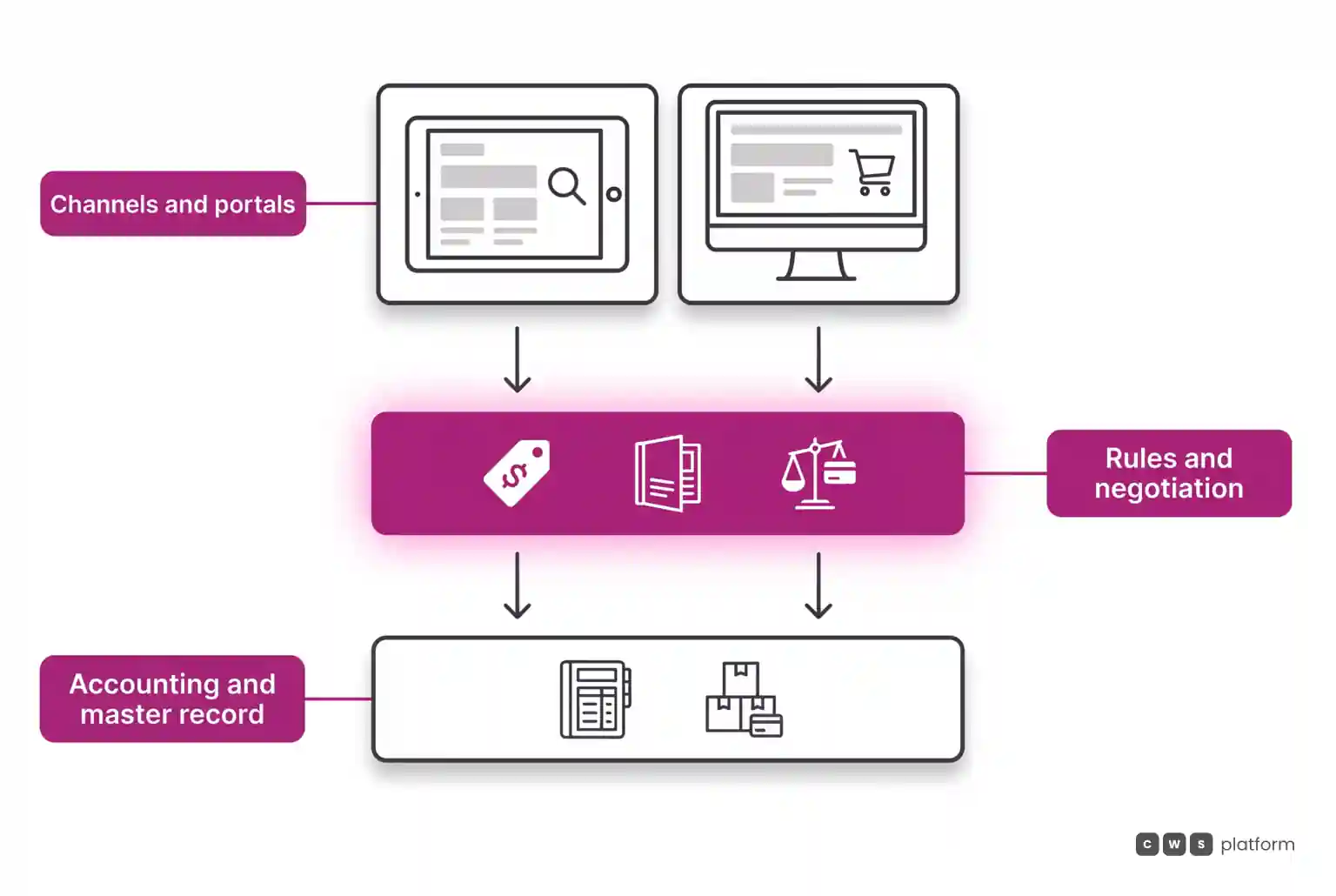
- The central system remains the source of truth for financial accounting and master inventory, never the public surface for browsing and negotiation.
- Commercial logic must distribute through intermediate microservices that translate internal constraints to digital buyers without compromising back-office security.
- Logistics architecture must handle decentralized distribution natively. Treating each warehouse as an autonomous fulfillment node allows independent facilities to manage dedicated inventory allocations, pricing overlays, shipping zones, and discount ceilings while adhering to enterprise governance parameters.
- Data synchronization must run across standardized interfaces, eliminating direct customizations inside the corporate core.
- The commerce strategy must protect margins from day one, preventing scenarios where your wholesale distribution business gains marketplace volume but loses its operating margin due to weak rule validation at order intake.
From a transaction-cost economics standpoint, every technical bottleneck between platforms represents lost capital spent on redundant validation. An effective B2B Marketplace platform eliminates this drag by absorbing negotiation complexity and passing only clean, pre-validated transactions downstream for financial settlement.
CWS Platform addresses these requirements through an API-first framework, connecting governed negotiation workflows directly to existing enterprise systems. The platform has deployed deep integration with Microsoft Dynamics, enabling corporate governance policies to operate alongside modern digital commerce channels. Other enterprise systems connect through these identical endpoints, guaranteeing that multi-channel operations sync cleanly with financial records without relying on rigid, one-size-fits-all connectors that ignore complex tax and procurement environments.
Frequently asked questions
What are the critical priorities during an ERP marketplace integration?
The primary goal is safeguarding the performance and integrity of the corporate ledger by preventing uncontrolled API calls that lock database tables. Robust endpoints must synchronize product records, distributed inventory, credit limits, and negotiated contract pricing, while tax calculations and order staging execute within a transaction tier optimized for digital buyer traffic.
Can a corporate back-office platform serve as the buyer portal for customers and partners?
That is outside its design scope. The core enterprise platform functions as a ledger and calculation engine; it is not built to sustain thousands of concurrent external users running complex catalog searches. Customer interactions belong in a dedicated commerce layer that ingests central rules and returns fully validated purchase orders.
How can a business empower sales channels while keeping corporate governance intact?
By separating the negotiation environment from core ledgers and enforcing distributed business rules. Central management sets hard minimum margins, discount thresholds, and fulfillment parameters, while commercial channels operate autonomously within those boundaries, transmitting only compliant, pre-authorized orders back to core systems.
About this publication
This article analyzes structural and technical bottlenecks in connecting core enterprise software with sophisticated digital sales channels. The objective is to provide executive leadership with a clear model for building scalable architectures that lower transaction friction and protect corporate data assets.
Brands mentioned in this article
 Microsoft Dynamics 365
Trademarks and logos belong to their respective owners. Mention does not imply partnership or endorsement.
"responsive, technically engaged, and willing to work through complex commercial rules (negotiated pricing, credit, customer-specific conditions) rather than pushing generic answers"
Want to see this in your operation?
Real B2B operations already run on it.