B2B Wholesale Online: Why Sales Tax, Credit Terms, and Warehouses Break Retail Platforms
Why consumer carts fail wholesale distributors and how to automate complex multi-facility order capture

"The platform works great abroad, but orders break down here." Anyone who has tried to bring a foreign wholesale e-commerce model to Brazil has heard some version of this sentence. The cart works, the catalog works, credit card processing works. What fails is an order from an out-of-state reseller requiring tax substitution, net 60 terms, and fulfillment from the nearest regional warehouse.
In Brazilian wholesale distribution, the digital storefront is the easy part. An order only clears when three fundamental operational challenges are resolved directly at checkout: complex taxation, trade credit, and multi-warehouse routing.
Why Brazilian Wholesale Orders Fail on Retail-First Platforms
Why does the final order total change after checkout? Because taxes were calculated using generic assumptions instead of the actual fulfilling warehouse location, the destination state, and the specific tax profile of the buyer.
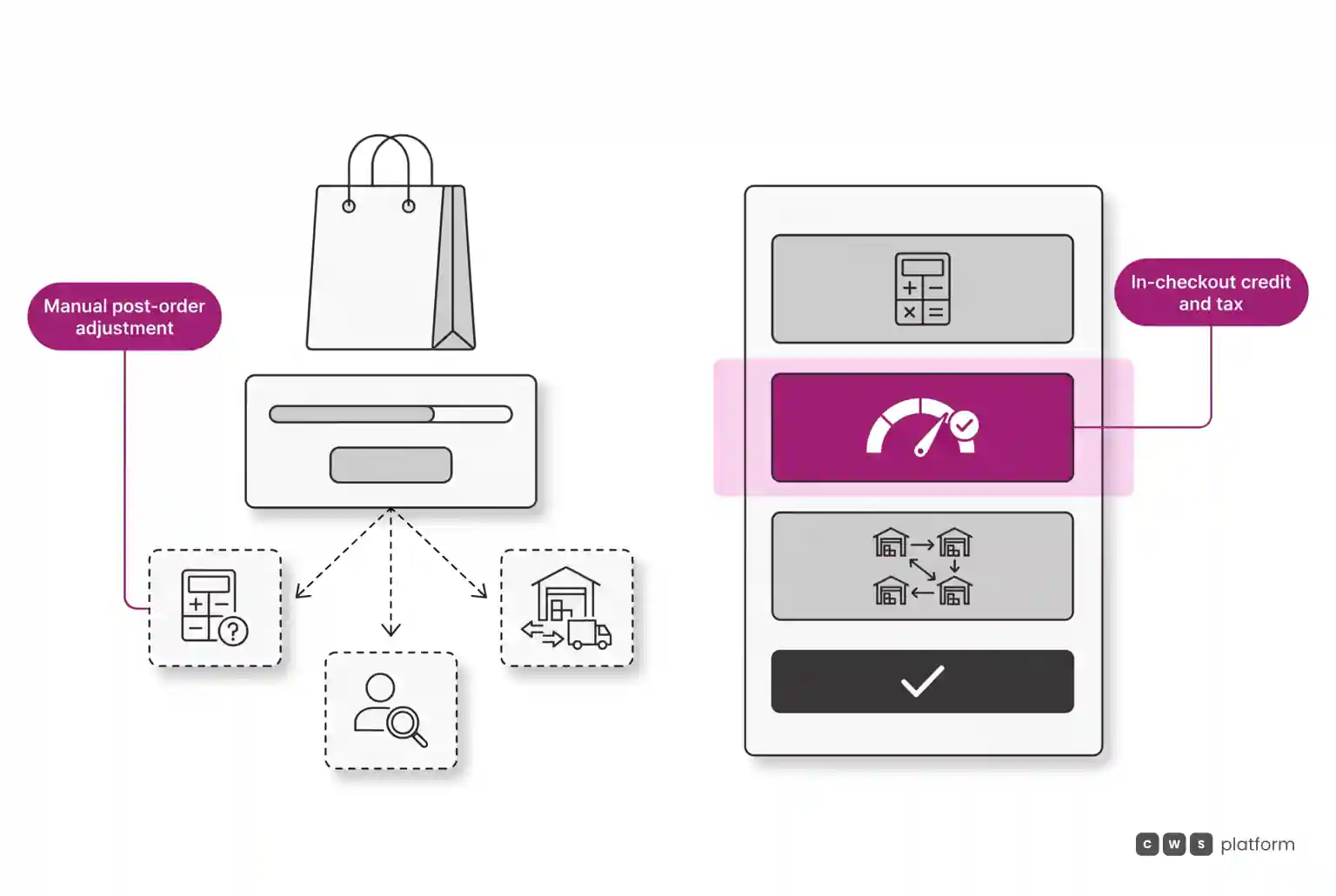
Why is tax so sensitive to warehouse origin? Because state value-added taxes (ICMS), federal excise taxes (IPI), and tax substitution regimes (ST) vary drastically depending on the origin facility, delivery destination, product category, and customer classification. Brazil remains one of the most time-consuming countries for corporate tax compliance, requiring 1,501 hours per year for a standard mid-size business, according to the World Bank's Doing Business 2020.
Why do wholesale buyers refuse to pay immediately? Because in B2B distribution, the standard payment method is net terms backed by trade credit limits and pre-negotiated conditions, not corporate credit cards.
Why is inventory visibility misleading? Because distributors manage multiple distribution centers. Available-to-promise inventory, freight costs, and tax liability all shift depending on which facility services each individual account.
The root cause: platforms built for retail treat taxes, trade credit, and warehouse routing as downstream integrations handled post-order. In Brazilian wholesale, these three elements are the core transaction. As long as they remain outside checkout, every digital sale requires manual intervention to recalculate what appeared on screen. We examined this same architectural trap for marketplaces in the risk of choosing a platform built for retail.
The Ongoing Tax Reform Will Not Simplify Checkouts Overnight
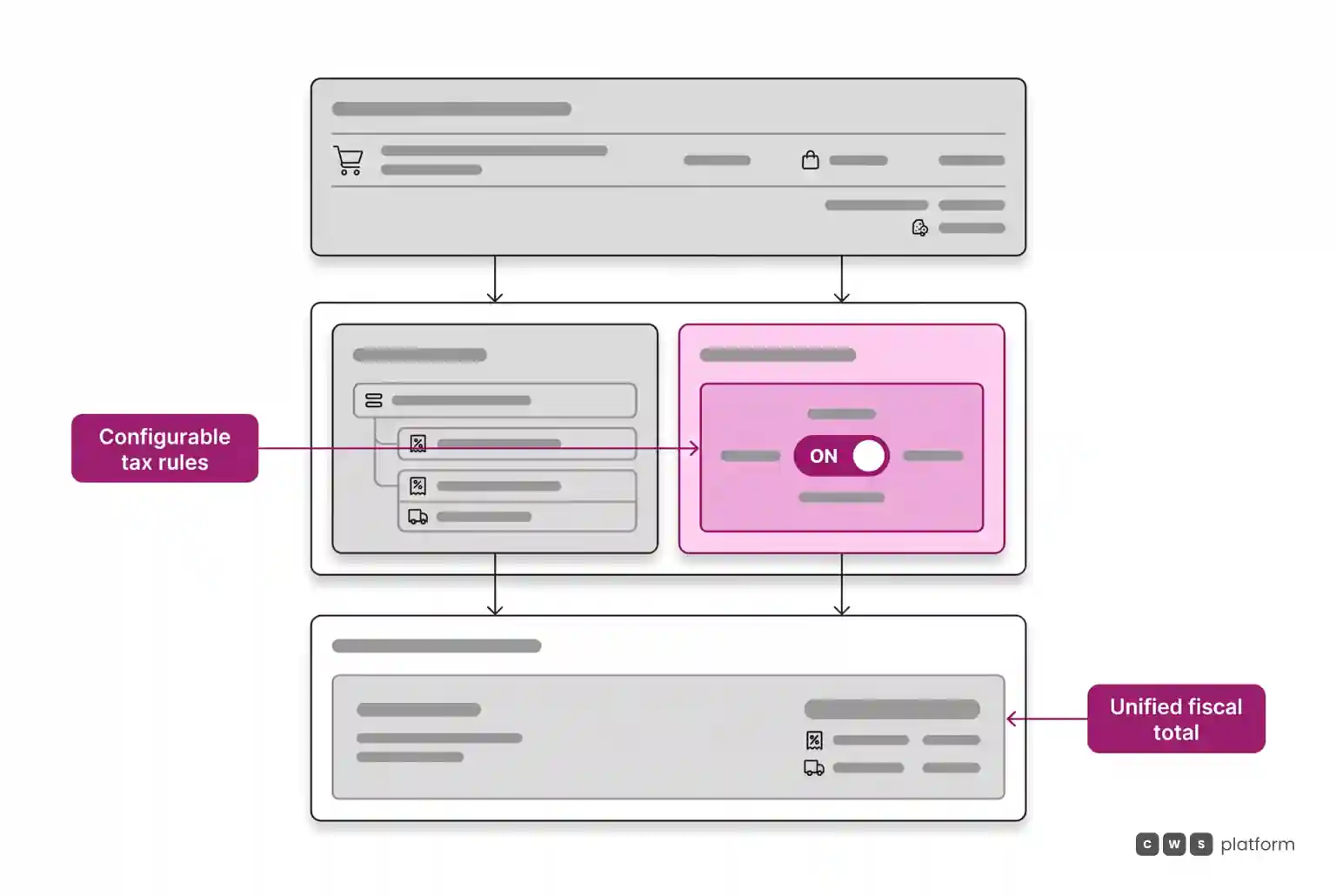
This serves as a critical warning for enterprise teams making platform decisions today. Brazil's comprehensive tax reform began its phase-in transition in 2026 with pilot rates for the new dual VAT model (CBS and IBS), initiates CBS collections in 2027, and gradually replaces legacy state ICMS and municipal ISS taxes through 2033, according to the tax reform schedule. In practice, wholesale distributors must operate two parallel tax systems simultaneously for years. A digital ordering channel that struggles to calculate one tax structure must now calculate both. Tax engines must rely on dynamic rules and configuration rather than hard-coded logic, because tax rules will shift repeatedly through 2033.
The Cost of Inaction
The commercial penalty shows up across three failure points: orders that must be rebuilt because adjusted taxes altered the final price, lost revenue caused by unavailable credit terms during checkout, and freight charges that erode gross margins because shipping was quoted from the wrong warehouse. All three drive the exact same behavioral outcome: wholesale buyers realize the digital screen is unreliable and revert to ordering through field sales reps, the most expensive sales channel in the business.
What an Enterprise Wholesale Platform in Brazil Must Solve
Origin-based tax calculation. State ICMS, federal IPI, and tax substitution calculated dynamically based on the fulfilling distribution center, the destination facility, and the buyer profile, directly in the cart before submission.
Trade credit as a primary payment method. Buyers check out on net terms against approved credit lines, checking real-time credit availability and consuming limits instantly. Without this capability, every large transaction requires manual credit approval.
Multi-facility warehouse logic. Each distribution center operates with dedicated inventory levels, localized pricing schedules, regional delivery zones, and tiered freight rules driven by zone, weight, and order value. This prevents companies from selling inventory that exists, but exists in the wrong geography.
Frictionless high-volume ordering. Resellers and commercial buyers purchase across spreadsheets with dozens or hundreds of line items. The platform must support bulk ordering by the customer's own part numbers and return real-time totals, including taxes and freight, in seconds.
ERP as the central source of truth. Core accounting, invoicing, and financial management remain inside the existing ERP. The e-commerce layer syncs via modern APIs and webhooks, passing clean, ready-to-invoice orders back to the core system without requiring a platform rip-and-replace.
At Imdepa, an automotive parts distributor operating across nine Brazilian states, a single checkout cart regularly processes over 250 SKUs with complete multi-tax calculations, freight rules, and pre-approved trade credit validated in seconds, detailed in the Imdepa case study. Over three years on the portal, the operation activated 153 B2B accounts and handled roughly 60,000 orders.
CWS Platform was engineered for the operational realities of Brazilian wholesale: precise origin-based tax calculation, native trade credit as a payment method, and dynamic multi-DC freight logic, orchestrating directly on top of legacy ERP systems. Explore the operational architecture on our B2B e-commerce for distributors page.
Next Step
Take a real-world enterprise order from an out-of-state reseller involving tax substitution and net payment terms. Challenge any software vendor during product evaluation to process that transaction live, displaying an exact, final balance. It is the fastest, most conclusive test for enterprise wholesale readiness in Brazil.
Frequently Asked Questions
What are the best online wholesale platforms for the Brazilian market?
The systems capable of calculating ICMS, IPI, and tax substitution based on the real fulfilling warehouse, supporting trade credit limits as an integrated payment method, managing multiple distribution centers, and using the ERP as the system of record. Platforms adapted from retail software inevitably push these requirements into messy post-order workflows.
Why is wholesale e-commerce in Brazil so different from retail?
Because B2B transactions involve dynamic tax rules based on origin, destination, and customer profile, trade credit terms instead of immediate credit card settlements, and distributed inventory across regional centers. In B2C retail, prices are uniform and payment clears immediately.
Does the Brazilian tax reform change how distributors evaluate software?
It fundamentally changes evaluation criteria. Between 2026 and 2033, distributors must run legacy taxes alongside the new CBS and IBS frameworks. Tax logic must be configurable via rules engines rather than hard-coded into custom platform logic.
What is the most effective B2B platform test for wholesale distributors in Brazil?
Processing a live, complex order with tax substitution, payment terms, and multi-warehouse fulfillment without requiring manual post-checkout adjustments. That single benchmark separates purpose-built B2B wholesale platforms from retrofitted retail carts.
About This Publication
Operational performance metrics cited in this piece reflect documented results from Imdepa, a CWS Platform enterprise client, published with authorization.
Brands mentioned in this article

Trademarks and logos belong to their respective owners. Mention does not imply partnership or endorsement.
"responsive, technically engaged, and willing to work through complex commercial rules (negotiated pricing, credit, customer-specific conditions) rather than pushing generic answers"
Want to see this in your operation?
Real B2B operations already run on it.