The Pitfalls of Choosing Retail Software for a B2B Marketplace
Why enterprise multi-seller models require warehouse-level governance, custom buy box logic, and automated split payments.

TL;DR
- Choosing a retail marketplace platform instead of dedicated B2B marketplace software brings an impulse-buying logic to business transactions where it does not belong.
- Portal operators must evaluate six core requirements: vendor management, vendor-specific inventory, buy box display rules, automated payment splits, built-in communication, and central support capabilities.
- The operational foundation is the warehouse: each inventory location carries its own catalog, pricing, geographic territory, logistics, and discount caps, all governed by central business logic.
- Robust ERP integration completes the architecture, ensuring complex commercial rules reach the digital storefront reliably.
What criteria matter for operators of a business-to-business marketplace?
When a manufacturer or master distributor sets out to digitize indirect sales channels, the default instinct is often to replicate a consumer e-commerce storefront. The reality is that enterprise commerce operates on fundamentally different mechanics than retail impulse purchasing. Attempting to customize a standard retail engine into a functional marketplace platform typically breaks down over catalog permissions, distributed multi-warehouse inventory, and multi-party financial settlement.
In wholesale and enterprise environments, onboarding multiple commercial partners requires an infrastructure that respects channel agreements built over decades. This depends on understanding how to build a viable B2B marketplace: the 4 core operating conditions without violating negotiated contracts, regional margins, or territory exclusivity. Network operators do not just need front-end web traffic: they need to orchestrate channel partners under transparent, ironclad rules. The following technical criteria separate viable solutions from costly dead ends.
Sellers and seller-level inventory: the warehouse as the configuration unit
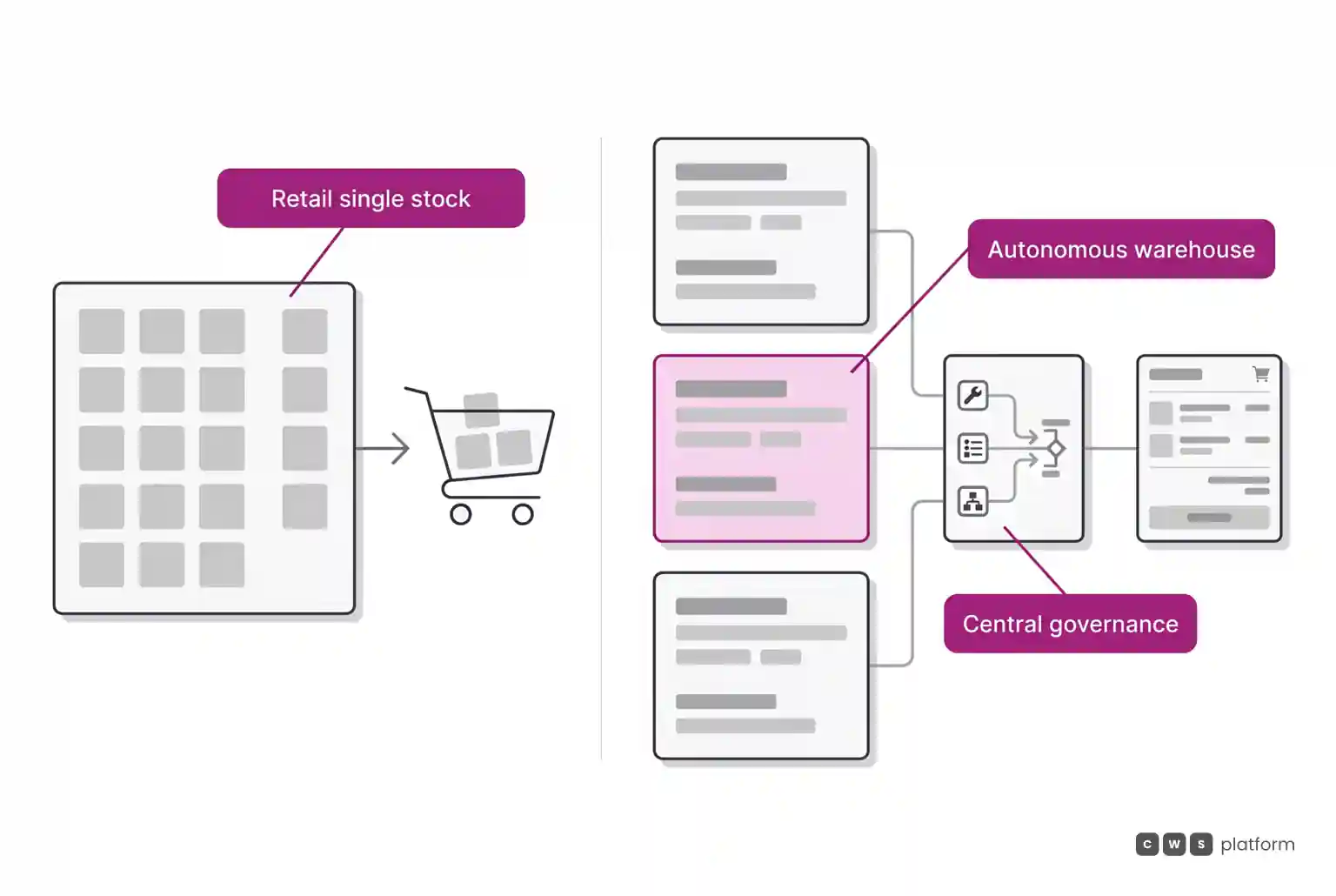
In standard retail, inventory is treated as a single, centralized pool. In a multi-seller wholesale model, inventory is dispersed across regional distribution centers, corporate branches, and independent dealer warehouses, each operating with specific shipping constraints and commercial boundaries. Because of this, the foundational configuration unit in dedicated B2B marketplace software is not the tenant company or the customer account: it is the warehouse.
Treated as an autonomous operating unit, each warehouse independently maintains:
- The catalog approved for its specific commercial territory;
- Regionally adjusted price books and freight freight tables;
- Assigned service territories and compatible freight carrier methods (LTL, FTL, parcel);
- Negotiated discount limits and margin floors enforced by central portal governance.
Every node operates strictly within the operational boundaries set by the portal operator. This granular isolation allows operators to decentralize inventory and order fulfillment without losing operational control: each vendor manages their own line items, while the marketplace operator enforces overarching channel policies. Without this architecture, buyers inevitably place orders that a local branch or third-party seller lacks the inventory, physical capacity, or legal authorization to fulfill.
During vendor evaluations, the fundamental question to ask is: does the architecture map each physical inventory location to a distinct seller, ensuring that seller sees, quotes, and fulfills only their own stock?
The buy box rules
When multiple distributors or dealers list the exact same SKU, the platform must determine which seller secures the featured position for a given buyer. Consumer platforms typically award this buy box to the lowest list price. In wholesale distribution, blindly surfacing the lowest price can route an order to a vendor unable to service that zip code or to a seller with no established credit line with that customer. That operational blind spot is precisely how your distributorship adds marketplace volume while destroying its bottom line.
The key architectural requirement is full governance over display logic. Purpose-built B2B marketplace software places buy box algorithms directly in the hands of the portal operator, rather than delegating order allocation to an unconfigurable black-box routine.
Multi-vendor split payments and settlements
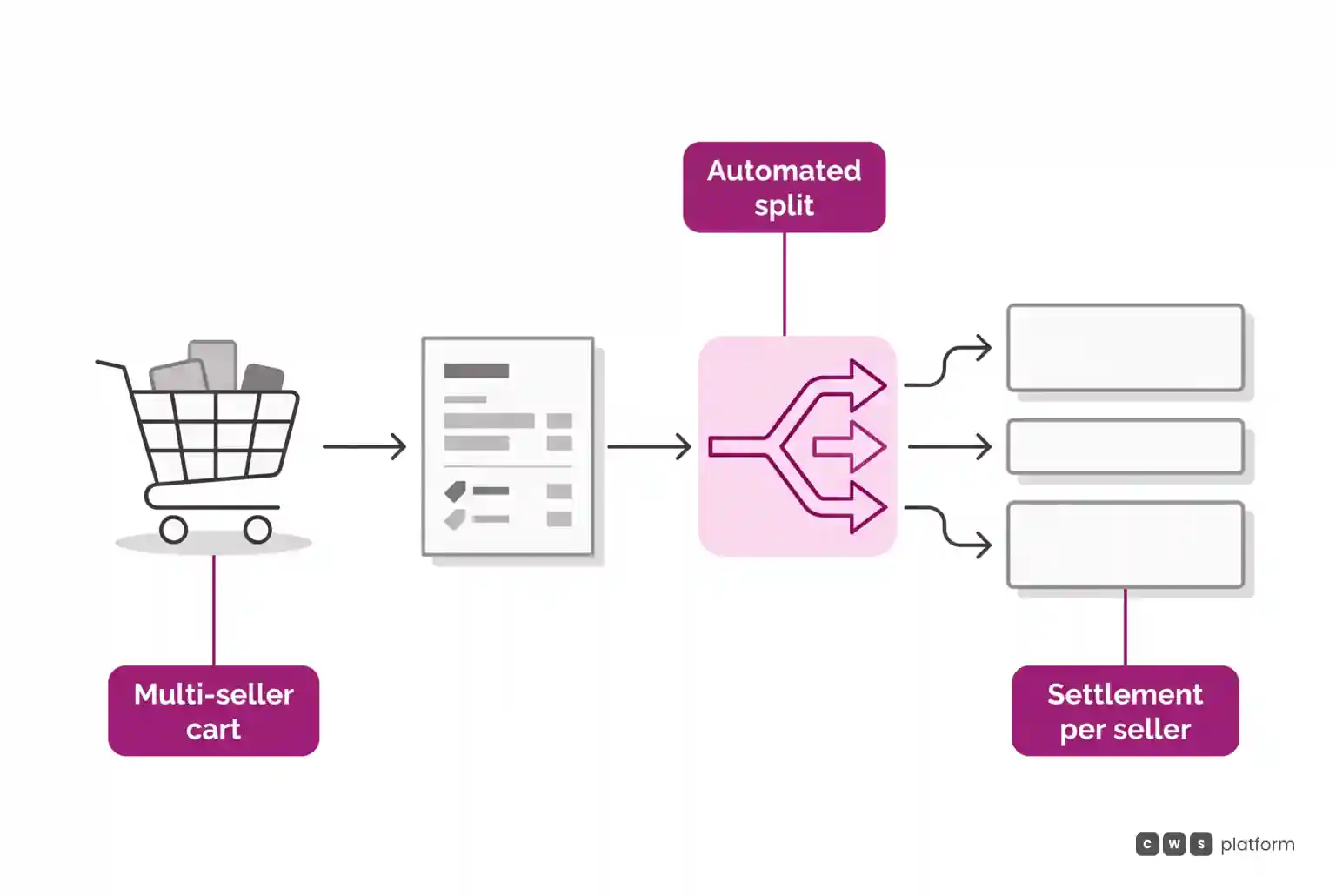
An order containing line items from multiple independent vendors is never a single charge to be manually reconciled after the fact. Each seller operates with distinct freight rates, sales tax nexus obligations, terms of sale, and payment methods (such as trade credit, net terms, or commercial ACH), while the operator must collect an administrative commission. The software must automatically execute payment splits at checkout, calculating marketplace commission tiers and disbursements according to item origination, eliminating post-order manual reconciliation.
Native communication and centralized escalation support
Wholesale procurement relies heavily on technical validation, custom bulk lot negotiations, and specialized commercial terms. In this operating model, digital chat is not a routine customer complaint desk: it is an active sales channel that connects independent sellers, procurement buyers, and the marketplace central support team within the order workflow itself.
Centralized back-office escalation is the natural counterpart to distributed selling. Network support personnel must have permissioned access to sell inventory across all vendor warehouses, or across an expanded catalog pool, ensuring corporate buyers get their line items fulfilled even when a local dealer shows a stockout.
Enterprise ERP integration
Wholesale commercial policy originates in core back-office systems: the ERP, financial engines, and inventory databases. Marketplace technology creates tangible value only if it syncs these business rules to the digital perimeter without exposing internal ERP databases to external third parties. Platform providers should be vetted on their REST/GraphQL API architecture, webhook reliability, and verified enterprise ERP connectors.
How the CWS Platform addresses these requirements
CWS Platform is built specifically for enterprise channel operators, providing direct support for the core operational criteria outlined above:
- Every inventory source maps to an authenticated vendor who views, manages, and creates orders strictly against their allocated stock;
- The portal operator configures customized buy box rules that determine vendor positioning by item, location, or customer tier;
- Central operator support teams can route orders from any vendor warehouse or across enterprise inventories to fulfill buyer demand;
- Multi-party messaging connects buyers, channel sellers, and platform administrators directly inside the transaction workflow;
- Complex multi-vendor carts process seamlessly, calculating split freight, payment terms, and vendor-specific discounts while executing automated split payouts and operator commissions;
- Secure, bidirectional ERP integration is handled via comprehensive API architecture.
These capabilities reflect the operational reality that you may be trying to build a basic marketplace when what you really need is an enterprise sales ecosystem: an integrated digital channel that scales existing channel partnerships under strict central governance.
The cost of inaction
Relying on modified retail software, or deferring the transition to a modern platform, traps wholesale operations in manual workarounds: reconciling misallocated split payments, managing returns caused by regional stock mismatches, and repairing relationships with channel partners alienated by uncoordinated digital channels. When enterprise governance remains dependent on manual spreadsheets or consumer-focused platforms, transaction costs increase with every digital order that requires human intervention.
Evaluation checklist for marketplace operators
- Model every warehouse and distribution partner as an autonomous unit with dedicated catalog, pricing, freight, and territory permissions.
- Ensure buy box and offer prioritization rules are entirely configurable by the marketplace operator.
- Require native split payments at checkout with automated commission calculation and multi-party payout settlement.
- Maintain commercial communication channels through native chat and central support tools built into order workflows.
- Confirm proven enterprise ERP integration architectures that enforce back-office commercial rules at the digital edge.
Frequently asked questions
What core capabilities must B2B marketplace software provide for the portal operator?
It must support multi-vendor management, seller-specific warehouse inventory, operator-defined buy box rules, native split payments with item-origin commissions, integrated multi-party chat, and centralized customer service tools capable of transacting across any partner warehouse.
Why does retail marketplace software fail in business-to-business commerce?
Retail platforms rely on consumer assumptions: unified inventory, single-charge card checkouts, and lowest-price listing logic. Enterprise wholesale involves distributed partner inventory, variable pricing agreements, commercial credit terms, and channel governance rules that standard retail platforms cannot enforce.
What should an operator ask prospective platform vendors during technical discovery?
Ask how physical inventory maps to distinct sellers, how the platform handles multi-seller split disbursements at checkout, who controls buy box display algorithms, how central customer support routes orders across warehouses, and which production-proven ERP integrations the vendor has deployed.
About this publication
This article breaks down the technical and operational criteria for selecting marketplace platforms in wholesale and enterprise sectors, focused on lowering transaction friction while protecting commercial channel governance across manufacturers, wholesale distributors, and commercial buyers.
"responsive, technically engaged, and willing to work through complex commercial rules (negotiated pricing, credit, customer-specific conditions) rather than pushing generic answers"
Want to see this in your operation?
Real B2B operations already run on it.