ERP Sales Module vs. Dedicated B2B Commerce Platform
Why pushing ERP order screens to external buyers and reps inflates sales costs and how modern commercial architecture solves it.

"Our ERP already has an order entry module. Why purchase something else?" It is a fair question, and nearly every distributor and manufacturer asks it before digitizing sales. The ERP order management module already exists, it is already paid for, and it is deeply connected to inventory and finance. The problem begins when it has to serve people on the outside: the buyer who wants self-service, the outside sales rep negotiating at the customer site, or the independent rep who needs price approval tiers.
Choosing between an ERP order module and a dedicated B2B platform is not a technical debate. It comes down to who will use the tool and what business logic it needs to execute.
Why the ERP module feels sufficient, until it falls short
Why does the ERP module work well initially? Because it was built to record an order that an internal operator already negotiated, and it does that with high precision.
Why does it struggle when buyers shift to self-service? Because the UI was designed for an internal operator who understands product IDs, complex codes, and system exceptions, not for a procurement buyer trying to find an SKU and see their negotiated contract price.
Why is negotiation left out? Because the ERP records the final outcome of a deal, not the journey: requested discounts, tier approvals, reason codes, and real-time sign-offs.
Why are custom modifications so expensive? Because every new commercial rule turns into an IT project inside the system that manages general ledger, taxes, and core inventory, where every line of code requires extreme caution.
The root cause: the ERP is the company's system of record. B2B commerce requires a system of negotiation. Expecting one to fulfill the role of the other makes digital initiatives costly and slow.
What each system does best
| What the ERP handles well | What the B2B platform handles well |
|---|---|
| Recording orders, invoices, inventory levels, and financials | Presenting buyers with their specific pricing, catalogs, and payment terms |
| Serving as the single source of truth for accounting and tax compliance | Enforcing commercial policy during active negotiation |
| Processing batch transactions with rigorous consistency | Delivering real-time responses to external users at scale |
| Supporting the back-office team | Supporting buyers, field reps, independent sales agents, and AI agents |
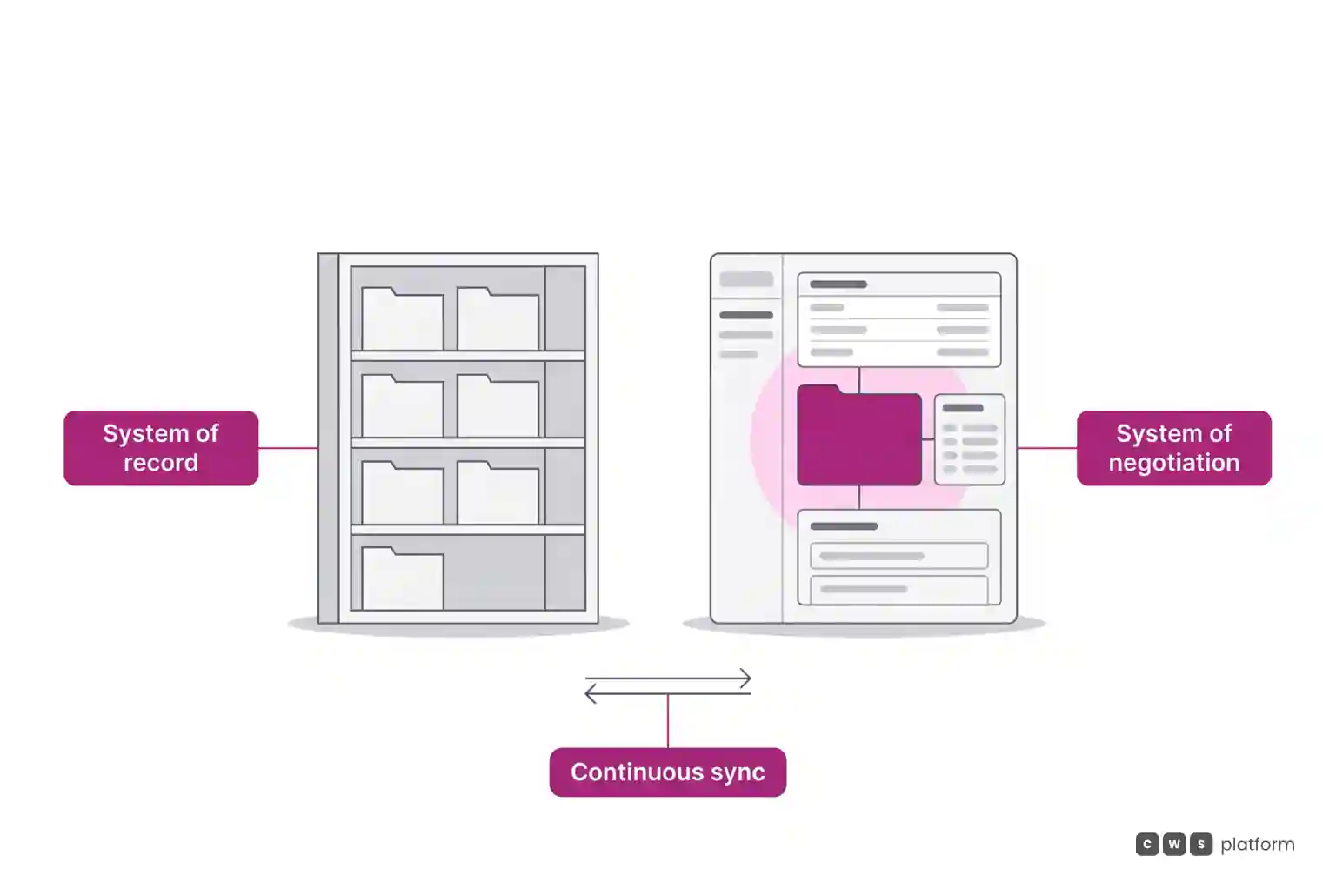
These two columns do not compete. The real question is where each operational decision belongs.
When the ERP module is enough
- Sales are entirely inside operations. Orders arrive via phone, EDI, or email, and someone on your team manually inputs them. There is no customer portal and no self-service demand.
- The commercial policy is straightforward. One simple price list, minimal discounting, and no multi-level approval hierarchies.
- Limited channels. You do not have independent sales agents, marketplace channels, or AI agents transacting on behalf of the company.
When a dedicated B2B platform delivers ROI
- Customers require self-service ordering. They need to see account-specific pricing, available credit, and real-time inventory, search items by customer SKU, and reorder quickly.
- Negotiation requires guardrails. Tiered volume pricing, margin-based approval levels, documented discount reasons, and instant workflows.
- You operate multiple channels. Buyer portals, outside reps, broker networks, and emerging AI sales agents, all governed by the same commercial policy.
- ERP customizations create an IT bottleneck. Every adjustment to sales rules sits in a developer backlog. This is the exact pattern we explore in your ERP is not the problem.
The architecture that avoids an either-or decision
The standard modern approach keeps the ERP as the system of record and positions the B2B platform as the commercial orchestration layer on top. The platform ingests master accounts, base pricing, available inventory, and credit lines from the ERP, conducts the commercial negotiation according to your rules, and passes a clean, verified order back to the ERP for fulfillment and invoicing. There is no need to rebuild the ERP, and no need to duplicate core business operations.
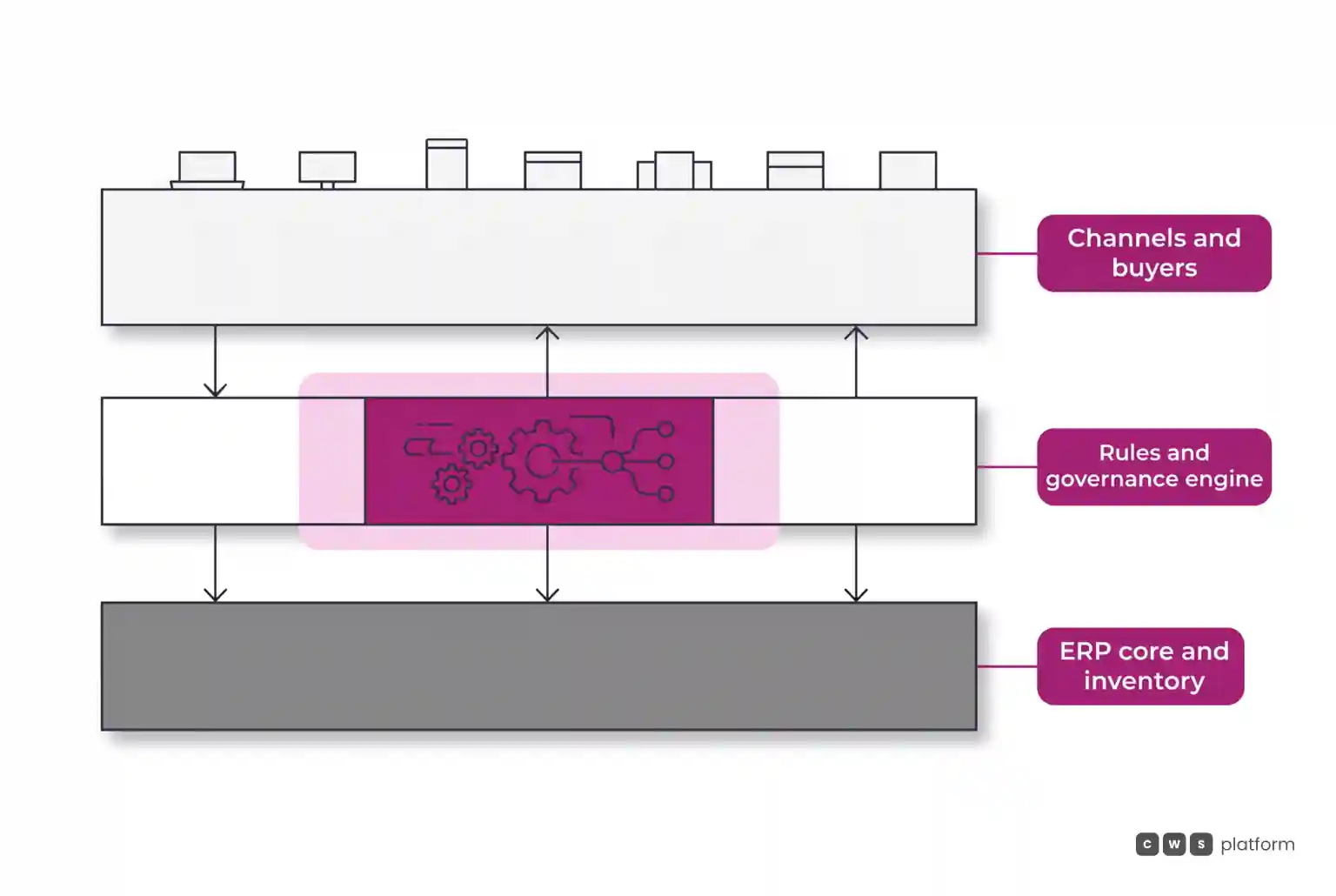
This is how CWS Platform operates: it orchestrates sales workflows on top of your existing ERP through modern open APIs and webhooks, without replacing it. The ERP remains the secure system of record, while commercial policy changes are configured instead of custom-coded. Review the technical blueprint on our APIs and integrations page.
Next steps
Review the last five pricing or commercial policy changes your business needed to roll out, and calculate how long each took to go live. If the average turnaround stretches past a couple of weeks, your ERP module is already carrying an operational burden it was never built to support.
Frequently asked questions
Is it better to use an ERP order management module or a dedicated B2B platform?
The ERP module works well when orders are handled entirely by inside sales reps and pricing rules are simple. A dedicated platform pays for itself when buyers expect self-service, deals require real-time approval thresholds and audit trails, and multiple sales channels need to follow uniform pricing rules.
Should we choose a B2B platform or customize our ERP?
Customizing the ERP embeds commercial workflows directly into core accounting, tax, and inventory software, turning routine business adjustments into lengthy dev cycles. A dedicated B2B platform running above the ERP preserves the core system of record while keeping commercial rules agile and configurable.
Does a dedicated B2B platform replace the ERP?
No. The proven setup positions the ERP as the system of record and the platform as the commercial layer: it consumes customer masters, price lists, inventory, and credit limits, manages the customer transaction, and sends validated orders back to the ERP for processing.
What is the primary difference between a B2B platform and an ERP order entry screen?
An ERP order entry screen captures orders that an internal team member has already finalized. A B2B platform is built for external parties, such as procurement buyers, field sales reps, and distributors, enforcing business logic throughout active transactions before the order ever reaches the ERP.
Read also
- When You Run on Several ERPs, Which One Is Right?
- ERP integration
- ERP and B2B eCommerce integration: why your ERP was never the problem (and the real cost that hits in year two)
- Where marketplace integrations with your ERP break down
About this publication
Published by CWS Platform.
"responsive, technically engaged, and willing to work through complex commercial rules (negotiated pricing, credit, customer-specific conditions) rather than pushing generic answers"
Want to see this in your operation?
Real B2B operations already run on it.