B2B Order Entry Automation: Eliminating Manual Re-Keying in Distribution
How wholesale distributors stop manual order processing, prevent costly clerical errors, and refocus sales teams on growth.

"Another purchase order just came in via email, can someone key it in?" Across many distributors and manufacturers, this sentence echoes dozens of times a day. The customer sends their list through email, a spreadsheet, text, or over the phone, and an internal rep manually turns it into a system order: line by line, checking SKUs, pricing, inventory availability, and credit terms. Manual order entry is the most repetitive task in the commercial department, and the single largest source of operational errors.
Deploying order entry automation is not about eliminating people from the loop. It is about removing the repetitive data entry so your team can focus on what actually requires human judgment.
Why Order Entry Remains Manual
Why do orders originate outside the core system? Because the buyer lacks a dedicated channel where they can self-serve using their specific contract pricing and terms.
Why don't they have one? Because existing digital channels often only display generic list prices, fail to support net terms, or cannot map items to the customer's internal part numbers.
Why doesn't automated integration fix this? Because Electronic Data Interchange (EDI) primarily serves enterprise accounts with dedicated IT budgets. The vast majority of your purchase orders come from mid-market accounts that will never invest in an EDI setup.
Why do entry errors persist? Because every manual keystroke creates an opportunity to misread an item code, quantity, or price tier, and human verification remains equally fallible.
The root cause is straightforward: the order does not originate digitally inside the system because the system was never designed for the end customer to use.
The Real Cost of Manual Order Entry
Here is a practical formula to estimate the expense in your own operation:
monthly cost = (monthly keyed orders × minutes spent keying and verifying × fully loaded labor cost per minute) + (reworked orders × cost per rework)
This calculation leaves out the intangible damages that are harder to track: shipments delayed because a purchase order sat in an inbox, and customers who turned to a competitor because they waited too long for a quote. We break down the direct labor impact in how much each manually processed order costs.
Pathways to Order Entry Automation
Customer self-service portal. The buyer orders independently, accessing their tailored pricing, real-time inventory, available credit line, and shipping options, while searching by their own cross-referenced part numbers. This covers the bulk of routine reorders.
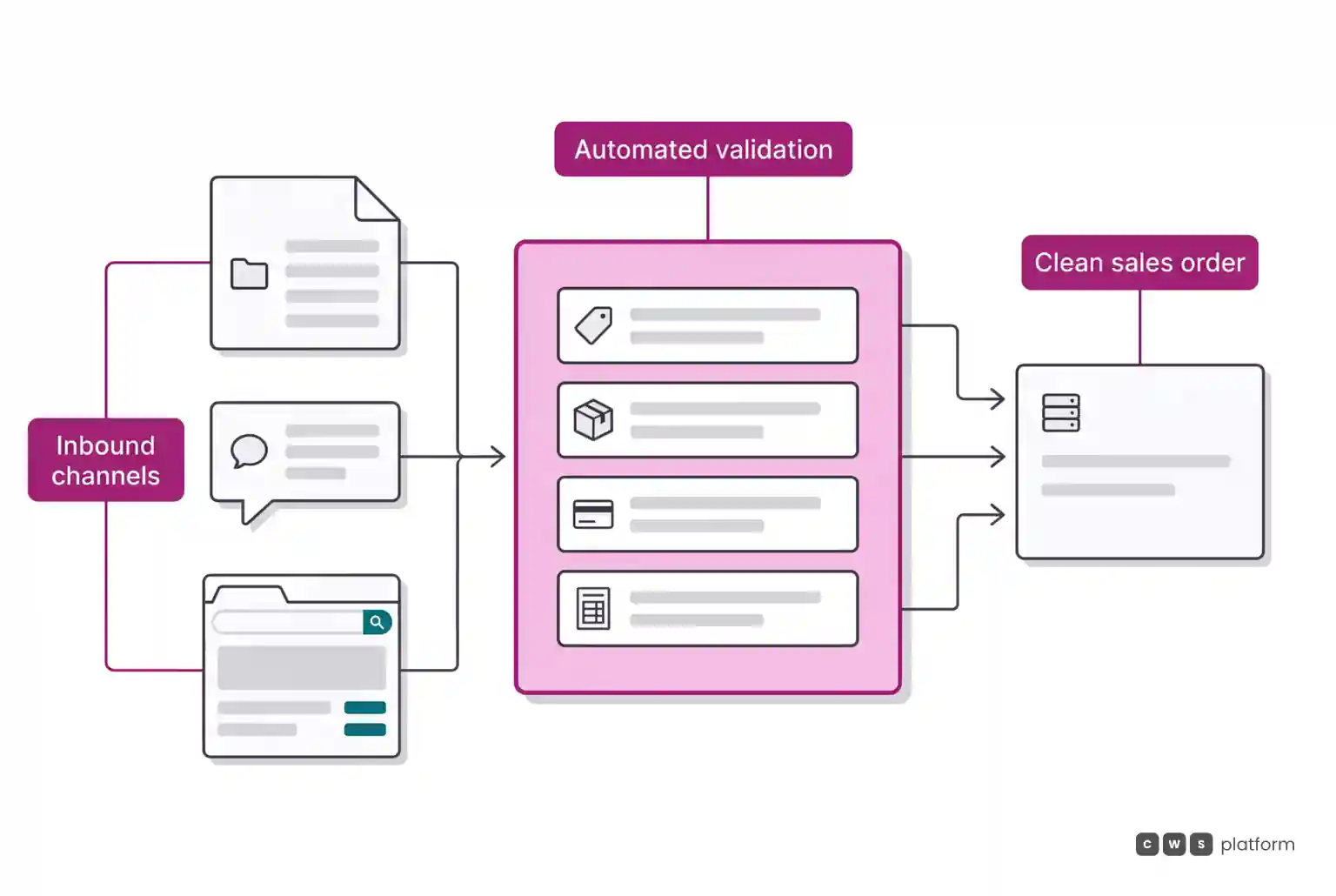
Bulk quick-order uploads. The customer pastes a list of part numbers or uploads an Excel or CSV file. The platform populates the cart in seconds, applying their contract conditions automatically. This cleanly eliminates the classic purchase order spreadsheet sent as an email attachment.
Sales rep assisted ordering. When a customer prefers to order through a direct conversation, the sales rep builds the quote or cart within the very same interface the customer sees, letting the buyer review and approve it. Data entry happens once, directly in the primary commercial platform.
Direct procurement integrations. For accounts with modern ERP or procurement systems, API-based order entry automation feeds the transaction straight into your environment with zero manual steps.
Across every path, the order is verified against business logic prior to routing: inventory allocations, tier pricing, credit limits, and sales taxes are calculated at checkout, reaching the ERP clean and ready for fulfillment.
The Impact on Your Sales Team
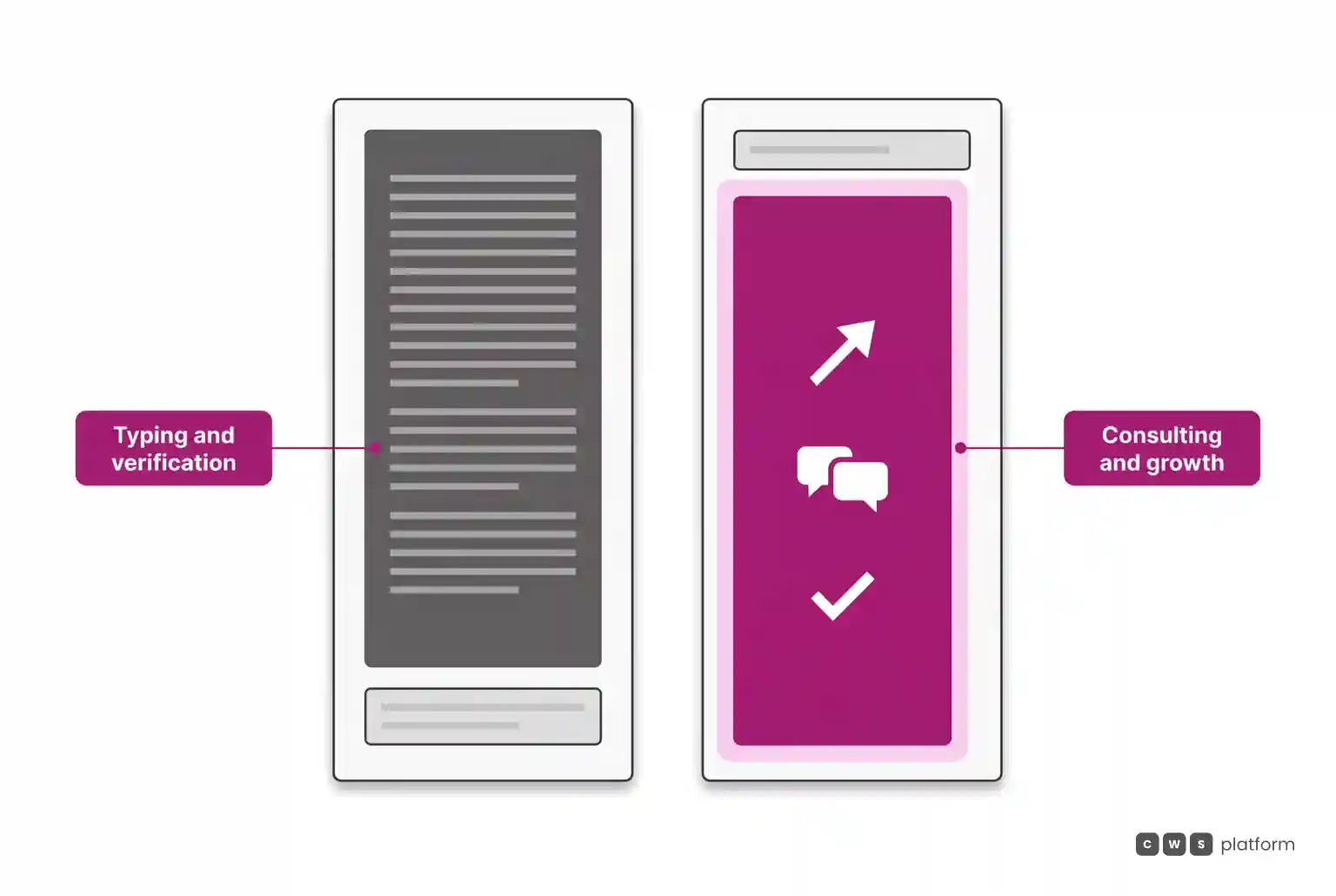
Team members who spent their days keying in line items transition to managing order exceptions, complex configurations, and onboarding accounts that still rely on offline channels. Outside reps shift away from being order-takers for standard replenishments and return to strategic prospecting and relationship building. At industrial parts distributor Imdepa, reps shifted from spending roughly 70% of their working hours on routine order processing to high-value technical consulting, as outlined in the Imdepa case study.
How to Get Started
1. Categorize last month's orders by intake channel. Break them down by phone, email, text, field reps, and web portal.
2. Identify accounts submitting repetitive email or spreadsheet orders. These customers are prime candidates for bulk paste-and-order workflows.
3. Involve your sales reps in the digital channel. Sales representatives are the ones who guide buyers to replace offline purchase orders with the self-service interface. We explore this dynamic in two-phase digital transformation.
4. Track adoption account by account. Focus on the percentage of total order volume transitioned away from manual entry.
On CWS Platform, purchasing teams can place self-serve orders or upload part lists using their own technical codes. Inside reps can build carts in the exact same workspace whenever an order comes in via phone, and every transaction routes straight to the ERP pre-validated. Explore the workflow on our B2B ordering portal page.
Next Steps
Review the purchase orders keyed in over the past thirty days and flag repeat orders containing items the customer buys on a standard cycle. This volume can be transitioned to digital ordering within the first month of deploying an integrated ordering portal.
Frequently Asked Questions
What is order entry automation?
It is the process of generating validated orders in your business system without manual rekeying. Orders originate via customer self-service portals, bulk list uploads, rep-assisted digital carts, or direct software integrations, verifying inventory, contract prices, credit limits, and taxes before syncing to the ERP.
How does a B2B portal automate orders that do not arrive via EDI?
By accepting the data formats buyers already work with, such as pasted text or uploaded spreadsheets, and converting them into a verified digital cart with their specific account pricing. Orders that once arrived as email attachments move through automated validation straight into the ERP.
How can wholesale businesses automate orders without alienating their sales force?
By providing buyers with a dedicated portal featuring contract pricing, net terms, and part-number search, while allowing reps to access the same cart to assist during phone calls or negotiations. The rep focuses on closing margins instead of keying in item numbers.
What is the true cost of manual order entry?
Multiply the number of manually entered orders per month by the time required to key and verify each one, apply your fully loaded employee minute rate, and add the cost of resolving order entry errors. The cumulative figure is often substantial because the labor is dispersed across customer service, accounting, and warehouse personnel.
Related Articles
- Cost to serve and sales operations
- The true cost of B2B self-service, and the cost of operating without it
- Your B2B channel is growing but margins are flat: the problem occurs before the order
About This Publication
Operational performance metrics cited in this piece reflect real-world data from Imdepa, a CWS Platform customer, shared with permission.
Brands mentioned in this article

Trademarks and logos belong to their respective owners. Mention does not imply partnership or endorsement.
"responsive, technically engaged, and willing to work through complex commercial rules (negotiated pricing, credit, customer-specific conditions) rather than pushing generic answers"
Want to see this in your operation?
Real B2B operations already run on it.