What B2B Self-Service Ordering Truly Costs (and the Cost of Inaction)
Why most B2B portal business cases fail by ignoring manual order entry and rule maintenance overhead

"How much does it cost to launch a B2B self-service portal?" This is the first question almost every CFO asks, and it is almost always answered only halfway. The proposal shows software licensing, implementation, and ERP integration. It does not show the cost of not having the channel, nor the cost of running a channel nobody uses. These two components actually decide whether the investment pays off.
Evaluating a B2B ordering system solely by its implementation price is like evaluating a new hire by their first month's salary.
Why the self-service math goes wrong
Why does the business case fail to add up? Because it compares project costs to zero, as if current manual operations were free.
Why does the current operation seem free? Because the cost to serve each manual order is scattered across the payroll: inside sales reps, back-office clerks checking entries, rework on incorrect orders, and price concessions offered to make up for delays.
Why do project costs blow up later? Because every commercial policy that cannot be handled out-of-the-box turns into custom software development, and every policy update requires a new change order.
Why do expected savings never show up? Because the portal launched without native business logic, buyers refused to adopt it, and purchase orders kept arriving by phone and email.
The root cause: B2B self-service costs are measured in the wrong place. The real expense is not the initial rollout; it is the lingering cost to serve and the ongoing expense of maintaining logic hard-coded into custom software. We broke down this operational baseline in how much each manually processed order costs.
The four components of the true cost
1. Implementation. ERP integration, commercial policy configuration, product catalogs, and user onboarding. This is the figure present in every proposal. It drops significantly when the technology is a configurable product rather than a custom software build, meaning commercial rules are parameterized rather than hard-coded.
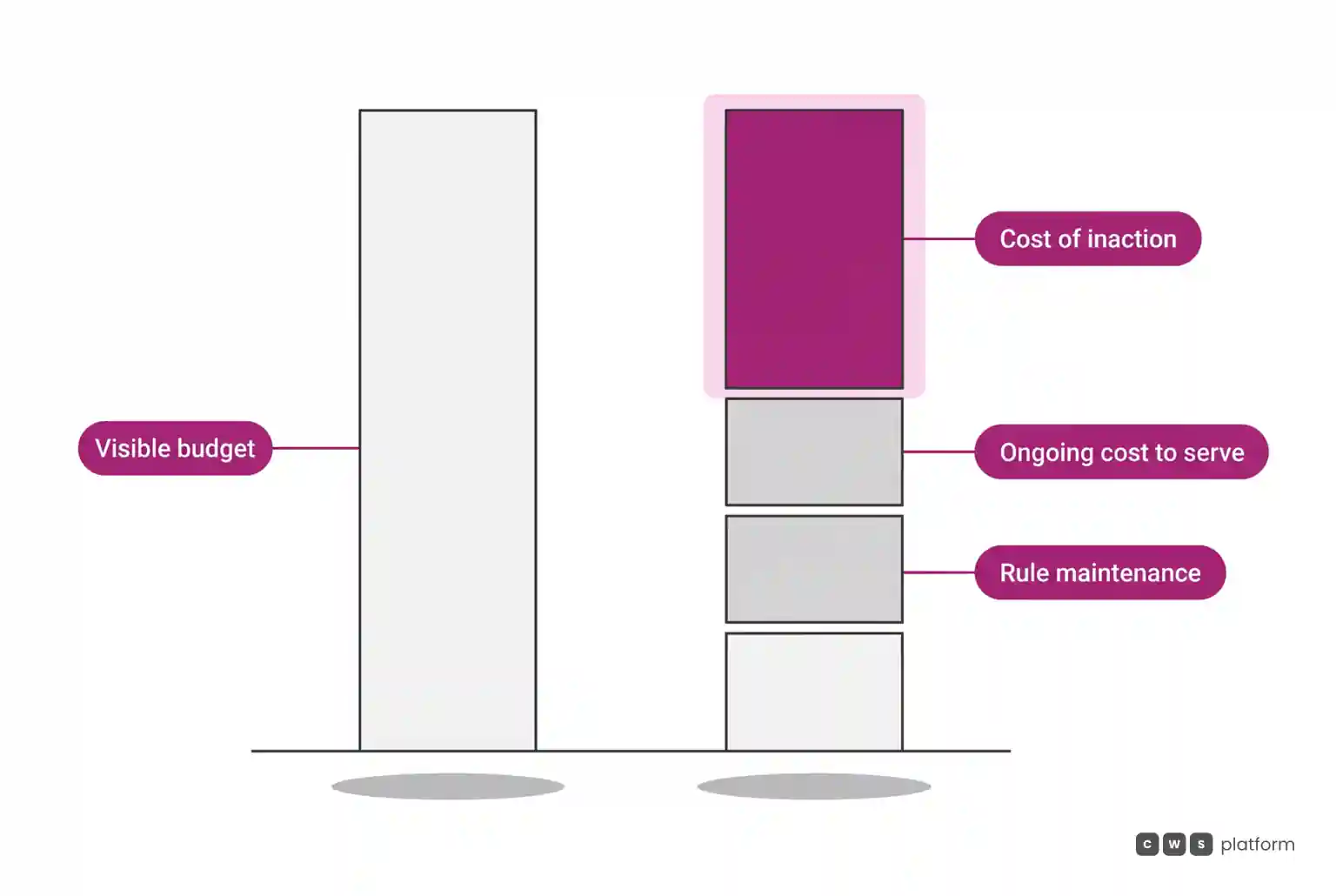
2. Rule maintenance. Every commercial policy evolves: updated payment terms, new discount tiers, or revised sales territories. In a custom software build, every adjustment consumes developer hours. In a parameterized setup, it takes only the time of the business administrator managing the policies. Over a few years, this expense can surpass the initial launch cost, making it essential to budget up front.
3. Lingering cost to serve. Orders that continue to arrive via phone calls, emails, or spreadsheets even after the portal goes live. This metric tracks buyer adoption, and it is the single biggest differentiator between successful and failed projects.
4. The cost of inaction. What the business loses every month without digital channels: dormant accounts overlooked by busy sales reps, low-margin orders that cost more to process than they generate, and company growth that strictly requires hiring more staff. We explored this dynamic in when serving more customers requires hiring more sales reps.
Here is a practical formula to model your current baseline:
current monthly cost = manual orders × minutes per order × cost per minute + reworked orders × rework cost + dormant monthly accounts × average order value × gross margin
Run this calculation across three adoption scenarios (low, medium, and high) and compare the results against implementation plus ongoing policy maintenance. The break-even point is dictated by user adoption, not the software license fee.
What changes the equation
At auto parts distributor Imdepa, launching a B2B self-service platform activated 153 new accounts over three years, roughly tripling their active client base. At the same time, field reps shifted from spending 70% of their day manually keying in orders to providing technical advisory services. The bottom-line impact came not from downsizing headcounts, but from scaling revenue using the exact same operational team, as detailed in the Imdepa case study.
Principles for an honest business case
- Compare against your current baseline, not zero. Manual order processing carries a steep hidden tax, even if it is not broken out as a line item.
- Include three years of rule maintenance. This lifecycle cost is where custom development projects bleed cash.
- Measure adoption, not just go-live. The digital channel yields return on investment only when orders move off the phone lines.
- Choose configuration over custom code. Parameterized rules can be adjusted instantly without waiting in developer queues.
The CWS Platform is a parameterized engine: commercial policies are fully configurable, identical rules apply across digital channels and sales rep workflows, and the architecture coordinates directly on top of your existing ERP without operational disruption. See our structural design on the B2B ordering system overview.
Next steps
Before requesting quotes, calculate your current monthly baseline with the formula above using figures from a recent month. That monthly loss represents the absolute ceiling of what an initiative can cost while still paying for itself within your target payback window.
Frequently asked questions
How much does it cost to implement a B2B self-service platform?
The total investment depends far less on licensing costs and far more on two hidden items: maintaining complex commercial policies over time and the lingering cost to serve unadopted manual orders. A configurable product dramatically minimizes both factors.
How can a business reduce operational support costs with self-service?
By shifting routine reorders and standard replenishment to an online portal where wholesale buyers view negotiated pricing and terms automatically. Sales teams stop acting as order-entry clerks and redirect their hours toward consultative selling and account acquisition.
How do you calculate the ROI of a B2B ordering system?
Compare your current monthly operational overhead (manual keying, order errors, and inactive accounts) against total rollout and rule-maintenance expenses across low, medium, and high buyer adoption rates. The true payback timeline is driven by customer adoption rather than base software pricing.
Read also
- B2B ordering portal and self-service
- Your B2B portal accepts orders that will never close
- Which architecture maintains branch inventory and regional pricing in B2B self-service?
About this publication
The operational metrics cited are from Imdepa, a CWS Platform client, published with authorization.
Brands mentioned in this article

Trademarks and logos belong to their respective owners. Mention does not imply partnership or endorsement.
"responsive, technically engaged, and willing to work through complex commercial rules (negotiated pricing, credit, customer-specific conditions) rather than pushing generic answers"
Want to see this in your operation?
Real B2B operations already run on it.