Salesforce vs. CWS Platform: Who Rebuilds the Storefront When Frameworks Change?
A comparison from the engineering point of view: what happens to what the team built when the technical base of the store changes.

Editorial note: an architecture comparison between Salesforce and CWS Platform, written for those who answer as CTO. Every fact about Salesforce comes from its public documentation, with the address next to it.
For the CTO, the cost of a B2B commerce platform does not end at implementation. It continues in each update cycle: what the team needs to rewrite, test, and publish again to stay on a version that receives evolution. The question of this comparison is this: when the technical base of the store changes, who redoes the work?
Salesforce and CWS Platform answer in different ways, and neither answer is wrong in itself. They call for different teams, calendars, and budgets.
What Salesforce solves well
Salesforce delivers a consolidated structure for unifying corporate data and managing the customer lifecycle at global scale. In Data 360, data from multiple sources enters the lakehouse and is first modeled as Data Lake Objects (DLOs), later mapped to Data Model Objects (DMOs) to apply identity resolution rules and generate unified profiles. The governance of this ingestion and querying is controlled programmatically, including the use of Data 360 SQL and tenant-specific APIs, allowing automated actions to be triggered through external webhooks or platform events.
In the transactional purchasing environment, B2B Commerce enables portals to be created with Lightning components and Experience Builder, with asynchronous import of products, price lists, and entitlements through structured files. The solution allows buyers to be managed by accounts and groups, delegating final processing to custom checkouts built by providers and external integrations.
For commercial management and relationship, the ecosystem connects Sales Cloud for structuring pipelines, territories, and revenue splitting among teams, while Marketing Cloud exposes REST and SOAP interfaces for orchestrating journeys and multichannel messages. The autonomous agent layer Agentforce complements the suite by allowing natural language instructions to be combined with programmatic conditional routines in Agent Script, enabling automated tests through the CLI and messaging connections through dedicated REST endpoints.
Where the architecture diverges
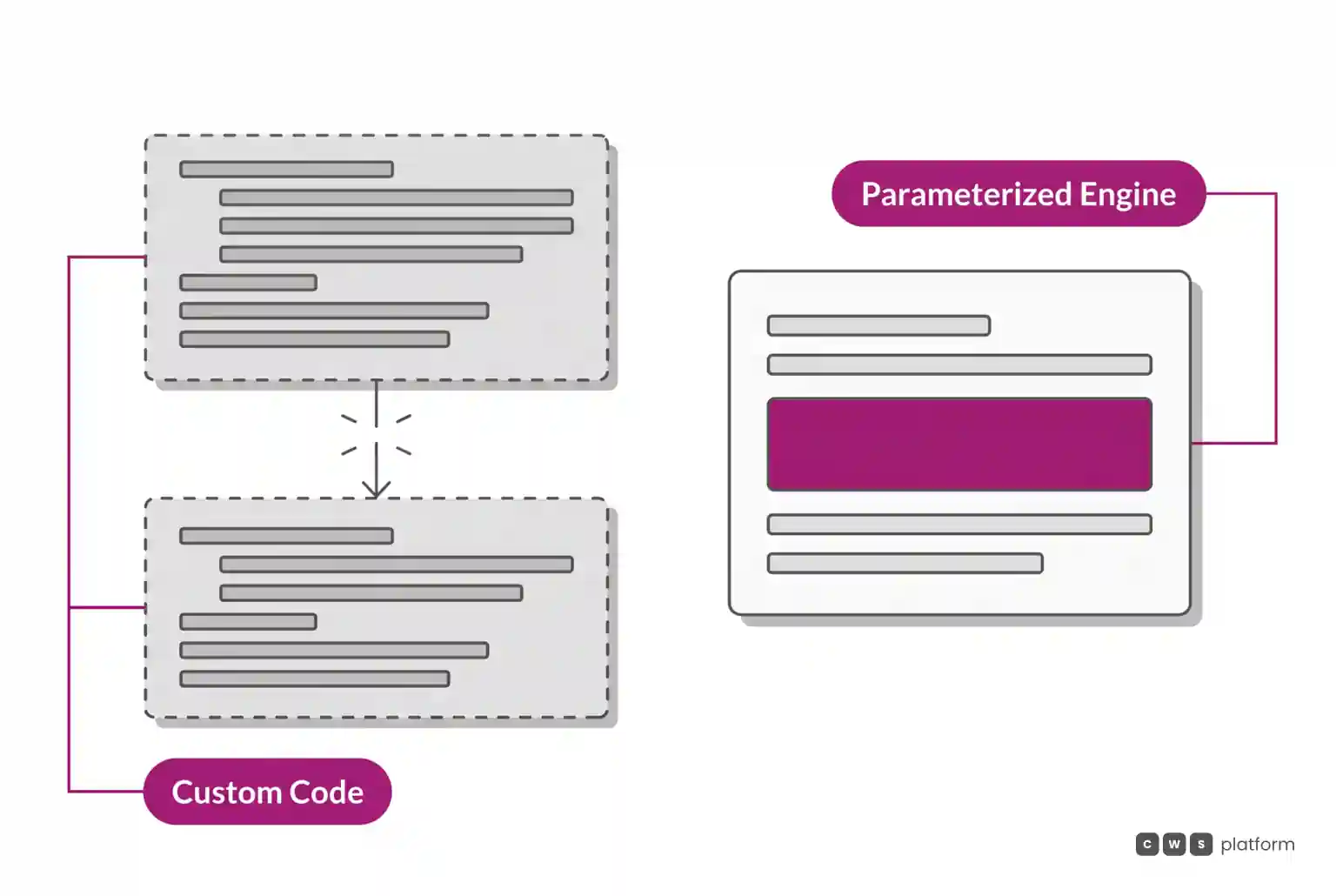
The divergence that weighs on maintenance is what happens to what your team built when the technical base of the store changes.
Salesforce's own documentation records two points about this cycle:
- limitation recorded in the vendor's documentation, consulted on October 9, 2026: to complete a store's migration to LWR, all Aura components must eventually be replaced ("all Aura components must be replaced eventually", https://developer.salesforce.com/docs/commerce/lwr-migration/guide/prepare-for-migration.html).
- limitation declared by the vendor, recorded in its release notes, consulted on October 9, 2026: since Summer '25, B2B Commerce for Visualforce receives only patch notes ("maintains only patch notes for B2B Commerce for Visualforce", https://help.salesforce.com/s/articleView?language=en_US&id=commerce.b2b_commerce_release_notes.htm&type=5).
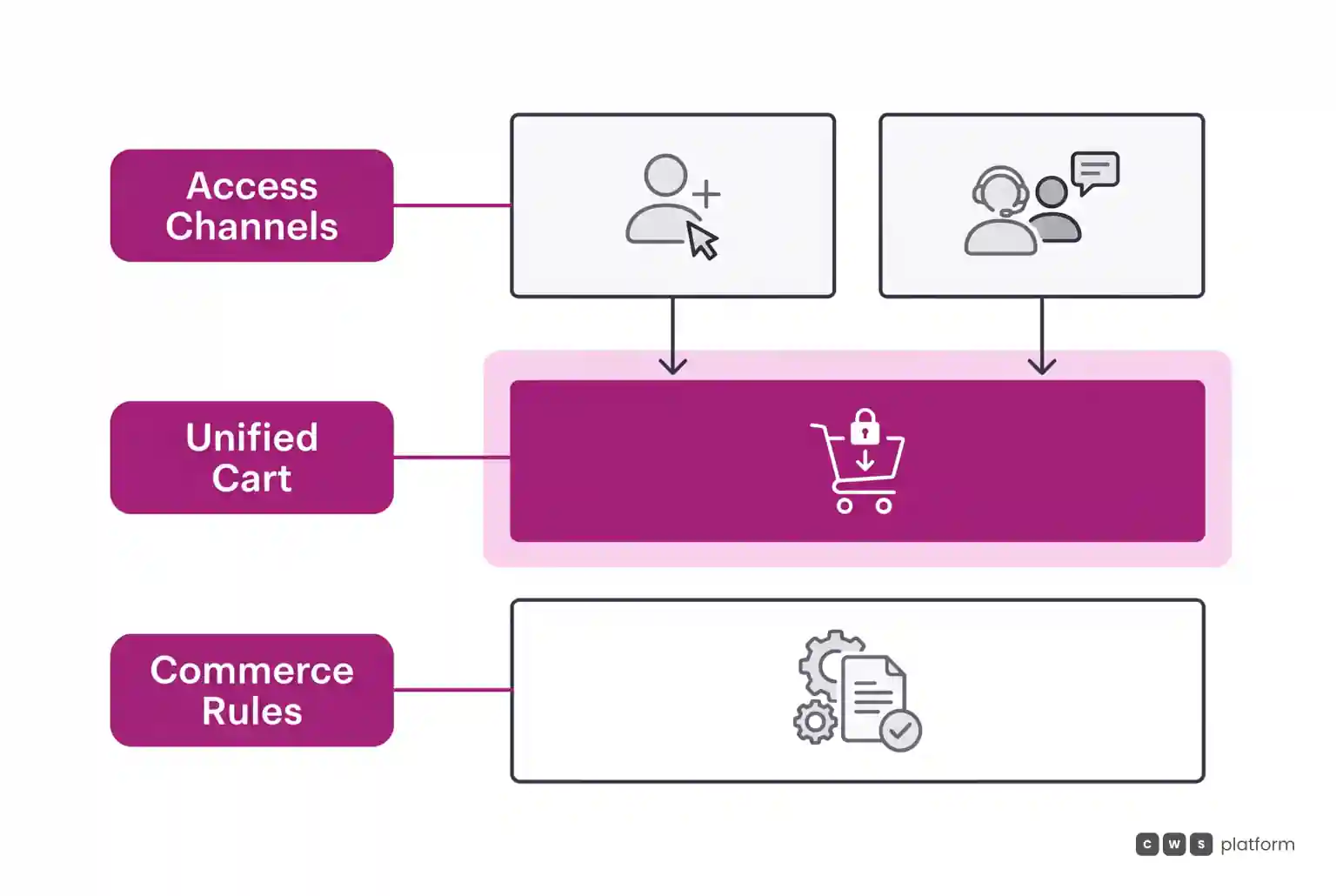
On CWS Platform, all customers run the same version of the platform, and there is no framework change or upgrade project on the customer side. The portal is assembled without code, on a single parameterized template, and commercial policy sits in parameters of the Commerce Rules Engine (CDL Workspace), on the principle of configuration over code. Customer and seller use the same system and the same interface, with no storefront migration.
| decision | Salesforce, per the documented mechanism | CWS Platform |
|---|---|---|
| How the store is built | Portals with Lightning components and Experience Builder. | Portal without code, on a single parameterized template. |
| What happens when the front-end generation changes | Migrating the store to LWR calls for replacing all Aura components. | There is no framework change on the customer side. |
| Where commercial policy is expressed | Maps rules through entitlements, price lists, and custom flows integrated with the CRM. | Parameters in the Commerce Rules Engine (CDL Workspace), changed by configuration. |
| How order closing is adapted | Custom checkouts, built by providers and external integrations. | Credit and approval levels applied by the platform's rules when the order closes. |
The technical decision is how much of what the team builds today it accepts rebuilding when the base of the store changes.
What changes in the operation, through the CTO lens
Through the CTO lens, the maintenance bill has two parts. The first is the inventory of what was customized: components, flows, and integrations that belong to the customer and that the customer needs to carry from one generation to the next. The second is the calendar: when a product line starts receiving only fixes, migrating stops being optional in the planning.
It is worth taking three questions to any vendor: what part of our code survives the next change of technical base; who carries out the migration and by when; and what stops receiving evolution while it does not happen.
On CWS Platform, what the team maintains are integrations and parameters. The platform integrates with the ERP and the other systems through REST APIs and webhooks. Price tables, rules, and contracts are configured on the platform or received from the ERP, the CRM, or another system through an API, and tax per item comes from the customer's ERP tax API. Moving from the v1 pricing model to v2 requires only validation by the customer, with no project on the customer's side.
Where the pains of this scenario come from, and how the architecture resolves them:
| pain | why it happens | how the architecture resolves it |
|---|---|---|
| "Every change in commercial policy becomes an integrator project" | A business rule treated as a custom extension goes through development and acceptance testing at each change. | Parameters and approval levels are changed by configuration in the Commerce Rules Engine (CDL Workspace). |
| "The seller does not see the cart the customer is building, and the negotiation becomes a parallel quote" | Self-service and CRM keep separate carts. | Seller and buyer stay in the same cart, updated for both when the page is reloaded, with discount approval levels applied. |
When to choose Salesforce
The Salesforce architecture is indicated when corporate demands go beyond strict commerce execution and require a unified relationship and data layer at global level.
Consolidation of multi-system corporate data and a generalist CDP. Choose this architecture when the organization needs to unify data from multiple legacy ecosystems in a data lakehouse with comprehensive identity resolution. Data 360 allows DLOs to be mapped to standardized DMO models and SQL transformations to be run at enterprise scale.
Operations with complex pipeline governance and multiple global territories. Choose this architecture when the company requires deep management of a corporate sales force, covering pipeline budget forecasts, commission allocation, and management of global territories with multiple currencies. Sales Cloud offers mature native structures to support large distributed commercial teams.
Horizontal agent development and omnichannel journey orchestration. Choose this architecture when the goal is to create flexible conversational flows with tests through the CLI, using Agent Script and specific SDKs for multiple contact channels. The Agentforce platform and the support for advanced journeys in Marketing Cloud offer extensible tools for this level of corporate personalization.
When CWS Platform is the right choice in this scenario
CWS Platform is the suitable choice when the goal is to take the upgrade project and the maintenance of an in-house front end off the engineering calendar.
One version for all customers. Choose this architecture when the engineering team does not want to reserve budget and calendar for an upgrade project. All customers run the same version of the platform, and there is no framework change on the customer side.
A store with no code of your own to maintain. Choose this architecture when the B2B portal needs to be assembled and changed without front-end development. The portal is parameterized on a single template, and customer and seller use the same interface.
Commercial policy in parameters. Choose this architecture when price, approval levels, and credit change frequently. The rules sit in the Commerce Rules Engine (CDL Workspace), the seller's discount goes through approval levels, and the credit limit works as a current account for the customer, granted in CDL Workspace or through an API.
Integration by API with what already exists. Choose this architecture when the ERP remains the system of record. The platform integrates through REST APIs and webhooks, and the tax calculation per item is done by the customer's ERP tax API.
Where to go from here
If your question is still which architecture fits your operation, and not which vendor to choose, the path is the seven questions that separate B2B commerce architectures.
If what is blocking you today is the pain behind this scenario, the pages When the Catalog Becomes Chaos and When Integration Blocks Everything cover it in depth, without talking about any vendor.
Read also
"responsive, technically engaged, and willing to work through complex commercial rules (negotiated pricing, credit, customer-specific conditions) rather than pushing generic answers"
Want to see this in your operation?
Real B2B operations already run on it.