What Is an Approval Matrix and How to Structure Discount Tiers
Establish robust pricing governance to protect gross margins and cash flow without slowing down B2B sales cycles.

Approval limits, or delegation of authority, represent the decision-making threshold each person holds within a business process: how much they can approve on their own, and at what point the decision must escalate to the next level. In B2B sales, the most common approval limit involves discounts: the sales rep grants up to a certain tier, the sales manager approves the next tier, and executive leadership decides anything beyond that.
Approval limits exist so a company can decide routine matters quickly, while taking deliberate time on high-stakes, costly exceptions.
Where Approval Limits Appear
- Discounts. The percentage or dollar amount each role can deduct from standard customer pricing.
- Payment Terms. Extending payment terms beyond standard customer conditions (such as moving from Net 30 to Net 60).
- Credit Limits. Releasing orders that exceed a customer's available credit line.
- Freight and Shipping. Waiving freight fees or offering subsidized shipping outside established policy.
- Purchasing and Expenses. Outside commercial sales, the exact same logic applies to purchase orders and vendor disbursements, which is why the concept is equally foundational in corporate finance.
Why Approval Limits on Paper Fail
Why do discounts slip outside the approved tier without anyone signing off? Because the policy sits in a PDF handbook, while the live negotiation happens over the phone.
Why doesn't the sales rep ask for approval? Because asking takes time, and the customer is waiting on the line for an answer right now.
Why does approval take so long? Because the request lands via email, Slack, or text message without the line items, gross margin, or account order history attached.
Why does this erode margin? Because an exception approved in a rush, devoid of context, immediately sets a permanent price precedent for the next order.
The root cause: the approval limit was designed as an operational rule, but executed as an informal conversation.
How to Set Approval Limit Tiers
1. Start with margin, not discount percentage. The sales rep tier should be calibrated to protect the baseline gross margin of the specific product or category. An identical 10% discount across two products with wildly different margin profiles represents two completely different commercial decisions.
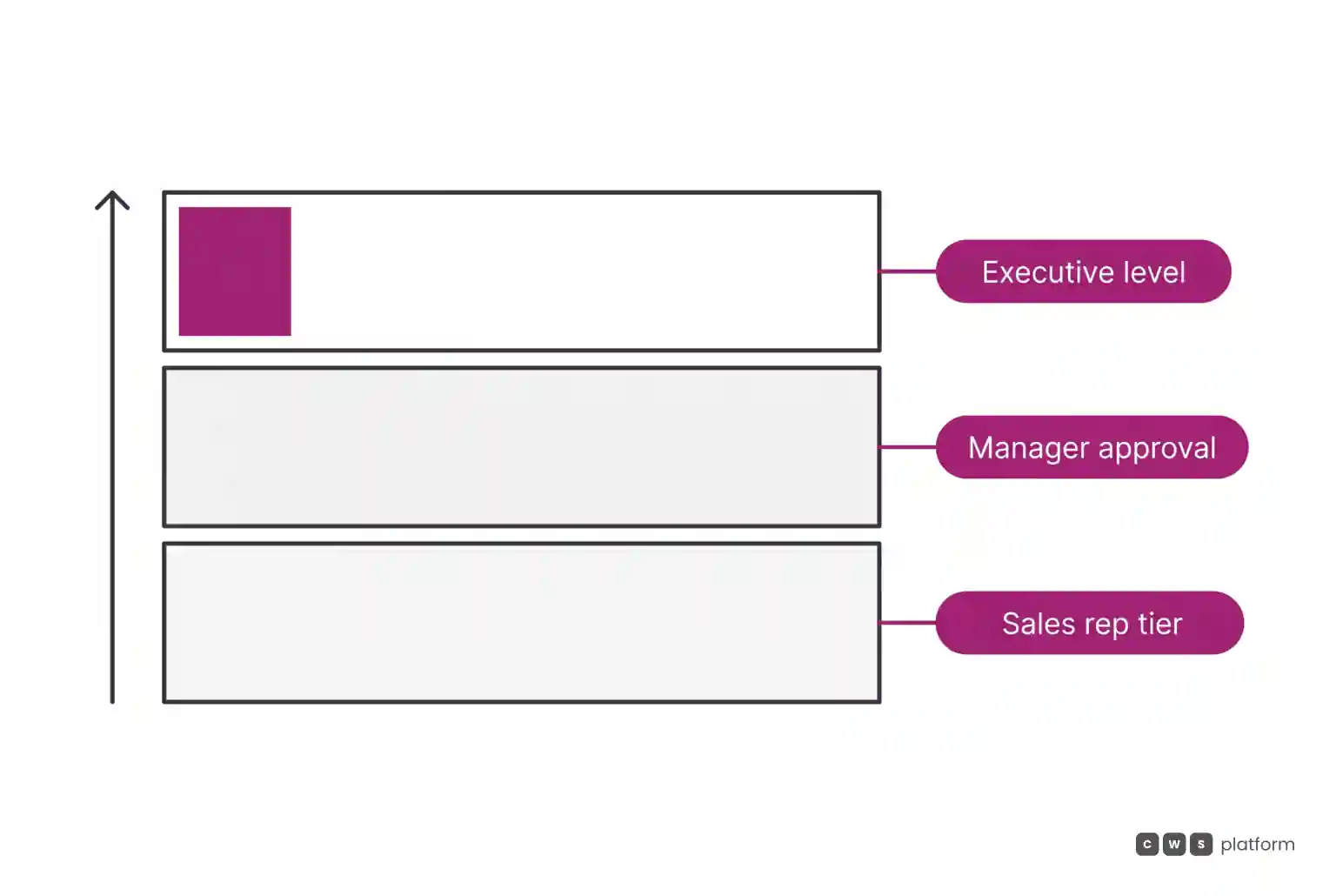
2. Keep the hierarchy lean. Rep, manager, and executive leadership handle the vast majority of enterprise and mid-market operations. Every additional approval tier adds another day of deal lag.
3. Account for context. Strategic accounts, high-volume orders, dead stock, and new product launches can carry dedicated approval rules.
4. Mandate reason codes for exceptions. Any pricing concession beyond standard rep authority must require a clear business justification: competitive match, volume commitment, strategic acquisition, or slow-moving inventory. These reason codes provide the data needed to audit and refine pricing policies later.
5. Establish response time SLAs. Approvals that stall for days drive buyers straight to competitors. Tight turnaround expectations and designated backup approvers eliminate bottlenecks.
6. Review policies using real data. Every quarter, analyze how many approval requests each tier received, how much margin was surrendered, and the underlying reason codes. A tier that triggers escalations on nearly every single transaction is set too low; a tier that never gets triggered might be set too high.
What Changes When Approval Limits Are Built into the System
When approval tiers are enforced directly within your sales software, negotiation no longer relies on memory or goodwill. The sales rep clearly sees their authorized pricing boundary, an order exceeding that threshold is held automatically, and the designated manager receives the complete order context, including line-item gross margins and purchasing history, to decide within minutes. We explore the bottom-line impact of this governance in growing top-line revenue is not the same as growing margin.
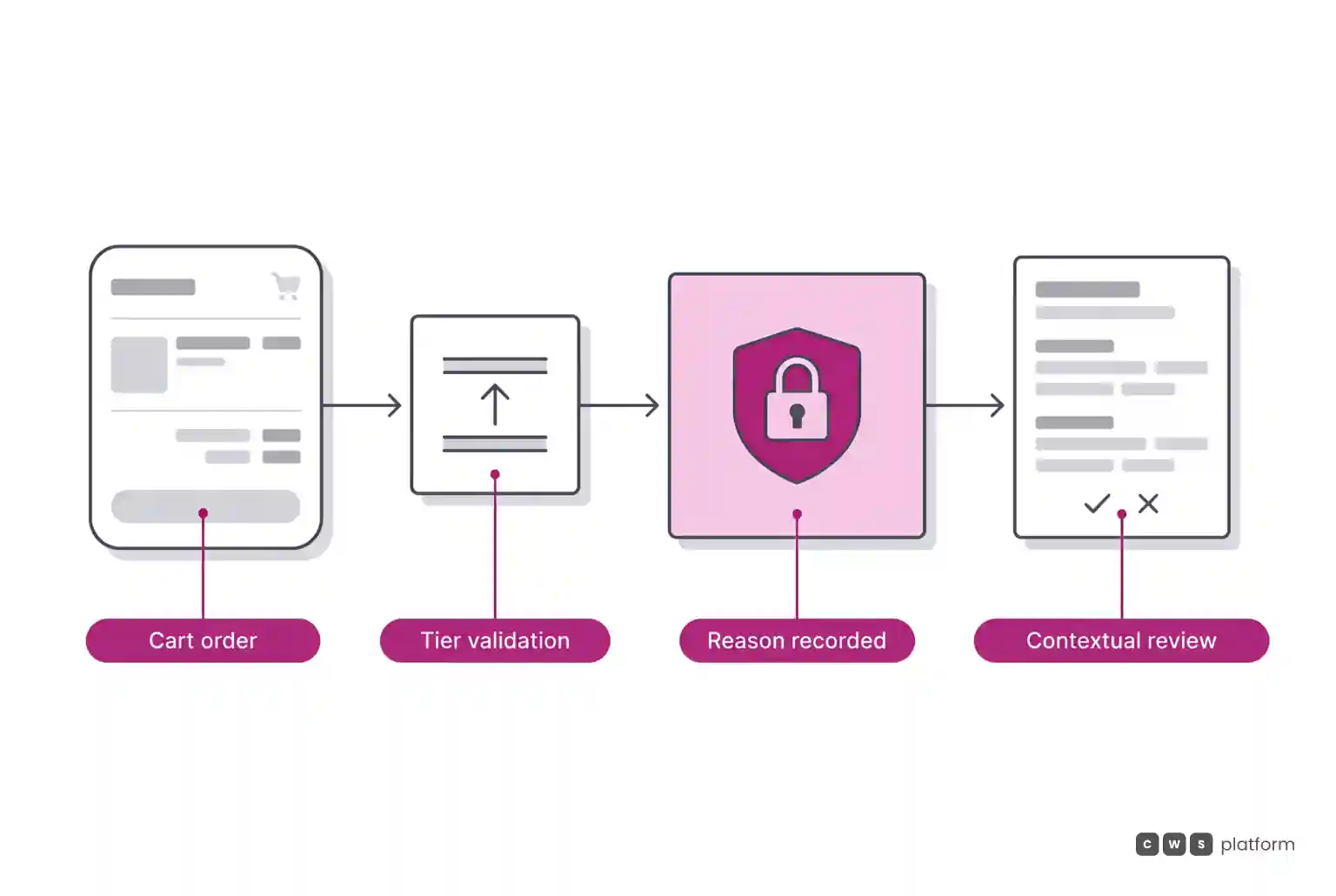
On CWS Platform, sales reps work with an integrated approval dashboard displaying clear authority bands across every tier. Any line item that breaches the rep threshold is locked until a reason code is selected, routing the order directly into the approver's queue with full commercial context. The identical governance rules apply seamlessly whether orders are placed by field sales reps, through the B2B customer portal, or via automated AI agents. See the full workflow on our guided selling page.
Next Steps
Review every order closed over the past month that included a discount exceeding your rep baseline, and check how many include a documented business justification. If the answer is "almost none," your commercial approval policy exists only on paper.
Frequently Asked Questions
What is an approval limit?
It is the formal decision-making threshold assigned to a specific role in an organization: the maximum authority they hold to approve transactions independently before the request must escalate. In B2B commerce, it is primarily applied to discounts, payment terms, credit limits, and freight terms.
What is a discount approval matrix?
It is a structured schedule defining the exact discount range each sales tier can authorize without managerial sign-off. When pricing exceeds that baseline, the system routes the quote to the next management level, logging the explicit business justification.
How many approval tiers should a B2B business maintain?
For most wholesale and distribution businesses, three levels are sufficient: sales rep, sales manager, and executive leadership (VP or Director). Adding more layers typically increases quote turnaround time without improving pricing discipline.
How does an automated discount approval workflow operate?
The sales rep negotiates pricing within their authorized band. When a proposed discount breaches that limit, the order is paused, the rep submits an operational reason code, and the quote routes instantly to the manager holding the appropriate authority, who approves or rejects the request with margins, customer history, and full order details in front of them.
Related Articles
- Discounts, approvals and traceability
- Rogue discounting: how to know if your sales reps are cutting prices under the radar
- Operational costs in distribution: where they hide and how to reduce them
About This Publication
Published by CWS Platform.
"responsive, technically engaged, and willing to work through complex commercial rules (negotiated pricing, credit, customer-specific conditions) rather than pushing generic answers"
Want to see this in your operation?
Real B2B operations already run on it.