Operating Costs in Distribution: Hidden Leaks and How to Cut Them
Why wholesale margins shrink as order volume scales and how commercial governance stops order rework.

Operating cost is what a company spends to run day to day: headcount, systems, infrastructure, logistics, and all the processes required to turn an order into a delivery. In wholesale distribution, it often dictates the bottom line more than purchase price, because industry gross margins are tight and every point of operating cost comes straight out of net profit.
The problem is that most operating costs in distribution do not appear as a single line item. They are scattered across rework, waiting times, and ad hoc exceptions.
Where Operating Costs Hide in Distribution
Manually entered orders. Every order that arrives by phone, email, or messaging app must be manually keyed in, reviewed, and, all too often, corrected. The real cost is not a single person's salary, but the cumulative hours of multiple employees across teams.
Returned and stalled orders. An order accepted without validating customer credit, live inventory, or tax compliance gets stuck in billing and requires rework. We explored this issue in how to automate wholesale orders with credit and inventory rules.
Unnecessary inquiries. Customers calling just to check pricing, stock availability, or order status tie up inside sales and customer service reps who could otherwise be closing new business.
Exceptions without rules. Discounts, shipping fees, and payment terms decided on a case by case basis consume managerial approval time and erode gross margin along the way.
Split shipments. Orders fulfilled out of multiple distribution centers without prior planning generate extra freight bills and redundant handling.
Why Operating Costs Scale Directly with Sales
Why does selling more increase costs at the exact same rate? Because every single new order passes through the exact same set of hands.
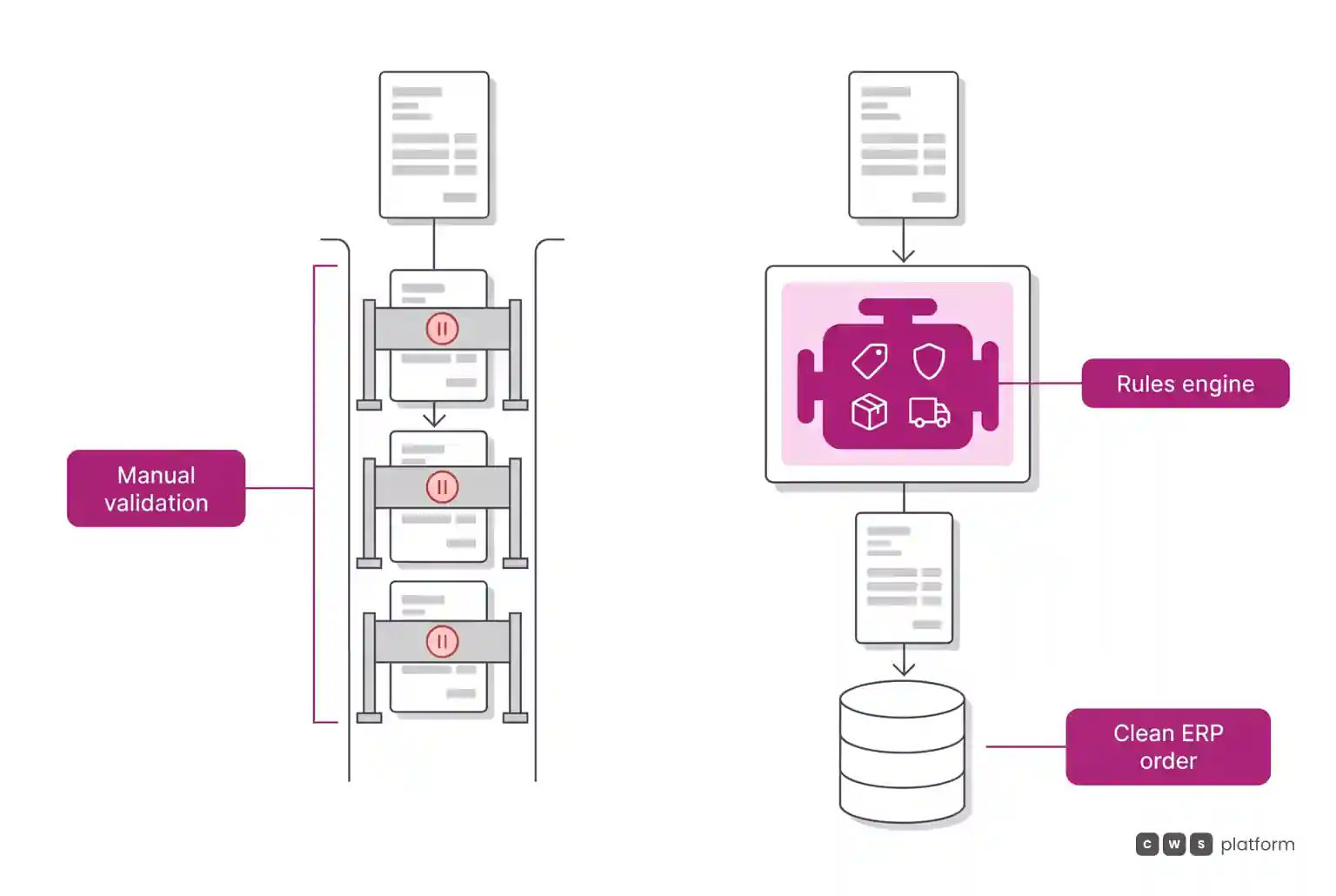
Why the same hands? Because the workflow relies on people to verify what software could validate automatically.
Why does the system fail to validate it? Because commercial business rules (customer-specific pricing, credit limits, shipping matrices, and discount tiers) are not defined anywhere machine-readable.
Why does this stall growth? Because handling more accounts forces the company to hire more staff, and margins cannot keep pace. This is the exact dilemma analyzed in the distributor that does not die from technology dies from high operating costs.
The root cause: operating cost in wholesale distribution is largely the cost of manually deciding what should be executed by automated business logic.
How to Cut Operating Costs Without Hurting Customer Service
1. Track cost per order, not just department budgets. Add up the loaded payroll of everyone who touches an order and divide that by total order volume. This metric exposes the true cost of manual order processing.
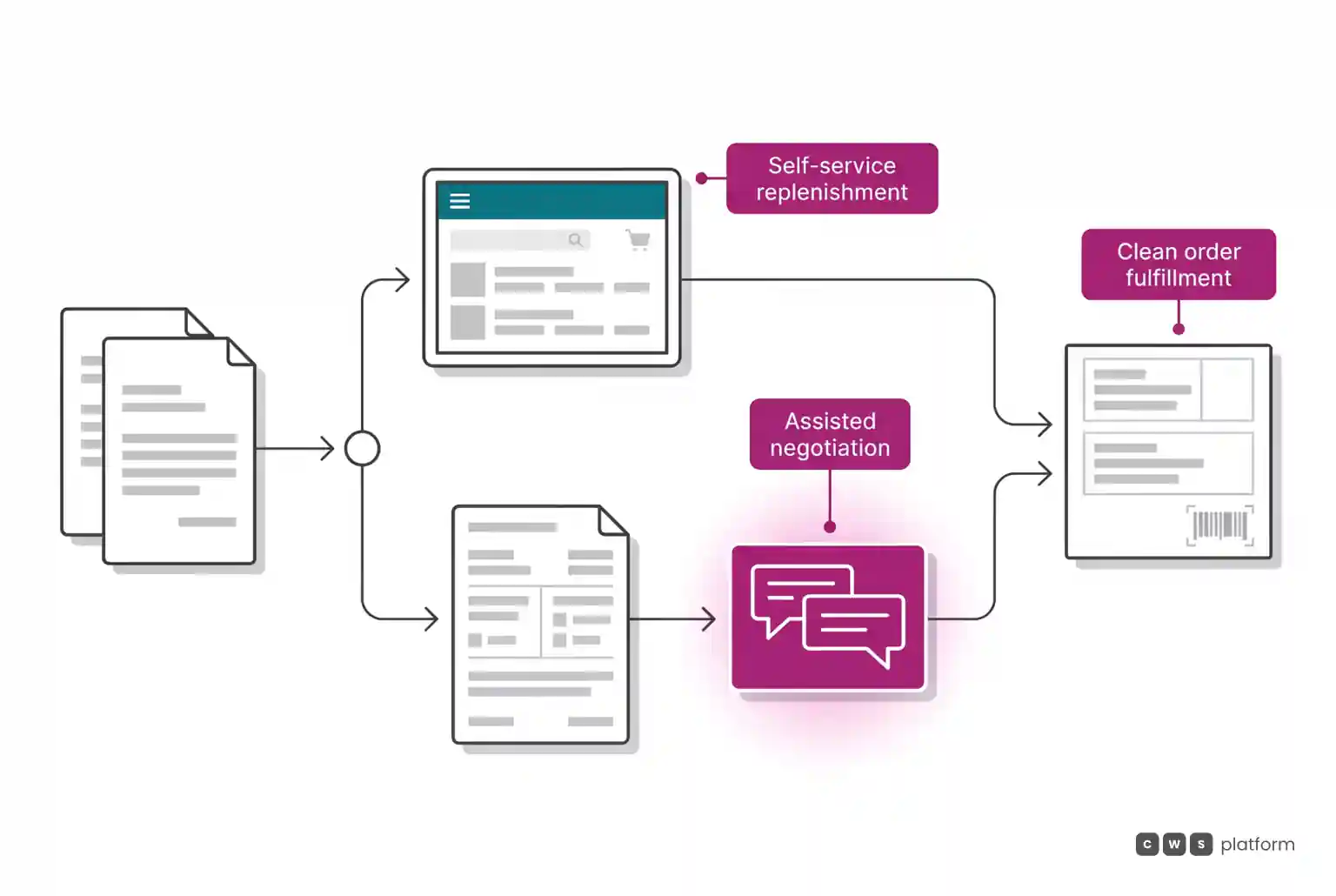
2. Separate routine replenishment from complex negotiation. Routine reorders should flow into customer self-service. Complex deal negotiations remain with the sales rep.
3. Define commercial rules once. Customer-specific price tiers, credit terms, freight policies, and approval thresholds should be set within the system and enforced consistently across all channels.
4. Validate before accepting the order. Inventory availability, contract pricing, credit status, and sales tax calculated automatically at checkout eliminate downstream rework.
5. Enable zero-touch order tracking. Real-time pricing, stock levels, and order tracking made available directly via a customer portal eliminate inbound status calls.
Logistics Costs Are Part of the Equation
Freight is a visible component of operational overhead. Straightforward rules, such as order minimums for prepaid freight, freight calculations by shipping location right on the order, and delivery consolidation, reduce outbound logistics expenses without haggling on every order.
What Changes When Workflows Become Automated Rules
At Imdepa, an automotive parts distributor, a single digital cart handles over 250 SKUs with sales taxes, freight tables, and pre-approved credit lines calculated in seconds. Field reps shifted from spending roughly 70% of their day manually keying in orders to serving as consultative sales advisors, as documented in the Imdepa case study.
On CWS Platform, commercial business logic is configured rather than hard-coded, delivering clean, validated orders directly to the ERP: commercial buyers place orders independently with their negotiated terms and credit limits, freight rates calculate automatically, and reps step into the cart only when manual negotiation is truly required. See the architecture on our B2B ordering portal page.
Next Step
Over the course of a normal business week, track how many calls and emails your customer service desk receives solely for price checks, stock inquiries, or tracking updates. That total represents the exact portion of operating expenses your buyers could easily handle through self-service.
Frequently Asked Questions
What are operating costs in distribution?
They are the day-to-day expenses required to run the operation: headcount, software, warehouse facilities, logistics, and the administrative workflows needed to convert an order into a completed delivery. In wholesale distribution, these costs impact the bottom line just as heavily as supplier pricing.
How do you reduce operating costs in wholesale distribution?
By tracking operating cost per order, routing recurring reorders to self-service channels, embedding pricing, credit, and freight rules directly into the ordering platform, validating orders before ERP entry, and giving customers self-serve access to pricing, stock, and order status.
What are distribution logistics costs?
They represent the expense of moving product to the customer: pick, pack, outbound freight, split shipments, and rush order handling. Order minimum thresholds, fulfillment location rules, and shipment consolidation help keep these expenses under control.
Why do operating costs grow right alongside sales revenue?
Because when order fulfillment depends on manual touchpoints for verification, every incremental sale demands more labor hours. When business logic is automated within your platform, the company scales transaction volume without bloating administrative headcount.
Read More
- Cost to serve and sales operations
- What B2B self-service costs, and what it costs not to have it
- Your B2B channel is growing, but margins are flat: the real bottleneck happens before the order
About This Publication
Operational performance metrics cited reflect data from Imdepa, a CWS Platform client, shared with explicit permission.
Brands mentioned in this article

Trademarks and logos belong to their respective owners. Mention does not imply partnership or endorsement.
"responsive, technically engaged, and willing to work through complex commercial rules (negotiated pricing, credit, customer-specific conditions) rather than pushing generic answers"
Want to see this in your operation?
Real B2B operations already run on it.