B2B Marketplace Payments: The Multi-Vendor Cart Settlement Trap
Navigating the financial, freight, and trade credit complexities of multi-vendor checkout reconciliation in enterprise commerce.

Closing a corporate order containing items from multiple origins exposes a fundamental flaw in standard settlement systems. In B2B commerce, combining items from different suppliers into a single order cannot be solved with a simple credit card split. A dedicated payment split architecture must calculate commissions by source, isolate freight for each seller, and reconcile distinct commercial terms. This is precisely what sets B2B marketplace payments apart from retail checkouts.
When a manufacturer or master distributor attempts to run a multi seller B2B model using tools designed for retail consumers, operational friction quickly surfaces during invoicing. In retail, payment splitting merely divides a single lump sum paid via credit card or instant payment rails. Between businesses, transactions involve trade credit limits, negotiated net terms, vendor specific conditions, and complex logistics rules that simply do not fit into a linear consumer checkout.
TL;DR
- B2B payment splits are not just technical: they require source-based commission logic, seller-specific freight, and multiple payment terms within the exact same order.
- Splitting a corporate purchase among multiple vendors changes freight calculations, invoicing documentation, and the financial risk carried by each party.
- Checkouts break down when vendors cannot maintain their individual terms and finance teams are forced to reconcile everything manually.
- The tax and financial structure of the split must be vetted alongside corporate accounting and payment gateway partners.
Why Multi Seller Settlement Fails in Traditional Models
Most enterprise projects that assemble multiple sellers within the same commercial environment run into walls during invoicing and fund disbursement. Intercompany transactions do not operate on a single charge principle. Every partner has its own freight tables, unique commercial terms, and, frequently, net terms that depend on individual corporate credit underwriting.
In traditional setups, trying to support this dynamic leads to two bad outcomes: either the buyer is forced to place separate orders and issue separate payments for each supplier, which degrades the procurement experience, or the platform operator centralizes the billing for products it does not own, taking on unnecessary balance sheet and tax liabilities. To understand this challenge deeply, it helps to review the conditions that define the viability of a B2B marketplace.
The problem escalates in cart composition. If a client buys heavy machinery from one supplier and recurring operational consumables from another, each product has its own shipping route, fulfillment timeline, and payment terms. Unifying these variables requires calculating commissions per seller and routing line-item payouts accordingly, something a typical retail payment gateway split cannot handle.
The Multi Seller Cart
The primary pitfall lies in treating the cart as a single aggregate charge. In a multi vendor enterprise cart, each seller must preserve its own shipping methods, payment terms, and volume discounts. Meanwhile, procurement buyers must be able to negotiate pricing with several vendors concurrently, each adhering to designated approval hierarchies. Only after handling this complexity does it make sense to split the payout.
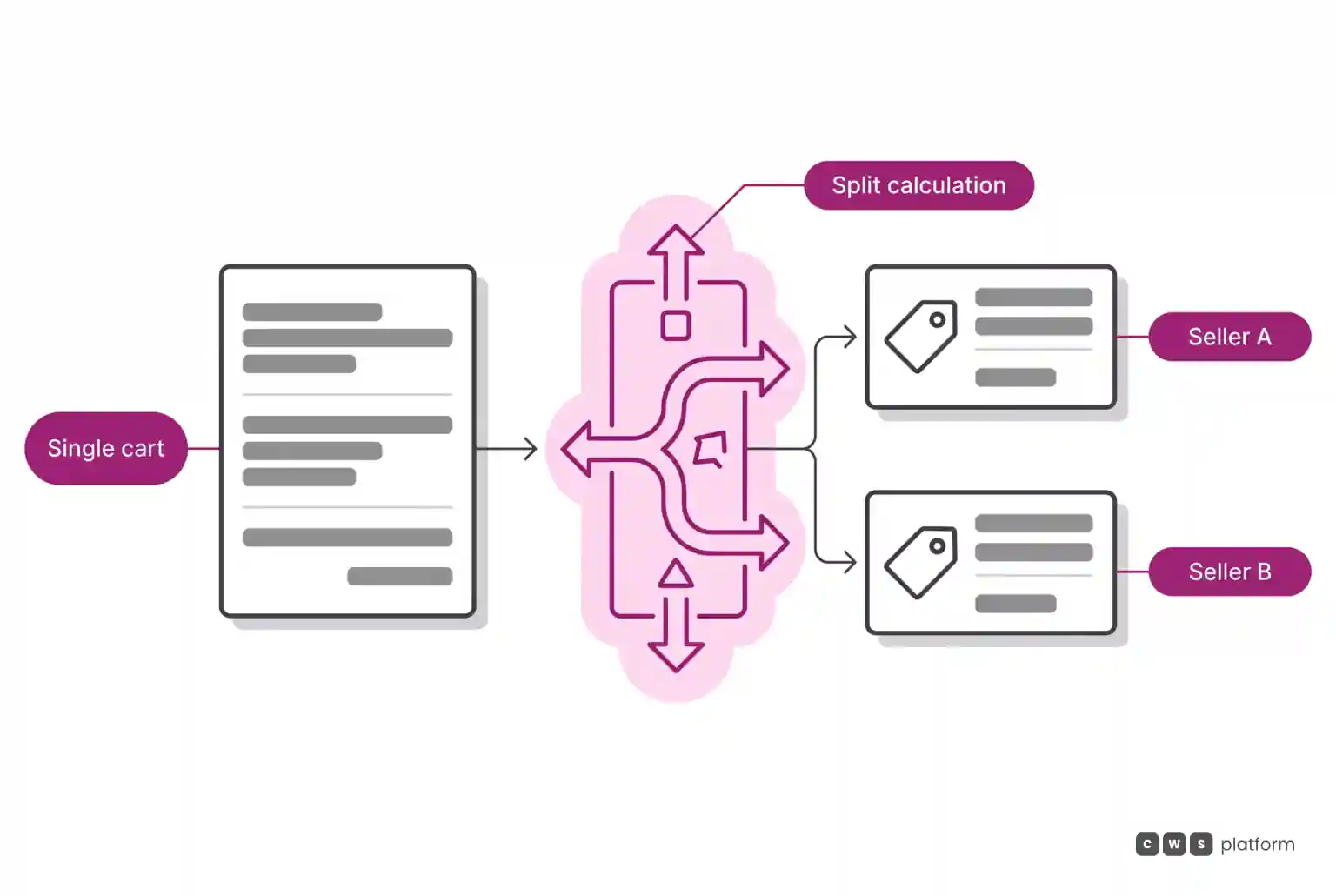
Two structural best practices help prevent operational breakdown. First, calculate the payout allocation at the exact moment of order placement rather than attempting to reconcile discrepancies post transaction. Second, treat each inventory node as an autonomous unit carrying its own catalog rules, tier pricing, shipping calculation, and maximum discount thresholds, within centralized platform guardrails. Without this operational framework, companies find that they gain transaction volume but lose margin along the way due to the hidden costs of manual overrides and spreadsheet reconciliation.
Commission rules and payout schedules typically originate inside enterprise resource planning systems. Therefore, the commercial channel requires an ERP integration that transmits strictly relevant order line items to each respective vendor.
How CWS Platform Handles Multi Seller Carts
Within CWS Platform, multiple vendors operate seamlessly in a unified cart, each maintaining independent freight terms, payment rules, and discounting structures. Multiple approval tiers can be managed in parallel. Funds are systematically split across vendors, applying commissions based on product origin. In addition, corporate buyers can allocate purchases across multiple branch locations under one transaction.
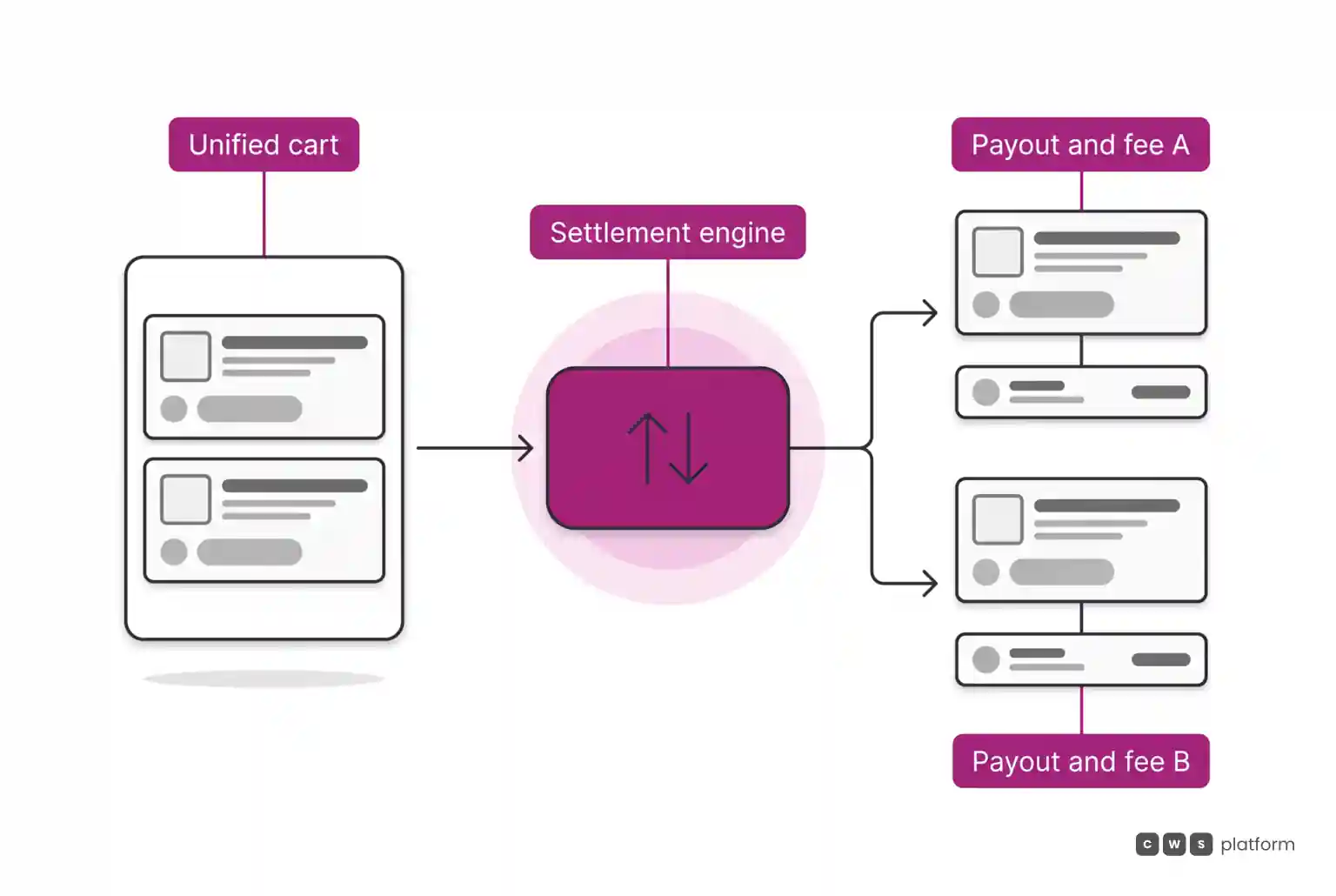
This capability is what modern B2B Marketplace architectures must deliver: buyers gain the simplicity of a single procurement interface while vendors retain their essential commercial autonomy. In many corporate operations, companies require an integrated digital sales ecosystem rather than an unregulated marketplace model.
The Cost of Inaction
Postponing proper settlement governance within your digital channel drives compounding losses:
- Finance team burnout: accounting departments waste valuable hours manually reconciling split invoices, partial purchase order cancellations, and multi-vendor chargebacks.
- Vendor churn: key distributors and manufacturers deprioritize the platform whenever they encounter payout delays or recurring commission and freight discrepancies.
- Cart abandonment: corporate procurement officers abandon transactions when digital checkouts fail to support vendor-specific payment terms and net billing requirements.
Core Principles for Multi Seller Settlement
- Calculate before settling: split allocations, marketplace platform fees, and contractual escrow reserves must be fully calculated at order confirmation.
- Vendor-level terms: freight costs, settlement methods, and promotional discounts belong to individual sellers, not the macro shopping cart.
- Origin-based commissions: platform take-rates must accurately mirror the fulfillment facility or vendor sourcing each specific product.
- External validation: tax structures, invoicing workflows, and escrow flows should be audited by certified tax professionals and commercial banking partners.
FAQ
How do B2B marketplace payments handle multiple sellers in a single checkout?
Each supplier keeps its own shipping tables, net terms, and discount matrices inside the shared procurement cart. During checkout, the aggregate total splits into dedicated sub orders, routing payout allocations and platform commissions according to item sourcing.
What distinguishes enterprise split payouts from retail payment splits?
Consumer retail splits simply divide an immediate payment captured via credit card or digital wallet. In B2B environments, orders balance varied corporate credit lines, net terms, and divergent freight tables, requiring line-item settlement governance.
What are origin-based commissions in B2B marketplace payments?
This refers to platform fee logic where commissions are calculated based on the specific vendor, facility, or warehouse fulfilling the inventory, rather than charging a flat commission across the entire order balance.
About This Publication
This article breaks down the operational, tax, and governance bottlenecks encountered in multi-vendor enterprise commerce. The analysis is based on transactional architecture frameworks and digital channel governance principles developed by CWS Platform. To learn more, visit cws-platform.com.
"responsive, technically engaged, and willing to work through complex commercial rules (negotiated pricing, credit, customer-specific conditions) rather than pushing generic answers"
Want to see this in your operation?
Real B2B operations already run on it.