Tiers, Price Books, and Resellers: Managing Complex B2B Pricing Without Spreadsheet Sprawl
Why cloning price sheets erodes distributor margins and how dynamic rules protect your bottom line

"We have dozens of price sheets and nobody can tell which one applies to whom." This sentence comes from anyone who inherited the commercial policy of a growing operation: one sheet per region, another for wholesale, another for enterprise accounts, one for every promotional push, plus quantity tier schedules. Each new sheet solved a problem for that specific month. Together, they became the problem.
B2B pricing is complex by nature. The mistake is trying to represent this complexity by multiplying static price sheets, rather than expressing it through rules.
Why price sheets multiply
Why is there a separate sheet for every scenario? Because the core system only knows how to apply a single price per sheet, and every channel, territory, or key account demands its own price point.
Why can you not simply adjust a single sheet? Because updating a single product line means pushing changes across every single clone, and one forgotten sheet always falls through the cracks.
Why do wholesale distributors and end customers clash so frequently? Because wholesale pricing depends on suggested retail pricing, distributor margin targets, and partner standing within the network, and no static sheet captures that dynamic relationship.
Why do volume tiers constantly trigger disputes? Because tier discounts were designed line by line, whereas actual purchase orders blend multiple SKUs, fulfillment centers, and payment terms.
The root cause: pricing policy was stored as static output (hardcoded numbers in spreadsheets), rather than the business logic that generates those numbers.
The price waterfall shows where margin disappears
The concept of a price waterfall, famously outlined by McKinsey, clarifies where value leaks out. Between the initial list price and what the company actually captures in cash, several layers take a cut: channel discounts, volume brackets, promotional programs, payment terms, freight allowances, rebates, and rep discretion. Each individual concession looks small. Combined, they dictate your net margin. According to the McKinsey Quarterly article "The power of pricing" (2003), a 1% improvement in price, assuming stable volume, yields an 8% increase in operating profit for the typical S&P 1500 company.
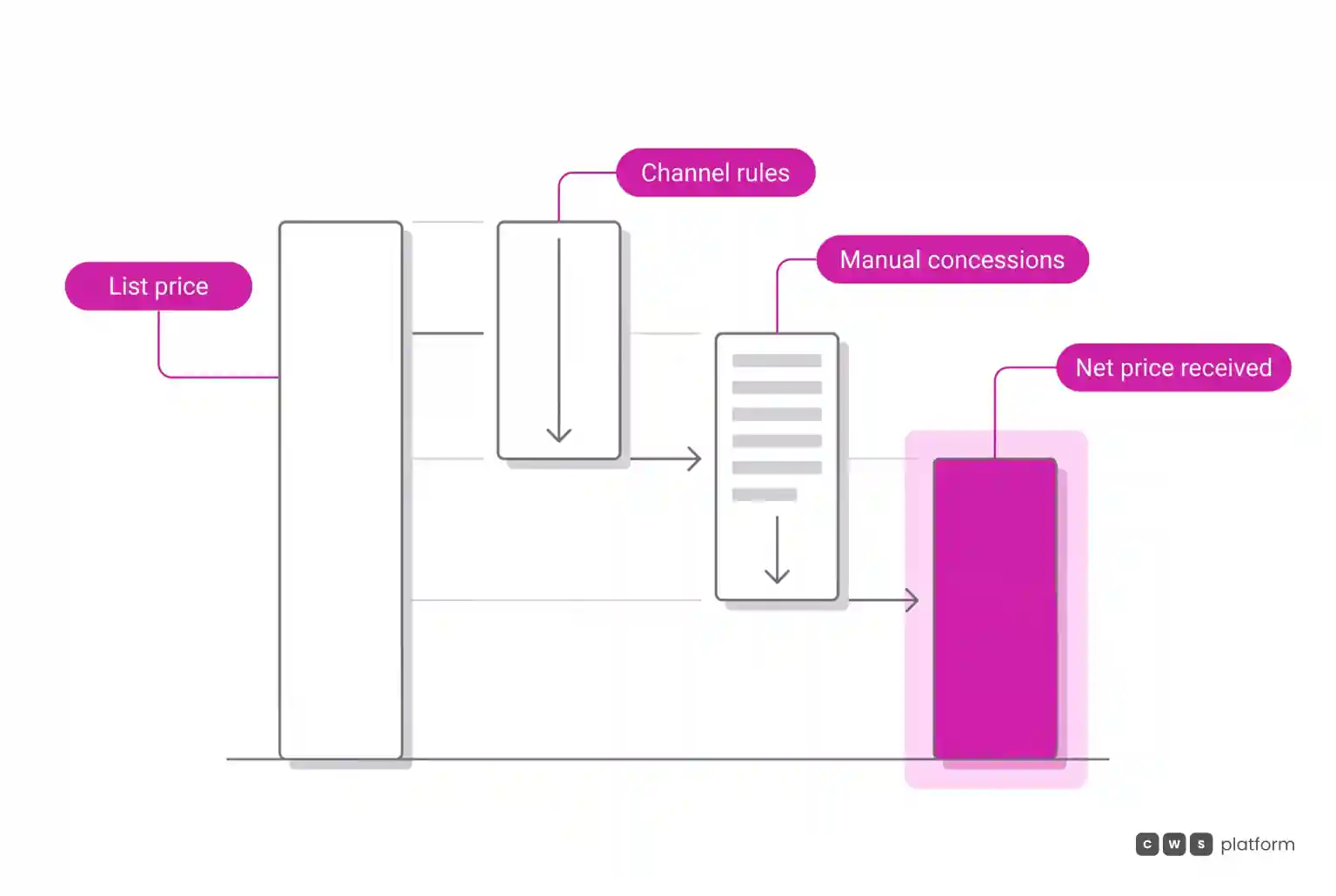
With dozens of disconnected sheets, no one can accurately map this price waterfall for an individual order. With rules, calculating it is an automated outcome.
How to manage complex pricing without multiplying sheets
1. One master base, multiple rules. Maintain a single reference point per SKU (either list price or standard cost) and define every adjustment as a rule layered on top of it: channel, geography, account tier, order volume. Updating the base propagates across the entire catalog instantly.
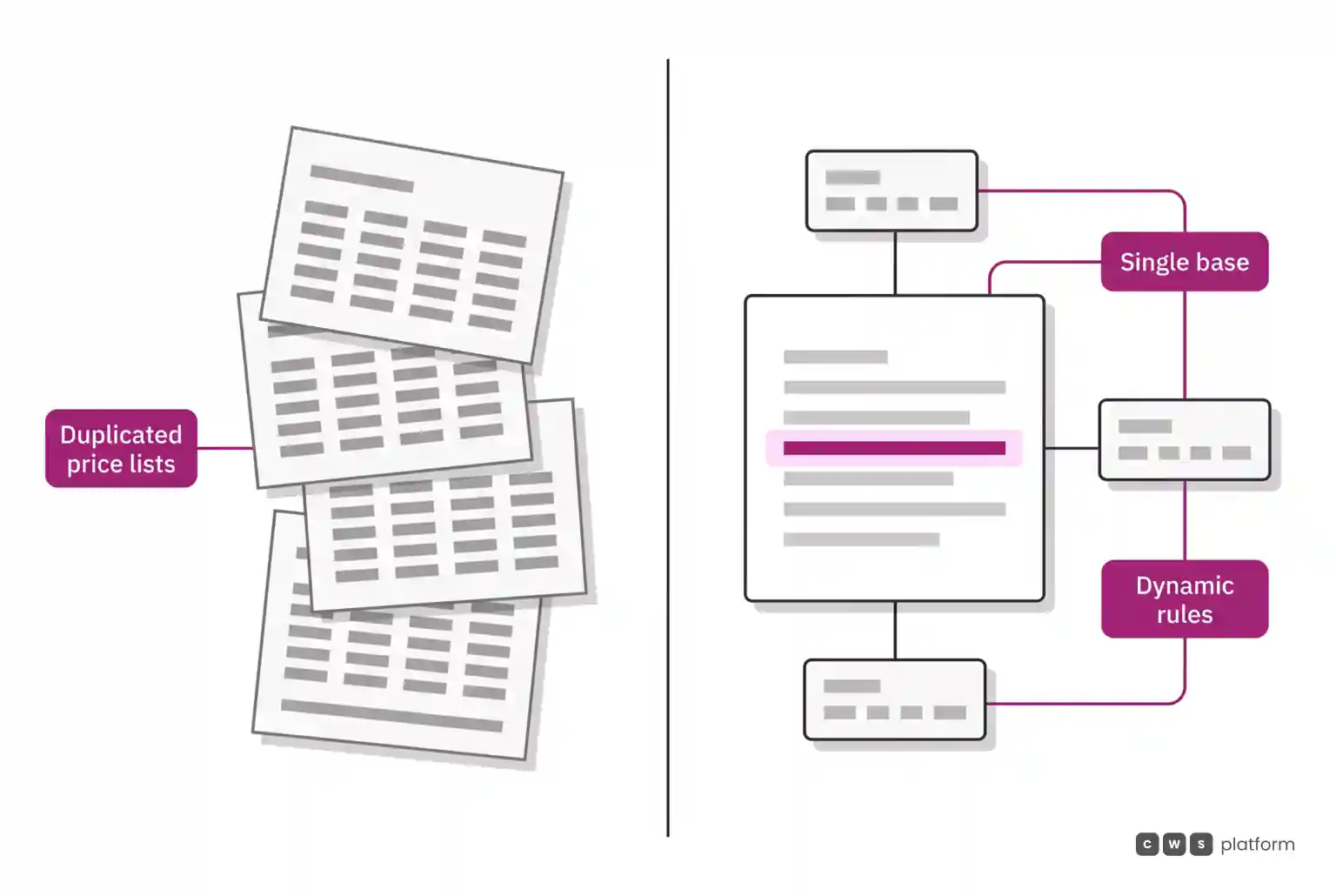
2. Segment by attributes, not by file clones. "Wholesale tier accounts in the Midwest receive X% off reference price on product line Y" is a single rule. The alternative is duplicating an entire catalog sheet.
3. Dynamic volume tiers calculated at checkout. Quantity tiering must evaluate the complete order as submitted, accounting for the entire basket mix and origin warehouse locations, rather than pricing an isolated line item in a silo.
4. Explicit relationships for partner pricing. Reseller pricing should derive directly from suggested retail price (MSRP) and the margin spread your partner network requires. When one shifts, the other adjusts automatically.
5. Clearly defined order of operations. Do promotional campaigns stack with customer group discounts? Does a sales rep concession override promo codes or blend with them? Logic must enforce this hierarchy, because discount stacking is precisely where profitability silently erodes. We explored this risk in growing top-line revenue is not growing margin.
How to assess if your pricing structure is healthy
Pick an active purchase order from a major reseller and ask someone on the team to explain, layer by layer, how the final price for each line item was calculated. If the explanation requires cross referencing multiple sheets, or if two team members arrive at conflicting totals, your structure is out of control.
On CWS Platform, pricing is calculated directly on the order based on customer classification, fulfillment center, and tax logic. Discretionary rep overrides bypass automated promotional codes rather than stacking on top of them, always logging a business justification. Tier structures and account groups are managed as dynamic rules, not duplicated sheets. You can review the architecture on our B2B pricing engine page.
Next step
Count how many price sheets are live today, and how many were spun up over the past twelve months. If the second figure outpaces the number of new sales channels you launched, your organization is absorbing in manual spreadsheets what ought to be handled by pricing logic.
Frequently asked questions
How do B2B platforms manage complex price tiering?
By maintaining a single source of truth per item and executing variations via rules: customer segment, sales channel, territory, and volume breaks. Each line price is calculated in real time against the actual cart mix and shipping node, rather than pulled from a static table.
How can businesses handle complex B2B pricing structures effectively?
By replacing cloned spreadsheets with business rules applied over a single catalog baseline, setting an explicit calculation sequence, and preventing promotional promos, group terms, and sales concessions from compounding unchecked.
What is the best way to handle reseller and distributor pricing?
By deriving dealer pricing directly from MSRP alongside the margin requirements your network demands through formulas. That way, any adjustment to suggested retail automatically recalculates wholesale cost without relying on side sheets.
What is a price waterfall?
It is the step by step drop from list price to realized revenue, capturing deductions such as trade terms, volume incentives, promotional allowances, credit terms, logistics concessions, and rep overrides. Tracking this margin flow at the order level is essential to safeguarding profitability.
Read also
- B2B pricing and margin
- Choosing software for wholesale distributors: five tests using real purchase orders
- Wholesale account retention: why customers stop reordering when sales depends on the rep
About this publication
A publication by CWS Platform.
"responsive, technically engaged, and willing to work through complex commercial rules (negotiated pricing, credit, customer-specific conditions) rather than pushing generic answers"
Want to see this in your operation?
Real B2B operations already run on it.