How to Choose Software for Wholesale Distribution: Five Tests With a Real Order
Generic vendor demos hide the gap between standard storefronts and real enterprise governance across terms, tax, and multi-warehouse routing.

"We sat through six product demos, and they all looked the same." That is what distribution leaders often say after weeks of vendor meetings for wholesale ecommerce software. Photo catalogs, digital carts, search bars, order portals, and an ERP integration diagram on a slide. The demo showcases a generic customer buying a single item at list price, which happens to be the exact order a distributor almost never processes.
The real order has eighty lines, negotiated contract pricing, net 60 terms, state and local sales tax calculated by fulfilling warehouse, and three line items out of stock at the closest distribution center. That is where platform decisions are actually won or lost, and standard product walkthroughs rarely go there on their own.
Why Software Demos All Look the Same
Why do platforms seem identical? Because vendors demo them using a generic buyer profile, one product, and default catalog pricing.
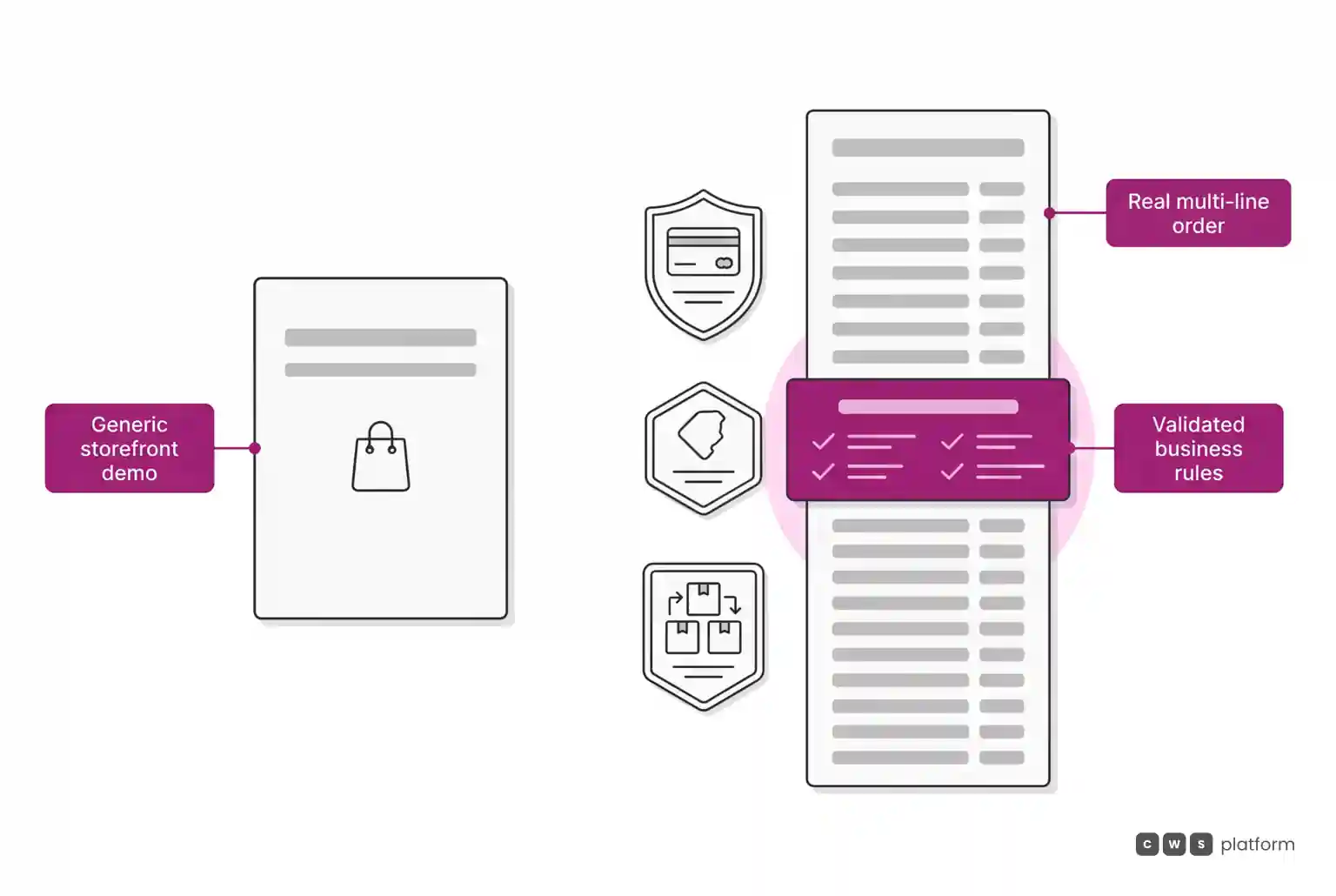
Why is the test environment so generic? Because the software evaluation team rarely brings proprietary business rules to the meeting, so the vendor shows pre-packaged templates.
Why stay silent on business logic? Because policies are scattered across the ERP, spreadsheets, and inside the sales team's heads, with nobody drafting them into actionable test scripts.
The core issue: evaluations compare feature checklists instead of analyzing system behavior against realistic wholesale ecommerce workflows. Buying from a feature list means buying a digital storefront, and the storefront skin is the least critical operational layer in distribution. We examine architectural models in seven questions that separate B2B commerce architectures. Here, the focus shifts to practical execution: turning a sales presentation into a live stress test.
The True Cost of Buying Off a Demo
The actual financial cost surfaces by year two. Commercial rules that do not fit into the core platform require custom code, custom code breeds backlogs, and the digital channel ends up serving only customers who buy at standard catalog pricing. Meanwhile, B2B buyers move on: according to the McKinsey 2024 B2B Pulse, corporate buyers use an average of ten interaction channels during their journey, and 61% prefer to transact without talking to a sales rep, based on Gartner 2025 research. A platform restricted to list prices pushes accounts right back to phone orders, or straight to competitors.
Five Practical Tests for Evaluating Distributor Platforms
Bring profiles of three actual accounts to the vendor evaluation (one enterprise key account, one mid-market buyer, one small business account) and insist on testing these workflows live.
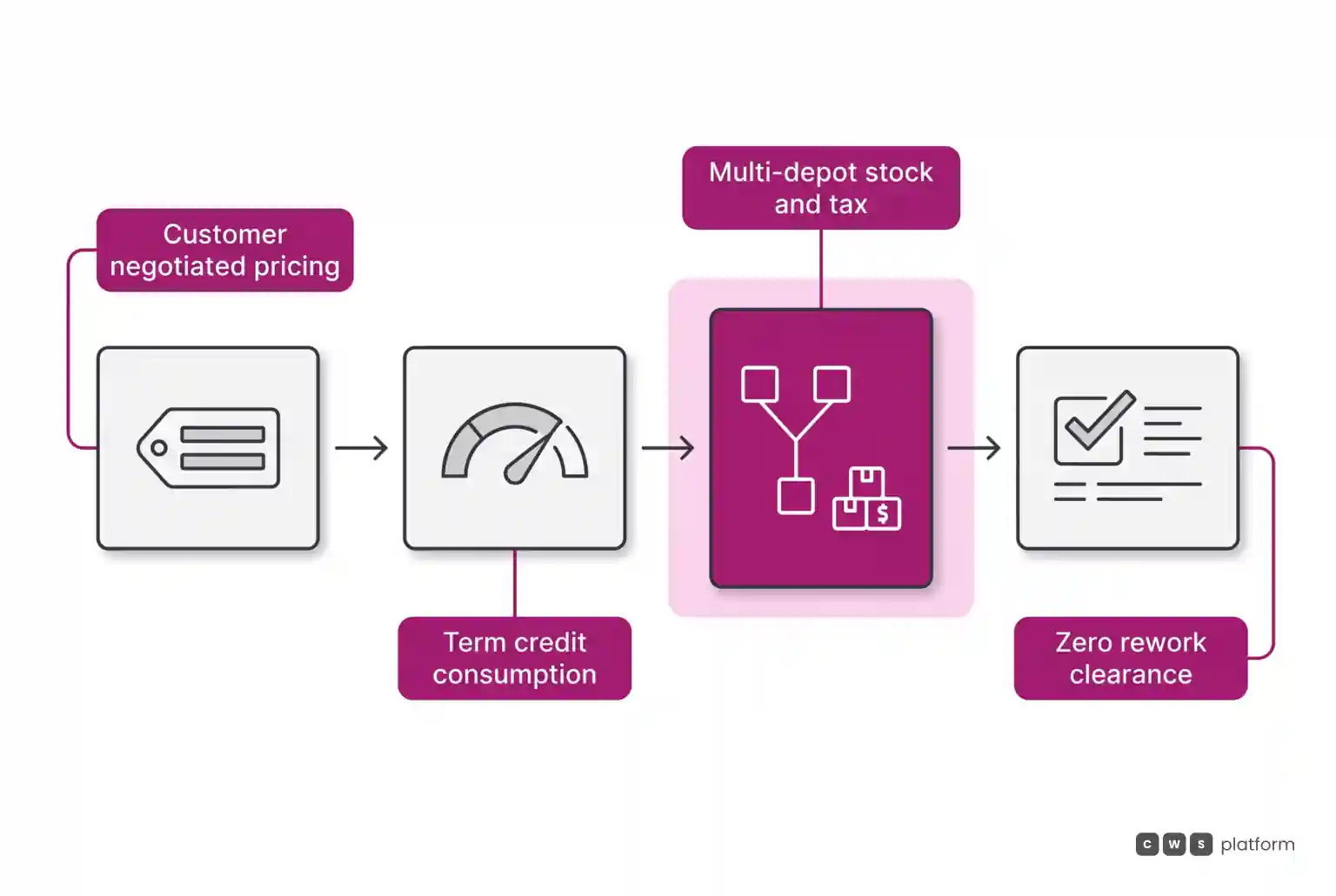
1. The account-specific pricing test. Log in as the mid-market account and build a purchase order. The system must display negotiated contract pricing, taking into account volume tiers, buyer geography, and regional fulfillment logic without manual interventions. If the vendor has to set up a manual exception table, the business logic is not native to the platform engine.
2. The trade credit limit test. Submit an order using net terms. The platform must check open credit limits and consume that balance at checkout, handling trade terms directly as a payment method. Placing an unverified order for manual accounting review later is a failed test.
3. The bulk order entry test. Build a massive multi-line order using buyer SKU codes or quick bulk CSV paste. Track how long the checkout engine takes to compute tax exemptions, delivery fees, and final order value. At auto parts distributor Imdepa, a single order easily exceeds 250 line items, calculating regional excise, sales taxes, line freight, and pre-approved commercial terms within seconds, as documented in the Imdepa case study.
4. The multi-warehouse fulfillment test. Select inventory stored across separate distribution facilities. The engine needs to surface available inventory from the exact warehouse routing to that customer, generate freight rates based on destination zone, weight, and order value, and compute destination sales tax based on the shipping node.
5. The real-time policy change test. Midway through the demo, ask for a policy adjustment: a new discount margin cap for a buyer category, or special payment term requirements for a territory. Watch who configures the update, how many minutes it takes, and whether it automatically applies to field sales reps. Any adjustment that turns into a development sprint reveals five years of technical debt ahead.
Key Factors Beyond the Core Tests
- Unified logic across self-service and assisted sales. The wholesale ecommerce engine must run web portal workflows and field sales rep tools off the identical commercial rulebook, or channels will clash.
- Preserve the core ERP system. Data exchange requires resilient bi-directional APIs and webhooks, without forcing distributors into costly ERP migration projects just to launch online channels.
- Configurable enterprise software over custom code. Every core policy that demands bespoke developer hours represents future delays and maintenance overhead.
CWS Platform was designed to pass every one of these distribution requirements: zero-code business parameterization, customer contract pricing and credit limits evaluated at the point of checkout, real-time inventory and sales tax computed before submission, and collaborative sales rep access inside customer carts. The practical guide on how to choose a B2B ecommerce platform and our dedicated page on B2B ecommerce for wholesale distributors detail these architectural capabilities.
Next Steps
Prepare a functional test script using data from your three buyer accounts, then distribute it to prospective software vendors before your next software demo. Vendors that refuse to run live scenarios against your actual operational data have already delivered their answer.
Frequently Asked Questions
How should distributors evaluate business management systems?
By running live workflows with real customer data: contracted custom pricing, automated trade credit checks at checkout, bulk line item performance, multi-warehouse routing rules, and live configuration updates. Generic feature matrices do not reveal actual system capabilities.
What is the most effective platform strategy for wholesale distributors?
The right wholesale ecommerce approach supports distribution-specific operating logic, such as multi-origin sales tax calculations, freight matrices, and automated net terms, without requiring custom code for every rule. The safest answer comes from seeing vendors execute these scenarios live.
What should wholesale operations compare across digital commerce software?
Evaluate account-level pricing accuracy, trade terms management at checkout, processing speed for massive line-item orders, multi-warehouse routing, two-way ERP integrations, and how easily staff can update commercial policies. Front-end visual themes matter far less than order logic.
How do you automate large wholesale orders with trade credit and inventory rules?
By running parallel validations on unit pricing, sales tax, customer credit balance, and stock levels at the designated fulfillment node before orders are confirmed, escalating only true edge cases to management. This core workflow is a non-negotiable benchmark for any prospective platform.
About This Publication
Operational performance benchmarks cited in this article are from Imdepa, a CWS Platform client, referenced with permission.
Brands mentioned in this article

- McKinsey & Company
- Gartner
Trademarks and logos belong to their respective owners. Mention does not imply partnership or endorsement.
"responsive, technically engaged, and willing to work through complex commercial rules (negotiated pricing, credit, customer-specific conditions) rather than pushing generic answers"
Want to see this in your operation?
Real B2B operations already run on it.