B2B Sales Process: Key Stages and the Role of Commercial Policy
Why enterprise sales pipelines stall during scale and how to protect gross margins with automated commercial guardrails.

A commercial process is the sequence of steps a company follows to turn initial buyer interest into an invoiced order and ongoing repeat purchases: from prospecting to proposal, negotiation to order entry, fulfillment to post-sale support. In B2B, this process is longer and subject to far more constraints than in retail, because every account has custom pricing, payment terms, credit limits, and delivery conditions.
A well-designed commercial sales process clearly defines what happens at each stage, who is responsible, and which rules apply. That is where commercial policy comes in.
The Stages of the B2B Commercial Process
1. Prospecting and qualification. Identifying accounts that match your ideal customer profile and determining whether need, budget, and timing align.
2. Onboarding and credit approval. Setting up the account, validating tax and corporate details, and defining credit limits along with payment terms.
3. Proposal or quote generation. Building the offer using customer-specific price tiers, taxes, freight terms, and lead times. We explore this stage in detail in what a quotation is and how to create a B2B quote.
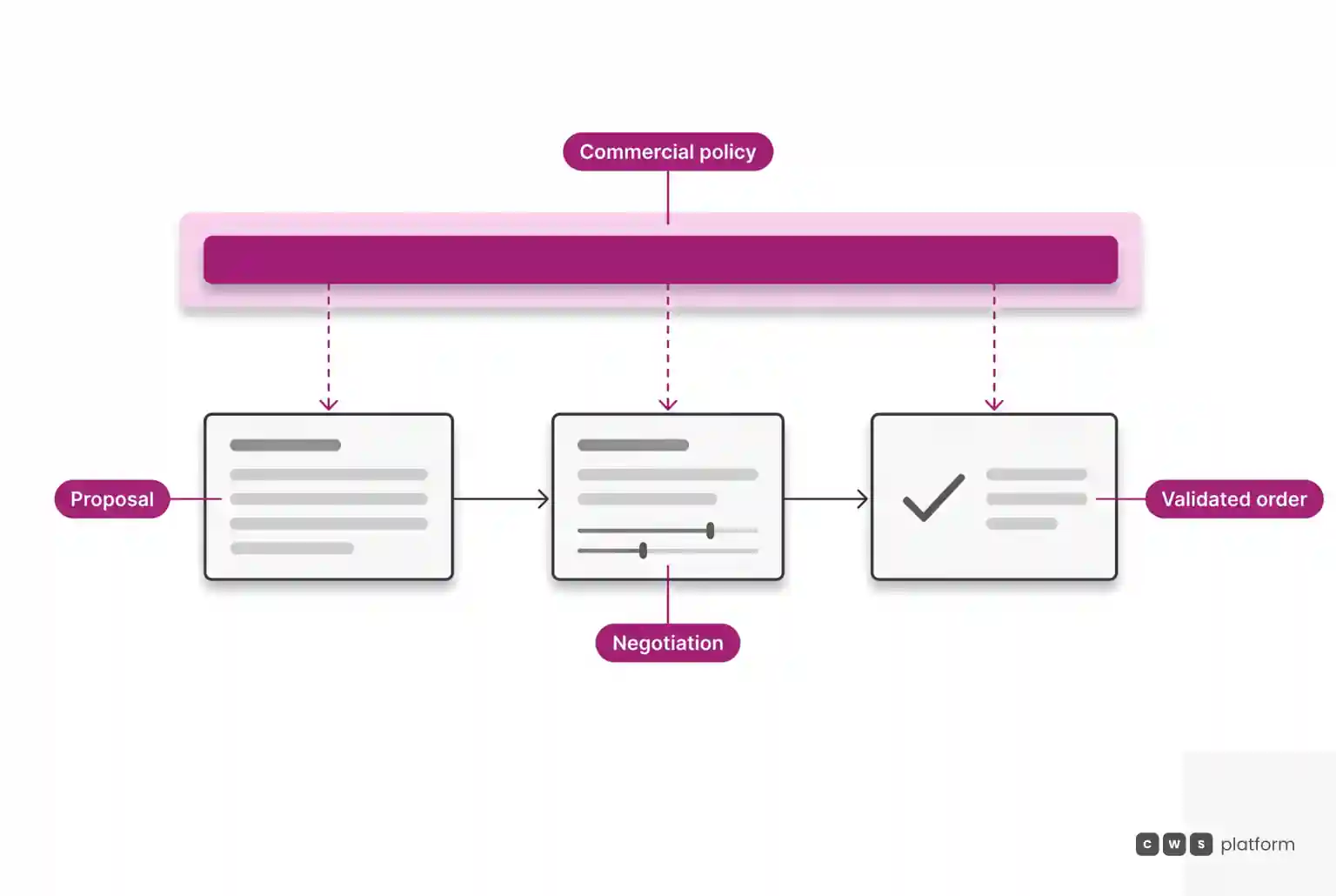
4. Negotiation. Adjusting pricing, discounts, payment terms, and minimum order quantities within pre-approved authorization limits.
5. Order entry. Booking the order with inventory availability, pricing, credit status, and taxes fully validated, ready for invoicing.
6. Fulfillment and billing. Picking, packing, generating invoices, shipping, and tracking the delivery.
7. Post-sale support and reorders. Providing account service, handling disputes, and driving reorders, ideally through self-service channels.
What Commercial Policy Is and Where It Fits
A commercial policy is the governance framework regulating every stage of the sales workflow: price lists by customer tier or segment, discount thresholds and approval levels, payment terms, credit lines, freight policies, and order minimums. The process defines the journey; the policy defines what is permitted at each step along the way.
Why the Commercial Process Breaks Down as Companies Scale
Why does the process work smoothly with only a few accounts? Because sales leadership personally knows every buyer and manages exceptions from memory.
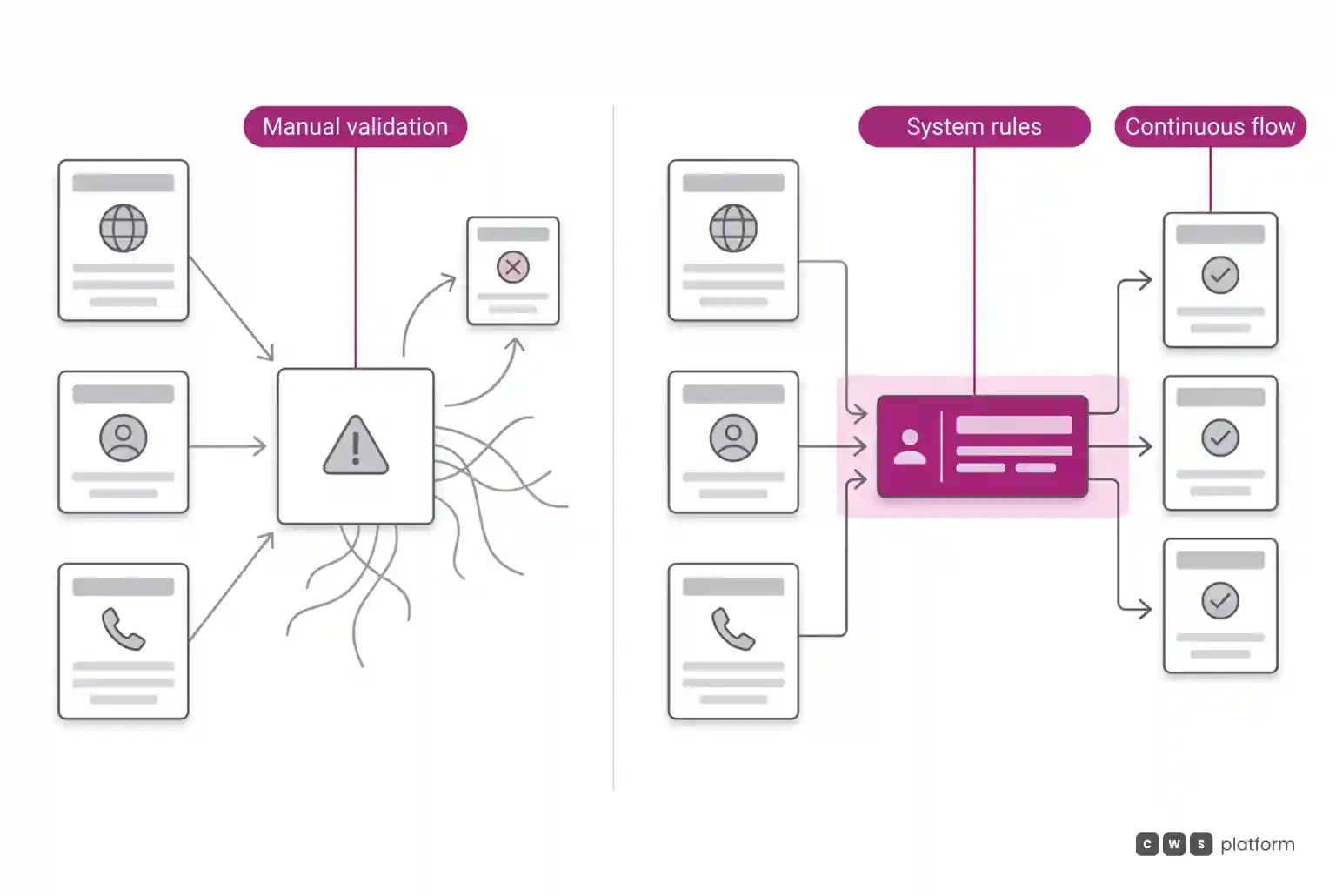
Why does it break down? Because as order volume scales, tribal knowledge and manual checks simply cannot keep up.
Why does a documented policy fail to solve this? Because policies stored in static manuals rely on sales reps to manually enforce them in the middle of closing a deal.
Why does every new channel make it worse? Because buyer portals, independent sales reps, inside sales teams, and autonomous AI agents become additional endpoints where someone or something must remember the rule.
The root cause: the process was designed in operational stages, but the business rules for each stage remained trapped in people's heads.
How to Improve Your Commercial Sales Process
1. Map where every order originates. Phone, email, messaging apps, field sales reps, buyer portals. The most manual entry points are almost always the most expensive.
2. Encode your policy as automated rules. Pricing tables, volume tiers, terms, credit lines, and shipping terms must be configured directly inside your systems and enforced across every channel. We break this down in how to transform commercial policy into automated business rules.
3. Separate routine reorders from complex negotiations. Routine replenishment should flow autonomously through a customer self-service portal. Reps should focus exclusively on high-value negotiations within strictly enforced approval thresholds.
4. Validate every order before confirmation. Checking real-time inventory, pricing accuracy, available credit, and tax calculations at checkout eliminates orders bouncing back from billing.
5. Measure each phase. Track quote turnaround times, win rates, average realized discounts, order rework rates, and the share of unassisted repeat orders.
Key Commercial Process Metrics
- Quote-to-order conversion rate.
- Quote turnaround time.
- Average discount rate by sales rep and account.
- Reworked orders caused by pricing, credit, or customer master data errors.
- Share of reorders placed directly through self-service channels.
On CWS Platform, commercial policy rules (contract pricing, discount thresholds, approval matrices, credit controls, freight calculations, and payment terms) are configured without custom code. They apply uniformly across the buyer portal, the sales representative workspace, and AI agents. See how this works on our configurable business rules page.
Next Steps
Map the seven stages outlined above across your operation. For each stage, evaluate whether the rule is automated in software or trapped in an employee's head. Every stage labeled "head" represents where your commercial operations will bottleneck during your next growth phase.
Frequently Asked Questions
What is a commercial process?
It is the end-to-end sequence of stages that moves an account from initial interest to an invoiced order and recurring replenishment: prospecting, onboarding, quoting, negotiation, order booking, fulfillment, and ongoing customer retention.
What is a commercial policy?
It is the set of governing rules that regulates the commercial process: account-specific price books, discount tiers, management approval thresholds, payment terms, credit ceilings, shipping rules, and order minimums.
What is the difference between a commercial process and a commercial policy?
The process defines the operational workflow, its stages, and task ownership. The policy defines what actions, terms, and limits are permitted within each stage, such as maximum rep discount levels or credit limits per customer segment.
Which KPIs should you track in a B2B commercial process?
Quote-to-order conversion rate, quote turnaround time, average discount percentage by rep and account tier, orders rejected or reworked due to clerical errors, and the percentage of repeat purchases executed via customer self-service.
Read Also
- Commercial governance and executable policy
- When an AI Agent Makes a Mistake, the Error Does Not Stay Isolated: It Replicates Across Every Order
About This Publication
A publication by CWS Platform.
"responsive, technically engaged, and willing to work through complex commercial rules (negotiated pricing, credit, customer-specific conditions) rather than pushing generic answers"
Want to see this in your operation?
Real B2B operations already run on it.