What Is a B2B Quote and How to Run Profitable Quote Management
Stop margin leakage when responding to wholesale RFQs with strict pricing rules, approval tiers, and direct order conversion.

A quote is a request for pricing and terms that a company submits to one or more suppliers before purchasing. The buyer specifies what they need, the required quantities, and the delivery timeline. The supplier responds with unit pricing, payment terms, delivery schedules, and freight costs. In B2B, quotes serve as the entry point for almost every new sale and a significant portion of high volume reorders.
For buyers, it is a tool for vendor comparison. For sellers, it is the exact moment where profit margin is decided.
How B2B Quotations Work
1. The buyer identifies the need. Items, quantities, exact specifications, target delivery dates, and sometimes requested payment terms.
2. The request goes to suppliers. Sent via email, spreadsheet, procurement portal, or messaging channels. Larger companies routinely request bids from three or more suppliers as a matter of internal compliance policy.
3. The supplier responds. Providing line item pricing, payment terms, shipping costs, lead times, and quote expiration dates.
4. The buyer compares and negotiates. Price is not the only variable. Lead times, freight terms, product availability, and vendor reliability all factor into the final award.
5. The quote becomes an order. Once the proposal is accepted, a purchase order is generated under the agreed quote terms.
How Buyers Should Request a Quote
- Provide exact specifications. Manufacturer part numbers, dimensions, and use cases. Vague RFQs produce proposals that cannot be compared accurately.
- Request identical commercial terms from everyone. Align payment terms, shipping destinations, and volume tiers across all bidders.
- Evaluate total landed cost. Combine unit price, shipping, local sales tax, and payment terms. The lowest catalog price does not always yield the lowest total cost.
- Track quote expiration. Offers without explicit validity windows lead to commercial disputes when purchase orders are placed.
How Suppliers Should Respond to a Quote
This is where risk enters the process. Sales reps frequently respond under intense time pressure, manually checking price lists and estimating discounts on the fly. This workflow is where profit margins slip away, as we explored in quotes as a contract of commercial rules. Effective quote management requires disciplined execution across five core areas:
Price to customer specific terms. The opening rate must reflect that specific account contract pricing rather than generic list pricing.
Calculate the complete order economics. Destination sales tax, warehouse fulfillment locations, and payment terms fundamentally alter net margin. The math must be finalized before the proposal leaves the building.
Enforce discount approval limits. Any price reduction exceeding a sales rep authorization tier must route to management, complete with documented justification.
Convert quotes without manual rekeying. An accepted proposal should convert directly into an active order under identical terms without requiring operational staff to enter data twice.
Track quote conversion metrics. Monitor how many quotes turn into orders, alongside the average discount granted. This metric provides direct insight into commercial policy health.
Quote Systems: Spreadsheets, ERPs, or Dedicated Platforms
Spreadsheets and email are common early on, but they lack audit trails, fail to enforce commercial rules, and cannot convert into orders automatically.
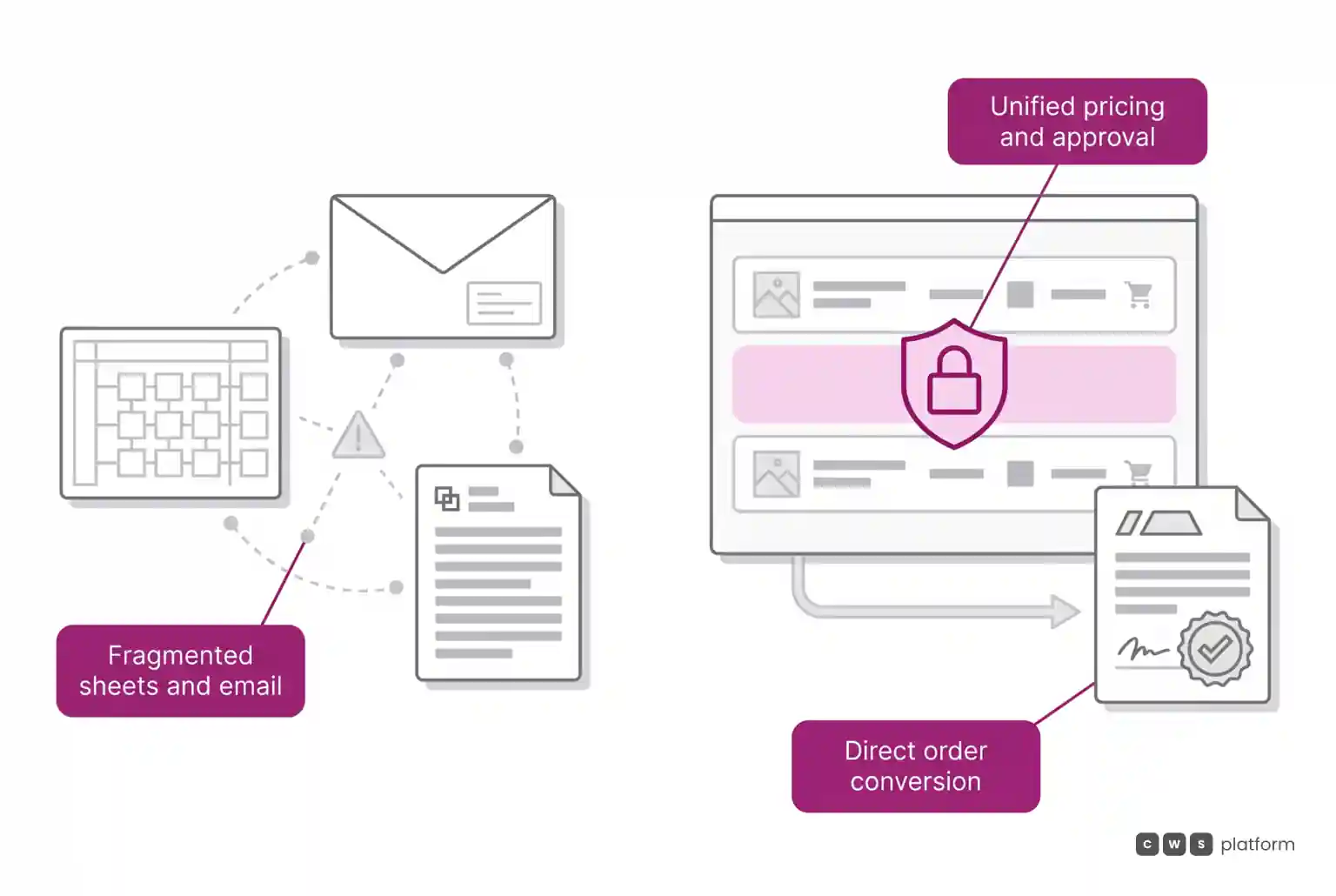
ERP systems capture the final proposal, but their interfaces are built for back office processing, leaving active sales negotiations scattered across outside channels.
A dedicated B2B platform automates quote management by pricing proposals against customer terms, enforcing discount guardrails, and turning approved quotes directly into orders. Buyers can even build their own quote requests in a self service portal while sales reps collaborate within that exact cart.
On CWS Platform, sales reps and buyers negotiate within a single shared cart that stays synchronized for both parties. Pricing calculates customer specific tiers, applicable taxes, and logistics costs in real time. Discounts above assigned rep thresholds trigger approval workflows before release, and accepted negotiations convert to orders without manual data entry. You can view the full architecture on our assisted sales page.
Next Steps
Review your last twenty closed quotes and compare their average discount against the standard margin on your non quoted orders. If the discrepancy is substantial, unstructured quote management is likely serving as a direct leak in your commercial profitability.
Frequently Asked Questions
What is a quote?
A quote is an official proposal of prices and terms provided by a supplier to an enterprise buyer prior to purchase. It details unit costs, payment terms, fulfillment timelines, freight costs, and offer validity.
How do you request a quote?
Specify items using manufacturer part numbers and exact quantities, request identical terms from all candidate vendors, calculate total landed cost including tax and freight, and confirm proposal expiration dates.
What does B2B price quoting involve?
It is the commercial stage where a corporate procurement team requests formal bids from vendors before issuing a purchase order. For sellers, this is the operational point where price, discounts, and margins are locked in.
What is quote management software?
It is software that standardizes pricing workflows: it applies account specific pricing rules, enforces discount approval tiers, maintains negotiation audit trails, and converts accepted proposals directly into orders without manual reentry.
Read More
About This Publication
Published by CWS Platform.
"responsive, technically engaged, and willing to work through complex commercial rules (negotiated pricing, credit, customer-specific conditions) rather than pushing generic answers"
Want to see this in your operation?
Real B2B operations already run on it.