B2B vs B2C: Structural Differences That Reshape Selling
Why applying retail mechanics to complex corporate procurement erodes operating margins and overwhelms sales reps.

B2B (business to business) refers to sales made from one company to another. B2C (business to consumer) refers to sales made from a company directly to the end consumer. In B2B, the buyer is a business with formal procurement processes, credit terms, and negotiated pricing. In B2C, the buyer is an individual, usually purchasing for personal use and paying the storefront price upfront.
The difference might seem to be just about the audience. In practice, it completely transforms pricing, payments, order structures, and the role of the sales rep.
B2B and B2C Side by Side
| B2C | B2B | |
|---|---|---|
| Who buys | End consumer | Business, through a corporate buyer |
| Price | The same for everyone | Depends on customer, volume, region, and contract |
| Payment | Immediate: credit card, debit, digital wallet | Net payment terms, against a credit limit |
| Order | A few items | Dozens or hundreds of line items, sometimes from multiple warehouses |
| Decision | Individual, often fast | Formal process with approvals and approved vendors |
| Relationship | Often one-off | Recurring, with frequent reorders |
| Sales rep | Rarely involved | Actively involved in negotiation and relationship management |
| Taxes | Included in listed price or added standard at checkout | Calculated based on nexus, destination, tax exemptions, and resale certificates |
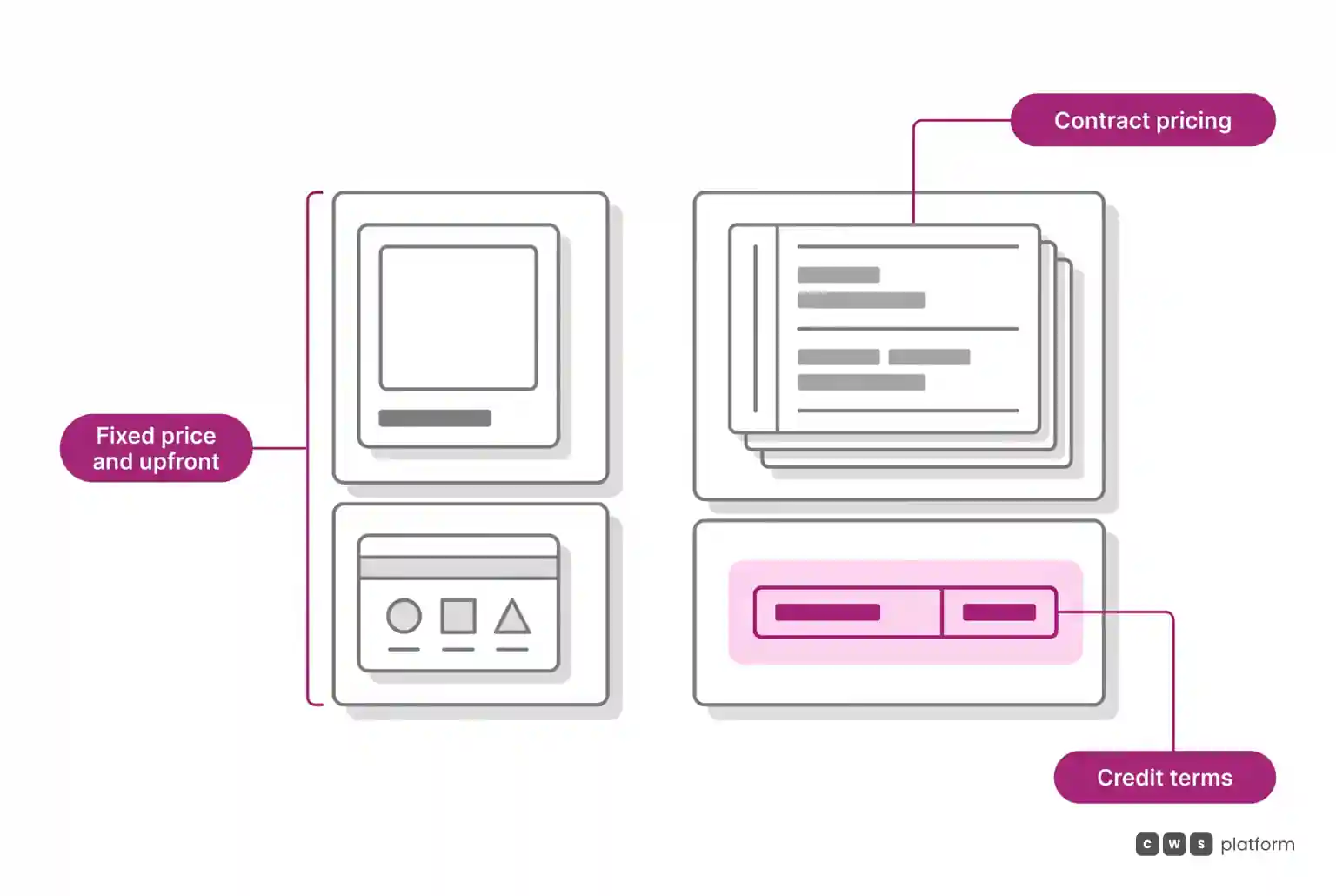
The Differences That Matter Most
Pricing is not one-size-fits-all. In B2C, the storefront displays the exact same price to everyone. In B2B, every account has its own pricing structure: customer group tiers, volume breaks, and contracted agreements. Displaying the right price for each buyer is the primary requirement for any B2B sales channel.
Credit is a primary payment method. Corporate buyers rarely pay upfront with a credit card. They purchase on net terms (such as Net 30 or Net 60), meaning the seller must verify available credit limits before approving and routing the order.
The order is a list, not a single item. B2B buyers log in looking to complete routine replenishment. They need SKU searches, bulk order uploads, and quick reorder workflows, not an editorial retail storefront designed for casual browsing.
Negotiation still takes place. High-volume orders involve custom pricing, terms, and special freight agreements, with approval workflows routing decisions through management. In B2C, price negotiation almost never occurs.
Taxes require complex logic. Across different jurisdictions, state sales tax, destination nexus, and tax-exempt resale certificates dynamically alter the final balance, and these rules must be validated accurately before checkout.
What B2B and B2C Have in Common
A B2B buyer is the same individual who shops online at home, and they bring the exact same expectations to their workday: find the item quickly, see accurate pricing, and check out without delays. According to the Gartner sales survey published in 2025, 61% of B2B buyers prefer a rep-free buying experience. The interface needs to be as intuitive as consumer ecommerce, while the backend supports complex enterprise rules.
Companies Selling to Both Audiences
Many organizations serve both businesses and retail consumers simultaneously: distributors selling wholesale to dealers alongside retail sales, or multi-location retailers operating commercial counters alongside retail floors. The common mistake is launching two separate ecommerce websites, which duplicates product catalogs, inventory management, and customer databases. The modern alternative is a unified commerce portal where catalogs, pricing, and terms adapt instantly upon customer authentication.
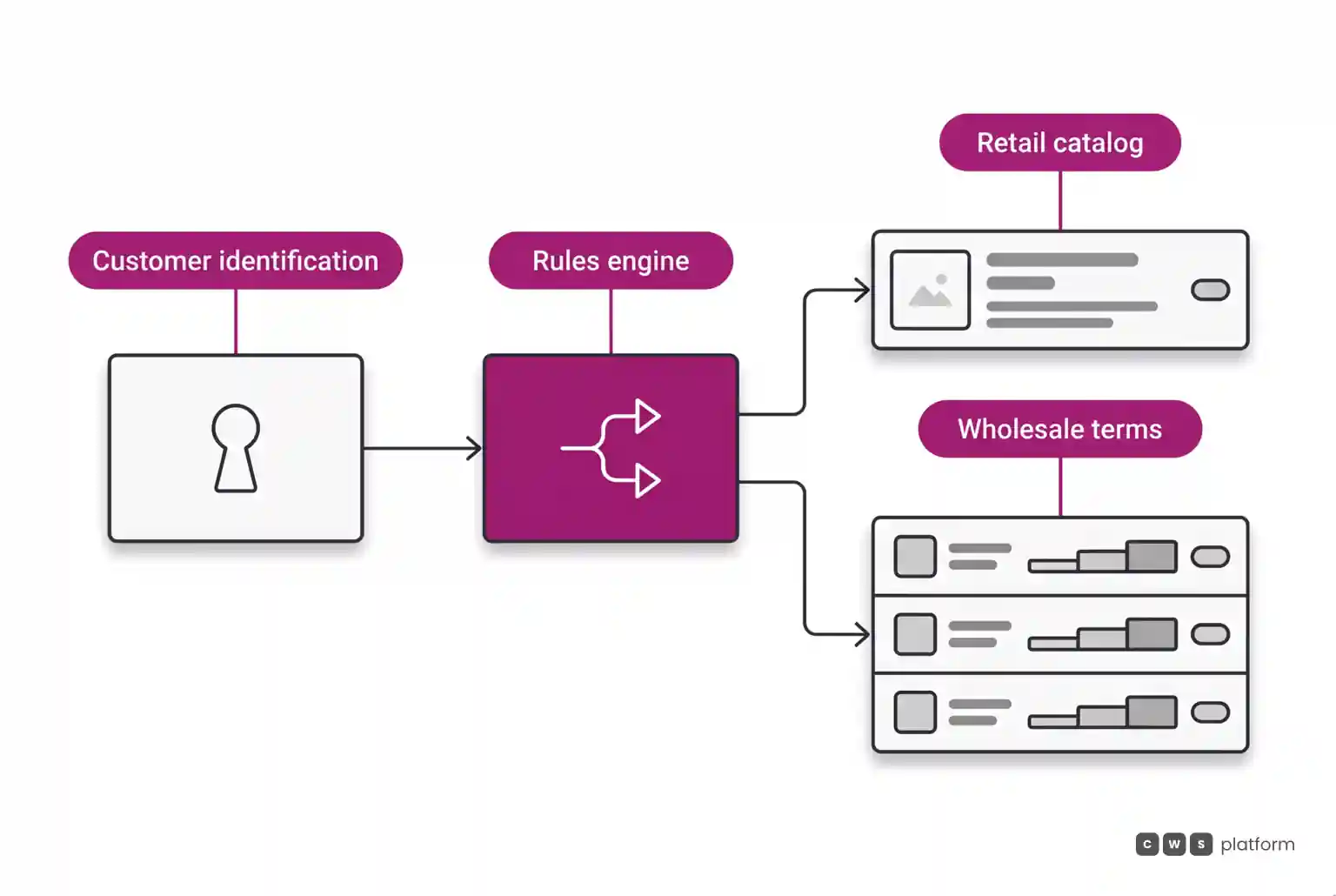
On CWS Platform, retail consumers and commercial accounts buy through the exact same portal: upon login, the customer account automatically loads assigned pricing tiers, payment terms, and credit availability. Resellers see wholesale pricing, while anonymous or retail visitors see consumer pricing. Campneus, a network of more than 117 tire and auto care centers, powers both commercial channels and retail consumer sales using this shared infrastructure. Learn more about the architecture on our B2B ordering portal page.
Next Steps
If your business sells to both enterprise accounts and end consumers, map out the distinctions between the two: pricing structures, payment terms, shipping arrangements, and tax exemptions. Every item on that checklist represents a business rule your digital channel must automate natively.
Frequently Asked Questions
What is B2B and B2C?
B2B (business to business) refers to commerce between commercial entities, whereas B2C (business to consumer) refers to sales made directly to individual end users. B2B involves negotiated pricing tiers, net payment terms, and higher order volumes; B2C features uniform public pricing and immediate checkout settlement.
What is the main difference between B2B and B2C?
In B2B, purchasing is executed by corporate buyers working under negotiated contracts, credit approvals, and defined procurement processes, supporting recurring trade. In B2C, consumers purchase for personal use at public retail prices, often as transactional one-off purchases.
Can a company operate as both B2B and B2C?
Yes. Wholesale distributors and specialty retail networks often supply commercial accounts while also serving retail shoppers. The most efficient model uses a single unified portal that dynamically reveals customer-specific pricing, payment options, and credit terms based on user login.
What is B2B2C?
B2B2C (business to business to consumer) is a distribution model where a business sells products or services through another enterprise, which in turn delivers them to the final consumer, creating a connected digital workflow between all three parties (such as a manufacturer supplying authorized dealers while tracking end-consumer demand).
Read Also
- ERP sales module or a dedicated B2B platform?
- How to automate your commercial policy with software rules
- B2B Fundamentals (definitions)
About This Publication
A publication by CWS Platform.
Brands mentioned in this article

- Gartner
Trademarks and logos belong to their respective owners. Mention does not imply partnership or endorsement.
"responsive, technically engaged, and willing to work through complex commercial rules (negotiated pricing, credit, customer-specific conditions) rather than pushing generic answers"
Want to see this in your operation?
Real B2B operations already run on it.