Beyond the Shopping Cart: How a B2B Ordering System Handles Complex Orders
Why wholesale buyers still send spreadsheets via email and what modern commerce portals need to automate high-ticket sales.

"The portal works great for small orders. For large orders, the customer still emails us a spreadsheet." This phrase echoes across almost every company that has launched a B2B ordering portal. Self-service resolved the three-item replenishment order, yet completely bypassed the exact orders that cost the most to process: orders with hundreds of line items, orders splitting inventory across multiple distribution centers, or lists sent via spreadsheet or messaging apps.
The result is a digital channel that captures easy, low-hanging volume while handing the hard, manual work right back to your internal sales support team.
Why Complex Orders Escape Self-Service
Why do customers send spreadsheets? Because manually keying eighty line items one by one into an e-commerce interface takes far longer than emailing an attachment to an inside sales rep.
Why does the interface reject the list? Because the shopping cart was built for consumers buying one product at a time by browsing categories.
Why can a sales rep handle it when the software cannot? Because the rep knows how to split the order across regional warehouses, verify inventory balances at each site, apply volume pricing tiers, and ensure the order clears the customer credit limit. The standard e-commerce screen only knows how to display catalog items.
Why does this matter? Because complex orders represent your highest-grossing revenue. They are the exact orders buyers want to resolve fastest, and they are the exact orders standard digital storefronts fail to support.
The root cause: the ordering system was designed around simple transactions, treating complex orders as edge cases. In practice, these edge cases account for the bulk of commercial revenue.
Buyers already expect to handle these transactions on their own. According to McKinsey's 2024 B2B Pulse, 69% of digitally advanced buyers are willing to close remote purchases worth $500,000 or more. The bottleneck is not buyer willingness. The bottleneck is the order complexity your platform can tolerate.
What a Complex Order Demands from the System
Bulk entry via customer part numbers. Pasting a raw list or uploading a CSV, using the manufacturer part number or the buyer internal SKU, and generating cart line items in seconds. This capability eliminates email attachments entirely.
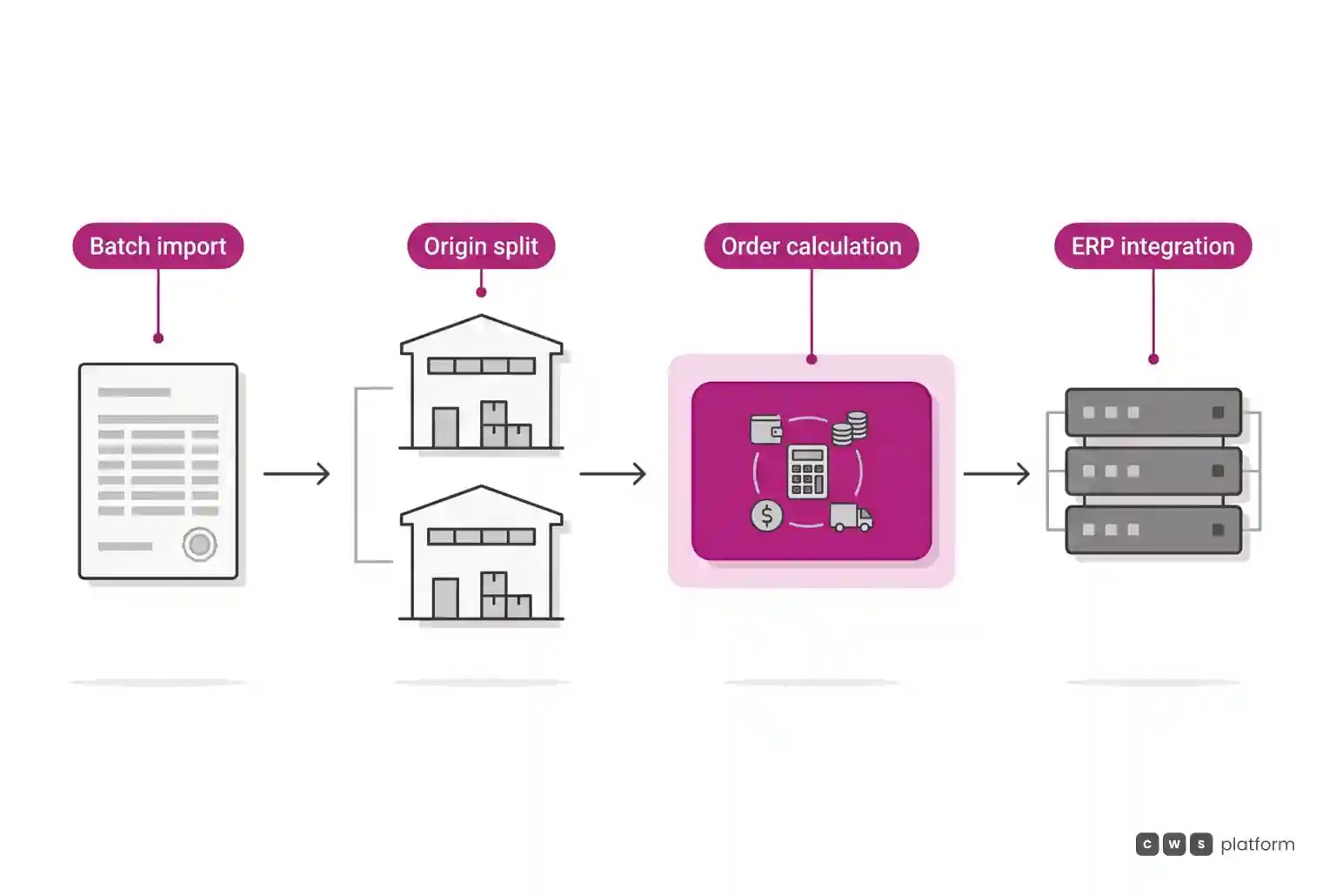
Order-level calculation, not line-by-line totals. Volume pricing, state and local sales tax based on origin and nexus, freight rules, and available credit calculated simultaneously across the complete purchase. At auto parts distributor Imdepa, a single cart handles more than 250 SKUs with sales taxes, location-specific surcharges, freight, and pre-approved commercial credit evaluated in seconds, as detailed in the Imdepa case study.
Visible warehouse splitting. When an order requires inventory from multiple regional fulfillment centers, the buyer needs full visibility before checkout, including separate freight costs for each shipment. Multi-warehouse sourcing stops being an unexpected surprise on the final invoice.
Net terms within approved credit limits. Large enterprise purchases are rarely paid via corporate credit card. Pre-approved payment terms (such as Net 30 or Net 60) must function as the payment method, and available credit balances must be checked at checkout, preventing orders from stalling in manual finance reviews after placement.
Sales rep collaboration inside the same cart. When a large order requires custom pricing, the sales rep accesses the exact cart the buyer assembled, applying authorized discounts directly rather than rekeying the entire order into internal software. We explore this dynamic in the sales rep who builds hundred-item orders by hand.
Seamless bi-directional ERP integration. Fully verified orders flow into the ERP automatically. At heavy equipment distribution network Tracbel, operating across 40 locations, integration with SAP is bi-directional and real-time, as shown in the Tracbel case study.
The Cost of Inaction
Every complex order submitted through a spreadsheet drains labor hours from data entry teams, ties up review cycles, and introduces error risks on every single line item. A simple operational calculation reveals the drag: monthly spreadsheet or email orders multiplied by the minutes required to transcribe and verify them, multiplied by internal labor rates, plus the administrative expense of correcting fulfillment errors. This operational cost scales up as enterprise accounts grow, which is the exact inverse of operational efficiency.
Core Principles for Moving Complex Orders Out of the Inbox
- Architect for the largest order, not the smallest. If your system handles a 300-line order, it handles a 3-line order effortlessly.
- Calculate across the order, not the SKU. Tiered pricing, sales tax, freight brackets, and credit lines depend on the aggregate purchase.
- Route exceptions to decision-makers with context. A single non-standard line item should never halt the remaining order.
- Maintain a single record for buyer and seller. The digital cart configured by the procurement officer must be the exact workspace reviewed by the sales representative.
CWS Platform was designed specifically for wholesale B2B ordering reality: bulk addition via technical part numbers, real-time inventory, custom contract pricing, credit terms, and multi-jurisdiction tax calculated together across the full order, with direct sales rep co-browsing. Review the architecture on the B2B ordering portal page.
Next Step
Isolate all orders received via spreadsheet, email, or messaging apps last month from accounts with portal logins, and calculate their dollar share against your total revenue. That percentage represents the digital revenue capture your current portal fails to reach.
Frequently Asked Questions
Can B2B self-service portals handle complex purchase orders?
Yes, provided the underlying order management system was built for them: quick order bulk entry using buyer SKUs, real-time evaluation of volume pricing, sales tax, shipping rates, and credit limits across the full order, clear warehouse split visibility, and collaborative cart access for sales teams during price negotiations.
How does a B2B portal automate orders that do not arrive via EDI?
By accepting the data format the buyer already maintains, whether pasted plain text or uploaded spreadsheets, and converting those rows into an active cart applying contract terms. Orders that previously required manual data entry from emails are finalized by the buyer, validated automatically, and pushed straight to the ERP.
How are payments handled for large B2B transactions?
Typically through trade credit terms, such as Net 30 or Net 60, constrained by an approved credit line. The portal evaluates available credit limits at checkout, applying terms as an automated payment option so orders do not get placed only to be flagged and delayed by internal finance teams.
What is a B2B ordering portal?
It is a private digital commerce environment where corporate accounts place self-service orders under negotiated contract terms, covering everything from simple replenishment to massive multi-line purchases, with pricing, tax rules, freight, and trade credit verified before order submission and integrated directly into the ERP.
Read More
- B2B ordering portal and self-service
- Is your B2B portal accepting orders that can never be fulfilled?
- Which architecture maintains branch inventory and contract pricing in B2B self-service?
About This Publication
Operational performance metrics cited in this article are from Imdepa and Tracbel, clients of CWS Platform, shared with permission.
Brands mentioned in this article



- McKinsey & Company
Trademarks and logos belong to their respective owners. Mention does not imply partnership or endorsement.
"responsive, technically engaged, and willing to work through complex commercial rules (negotiated pricing, credit, customer-specific conditions) rather than pushing generic answers"
Want to see this in your operation?
Real B2B operations already run on it.