Optimizely Configured Commerce or CWS Platform: Can You Change Commercial Rules Without a Ticket?
An architecture comparison through the revenue lens: price breaks, sales rep quotes, and promotions.

Editorial note: an architecture comparison between Optimizely Configured Commerce and CWS Platform, written for those who answer as VP of Sales or head of commerce. Every fact about Optimizely Configured Commerce comes from its public documentation, with the address next to it.
Whoever owns revenue at a distributor judges a commerce platform by one simple question: can I change the commercial rules without opening a ticket? Volume price breaks, the sales rep's quote, this quarter's promotion, and each account's contract price change every week, and the difference between platforms shows up in who can change them and how far.
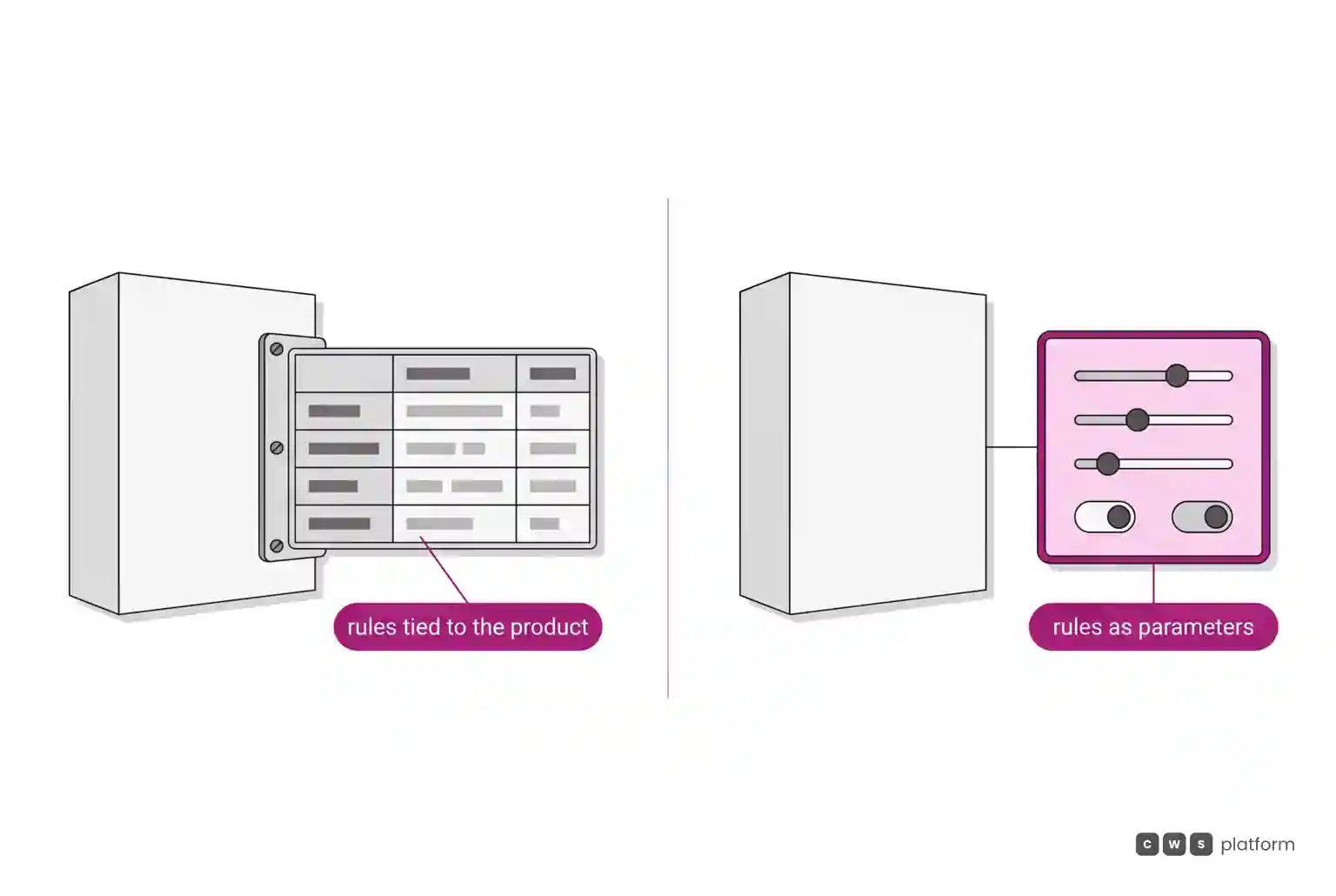
There are two designs in play. In one, the platform ships ready-made B2B features, with prices calculated from a table and with limits set by the product itself. In the other, commercial rules live in the platform as parameters, changed by configuration, and the ERP sends data without carrying pricing policy.
This comparison looks at Optimizely Configured Commerce and CWS Platform from that angle only: where pricing rules live, what happens when a sales rep negotiates, and what the documentation says about the limits of those pieces. It is not a feature ranking.
What Optimizely Configured Commerce does well
Optimizely Configured Commerce brings ready-made B2B features. Customer-specific pricing comes from the Price Matrix, a flat table designed to calculate prices without a live connection to the ERP. Teams that prefer to ask the ERP at the moment of the request can use real-time pricing and inventory, through a direct call to the ERP API or through the Windows Integration Service.
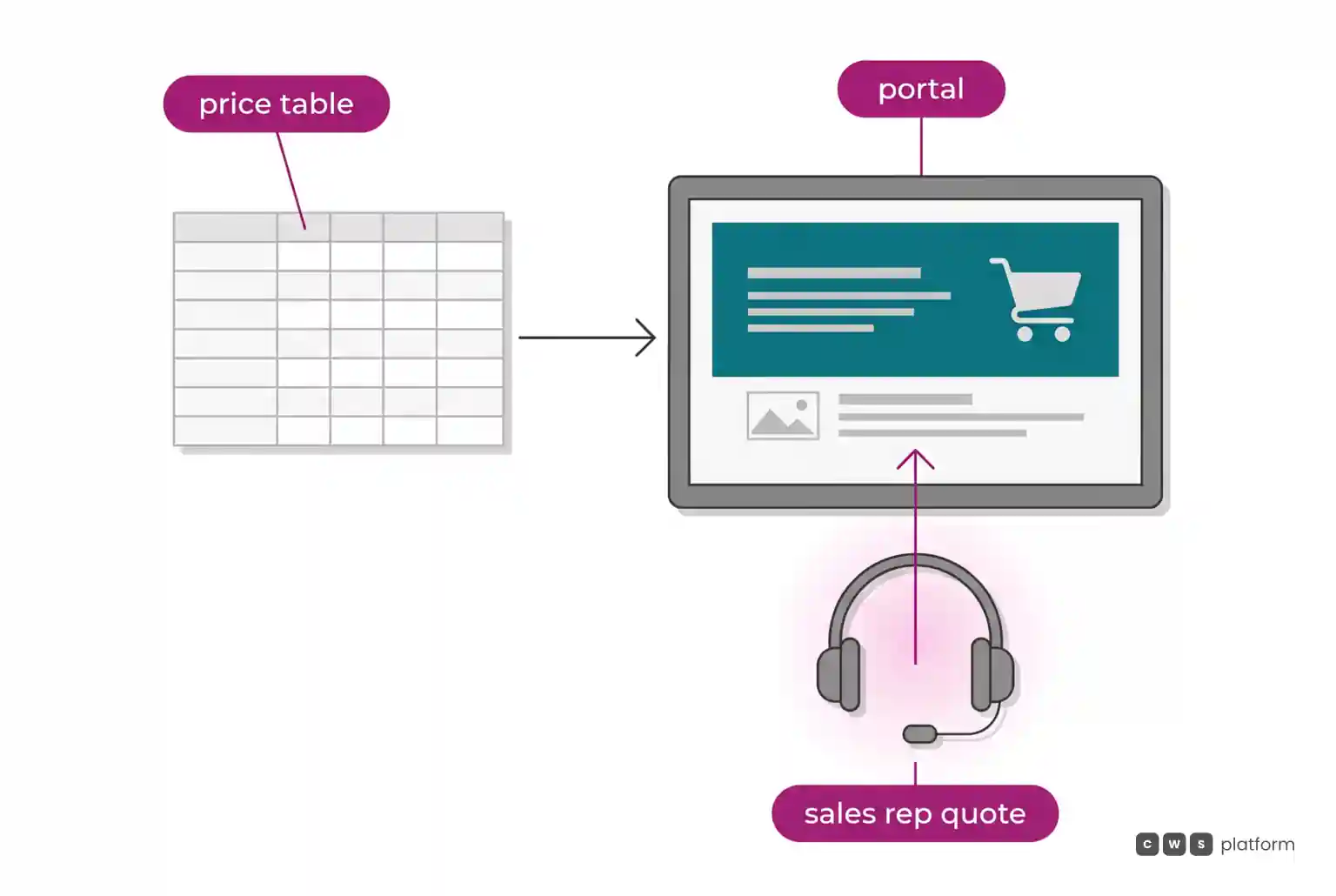
Negotiation goes through Request for Quote, where the buyer asks for special pricing and the sales rep responds, and there are also Job Quotes. For repeat buyers, Quick Order and order upload by file speed up reordering.
The product also serves operations that manage inventory at the customer's site, through Vendor Managed Inventory, with barcode-based counting in the app. For a distributor that wants ready-made B2B features and connectors for distribution ERPs, this covers a lot of ground.
Where the architecture diverges
The divergence that matters to whoever owns revenue is the limits of the commercial rules the product already ships with. The vendor's own documentation records two points:
- limitation recorded in the vendor's documentation, accessed on October 16, 2026: the price matrix has limitations, such as a maximum of 10 price breaks ("It does have its limitations, such as a maximum of 10 price breaks.", https://docs.optimizely.com/configured-commerce/docs/get-started-with-pricing).
- limitation recorded in the vendor's documentation, accessed on October 16, 2026: when a sales representative quotes a product price, any available promotions are disallowed ("If a sales representative provides a price quote on a product, any available promotions are disallowed.", https://docs.optimizely.com/configured-commerce/docs/configure-request-for-quote).
For the sales organization, both points meet at the negotiating table: the volume discount ladder has a cap on the number of steps, and the sales rep's quote and the current promotion cannot coexist on the same product. Commercial policy ends up being designed around those limits.
On CWS Platform, commercial rules sit in parameters of the Commerce Rules Engine (CDL Workspace): price tables, rules, and contracts are configured on the platform and can also arrive from the ERP or CRM through an API, with customizable decimal places. Thousands of promotions can run at the same time, and the sales rep's discount goes through multi-level approvals.
| decision | Optimizely Configured Commerce, per the documented mechanism | CWS Platform |
|---|---|---|
| Where customer-specific pricing comes from | Price Matrix, or a live ERP lookup | Tables, rules, and contracts configured on the platform or received from the ERP and CRM through an API |
| Where the volume ladder is defined | In the price matrix, with a maximum of 10 price breaks | In tables, rules, and contracts configured on the platform |
| How promotions and negotiation are governed | Available promotions are disallowed on a product the sales rep has quoted | Thousands of promotions can run at the same time, and the sales rep's discount goes through multi-level approvals |
The commercial decision is to check whether your pricing policy fits within each product's documented limits before you choose.
What changes in operations, through the revenue lens
The difference shows up in how fast you can change the rules and how many exceptions end up outside the system. When the volume ladder or the combination of quote and promotion hits a product limit, the exception leaves the portal and moves to a spreadsheet, an email, or the sales rep's phone.
Three questions help bring this point into any evaluation: how many volume price steps your policy uses today; what should happen to the current promotion when a sales rep negotiates a price; and who in your company changes those rules, and how long it takes.
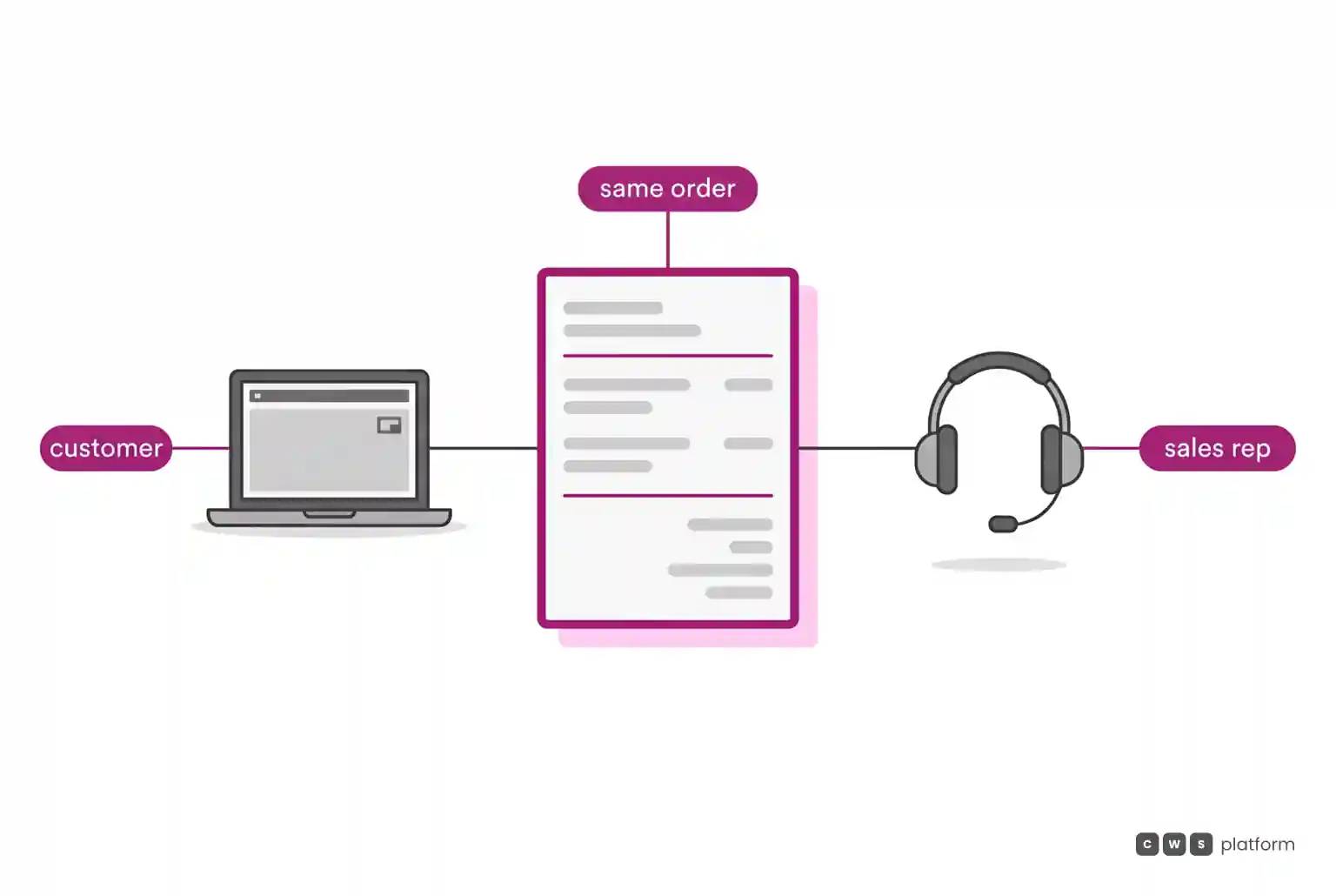
On CWS Platform, one sales rep serves thousands of customers, and customer and sales rep use the same interface, on the same order. The sales rep can build a cart, with the items and the source of each one, and send the link for the customer to complete the purchase, and the order records who built the cart and who chose the payment. Net terms work with split shipments, scheduled deliveries, multiple ship-to addresses, and multiple ship-from locations.
When to choose Optimizely Configured Commerce
Optimizely Configured Commerce fits scenarios with these characteristics:
A distributor that wants a ready-made B2B portal with connectors for common ERPs. Choose this architecture when the company wants ready-made B2B features and runs an ERP that already has a connector, with the integration handled by the Windows Integration Service installed in the customer's environment.
A stable pricing policy that a table represents well. Choose this architecture when your pricing policy fits within the limits of the Price Matrix and changes little over the year.
Inventory managed at the customer's site. Choose this architecture when the operation depends on counting and replenishment at the customer's location, as in Vendor Managed Inventory.
When CWS Platform is the right choice in this scenario
CWS Platform is the right choice when commercial policy changes often and needs to be maintained through configuration.
Commercial rules as configuration. Choose this architecture when commercial policy changes often. Tables, rules, and contracts are configured on the platform, on the principle of configuration over code, or received through an API; the sales rep's discount goes through multi-level approvals, the customer's credit is maintained on the platform, and thousands of promotions can run at the same time.
Customer and sales rep on the same order. Choose this architecture when selling mixes self-service and sales reps. Customer and sales rep use the same interface, one sales rep serves thousands of customers, and the cart holds 250 line items by default, configurable.
Net terms that match how distributors actually ship. Choose this architecture when net terms have to coexist with split shipments, scheduled deliveries, multiple ship-to addresses, and multiple ship-from locations. The same order accepts more than one payment method, with the rules combined in CDL Workspace.
Predictable licensing. Choose this architecture when the budget should not track the volume you sell. Billing is a platform license plus an integration license, with no percentage of sales or GMV.
Where to go from here
If your question is still which architecture fits your operation, and not which vendor to choose, the path is the seven questions that separate B2B commerce architectures.
If the decision depends on how your pricing and promotion policy works today, it is worth talking to a CWS Platform specialist to map the rules before you choose. The page When Channels Fight Each Other covers the pain behind this scenario in depth, without talking about any vendor.
"responsive, technically engaged, and willing to work through complex commercial rules (negotiated pricing, credit, customer-specific conditions) rather than pushing generic answers"
Want to see this in your operation?
Real B2B operations already run on it.