
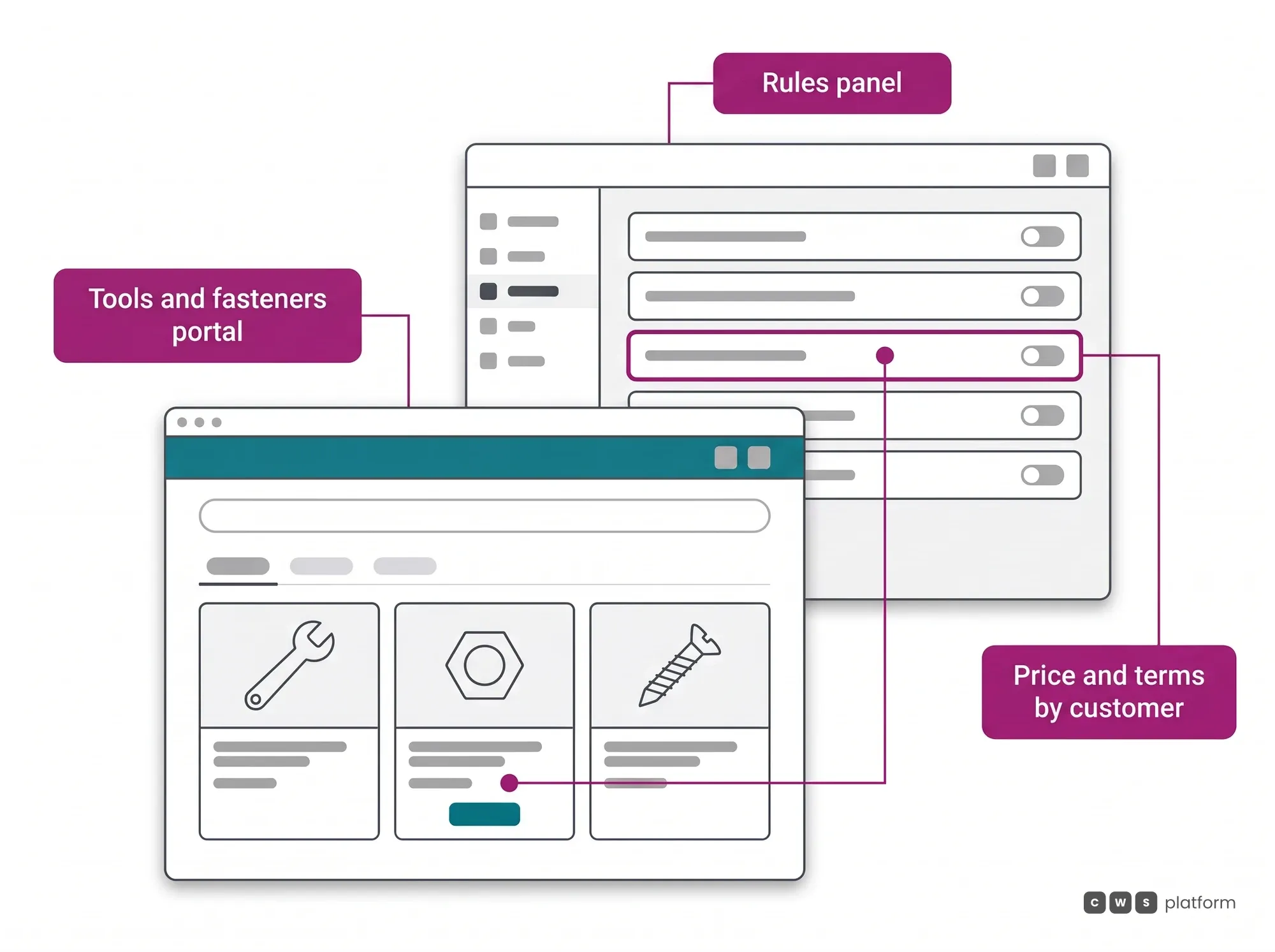
Würth is one of the world’s largest distributors of fasteners, tools, chemicals and protective equipment, and it has operated in Brazil since 1972 (O Mecânico, Oct 16, 2012). In Brazil, the company reports more than 1,400 sales reps, more than 200,000 customers and a line of about 10,000 products across eight divisions, from automotive to construction (Portal da Autopeça, Apr 29, 2024). Würth do Brasil launched its digital channel in 2017 (E-Commerce Brasil, Jul 31, 2023).
Today that channel runs on CWS Platform, across three portals with meaningful volume, each for a different audience.
This is a scale case: we describe the mechanism and the size of the operation using public figures. Business results belong to Würth and are not published here.
Digital that does not compete with the sales rep
Würth sells through relationships. The sales force is the company’s largest commercial structure, and the move to digital started from a clear premise: the online channel does not replace the rep, it works for the rep. The company has said publicly that reps earn commission on online purchases made by customers in their portfolio, even when they were not involved, and that reps are trained to build personalized carts and offers on the platform.
For Marco Avelino, sales and marketing director at Würth do Brasil, the Würth brand is “the handshake”. Digital exists so that handshake reaches more customers, with less friction.
Three sales journeys on one platform
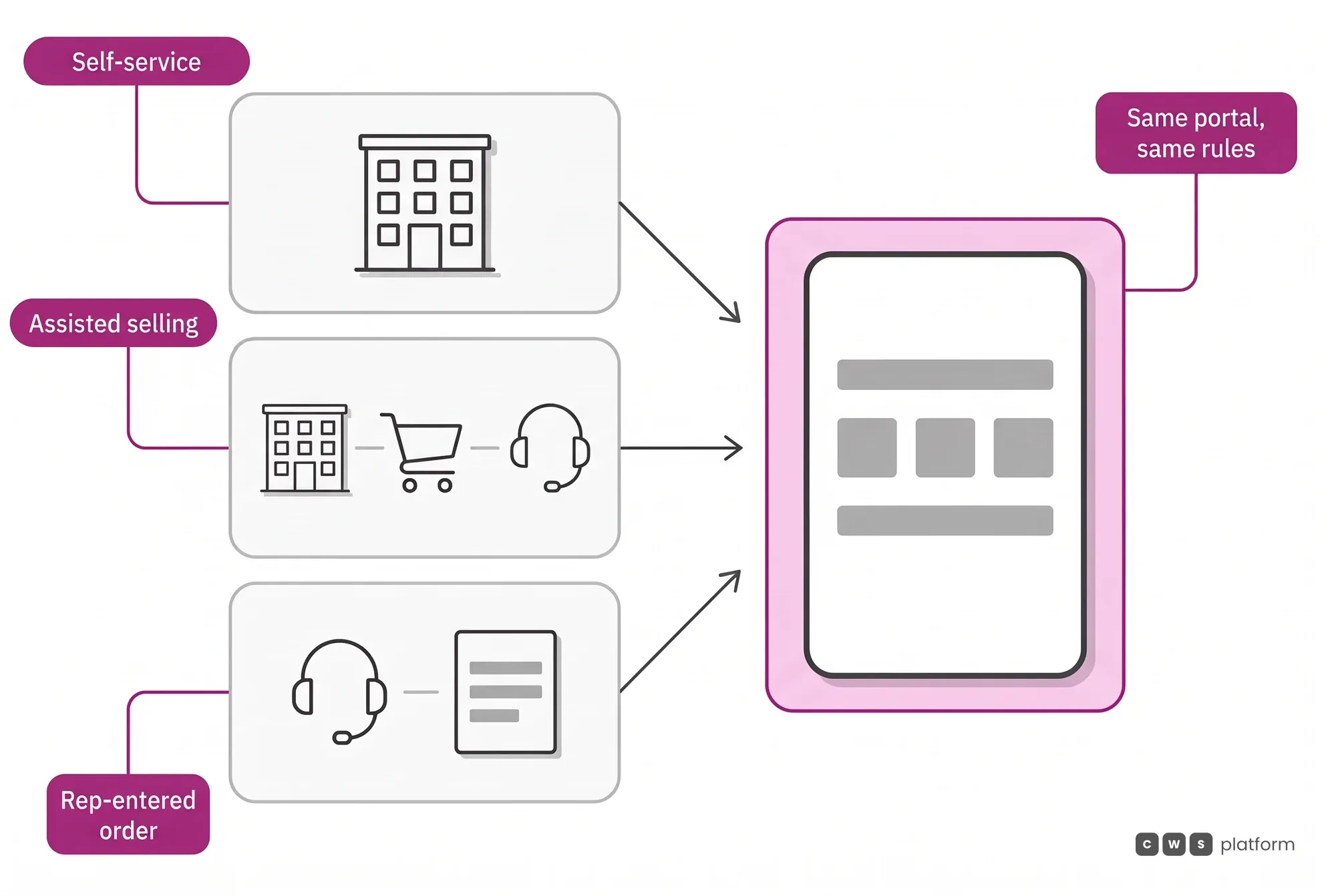
On CWS Platform, the same portal serves three ways of buying, and a customer can use more than one:
- Self-service. The customer logs in, finds the product, sees the price and terms that apply to them and places the order alone, at any time.
- Assisted selling. Rep and customer work in the same cart. The rep builds the proposal and adjusts items and terms; the customer reviews it and completes the purchase.
- Rep-entered orders. For customers who prefer the traditional way, the rep places the order on their behalf, in the same interface and under the same rules.
All three journeys share the same interface, the same catalog and the same commercial rules. Reps do not learn a separate system to serve customers, and they do not lose the sale when a customer decides to buy alone. The platform records which journey each order came from, which is what makes it possible to see, portfolio by portfolio, how each customer prefers to buy.
Three portals, three audiences
Würth does not speak to everyone the same way, and neither does its digital channel:
- Würth B2B, for companies: manufacturers, repair shops, builders, woodworkers and maintenance teams, with login and customer-specific prices and terms.
- W-max, for auto and motorcycle parts resellers, with its own catalog, which includes the W-max brand and does not appear in the other portals.
- Würth B2C, for individual buyers.
Each portal has its own account base, assortment and commercial policy, and all three run on the same platform, with the same team and the same management tools. Opening a new portal for a new audience is a business decision, not a technology project from scratch.
The catalog as an ongoing operation
In a technical assortment, the sale depends on the customer finding the right part: the drill bit size, the screw head type, the right chemical for the job. The CWS Platform Technical Content team manages Würth’s product data and catalog quality as a routine, not a one-time load: descriptions, attributes, categories and images are reviewed as customer searches show where the catalog falls short.
Sales data that turns into commercial action
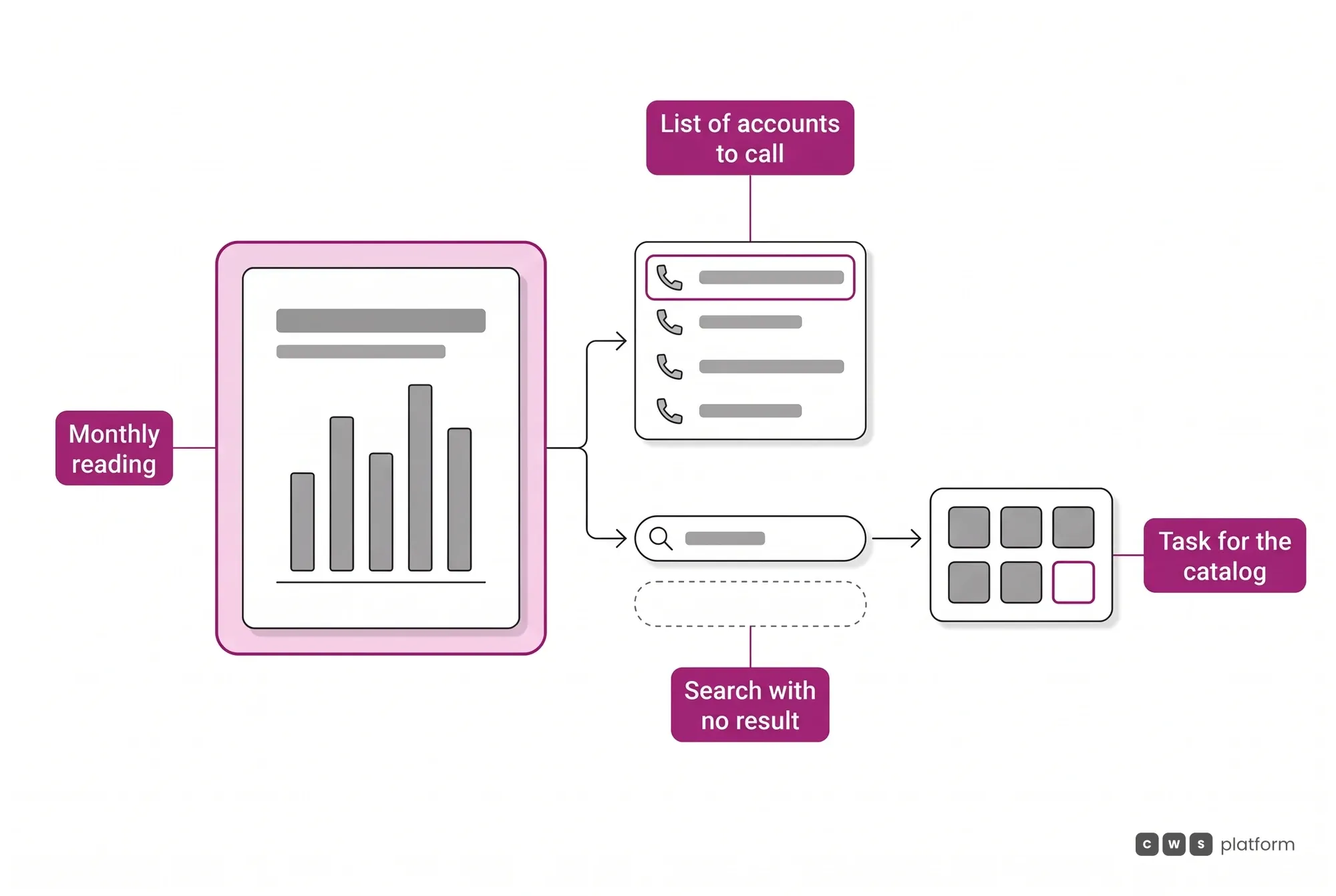
Every month, the CWS Platform Strategy and Data team delivers to Würth’s leadership an executive reading of the digital operation across the three portals. The point is not the dashboard, it is the action that comes out of it:
- Where the month’s revenue came from. The change is split into new customers, reactivated customers, customers who bought more, customers who bought less and customers who did not come back. It becomes clear whether a month was won with new customers or lost with existing ones.
- Retention by cohort. Each group of customers is tracked from its first purchase, to see whether the second purchase is happening.
- Alerts based on each customer’s own rhythm. Instead of comparing everyone with an average, the analysis compares each customer with their own buying habit. A customer who buys every week triggers the alert much earlier than one who buys once a quarter.
- A list of accounts to call. Accounts that are past their own rhythm become a prioritized list for the sales team, separating customers who only buy through a rep (the action is a call) from those who buy on their own (the action can be a campaign).
- Why search did not sell. The most searched terms, conversion by search method and the terms many people look for and nobody finds. Each of those terms is existing demand that is not being met, and it goes back to the catalog team as a task.
- How customers come in. Comparing customers who arrive through typed search with those who browse categories shows which entry point needs fixing before any spend on traffic.
The reports use the same definitions of a valid order, revenue and active customer in every month and every portal, so comparisons are always like for like.
Artificial Intelligence in customer service
Würth also uses, day to day, an AI sales agent built on CWS Platform. It interprets what the customer or the rep asks for in natural language, searches the catalog, recommends products, builds the cart and generates a link so the purchase can continue in the portal. The agent does not invent prices or terms: everything it proposes comes from the same commercial rules that apply to a sale made by a rep.
What the case shows
A company with more than 1,400 sales reps does not have to choose between its sales force and digital. With all three journeys on the same platform, customers choose how to buy, reps keep ownership of their portfolio, and the company sees every month who is buying, through which path and who needs a call.
The takeaway: in B2B with a technical assortment, digital works when it is a tool for the sales rep, not a competitor. The platform records every journey, and the data tells the sales team where to act.
Frequently asked questions about this case
Why does the digital channel not compete with the sales rep?
Because it was designed to work for the rep, not to replace the rep. Würth sells through relationships, and the sales force, with more than 1,400 reps, is the company's largest commercial structure. Würth itself has said publicly that reps earn commission on online purchases made by customers in their portfolio, even when they were not involved, and that reps are trained to build personalized carts and offers on the platform. Reps do not lose the sale when a customer decides to buy alone, and they keep ownership of their portfolio.
How do the three sales journeys work?
The same portal serves three ways of buying, and a customer can use more than one. In self-service, the customer finds the product, sees the price and terms that apply to them and places the order alone, at any time. In assisted selling, rep and customer work in the same cart: the rep builds the proposal and adjusts items and terms, and the customer reviews it and completes the purchase. In rep-entered orders, the rep places the order on behalf of a customer who prefers the traditional way. All three share the same interface, the same catalog and the same commercial rules, and the platform records which journey each order came from.
What does the monthly data reading deliver?
A list of actions, not a dashboard. Every month, the CWS Platform Strategy and Data team delivers to Würth's leadership an executive reading of the three portals: where the month's revenue came from, split into new customers, reactivated customers, customers who bought more, customers who bought less and customers who did not come back; retention by cohort; and alerts based on each customer's own buying rhythm. Accounts that are past their own rhythm become a prioritized list for the sales team to call, and terms many people search for and nobody finds go back to the catalog team as a task. The reports use the same definitions in every month and every portal. The figures in that reading belong to Würth and are not published.
Qualified access
Talk to someone already running this mechanism in operation
A short conversation unlocks access.
Schedule a conversation →