Spryker vs. CWS Platform: what goes into total cost of ownership after you sign?
The license is the first line of the proposal. Keeping the version current, the subscription model, and support make up the rest.

Editorial note: a comparison between Spryker and CWS Platform written for those who answer as CFO. Every fact about Spryker comes from its public documentation, with the address next to it.
A B2B commerce platform proposal reaches finance with one number on the first page: the license. Total cost of ownership shows up later, spread across lines that were not in the proposal: the hours your team or your implementation partner spends keeping the version current, the subscription model that does or does not include the upgrade tooling, and the time operations spend waiting when a support case drags on.
For a CFO, the question is not what the license costs in year one. It is what it costs to keep the platform running and current in year three, and which of those lines the contract leaves with the company.
This comparison looks at Spryker and CWS Platform from that angle only: how the version moves forward, what comes with the subscription, and what the documentation says about support. It is not a feature ranking. If you want the broader frame first, the post on the three B2B commerce platform models separates the architectures without focusing on a single vendor.
What Spryker does well
Spryker has its own tool to reduce manual upgrade work. The Spryker Code Upgrader combines the upgrade tool with CI pipelines on Spryker CI, with one dedicated pipeline per project, and the check schedule is configurable.
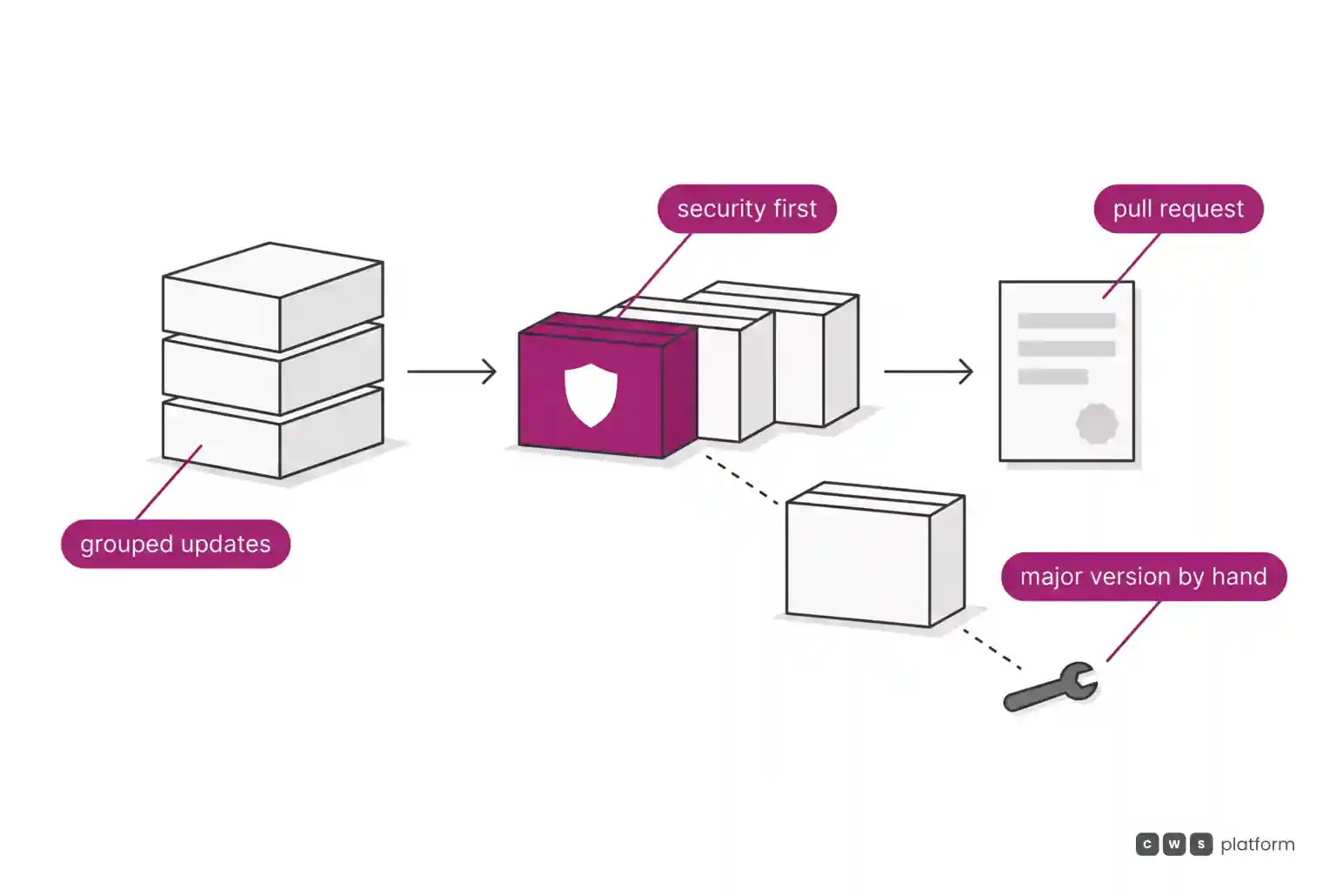
How it works is described in How Spryker Code Upgrader works: the tool compares the composer.json and composer.lock files of the connected branch with the latest code Spryker has released, groups modules and third-party libraries according to its release model, and applies the updates in groups. Security releases go first, and the result is committed to a standardized branch, with a pull request opened through the code provider's API.
For finance, this has concrete value: routine upgrades arrive as a reviewable change, not as a project someone has to remember to kick off. For a company with an engineering team that maintains its own project, it is an organized way to turn version maintenance into a continuous flow.
Where the architecture diverges
The divergence that matters to a CFO is what stays outside the automation and what depends on the subscription. Per the documented mechanism, major versions are not applied automatically: the Upgrader skips them and adds documentation links with manual instructions to the pull request. The same documentation records that projects older than release 2022.04 are not compatible with this incremental flow (When and why to use manual upgrade).
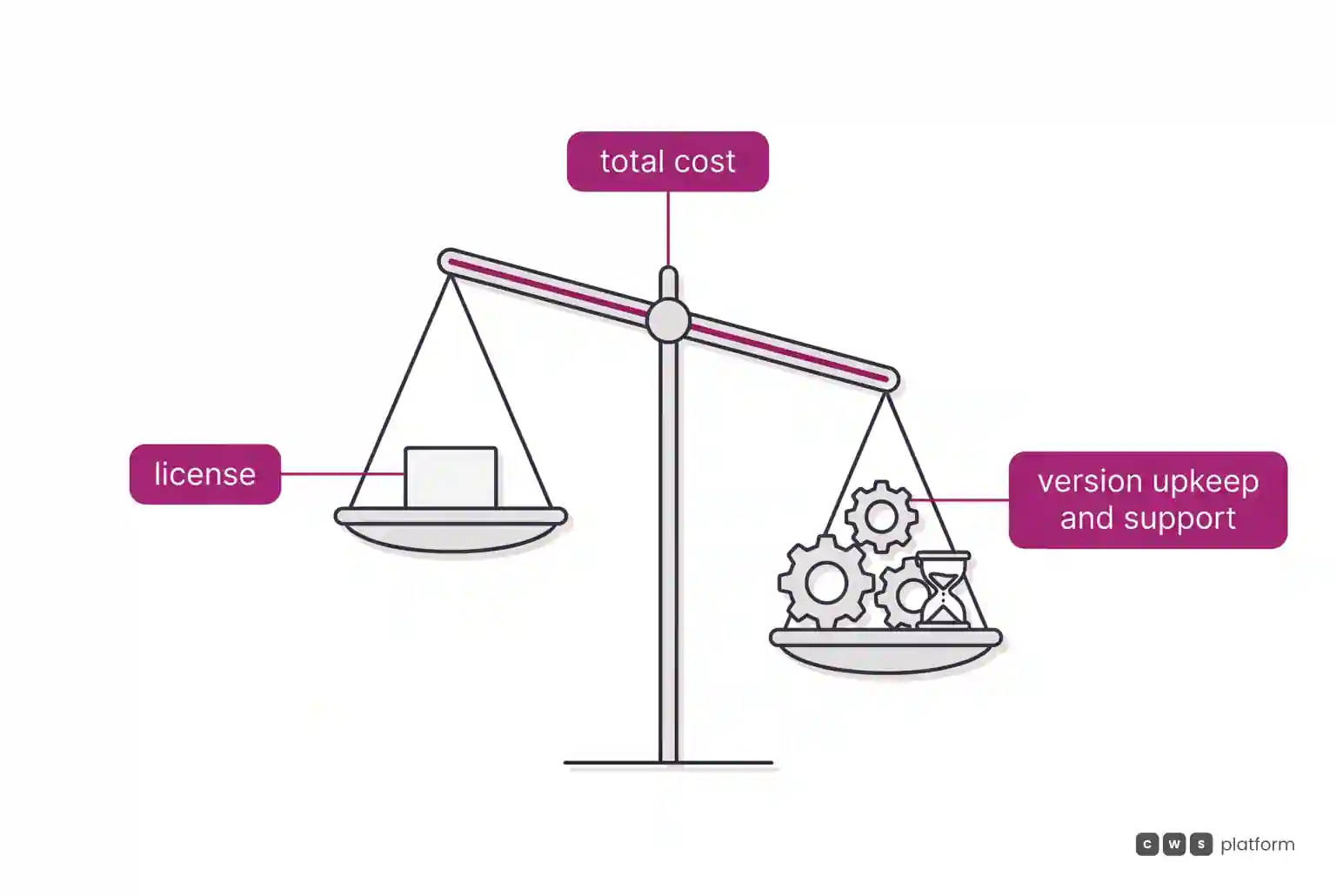
The vendor's own documentation records two points that belong in a three-year cost model:
- limitation recorded in the vendor's documentation, accessed on October 16, 2026: the Code Upgrader is shipped with PaaS+ in the EU and US regions ("The Upgrader is shipped with PaaS+ in the EU and US regions.", https://docs.spryker.com/docs/ca/devscu/spryker-code-upgrader.html).
- limitation recorded in the vendor's documentation on September 7, 2026: Spryker does not and cannot guarantee resolution times for support cases ("we do not and cannot guarantee resolution times for the issues you open with us", https://docs.spryker.com/docs/about/all/support/understanding-slas.html).
The first point ties the upgrade tool to a subscription model and to regions. For a CFO, the proposal question becomes concrete: does the quoted scope include PaaS+, in one of those regions? If it does not, upgrades go back to being separately planned work, and that work needs its own budget line.
The second point changes how operational risk is priced. When resolution time is not guaranteed, the cost of a long incident, in internal hours and in orders that wait, stays with the company. This is not a flaw in whoever wrote the policy: it is a stated contractual choice, and it is finance's job to put a number on it.
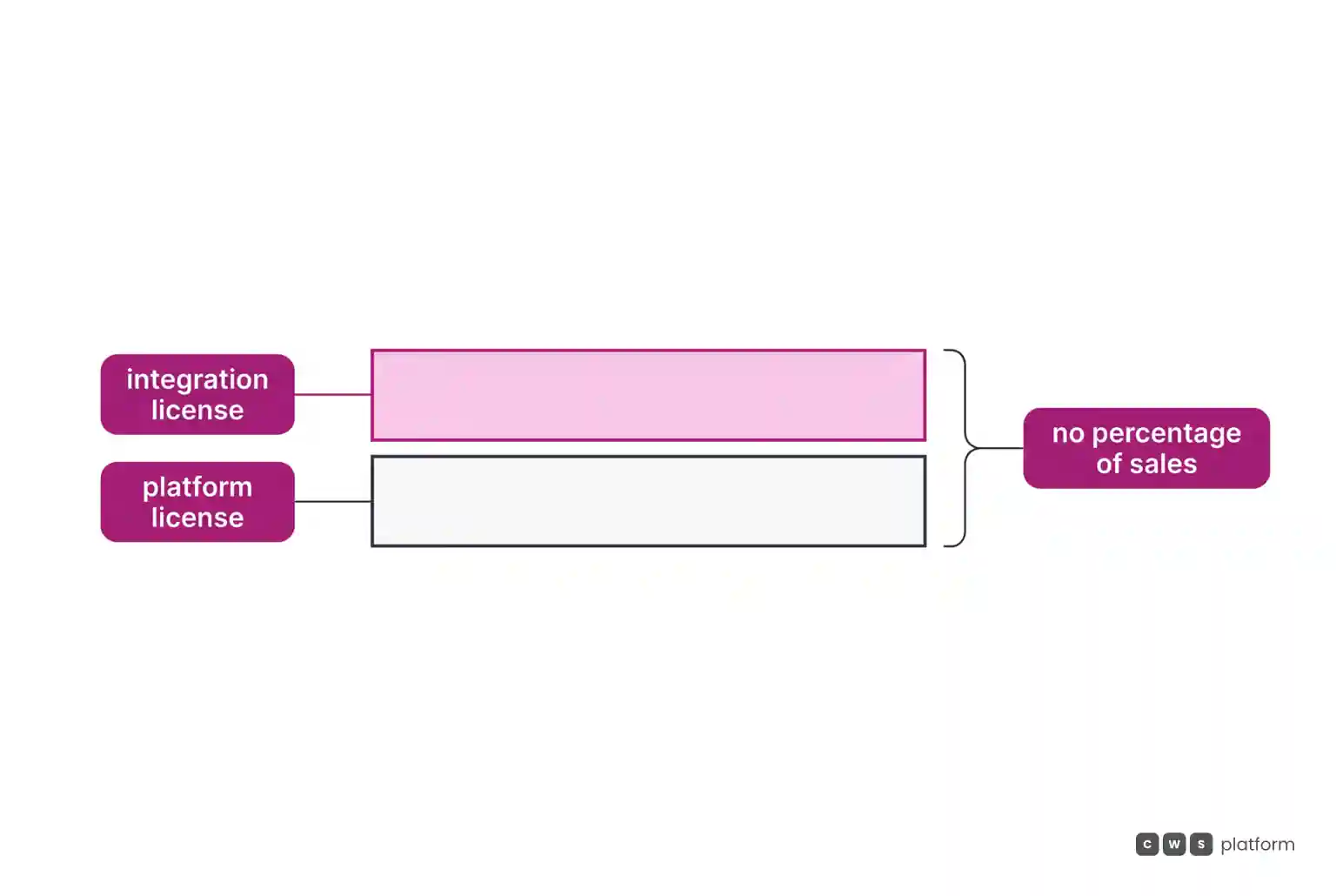
On CWS Platform, all customers run the same version of the platform. Commercial policy sits in parameters of the Commerce Rules Engine (CDL Workspace), on the principle of configuration over code, and billing is a platform license plus an integration license, with no percentage of sales or GMV.
| decision | Spryker, per the documented mechanism | CWS Platform |
|---|---|---|
| How the version moves forward | Code Upgrader opens a pull request with grouped updates, security first; major versions stay outside the automation, with manual instructions | All customers run the same version |
| What assisted upgrades depend on | Code Upgrader shipped with PaaS+ in the EU and US regions; projects older than release 2022.04 outside the incremental flow | Same version for every customer, with commercial rules in parameters |
| How billing relates to volume | A point to confirm in the proposal | Platform license plus integration license, with no percentage of sales or GMV |
The financial decision is knowing which lines of the cost of keeping the platform running stay with the company and which are covered by the model you subscribe to.
What changes in operations, through the CFO lens
A three-year cost model has three blocks that tend to be underestimated at proposal stage.
The first is version maintenance. A routine upgrade delivered as a pull request still needs someone to review and test it; a major version with manual instructions needs a project. The CFO does not need to read the code, but does need to know how many hours a year the company or its partner will spend on it.
The second is the subscription model. When an upgrade tool ships with a specific model and in specific regions, the cheapest proposal may be the one that leaves that tool out. Comparing proposals without matching scope means comparing numbers that do not measure the same thing.
The third is the cost of an incident. Without a guaranteed resolution time, the company has to decide how much order downtime it can tolerate and who absorbs the internal hours while the case is open.
Three questions bring this reasoning into any evaluation: which subscription model includes the upgrade tool, and in which regions; how many major versions the vendor expects during the contract term, and who runs the migration; and what the contract guarantees about support case resolution time.
On CWS Platform, all customers run the same version, and price tables, rules, and contracts are configured on the platform or received from the ERP and CRM through an API, with customizable decimal places, on the principle of configuration over code.
When to choose Spryker
Spryker fits scenarios where the company wants to maintain its project with its own team and has the structure to do it:
An engineering team that reviews upgrades. Choose this architecture when the company has a team that wants to receive routine upgrades as pull requests and decide when to apply them, as described for the Spryker Code Upgrader.
A subscription in which the tool is included. Choose this architecture when the contracted scope already includes PaaS+ in one of the regions where the Code Upgrader is shipped, and the budget covers the major migrations that stay outside the automation.
Bulk replenishment by the buyer. Choose this architecture when buyers reorder by pasting lists of products and quantities or searching by SKU, and validated items move to a cart, a shopping list, or checkout, as in Quick Add to Cart.
When CWS Platform is the right choice in this scenario
CWS Platform is the right choice when finance wants a license with no percentage of sales volume and commercial rules in parameters, with all customers on the same version.
A license with no percentage of sales. Choose this architecture when the technology budget should not be tied to a percentage of digital channel revenue. Billing is a platform license plus an integration license, with no percentage of sales or GMV.
One version for every customer. Choose this architecture when the company wants to always run on the current version of the platform. All customers run the same version.
Commercial rules as configuration. Choose this architecture when commercial policy changes often. Tables, rules, and contracts sit in parameters of the Commerce Rules Engine (CDL Workspace), the sales rep's discount goes through multi-level approvals, the customer's credit is maintained on the platform, and thousands of promotions can run at the same time.
One system for the whole ecosystem. Choose this architecture when customers, sales reps, and operations need to work in the same system. CDL Workspace is a single system for the entire ecosystem, and one sales rep serves thousands of customers in the same interface the customer uses.
Where to go from here
If your decision also depends on the ERP integration, the comparison of customer-specific pricing in the Spryker and CWS Platform ERP integration looks at the same choice through the CTO lens.
Before you sign, it is worth talking to a CWS Platform specialist to build the three-year cost model side by side, with the same scope in both proposals. The page When Selling More Doesn't Mean Earning More covers the pain behind this scenario, without talking about any vendor.
Brands mentioned in this article

Trademarks and logos belong to their respective owners. Mention does not imply partnership or endorsement.
"responsive, technically engaged, and willing to work through complex commercial rules (negotiated pricing, credit, customer-specific conditions) rather than pushing generic answers"
Want to see this in your operation?
Real B2B operations already run on it.