What B2B Customer Service Is and What It Costs per Account
Why sales volume scales while cost-to-serve erodes margins across repetitive support queries

B2B customer service encompasses the channels and personnel a company uses to serve other businesses: sales reps, independent brokers, inside sales, customer support, customer portals, and increasingly, AI agents. Unlike B2C support, it manages recurring accounts, contract pricing, bulk purchase orders, and decisions involving commercial credit lines and net payment terms.
Because of this complexity, every B2B touchpoint carries a real cost, and that cost varies significantly depending on the channel.
What B2B Customer Service Actually Handles
- Processing orders. Coming through phone, email, text, field reps, or digital portals.
- Answering routine inquiries. Contract pricing, inventory availability, estimated delivery dates, order tracking, invoice copies.
- Negotiating terms. Volume discounts, customized payment terms, and special pricing agreements on larger orders.
- Resolving fulfillment issues. Shipping delays, order discrepancies, returns, and warranty claims.
- Maintaining account relationships. On-site visits, pipeline reviews, and re-engaging inactive accounts.
Each of these tasks carries a distinct operational cost, and not all of them require a human rep.
How Much It Costs to Serve Each Account
Customer service expenses directly feed into each account's total cost to serve. A practical way to estimate this:
account service cost = total contacts in period × average handle time × team labor cost per minute
When calculated account by account, a clear pattern typically emerges: the customers who call most often are rarely the most profitable. Instead, they are the ones who have no other way to check their pricing, stock levels, or order status.
Why B2B Customer Service Becomes Expensive
Why do accounts call so often? Because the critical information they need (their negotiated pricing, inventory, order status) is locked inside internal ERP screens accessible only by your staff.
Why is it restricted to staff? Because there is no digital self-service channel where the buyer can see their own custom terms.
Why does this drag down profitability? Customer service capacity is consumed by low-value operational lookups that generate zero incremental revenue, leaving zero bandwidth for strategic negotiations or proactive business development.
Why does this worsen as the business scales? More customer accounts mean more inbound inquiries, and leadership typically responds by hiring more customer service reps rather than restructuring the channel.
The root cause: legacy B2B customer operations were designed to react and answer questions, not to empower buyers to serve themselves.
How to Lower B2B Customer Service Costs
1. Separate routine inquiries from strategic decisions. Route transactional lookups (pricing, inventory, order tracking, invoices) to self-service portals. Keep human reps focused on high-touch decisions (contract negotiation, exceptions, complex issue resolution).
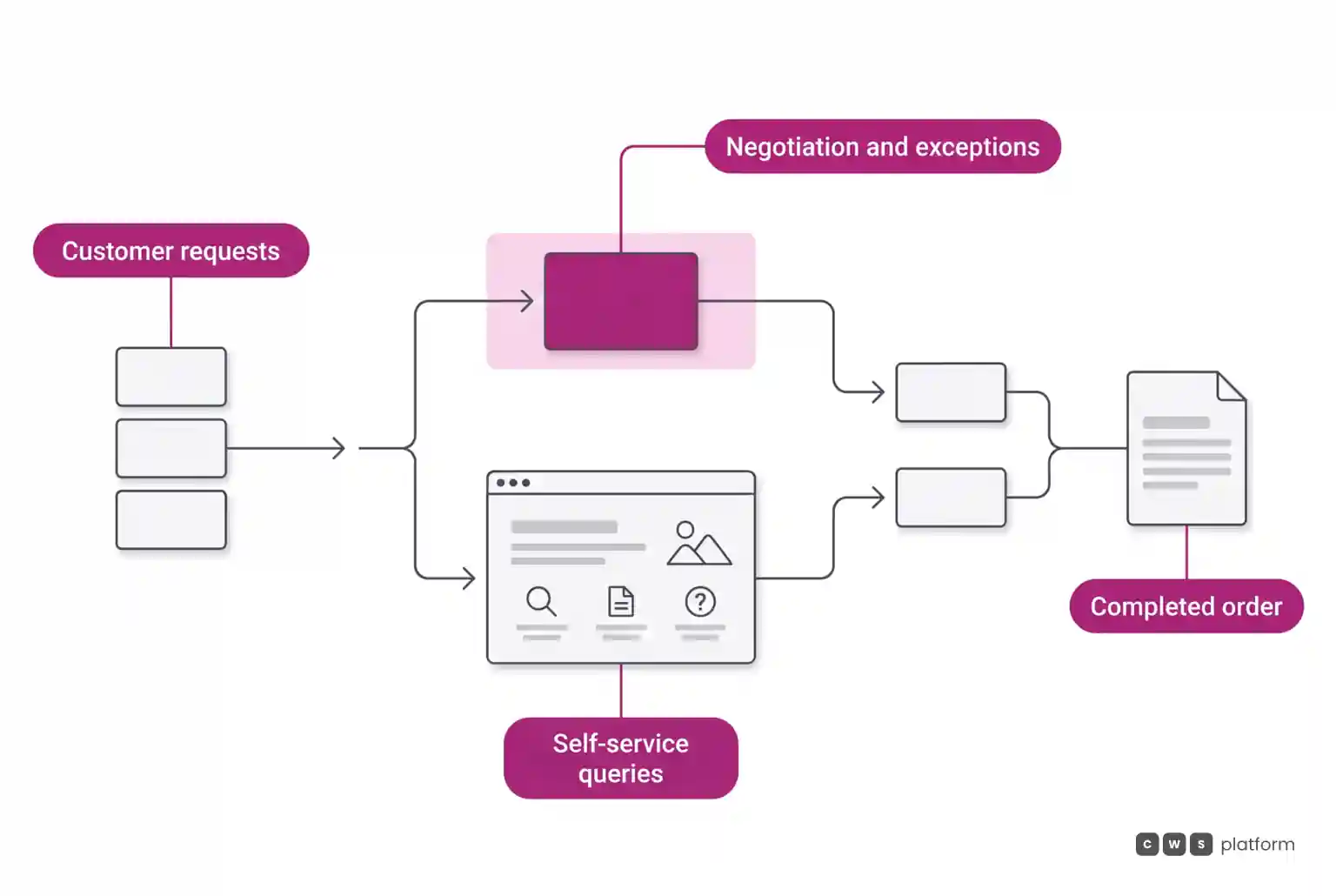
2. Give buyers real-time access to their specific commercial terms. Deploy an authenticated portal where buyers log in and instantly see their contracted price lists, available credit balance, and complete order history.
3. Keep the sales rep in the exact same workspace. When a buyer requires human assistance, the sales rep should be able to step directly into the buyer's active cart and view the same historical context without forcing the client to re-explain their request.
4. Track contact frequency per order. The volume of manual contacts required to complete a single order is the most accurate metric for evaluating support overhead.
5. Deploy rule-governed AI agents. AI agents can resolve inquiries and assemble draft orders effectively, provided they operate under the exact same pricing rules, credit constraints, and approval workflows as your field reps.
How the Customer Experience Improves
B2B buyers are not looking for less support, they are looking for zero wait time. According to a Gartner study of B2B buyers published in 2025, 61% of business buyers prefer a rep-free purchasing experience. When price checks and standard reorders happen instantly online, conversations with account reps are reserved for discussions that genuinely warrant a meeting.
On CWS Platform, buyers access their negotiated pricing, credit limits, and full purchase history through a self-service portal. Reps share the identical interface, allowing them to access the customer's shared cart in real time with integrated chat, while enterprise business rules govern sales reps and AI agents alike. See how the architecture works on our assisted sales page.
Next Step
Ask your customer service and support team to track the primary driver of every incoming call and email for one week: new order, routine inquiry, commercial negotiation, or fulfillment issue. The share represented by routine inquiries represents the service overhead that can be moved to digital self-service immediately.
Frequently Asked Questions
What is B2B customer service?
It is the network of channels and teams a company uses to support its corporate accounts: sales reps, independent brokers, inside sales, customer support, digital portals, and AI agents. It handles repeat buyers, contract pricing, trade credit, and high-volume orders.
What is the difference between B2B and B2C customer service?
In B2B, buyers make recurring purchases, rely on negotiated contracts and net payment terms, and need support on credit limits and bulk logistics. In B2C, service handles transactional, one-off purchases, uniform pricing, and immediate card or electronic payments.
How do you reduce B2B customer service costs?
By decoupling simple inquiries from complex commercial decisions: move pricing lookups, inventory checks, order tracking, and invoice downloads to a self-service portal, while preserving human support for negotiations, exceptions, and high-impact issues. Reps should also have the ability to co-browse the customer's shared digital cart when summoned.
Can AI agents handle B2B customer support?
Yes. AI agents can resolve technical inquiries, check stock, and build draft orders, as long as they are bound by the company's pricing logic, discount policies, credit limits, and managerial approval tiers, with built-in escalation to human staff whenever an edge case arises.
Recommended Reading
- The Cost of B2B Self-Service, and the Cost of Going Without It
- Your B2B Revenue Is Growing. Your Margins Aren't. The Bottleneck Happens Before the Order.
- Cost to Serve and Sales Operations
About This Publication
A publication by CWS Platform.
"responsive, technically engaged, and willing to work through complex commercial rules (negotiated pricing, credit, customer-specific conditions) rather than pushing generic answers"
Want to see this in your operation?
Real B2B operations already run on it.