What B2B Sales Is and How It Actually Works
From order capture to fulfillment: structuring wholesale workflows to protect margins and free reps to negotiate.

B2B sales refers to the sale of products or services from one business to another. It is what happens when a manufacturer sells to a distributor, a distributor supplies a dealer, or a wholesaler serves a local merchant. Unlike consumer sales, it involves customer-specific pricing, payment terms, large orders, and commercial relationships that span years.
Understanding how B2B sales works in practice is the first step toward uncovering where time and margin are being lost.
How B2B sales works, from initial contact to invoicing
1. Onboarding and commercial terms. Before the first order, the account is created and assigned commercial terms: price list, credit limit, payment terms, and sometimes a master service agreement or contract.
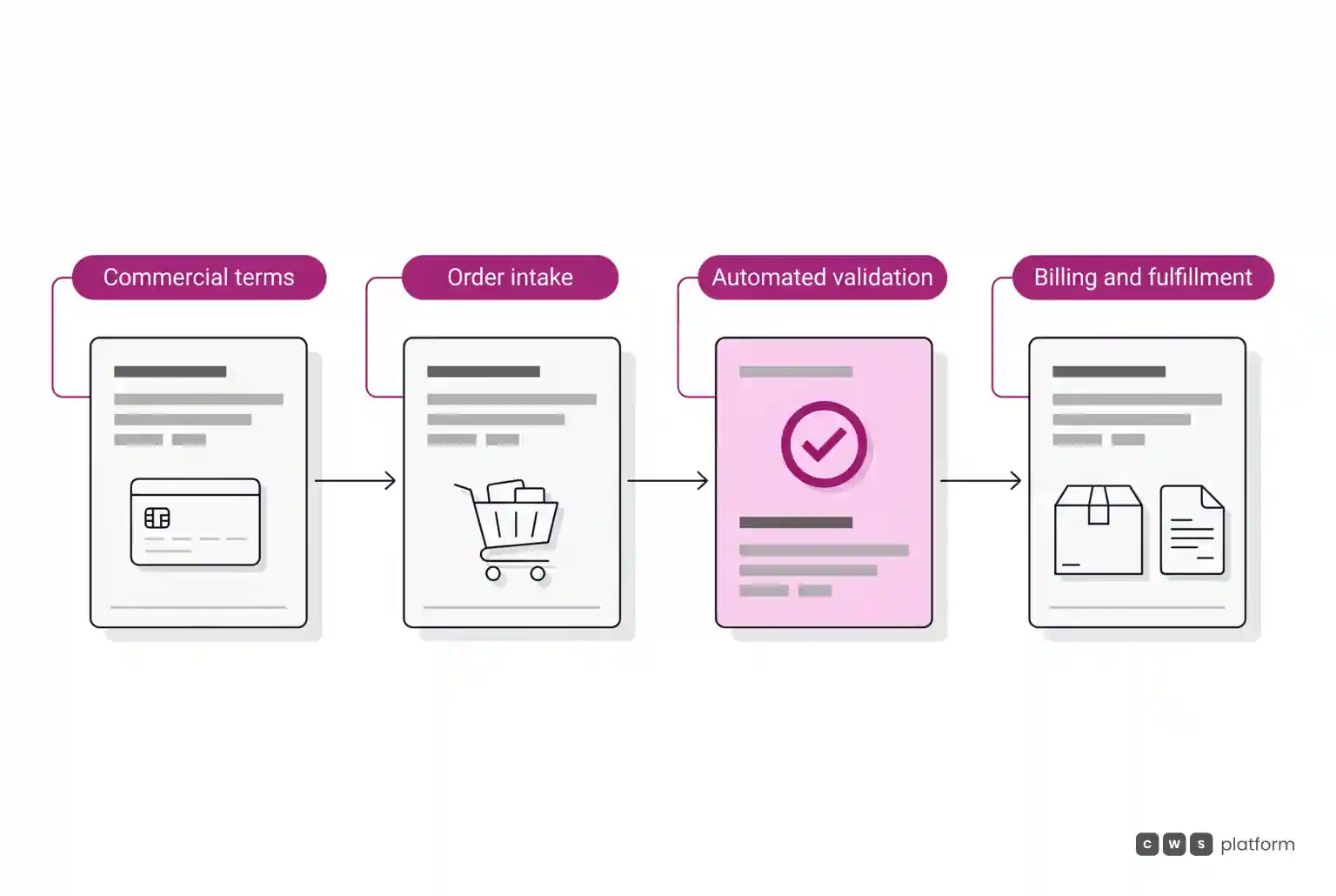
2. Order placement. The buyer submits the list of required items via phone, email, messaging apps, an outside sales rep, or a customer portal. In mature operations, the vast majority of orders are routine reorders.
3. Negotiation. On larger orders, the buyer asks for discounts, extended terms, or custom conditions. The sales rep negotiates within their pre-approved authority or escalates the decision up the chain.
4. Verification. Before accepting, the company verifies inventory, pricing, sales tax, and available credit. Any order accepted without proper checks inevitably resurfaces as an operational problem.
5. Invoicing and fulfillment. The order enters the ERP, is invoiced with the correct documentation, and moves to fulfillment, often shipping across multiple warehouses.
6. Reordering. The cycle repeats. The operational quality of the previous steps determines whether the customer reorders through the lowest-cost channel or calls back on the phone.
The role of the B2B sales representative
The B2B sales rep manages an account portfolio: negotiating deals, resolving exceptions, introducing new products, and maintaining relationships. In practice, across many organizations, reps spend much of their day manually keying in routine replenishment orders, tasks that require no actual negotiation. We discuss this cost in when serving more customers requires hiring more reps.
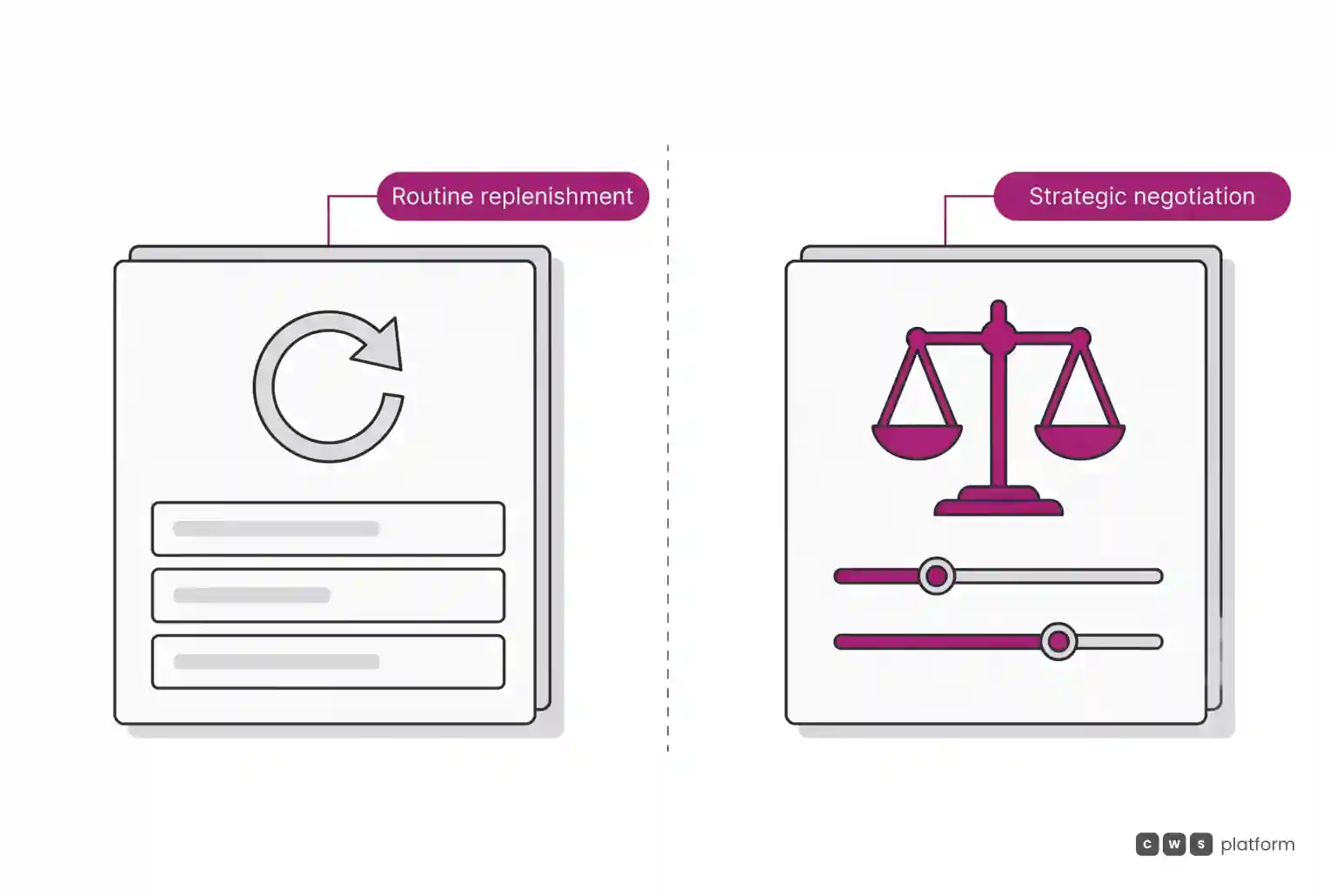
High-growth organizations take routine order entry off the rep's desk, returning that time so reps can negotiate complex deals and activate dormant accounts.
Traditional B2B sales versus digital B2B sales
| Traditional B2B Sales | Digital B2B Sales |
|---|---|
| Orders submitted via phone, email, or outside rep | Customer orders independently via self-service portal, 24/7 |
| Rep manually keys in and checks the order | System validates inventory, pricing, tax, and credit automatically |
| Pricing looked up in spreadsheets | Account-specific pricing calculated directly in the cart |
| Discounts negotiated without documentation | Discounts stay within approval thresholds, with audit trails |
| Reorders depend on someone calling | Reorders placed in just a few clicks |
Digital sales does not replace the sales rep. It separates routine replenishment, which shifts to self-service, from high-value negotiation, which stays with the rep, who now has real-time account data right on screen. Buyers already expect this: according to a Gartner survey of B2B buyers published in 2025, 61% prefer a rep-free buying experience.
Where B2B sales typically loses margin
- Unregulated discounting. Concessions made simply to close the deal, without governance or approval workflows.
- Reworked orders. Orders accepted without real-time credit or inventory validation, only to be held up later.
- High cost to serve. Processing a small manual order costs nearly the same as processing a large truckload order.
- Customer churn. Without frictionless digital ordering, unvisited accounts simply shift spend to competitors.
How CWS Platform supports B2B sales
CWS Platform acts as the commercial execution layer on top of the ERP: buyers order independently through the portal with their own contract pricing and credit limits; sales reps use the exact same interface and can co-browse or take over a cart during live negotiations; and approval matrices, payment terms, and credit rules are configured once to apply across every channel. At Imdepa, an auto parts distributor, the B2B portal activated 153 new buying accounts over three years, roughly 3 times their starting active base, according to the Imdepa case study.
Next step
Segment last month's orders into two buckets: those requiring active negotiation and those that were simple replenishment. That second bucket represents the exact volume of time your sales team can win back.
Frequently asked questions
What is B2B sales?
It is the sale of products or services from one business to another, such as a manufacturer selling to a distributor or a wholesaler supplying retail stores. It typically features customer-specific contract pricing, net payment terms, high order volumes, and recurring business relationships.
What are B2B sales operations?
It encompasses the commercial department and workflows of a company selling to other businesses: customer onboarding, pricing policy, order processing, quote negotiation, credit validation, invoicing, and reorder management.
What does B2B mean in sales?
It indicates that the customer is another company rather than an individual consumer. This fundamentally changes pricing, which depends on negotiated contracts, payment methods, which typically involve net terms, and purchasing patterns, which recur over time.
What does a B2B sales rep do?
A B2B rep manages a portfolio of business accounts: negotiating pricing, payment terms, and delivery schedules, handling exceptions, and driving account growth. When routine orders move to digital self-service, reps focus their time on strategic negotiations and proactive account activation.
Read also
- ERP sales module or dedicated B2B platform?
- How to turn commercial policies into automated rules
- B2B fundamentals (definitions)
About this publication
Operational metrics cited are from Imdepa, a CWS Platform customer, used with permission.
Brands mentioned in this article

- Gartner
Trademarks and logos belong to their respective owners. Mention does not imply partnership or endorsement.
"responsive, technically engaged, and willing to work through complex commercial rules (negotiated pricing, credit, customer-specific conditions) rather than pushing generic answers"
Want to see this in your operation?
Real B2B operations already run on it.